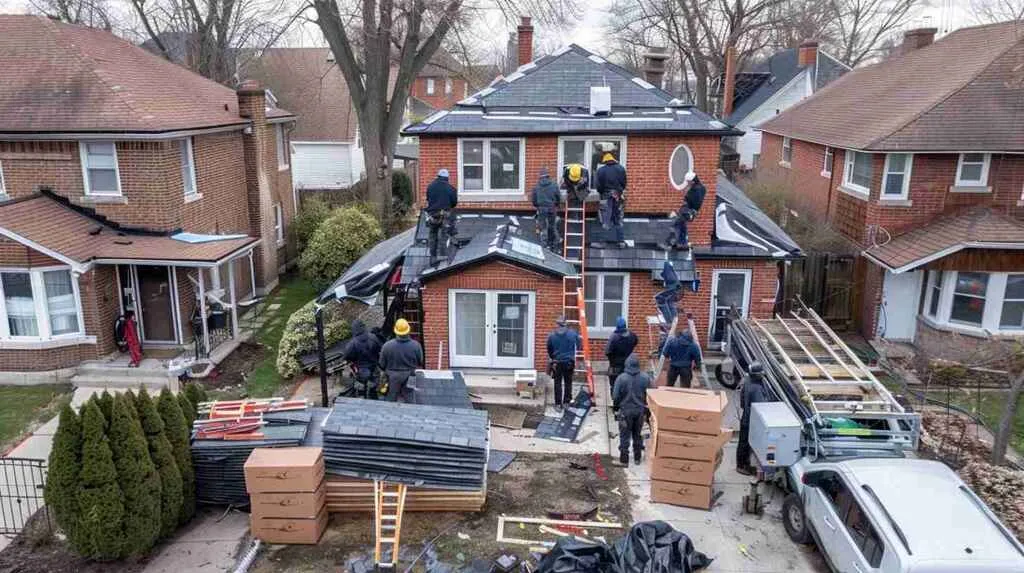
TPO Roofing Over Shingles Queens NY – When It Makes Sense | Free Estimates
Blueprint for TPO over shingles in Queens: you’re looking at $6,500 to $11,000 for a typical two-family in Jackson Heights, depending on square footage and how many weird transitions you’ve got where the addition meets the main house. That money is completely wasted if you’ve got three layers of shingles sitting on plywood that feels like a sponge when you walk on it-the deck is already cooked, and throwing TPO on top is like wrapping a nice jacket around a dead tree.
On a typical two-family in Jackson Heights, the difference between a smart TPO-over-shingles job and a disaster comes down to one thing: what’s under those shingles before you start. I think about roof prep the way I used to think about wiring panels-you don’t add a new circuit to corroded wires and wonder why it keeps tripping. If your deck is solid, you’ve only got one or two shingle layers, and the slope is low enough that water doesn’t rush off like a waterfall, then TPO over shingles can actually make sense. But if there’s rot, multiple soft spots, or ventilation problems, you’re building on quicksand. Sometimes the real “mother’s house” answer-and yeah, I ask that question out loud on every estimate-is a partial tear-off on the bad sections, then TPO over the solid areas, so you’re not throwing money at the wrong parts.
Typical Queens TPO Over Shingles Price Scenarios
| Roof Type / Scenario | Approx. Size | Scope of Work | Estimated Price Range (Queens, NY) |
|---|---|---|---|
| Low-slope addition (cape or ranch) | 400-600 sq ft | TPO over one shingle layer, cover board, edge metal | $3,200-$5,000 |
| Two-family flat/low-slope section | 800-1,200 sq ft | TPO over shingles, parapet flashing, two drains | $6,500-$9,500 |
| Attached row-house addition | 500-700 sq ft | TPO over shingles, custom wall transitions, one scupper | $4,800-$6,800 |
| Multi-family mixed slope roof | 1,500-2,000 sq ft | Partial tear-off on steep section, TPO on low slope, hybrid edge | $10,000-$14,000 |
| Garage or shed (detached) | 200-350 sq ft | TPO over shingles, simple perimeter flashing | $1,800-$2,800 |
Prices based on 2024-2025 Queens material and labor. Final cost depends on deck condition, access, shingle layers, and transition complexity.
When TPO Over Shingles in Queens Actually Makes Sense
Low-Slope & Row House Situations Where It Works
Here’s my honest take, whether you hire me or not: TPO over shingles works when you’ve got a roof pitch between 2/12 and 3/12, solid plywood underneath, only one or two shingle layers, and decent attic ventilation so heat doesn’t get trapped like a closed circuit. In Woodside and Jackson Heights, most of the two-families have those flat or near-flat additions off the back where shingles were never the right call in the first place-they pond water, curl at the edges, and leak every spring. In Bayside and Ozone Park, you see a lot of capes with low-slope garage sections or mudroom roofs where the shingles are fine structurally but the pitch just isn’t steep enough to shed water fast. That’s where TPO over shingles shines: you skip the tear-off cost, the deck stays protected, and the membrane gives you a waterproof surface that actually handles sitting water. The key is knowing that attached structures-rows, semi-attached, or anything sharing a wall-need extra attention on transitions, because that’s where the “circuit” of water movement gets complicated and amateur jobs go sideways.
I still remember a Saturday in November, mid-afternoon with that weird hazy sun, when I climbed onto a two-family in Woodside during a heat wave in July-owner wanted TPO right over three layers of old shingles because “the other guy said it’s fine and it’ll save me thousands.” I pulled out my infrared thermometer, laid it on the roof, and showed him the reading: 178°F surface temperature. Then I peeled back a test section near the edge and found the plywood already starting to delaminate, the glue between the layers turning to powder from years of trapped heat cycling through those shingle “loads” like an overloaded electrical panel. That job turned into a partial tear-off-stripped the worst sections down to the deck, replaced two sheets of plywood, then installed TPO over the solid areas with a proper cover board and mechanical fastening. Two summers later he called to tell me his top-floor tenant’s AC bill dropped by a third, because the white TPO was reflecting heat instead of letting it cook through into the attic like those black shingles had been doing. Let me put it in electrician terms, because that’s how my brain is wired: the shingles were drawing too many amps, the deck was the wire getting hot, and we had to reduce the load before adding a new “panel” on top.
When it’s done right-cover board installed, correct fastening pattern with plates, proper edge metal and terminations-TPO over shingles on a low-slope section can actually lower your cooling costs and stop those chronic leaks on additions where water just sits. You’re turning a section that used to “short out” every spring into a clean, sealed circuit. Here’s an insider tip I give every homeowner before they sign anything: ask your contractor to sketch-not just talk, actually draw-how they plan to handle the transitions where the TPO meets your existing shingle roof, any walls or parapets, and how water will drain at those spots. If they can’t show you on paper, they don’t know how to detail it in the field, and you’ll have leaks within a year at those terminations.
Situations Where TPO Over Shingles Usually Works in Queens
-
✅
Low-slope sections (2/12 to 3/12 pitch) on additions, garages, or back extensions where shingles pond water and never fully dry -
✅
Only one or two shingle layers over solid plywood with no soft spots, sagging, or visible rot from below -
✅
Chronic leak areas on flat or nearly flat sections where re-shingling has failed twice already and the pitch is the real problem -
✅
Attached or semi-attached row houses where tearing off shingles would expose shared walls or create neighbor access issues during the job -
✅
Energy upgrade goals where the homeowner wants to reflect heat instead of absorbing it, and the deck can handle the new fastening load
| Pros of TPO Over Shingles | Cons of TPO Over Shingles |
|---|---|
| Lower upfront cost – skipping the tear-off saves $1,500-$3,000 in labor and dumpster fees on a typical Queens two-family | Hidden deck problems – if the plywood is soft or delaminating under the shingles, you won’t know until the TPO starts failing at fastener points |
| Faster installation – no debris chute, no dumpster blocking the driveway, and the job is usually done in 2-3 days instead of a week | Shorter lifespan – TPO over uneven or curled shingles can develop stress points and membrane failures 5-8 years earlier than over clean deck |
| Added insulation value – the existing shingle layers plus cover board create extra R-value and noise dampening, especially on top-floor units | Weight and structural load – you’re adding TPO, cover board, and fasteners on top of existing layers, which older joists in Queens row houses weren’t always sized for |
| Less disruption – tenants or family stay in place, no nail-gun banging at 7 a.m., and you’re not exposing the interior to weather during the switchover | Warranty complications – many TPO manufacturers limit or void coverage if you install over more than one shingle layer or skip tear-off inspection |
When TPO Over Shingles Fails (And How to Avoid the Handyman Special)
Before we get too dreamy about “no-tear-off” jobs, here’s the part nobody likes: TPO over shingles fails when there’s no cover board, fasteners telegraph through the membrane like bubble wrap, curling shingles underneath create uneven surfaces that stress the TPO, or the edge metal is slapped on without proper termination bars. In late October, just before dark, I got called to a narrow semi-attached in Ozone Park with a so-called “TPO over shingles” that had been installed by a handyman crew the previous spring. They had mechanically fastened straight through curling, brittle shingles, skipped the proper cover board to save a few hundred bucks, and every fastener head was telegraphing through the membrane-you could see the bumps from the sidewalk. First cold snap in November, water froze around those raised fastener points, expanded, split the membrane in a dozen spots, and I got the emergency call at 6 a.m. in the rain with the dining room ceiling dripping. We ended up stripping a 12-foot section, installing proper recovery board, re-fastening with plates, and I used photos of that roof for two years as my go-to “this is why the prep matters” example. Water found the “short” in that system the second the temperature dropped-just like a bad splice in a wire that works fine until you put a load on it.
Warning signs you can spot from the sidewalk or a window: wavy or uneven TPO surface that follows the humps of curled shingles underneath, exposed fastener heads or plates along the edges where the installer ran out of membrane to fold over, ponding water that doesn’t drain within 48 hours after rain, or seams that look like they’re peeling apart near walls or pipes. It’s the roofing version of skipping a junction box in electrical and then wondering why the circuit keeps tripping every time you plug in the toaster-you took a shortcut on a critical connection, and physics doesn’t care about your budget.
⚠
Common TPO-Over-Shingle Mistakes in Queens That Lead to Leaks
- No cover board or recovery board installed – fasteners go straight into curled shingles, creating stress points and punctures within the first year
- Skipping deck inspection – soft plywood or delaminated OSB hidden under shingles that can’t hold fasteners, leading to “blow-offs” in wind
- Improper edge terminations – TPO just folded over the drip edge without termination bar or sealant, letting water wick under at the perimeter
- Fastening into the “valleys” of curled shingles – creates uneven membrane tension, and fastener plates eventually pull through under freeze-thaw cycling
- Ignoring transitions to walls or steeper roofs – no custom metal, just TPO lapped up and caulked, which fails the first time snow builds up or wind drives rain sideways
Quick Roof Check: Should You Even Be Considering TPO Over Shingles?
If we were standing on your sidewalk right now, I’d ask you this: Can you see from the street whether your roof looks flat or wavy when you step back? Is there any visible sagging in the roofline? And from inside your attic-if you can get up there-does the underside of the deck feel spongy when you press on it, or do you see any dark stains or light coming through nail holes? Those three checks-slope, layers, and deck integrity-are the “voltage” and “load” of your roof circuit. A low slope (under 3/12) means water moves slow, like low voltage that can’t push through a long wire, so TPO makes sense. Multiple shingle layers are like too many appliances on one circuit-you’re overloading the structure and trapping heat. And a soft deck is a short waiting to happen; you can’t build on it, period.
Should You Put TPO Over Your Shingles in Queens?
Things to Look At Before You Call for a TPO-Over-Shingle Estimate
-
☐
Walk around the house and check if any sections of the roof look wavy, sagging, or uneven from the street or yard -
☐
If you can safely get into the attic, press on the underside of the roof deck to see if it feels spongy, or look for water stains and light coming through -
☐
Count how many shingle layers you can see at the edge of the roof or at a rake board-peel back a corner if you can reach one safely -
☐
Take photos of any areas where the roof meets a wall, chimney, or skylight-these are the spots where cheap jobs fail first -
☐
Note whether water sits in any low areas for more than a day after rain-ponding is a sign you need TPO, not more shingles -
☐
Write down the approximate square footage of the low-slope section (length × width) so you can get realistic price ranges up front
$9,000 is a stupid amount of money to spend on the wrong roof system. This whole article exists so you don’t hand that cash to a contractor who’ll put TPO over three rotten layers and be gone before the first leak shows up.
How We Install TPO Over Shingles in Queens (When It’s Actually the Right Move)
Step-by-Step: From Inspection to Final Welds
When you call Shingle Masters for a TPO-over-shingles job in Queens, here’s exactly how I run it-start to finish, no shortcuts. First, I’m on your roof with a moisture meter and a screwdriver, doing test probes near the edges and at any suspicious spots to check if the plywood is solid or soft. If I find delamination or rot, we’re having the “partial tear-off” conversation right there, because I’m not fastening into bad wood. Assuming the deck checks out, we install a layer of cover board-usually half-inch ISO or dense gypsum-over the existing shingles to create a smooth, uniform substrate and protect the TPO from fastener heads telegraphing through. Then we roll out the TPO membrane, mechanically fasten it with plates on a grid pattern that meets wind-load specs for Queens (and trust me, wind off the bay is real), and heat-weld all the seams with a hot-air gun so you’ve got a single, continuous waterproof surface. Edge metal goes on last-custom bent to match your roof perimeter-and we terminate the membrane into the metal with termination bars and sealant, not just caulk. Finally, we detail every transition: walls get metal counter-flashing, pipes get TPO boots, and any connection to a steeper shingle section gets a custom transition piece so water flows down, not under. It’s the “panel upgrade” for your whole roof circuit-every connection has to be code, or the system shorts out the first time it’s under load.
Real Bayside “White Runway” Example
One weirdly foggy Sunday morning in March, I met an older couple in Bayside who had a low-slope addition off the back of their cape with shingles that never stopped leaking near the slider. They were convinced they needed a whole new roof-steeper sections and all-and were getting quotes for $18,000 to $22,000. Instead, I installed TPO over the shingles only on the 2/12 pitch section, about 450 square feet, tying it into the steeper shingle roof with a custom-bent aluminum transition that stepped down and lapped under the last course of shingles. The tricky part was making sure the drainage “circuit” worked: water had to flow from the TPO into the gutter without backing up under that transition metal, so I pitched the termination bar slightly and added a sealed lap joint. I still remember the husband asking if it was okay that “it looks like a white runway back there,” and I told him, “Yeah, a runway that lands your rainwater in the gutter instead of your dining room.” Three years later: still dry, and he sends me photos every time it snows to show me the TPO shedding clean while the shingle sections hold onto ice. That transition detail is the “junction box” where the two roof systems meet-you build it right, and it never gives you trouble; you caulk it and hope, and you’re back there every spring fixing leaks.
Raul’s Queens TPO-Over-Shingles Installation Process
Why Queens Homeowners Call Shingle Masters for TPO Over Shingles
TPO Over Shingles Questions Queens Owners Ask Raul on the Sidewalk
Does TPO over shingles void my manufacturer warranty?
+
How long does TPO over shingles actually last in Queens weather?
+
Will the white TPO make my house look weird from the street?
+
Is TPO noisier than shingles when it rains or hails?
+
Can TPO over shingles handle snow load and ice in Queens winters?
+
Here’s the thing: your roof is an electrical circuit for water. Either it’s wired right-solid deck, correct slope, proper terminations-and it runs clean for 15 years, or there’s a “short” somewhere and it trips the breaker every time it rains. TPO over shingles works when you treat it like a systems upgrade, not a patch job. If you’ve got a low-slope section in Queens that’s been leaking or just doesn’t make sense as a shingle roof anymore, call Shingle Masters at (718) 555-ROOF for a free on-site opinion-I’ll bring the moisture meter, the notepad, and a straight answer about whether TPO over your shingles is smart money or wasted money.