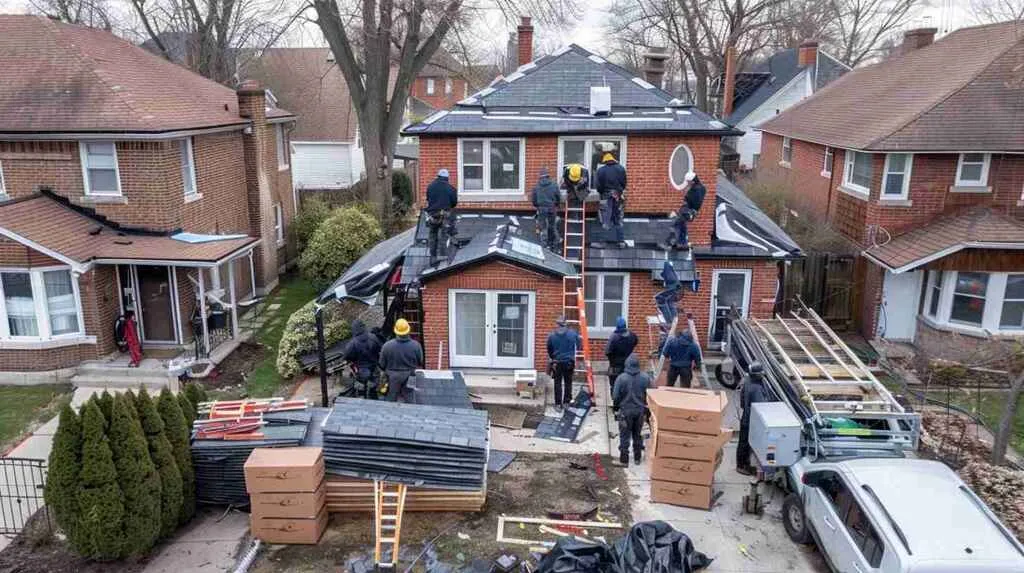
Thick Shingle Roof Queens NY – Why Thickness Improves Performance
Quiet decisions ruin roofs faster than storms. Around Queens, where every square foot is value-engineered and every contractor tries to shave ten bucks off the quote, the thickness people skip to save money is exactly what keeps roofs from failing after four summers instead of fifteen. I’ve been climbing these roofs for 19 years, and I still start every estimate by pulling scrap shingles from my truck, snapping one in half, and showing the broken edge-because the protective material is in that thickness, not the color on top.
Why Shingle Thickness Is the First Thing I Check on Queens Roofs
On a row house off 37th Avenue last winter, I showed a client two shingles side by side on her kitchen table and asked her to close her eyes and just feel the weight difference. She immediately understood what I’d been trying to explain over the phone for three days-one felt like cardboard, the other felt like you could actually trust it in a storm. Thickness isn’t a cosmetic upgrade or a marketing gimmick; it’s a tactile, measurable thing you can bend, weigh, and compare. Think of it like winter boots: you wouldn’t hike through February slush in canvas sneakers, and you shouldn’t roof a Queens house with flimsy shingles that feel like stiff paper.
Here’s my honest take: in Queens, thin shingles are like cheap sneakers on a mail carrier-you might get away with them for a year, but not for a decade. On the tightly budgeted jobs I see all over Flushing, Astoria, and Corona, skipping thickness is the hidden shortcut that leads to curling, blistering, and the “mysterious leaks” I get called about every weekend. A thick shingle physically bridges nail depressions, spans old patch seams, and doesn’t telegraph every dip in your deck the way a thin shingle does. When I’m looking at a roof proposal or walking a homeowner through options, thickness is the number-one performance factor I check-before brand names, before color samples, before any of the pretty brochure stuff.
| Myth about Thick Shingles | Reality on Queens Roofs |
|---|---|
| “All shingles are basically the same if they say 30 years.” | Actual thickness and weight change how shingles handle Queens heat, wind, and old decks far more than the printed warranty. |
| “Thicker shingles are just for looks and curb appeal.” | Extra material adds wind resistance, impact resistance, and slows heat transfer into top-floor rooms. |
| “Thin shingles are fine in the city because we don’t get real storms.” | Nor’easters off the Atlantic and sudden summer windstorms routinely peel up lighter, thinner shingles in Queens. |
| “If my last roof failed early, it was just a bad installer.” | Installation matters, but flimsy, ultra-thin shingles give even a good installer less margin for error on wavy or patched decks. |
| “Thicker shingles will make my roof too heavy for an older house.” | Modern thick laminated shingles are designed to be safely used on standard framed roofs that are in sound condition. |
How Thick Shingles Handle Queens Heat, Wind, and Old Decks
One August afternoon in Flushing, it was 94°F and the roof felt like a griddle, and a homeowner was furious because her “brand-new” roof was curling after only four summers. I climbed up, peeled back a shingle, and could literally feel how flimsy and thin it was between my fingers; the thing bent like a playing card. We ended up tearing it all off and installing a thick architectural shingle system, and I still remember how, two summers later in equal heat, I set my hand on those new shingles and they were noticeably cooler to the touch because of the extra material and shadow lines. That job taught me how brutally Queens sun punishes thin shingles-especially when you’ve got reflective brick walls, tight alleys that trap heat, and black tar driveways bouncing sunlight back up onto the roof all day long. The thicker system didn’t just look better; it physically ran cooler and stayed flatter because it had enough body to resist the constant expansion-contraction cycle.
One windy November night in Rockaway, a nor’easter was blowing 45 mph gusts and I got an emergency call from an older couple with rain pouring into their bedroom. When I got there, I could see from the street that the original 3-tab shingles had peeled back in strips, while the neighbor’s thicker laminated shingles were barely moving. We did temporary tarping in the sideways rain, then replaced their whole roof the next week with a heavier, thicker shingle rated for higher wind uplift; during the next big storm that spring, the husband called just to tell me he sat by the window watching the flags flap while his thick shingle roof didn’t budge. Wind performance isn’t just about better nails or fancy underlayment-heavier, thicker shingles physically resist wind uplift because they have more mass pressing down on the fasteners. Near the water, on corner lots, or anywhere wind can hit a roof edge clean, that extra weight makes all the difference.
Think about the way a thick winter coat smooths over the bumps of a sweater underneath-that’s exactly how a thick shingle handles the uneven old decks we see all over this borough. In Queens, you’re not always working with perfect plywood; you’re dealing with patched boards, old nail holes, and seams that don’t line up because the house has been added onto three times since 1950. A thin shingle telegraphs every one of those imperfections, creating tiny low spots where water can track sideways. A thicker shingle bridges those dips and gives installers a surface stiff enough to seal properly even when the deck isn’t showroom-flat. Add in the subway vibration, the constant thermal cycling, and the wind off the bay, and you start to see why thickness isn’t a luxury-it’s the baseline for a roof that actually lasts on real Queens homes.
Real Queens homes where thickness made the difference
| Thick Laminated Shingles | Thin 3-Tab Shingles |
|---|---|
| Better at resisting curling and blistering in intense summer heat. | More likely to curl or crack after a few Queens summers. |
| Heavier weight helps them stay put in coastal wind and nor’easters. | Lighter weight makes them easier to lift or peel in strong gusts. |
| Layered design bridges small dips, nail pops, and old patch seams. | Telegraphs every bump in an uneven deck, creating water channels. |
| Deeper shadow lines can slightly reduce surface temperature and UV impact. | Flatter profile exposes more direct surface to sun and heat. |
| Often carry higher wind ratings when installed to spec. | Typically limited to lower wind ratings and basic warranty coverage. |
⚠️ Warning: Ultra-Thin Budget Shingles in Queens Weather
If a shingle feels almost like a floppy playing card when you bend it, that’s a red flag on a Queens roof. Ultra-thin, bargain shingles are more likely to curl under summer heat, lift in fall nor’easters, and mirror every dip in an old deck-turning tiny imperfections into leak paths. On tightly packed row houses, one failing thin roof can also funnel water and wind-driven rain toward your neighbor’s walls and soffits.
Why Thickness Prevents the “Mysterious Leaks” I’m Always Called For
There was a Saturday morning in Astoria where a landlord complained about constant attic condensation and “mysterious leaks” over one top-floor apartment. The roof didn’t look ancient, but when I cut a test patch I saw they’d used a budget, ultra-thin shingle over a poorly vented deck; the shingles were so thin that every little deck imperfection telegraphed through, creating micro-channels for water. We rebuilt that section with proper underlayment and a much thicker shingle, and I remember holding a thin and a thick shingle piece side by side for the tenant, showing him how the extra thickness physically bridges small gaps and nail depressions. Now, here’s where it gets real on Queens roofs: if you stand on the sidewalk and you can see wavy lines that match the plywood seams underneath, or if your attic has staining that doesn’t match any obvious roof damage, you’re probably looking at a thickness problem. Those telegraph lines mean the shingle layer is sinking into low spots instead of spanning over them, and water follows those little valleys like a road map straight to your ceiling.
When you tell me, “Lou, why does thickness even matter if they all say 30 years on the wrapper?” I grab my notepad and draw you a cross-section of a shingle like a layered sandwich. A thick laminated shingle has multiple layers bonded together, which gives it stiffness and body-it doesn’t just sit on your roof, it holds its shape over nail depressions, old patch jobs, and the slight sags that happen in every old Queens house. A thin shingle is basically one layer doing all the work, so when a nail sinks in slightly or the deck has a low spot, that shingle sinks right along with it. In older housing stock-where decks have been patched, where rafters have settled, where nothing is perfectly flat-thickness is often the only real buffer between “built to code” and “actually watertight.” And honestly, on quirky old buildings where you’re dealing with add-ons, enclosed porches, and rooflines that meet at odd angles, that extra thickness can be the difference between a roof that lasts twenty years and one that starts leaking in five.
Cost of a Thick Shingle Roof in Queens, NY (And When It’s Worth It)
On most Queens homes, upgrading to a thick architectural shingle adds $1-$3 per square foot, which sounds like nothing until you realize that one wind-driven leak through a thin shingle can cost you $2,000 in drywall, paint, and mold cleanup.
Realistically, the difference between a basic thin shingle roof and a thick architectural system on a standard Queens home might be $1,500 to $3,500 depending on size and complexity. That’s real money, but it’s not a wild luxury markup-it’s the cost of actual material thickness, better wind ratings, and a product that’s designed to handle heat cycling and old decks. For roofs with high sun exposure (south-facing slopes, flat adjoining roofs that reflect heat upward), windy locations (near water, corner lots, open park frontage), or older deck conditions, the upgrade almost always pays off in fewer callbacks, longer life, and lower energy bills on those brutal top-floor summer days. If you’re replacing a roof anyway and the bones are good, spending an extra two grand to get real thickness is one of the smartest decisions you’ll make.
Sample Costs: Upgrading to a Thick Shingle Roof in Queens, NY
| Scenario | Roof Size (Approx.) | Thin Basic Shingles | Thick Architectural Shingles | Typical Upgrade Difference |
|---|---|---|---|---|
| Small row house front roof | 800-1,000 sq ft | $5,000-$7,000 | $6,000-$8,500 | + $1,000-$1,500 |
| Attached two-family with simple roof | 1,200-1,600 sq ft | $7,500-$10,000 | $9,000-$12,500 | + $1,500-$2,500 |
| Detached Queens home with moderate complexity | 1,800-2,400 sq ft | $10,000-$14,000 | $12,500-$17,500 | + $2,500-$3,500 |
| Large multi-family or corner property | 2,500-3,500 sq ft | $14,000-$20,000 | $17,000-$24,000 | + $3,000-$4,000 |
| Wind-exposed coastal property (extra fastening, accessories) | 1,600-2,200 sq ft | $9,500-$13,500 | $12,000-$17,000 | + $2,000-$3,500 |
All ranges assume tear-off, standard underlayment, and code-compliant ventilation. Steep pitches, extensive deck repairs, or specialty ventilation can increase costs.
Should You Upgrade to a Thick Shingle Roof? Quick Decision Guide
Start: Is your home exposed to strong wind (near water, open corner lot, or tall building)?
↓ If YES: Upgrade to thicker shingles with higher wind rating recommended.
↓ If NO: Next question: Do you have an older roof deck (patches, past leaks, or uneven ceilings inside)?
↓ If YES: Thicker shingles strongly recommended to bridge imperfections.
↓ If NO: Next question: Do top-floor rooms get very hot in summer even with AC?
↓ If YES: Thicker, darker-profile shingles can help buffer heat and are worth considering.
↓ If NO: You may be able to stay with a standard shingle, but ask for a side-by-side sample and thickness comparison before deciding.
What to Do Before You Call for a Thick Shingle Roof in Queens
When you tell me, “Lou, why does thickness even matter if they all say 30 years on the wrapper?” I grab my notepad and draw you a cross-section of a shingle like a layered sandwich. You don’t need to know jargon or memorize product codes-you just need to look at your roof, check inside your house, and think about where your building sits on the block. Before you call, take five minutes to do a few simple checks: walk outside and look at your roof from the sidewalk to see if shingles are curling or wavy, peek into your attic or top-floor closet after a hard rain to check for stains or damp smells, and think about whether your home faces open wind or gets cooked by sun all day. Those observations tell me way more than a panicked “my roof is leaking” phone call, and they help me figure out whether a thick shingle upgrade is a nice-to-have or an absolute must on your particular house.
Before You Call Shingle Masters: Quick Checklist
- ✅ Look at your roof from the sidewalk: do you see curling edges, wavy lines, or flat, paper-like shingles?
- ✅ Check inside the top floor or attic after a hard rain: any fresh stains, damp smells, or peeling paint?
- ✅ Note your home’s exposure: are you near the bay, on a corner, or facing open park/parking lots where wind hits harder?
- ✅ Think about summer: do upstairs rooms feel like they’re cooking even with the AC running?
- ✅ Gather any old roofing paperwork or warranties so we can compare what was installed to what you actually need now.
- ✅ Make a quick list of any past leak spots so we can focus on those areas when we talk thickness and underlayment.
Common Questions About Thick Shingle Roofs in Queens, NY
Why Queens Homeowners Trust Shingle Masters for Thick Shingle Roofs
- Licensed and insured roofing contractor serving Queens, NY
- 19+ years hands-on experience on Queens roofs, from Jackson Heights to Rockaway
- Specializing in thick architectural shingle systems for heat and wind exposure
- Detailed, on-roof thickness checks with every material delivery-not just a drive-by estimate
Blunt truth: most premature roof problems I see in Queens come from people buying the thinnest shingle that met code and hoping the weather wouldn’t notice. For a Queens home-where you’ve got summer heat bouncing off brick, nor’easters rolling in off the Atlantic, and roof decks that have been patched and added onto for decades-a thick shingle roof isn’t a luxury upgrade, it’s the practical choice that keeps you dry and cool longer. If you’re tired of watching your neighbors deal with leak after leak, or if you’re about to replace your roof and want to do it right the first time, call Shingle Masters and let me come out, check your existing shingle thickness on the roof itself, and quote you a thicker system tailored to your block and exposure. You’ll get a straight answer, a side-by-side shingle comparison you can actually feel with your hands, and a roof that handles the next fifteen Queens summers without curling into potato chips.