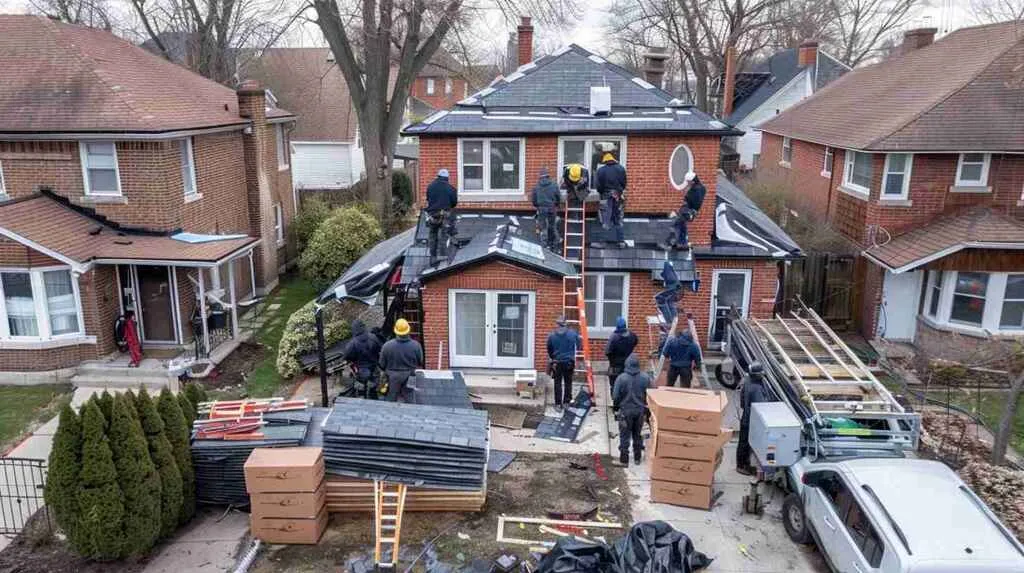
Synthetic Shingle Roof Queens NYC – Premium Look Without the Work
Sidewalk-level, you can’t tell the difference-that swooping charcoal slate roof on the Maspeth two-family looks exactly like real Vermont slate, but it weighs half as much, cost about $7,000 less, and won’t need replacement for another 35 years. Here’s what surprises most Queens homeowners I sit down with: by the time you factor in maintenance, repairs, and lifespan, a properly installed synthetic shingle roof often hits the same lifetime cost as a mid-range asphalt job-but you get the curb appeal of something that costs three times as much.
What Synthetic Shingle Roofs Really Cost in Queens
On a typical two-family in Maspeth, I’ll lay the numbers out like this right at the kitchen table: Yes, synthetic shingles cost more up front than basic architectural asphalt-maybe $13,000 to $16,000 installed versus $9,000 to $12,000 for decent asphalt on a 1,600 square foot roof. But here’s where the math gets interesting. That asphalt roof needs replacement at 15-18 years in Queens weather (nor’easters, freeze-thaw cycles, summer heat bouncing off all that brick). Your synthetic roof? Still going strong at 25, sometimes 30 years. It’s like comparing serious hiking boots to cheap sneakers for a wet three-day trek in the Andes-yeah, the boots cost more, but the sneakers fall apart and you’re buying new ones halfway through.
I remember one Saturday morning in Astoria, 6:30 a.m., starting a synthetic shingle tear-off on a narrow two-family while the bakery downstairs was already cranking out pan de yuca. The owner wanted the look of real slate but was terrified of the weight on his old framing. I stood in his tiny kitchen, holding an actual slate tile in one hand and a synthetic shingle in the other, letting him feel the weight difference while the coffee pot hissed between us. We avoided $4,000 in structural reinforcement right there-the synthetic weighed about 60% less than real slate. Three months later we had the heaviest-looking, lightest roof on the block, and during that first fall storm, he texted me a photo of dry ceiling corners and said, “Best fake slate I’ve ever seen.”
So what does that actually look like in Queens dollars, not brochure slogans?
Queens Synthetic vs Asphalt: Real Cost Scenarios
| Scenario | House Type | Roof Option | Installed Price | 25-Year Lifetime Cost |
|---|---|---|---|---|
| A | Maspeth two-family, 1,600 sq ft | Mid-range asphalt shingles | $9,000-$12,000 | ~$18,000-$24,000 (replacement + repairs) |
| B | Maspeth two-family, 1,600 sq ft | Synthetic slate-look shingles | $13,000-$16,000 | ~$15,000-$18,000 (minimal repairs, no replacement) |
| C | Bayside colonial, 2,200 sq ft | Premium asphalt shingles | $12,500-$15,500 | ~$23,000-$29,000 (replacement + storm repairs) |
| D | Bayside colonial, 2,200 sq ft | Synthetic cedar-shake shingles | $17,000-$21,000 | ~$19,000-$24,000 (no re-staining, minimal maintenance) |
These are ballpark Queens numbers based on typical installations-not exact quotes. Your project may vary based on pitch, flashing complexity, and underlayment upgrades.
Quick Facts Queens Homeowners Want to Know
LIFESPAN IN QUEENS WEATHER
30-50 years depending on brand and installation quality-way longer than most asphalt roofs see in nor’easters and summer heat
WEIGHT VS REAL SLATE
About 55-65% lighter than natural slate, which often saves thousands in structural reinforcement on older Queens framing
TYPICAL INSTALL TIME
3-5 days for a standard two-family roof in Queens, weather permitting-slightly longer than asphalt because details matter more
WARRANTY RANGE (PROPER INSTALL)
Limited lifetime warranties (30-50 years) on materials when installed to manufacturer specs and registered properly
Why Synthetic Shingles Work So Well on Queens Homes
Weight, Weather, and the “Andes Hike” Test
Let me be blunt: if you’re only judging shingles by how heavy they feel in your hand, you’re using 1970s logic on 2026 materials. The hiking analogy I always come back to is this-imagine packing for a wet three-day trek in the Andes. You need boots that won’t leak, a pack that won’t rip, and layers that breathe but shed water. Weight matters, but so does performance under the worst conditions you’ll face. Same with your roof. Most Queens homes-Maspeth two-families with their wide flat sections, Bayside colonials with steep gables, Astoria mixed-use buildings sharing walls-face wind, rain, freeze-thaw, and summer UV that would destroy cheap gear in a season. Synthetic shingles are engineered polymers that handle water shedding better than old organic asphalt, resist wind uplift like expensive architectural shingles, and weigh so little they don’t strain framing that’s already supporting decades of plaster and brick.
There was a windy November evening in Bayside when I got called back to a synthetic shingle job we’d done two years earlier because the homeowner’s neighbor swore “plastic roofs blow off in wind.” I climbed up in a 30 mph gust, headlamp on because the sun was already down at 4:45, and I inspected every ridge and hip. Not a single shingle lifted. What I did find was his neighbor’s old organic shingles peeling back like pages in a book. I came down, wiped the cold from my glasses, and explained that synthetic doesn’t mean flimsy-installed right, it actually grips tighter than half the “real” roofs around here. Here’s an insider tip: before you hire anyone for a synthetic roof in Queens, ask them to show you the product data sheet with the wind rating, then ask them to explain exactly how they meet that rating on your particular roof layout. If they shrug or change the subject, walk away.
Installation Matters More Than the Brand
Truth is, most of the leaks I fix on synthetic roofs in Queens have nothing to do with the shingles and everything to do with lazy flashing work. One July afternoon in Forest Hills, it was 94 degrees and the street was shimmering like a mirage when I got called to “fix a leak” on a three-year-old synthetic roof. Turned out the shingles were great-but the installer treated them like basic asphalt, skipped the proper starter course, and never read the manufacturer’s spec for the valley detail. I remember kneeling on that south-facing slope, sweat literally dripping off my nose onto the underlayment, thinking, “This isn’t a product problem, this is a pride problem-somebody didn’t bother to learn.” That day I decided I wouldn’t install a single synthetic shingle in Queens unless I walked the homeowner through why we do things differently with these materials. Synthetic shingles expand and contract differently than asphalt. They need specific nail placements. Valleys require careful weaving or metal inserts. It’s not rocket science, but it’s also not the same muscle memory your uncle’s roofer learned in 1985.
Think of your roof the way I think about my backpacking boots from back home: they don’t need to be made of stone to handle rough terrain-they just need to be engineered right, and you need to lace them correctly. If you ignore the manufacturer’s specs on a synthetic roof, you’re basically tying your boots wrong before a mountain trip. Here’s what to ask any Queens roofer before you let them touch synthetic shingles: How do you handle valleys on this particular product? What’s your approach to starter courses and hip caps? Have you completed manufacturer training, and can you show me photos of previous synthetic installs? If they fumble or say “it’s all the same,” you’re looking at someone who’ll give you a Forest Hills-style leak three years from now.
Warning: Shortcuts That Void Your Warranty and Create Leaks
- Skipping proper starter courses: Synthetic shingles need specific starter strips or doubled first courses to prevent wind uplift at eaves. Skip this, and you’ll get edge lifting and water intrusion within 18 months, especially on Queens roofs exposed to bay winds.
- Wrong nails or nail placement: Some synthetics require stainless fasteners or specific nail lengths and placement zones. Regular roofing nails or lazy placement outside the nailing strip can crack shingles or create voids-your warranty’s gone.
- Ignoring valley specifications: Many synthetic shingle manufacturers require woven valleys, metal valley inserts, or special underlayment details. Treat them like asphalt valleys, and you’ll see leaks the first heavy rain after install.
- Reusing old flashing: Old step flashing, chimney crickets, or vent boots that worked fine with asphalt may not seal properly against synthetic profiles. Fresh flashing matched to the new shingle thickness is critical-cutting corners here is asking for interior water damage.
✅ Questions to Ask Your Queens Roofer Before Hiring
-
✅
“Have you completed manufacturer training for the specific synthetic brand you’re proposing?” If they haven’t, they’re guessing. Most major synthetic shingle makers offer free certification-legit installers take it. -
✅
“Can you show me photos of completed synthetic roofs on steep-pitch Queens homes?” Flat or low-slope experience doesn’t translate-steep pitch and complex valleys are where the real skill shows. -
✅
“How do you handle flashing on attached rowhouses or party walls?” Queens is full of shared-wall buildings. Lazy flashing against brick neighbors is a leak waiting to happen-make sure they understand the details. -
✅
“Do you follow the manufacturer installation manual step-by-step, or do you ‘adapt’ based on experience?” The right answer is “We follow the manual exactly-that’s how warranties stay valid.” Anything else is a red flag. -
✅
“Will you register my warranty with the manufacturer after the install?” This simple step protects you, and good contractors do it automatically. If they dodge this question, they’re planning to skip it.
How We Install Synthetic Shingle Roofs in Queens, Step by Step
When I walk into a house and you tell me, “Luis, I want it to look expensive, but I don’t want to babysit it,” here’s what I start asking you: What’s the framing situation-are we dealing with original 1920s joists or something newer? What look are you after-slate, shake, or dimensional? And what’s your exposure like-are you on a corner catching wind off the East River, or tucked between taller buildings in a quiet Maspeth block? Those answers shape the whole approach. We’re not just slapping shingles on. We’re building a system designed around Queens-specific weather-nor’easters that dump three inches in four hours, freeze-thaw cycles that crack bad flashing, summer UV that bakes south-facing slopes. The process is built to handle all of it without you having to think about it for the next 30 years.
Think of it like packing and testing gear for a demanding mountain hike so there are no surprises on the trail. First visit, I’m measuring, sketching, checking deck condition, noting every chimney and vent. Then we sit at your kitchen table and pick the exact profile and color-I usually bring samples so you can see how they look against your brick or siding in real light. Tear-off day, we protect your landscaping, strip everything down to the deck, fix any soft spots or damaged sheathing. Next comes proper underlayment, ice-and-water barrier at eaves and valleys, all new flashing custom-fit to your building’s quirks. Then the shingles go on, following every manufacturer detail-starter courses, nailing zones, ridge vents, hip caps. Final day, I walk the roof with you (or show you photos if you’re not comfortable climbing), hand over warranty paperwork, and make sure every gutter and downspout is clear. No shortcuts, no “we always do it this way” nonsense-just the right way for your specific Queens roof.
Shingle Masters Synthetic Roof Installation Process
We visit your Queens home to measure the roof, check framing and deck condition, note every penetration, and discuss your building’s specific exposure and needs-no cookie-cutter estimates.
You choose the exact synthetic shingle profile (slate, shake, dimensional) and color at your kitchen table, with real samples in hand so you see how they look against your siding and brick in natural light.
We protect your landscaping, tear off the old roof, and inspect every inch of sheathing-replacing any soft, rotted, or damaged areas before we touch a single new shingle.
Premium underlayment goes down, ice-and-water barrier at all vulnerable spots, and every piece of flashing is installed fresh and custom-fit to your building’s details-chimneys, vents, party walls, the works.
We install your synthetic shingles exactly to the manufacturer’s manual-proper starter courses, correct nailing zones, valley treatments, and ridge details-because that’s how warranties stay valid and roofs stay dry.
We walk you through the finished roof (or show detailed photos), clean up every nail and scrap, clear gutters and downspouts, and hand you registered warranty documents so you’re fully covered.
Why Queens Homeowners Trust Shingle Masters
-
✓
NYC-Licensed and Fully Insured: We carry all required NYC contractor licenses, liability insurance, and workers’ comp-your building and your peace of mind are protected. -
✓
17+ Years Roofing Experience in Queens: We’ve installed hundreds of roofs across every Queens neighborhood and building type-two-families, colonials, rowhouses, mixed-use-and we know the local weather challenges. -
✓
Specialized Training on Synthetic Shingle Systems: Luis has completed manufacturer certification on multiple synthetic brands, so we install to exact specs-not guesswork. -
✓
Photo-Documented Installations: You get progress photos at every stage-tear-off, deck repair, underlayment, flashing, finished install-so you see exactly what’s happening even if you can’t be on-site. -
✓
24-48 Hour Estimate Response: We know Queens homeowners are busy-we schedule on-site visits within a day or two and deliver detailed written estimates fast, with no pressure to sign on the spot.
Keeping Your Synthetic Shingle Roof Storm-Ready
Here’s the thing: while synthetic shingles themselves are low-maintenance, Queens weather-nor’easters, summer downpours, wind off the East River, freeze-thaw cycles-makes regular checkups smart. It’s like inspecting your backpacking boots and pack straps before and after a tough trip: small checks prevent big failures. A quick visual inspection after a major storm (looking for lifted shingles, clogged gutters, damaged flashing) takes fifteen minutes and can save you from interior water damage. And honestly, most synthetic roofs in Queens go years without needing anything beyond gutter cleaning and the occasional repositioned branch. But when you do need a professional eye-after hail, a heavy snow load, or just as part of routine maintenance-Shingle Masters can handle quick inspections and minor repairs so small problems stay small.
Synthetic Shingle Roof Maintenance Timeline for Queens
Schedule a professional inspection to catch any settling issues or missed details. Check all flashing, look for any shingle movement, verify gutters are clear, and confirm warranty is registered.
Do a visual walk-around from ground level, clear debris from valleys and gutters, trim back any tree branches touching the roof, and check for moss or algae (rare on synthetic, but possible in shaded Queens spots).
Inspect for lifted shingles, check attic for any new water stains, look at flashing around chimneys and vents for damage. If you see anything unusual, call for a pro inspection before small issues become leaks.
Get a professional roof inspection report to show buyers. A well-maintained synthetic roof with years of warranty left is a major selling point-document it properly to maximize your Queens home’s value.
Common Questions About Synthetic Shingles in Queens
Are synthetic shingles allowed under NYC building code?
Yes, absolutely. Synthetic shingles that meet ASTM D6380 or D7158 standards and carry a Class A fire rating are fully compliant with NYC building code. Most major synthetic brands meet or exceed these specs. Your contractor should confirm the specific product is code-compliant and listed with the NYC Department of Buildings if required for your project-but rejection is extremely rare with quality products.
How loud are synthetic shingles in heavy rain compared to asphalt?
They’re quieter or about the same as asphalt shingles, not louder. The noise people worry about is usually from metal roofs. Synthetic shingles are dense polymers that dampen sound similarly to asphalt. If you have proper attic insulation and underlayment (which you should for energy efficiency anyway), you won’t notice any difference during a Queens downpour.
Can you install synthetic shingles over my existing roof?
Technically some products allow it, but I don’t recommend it-and most manufacturers void warranties if you do. Here’s why: you can’t inspect the deck for rot, you add unnecessary weight, and you trap moisture between layers. On Queens homes, especially older two-families and rowhouses, hidden deck damage is common. A proper tear-off lets us fix problems before they become expensive interior leaks. It’s worth the extra cost.
Will my insurance treat synthetic shingles differently from asphalt or slate?
Most insurers treat quality synthetic shingles the same as premium asphalt-sometimes even better because of superior impact and wind resistance. A few carriers offer small discounts for Class 4 impact-rated synthetics. Always notify your insurance when you replace your roof and provide the product data sheet showing fire and impact ratings. In 17 years, I’ve never had a Queens homeowner denied coverage because of synthetic shingles-it’s a non-issue with reputable products.
How do colors and styles hold up to Queens sun and pollution over time?
Premium synthetic shingles use through-body coloring and advanced UV stabilizers, so fading is minimal-typically less than you’d see on architectural asphalt over the same period. Yes, Queens has plenty of sun, pollution, and winter grime, but quality synthetics are engineered for it. Most warranties cover excessive color change (usually defined as more than a few shades). Real-world Queens installs I’ve done 10+ years ago still look sharp from the sidewalk. Just avoid the cheapest no-name brands-stick with established manufacturers and you’ll be fine.
If you’re ready to stop worrying about your Queens roof and want that premium slate or shake look without the weight or the endless maintenance, let’s talk. I’ll come to your home, measure everything, show you real samples in your actual light, and sketch out exactly what your project looks like-timeline, cost, and all the details other contractors skip. Call Shingle Masters today for a kitchen-table style consult and a tailored quote on a synthetic shingle roof that’ll handle everything Queens weather throws at it for the next 30 years.