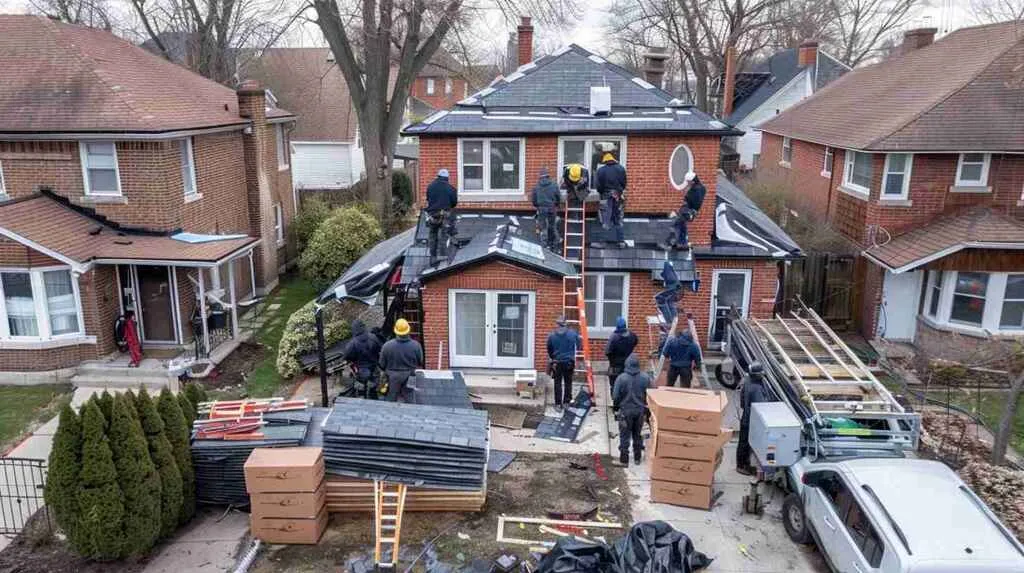
Slate Look Roof Shingles Queens NY – Elegant Aesthetic for Less
Unexpectedly, the homeowners who fall hardest for slate roofs are the ones who end up walking away from real slate the fastest once the structural engineer delivers the bad news. Two blocks from the 7 train in Jackson Heights, I recently priced a real slate roof at $62,000 and the slate look alternative at just under $19,000-and that gap isn’t just sticker shock, it’s the difference between a roof your house can carry and one that requires months of reinforcement, cranes, and permits nobody budgeted for. Here’s my honest opinion: if you don’t own a brownstone or a mini-mansion, real slate in Queens is usually overkill. Most attached rowhouses, Tudors, and Capes weren’t framed to hold that weight, so you’re chasing a design illusion anyway-and that’s where slate look roof shingles stop being a compromise and start being the smarter play. Think of slate look roof shingles like a really good cappuccino: same flavor profile, less equipment, less fuss, and a bill you don’t regret later.
Slate Look Roof Shingles in Queens: Cost Reality vs Curb Appeal
Two blocks from the 7 train in Jackson Heights, I recently priced a real slate roof at $62,000 and the slate look alternative at just under $19,000. That’s not a typo, and it’s not an outlier-it’s just what happens when you compare a material that weighs 800-1,500 pounds per square, needs custom fasteners and load-bearing upgrades, and takes three times as long to install against modern laminated asphalt shingles that mimic the shadow lines, color variation, and thickness of real quarried stone from Vermont or Pennsylvania. The blunt truth is that most Queens homeowners who walk into my office with a slate dream end up choosing slate look after we sketch out the structural math, and they don’t feel like they settled-they feel like they dodged a bullet. I’ve had people in Bayside, Forest Hills, even Astoria look at color samples under their kitchen lights, then walk outside to the sidewalk and realize they can’t tell the difference between a high-end slate look shingle and a $40,000 real slate roof three doors down. The cappuccino comparison is real: you’re getting the rich texture, the visual depth, the layered tones, just without the hand-quarried origin story and the crane rental.
Now, let’s be practical. A lot of Queens housing stock-rowhouses built in the 1920s and ’30s, post-war Capes, even some of the grander Tudors-wasn’t engineered to handle the dead load of real slate, which can run four to six times heavier than standard asphalt. That means before you install even one slate tile, you’re hiring a structural engineer to evaluate your rafters and possibly adding steel beams, sistering joists, or re-decking the entire roof, and none of that shows up in your final curb appeal. With slate look shingles, you skip that entire conversation. You get dimensional profiles that cast real shadows, multi-tonal color blends that shift in the sun just like stone, and a finished roof that your neighbors will assume cost twice what you actually paid-and your house’s bones don’t have to change at all. I had a Bayside couple who kept showing me a photo of a stone manor in the Basque Country where they’d spent their honeymoon; their budget and their Cape’s framing could not touch real slate, but we matched the color blend and stagger pattern to that postcard under warm kitchen light, and on install day it felt like their little house actually belonged in that picture they loved.
Estimated Installed Cost Ranges in Queens, NY: Real Slate vs Slate Look Roof Shingles
The following are estimated ranges combining typical labor and material costs for Queens installations. Every roof is different-these figures give you a planning baseline, not a quote.
| Scenario | Roof Size & House Type | Real Slate Installed Cost | Slate Look Asphalt Shingles Installed Cost | Typical Structural Upgrades Needed |
|---|---|---|---|---|
| Attached Rowhouse | 1,200 sq ft, Jackson Heights or Astoria | $42,000 – $58,000 | $13,500 – $18,000 | Often requires rafter reinforcement, engineer report |
| Tudor or Cape | 1,800 sq ft, Bayside or Forest Hills | $58,000 – $78,000 | $18,000 – $24,500 | Steep pitch may need additional framing support |
| Detached Colonial | 2,400 sq ft, Douglaston or Whitestone | $74,000 – $96,000 | $22,000 – $29,000 | Depends on rafter spacing and age of framing |
| Large Victorian or Mini-Mansion | 3,200+ sq ft, Kew Gardens or Forest Hills Gardens | $100,000 – $140,000+ | $30,000 – $42,000 | May be pre-engineered for slate; verify before install |
Real Slate vs Slate Look Roof Shingles: Core Differences
Design Illusion: Making Asphalt Shingles Pass for Slate from the Sidewalk
Shadow Lines, Color Blends, and the Queens Street View
I still remember a windy Tuesday on a corner lot in Bayside when a homeowner realized their ‘dream slate’ was literally too heavy for their rafters. The structural engineer had just handed over a report that showed we’d need to sister every other joist and possibly add a steel ridge beam before we could even think about hanging real slate tiles-and the project cost tripled on the spot. That was the moment I sat down at their kitchen table, pulled out a stack of slate look shingle samples, and started sketching shadow lines and stagger patterns on the back of a Domino’s box until they could see what I see: that the illusion of slate happens from the sidewalk, not from the attic. One January afternoon, about 3:30 p.m. with that flat gray Queens sky, I was on a steep-roofed Tudor in Forest Hills where the owner wanted real slate until I showed her the crane and reinforcement costs. We switched to a premium slate look roof shingle, and I still remember the neighbor across the street yelling from his driveway, asking if we were installing ‘the real stone stuff’ because from 40 feet away he couldn’t tell. That was the job where I learned how critical the shadow line layout is-one misaligned course and the illusion breaks, so we re-snapped our chalk lines twice in the cold just to get that perfect fake-slate pattern.
Now, let’s be practical. What actually makes slate look shingles believable from the street isn’t the material’s chemical formula or the warranty fine print-it’s the visual details that trick your eye into reading depth, texture, and natural variation. Shadow lines matter way more than most people think: if you install dimensional shingles with a deep reveal and stagger the exposure just right, each course casts a small shadow that mimics the uneven edges of hand-cut stone. Color blends matter too-real slate isn’t one flat gray; it’s streaked, mottled, and changes tone depending on the sun angle, so the best slate look shingles mix three or four color granules in one profile. Ridge details, the way the shingles meet dormers or valleys, the choice between a high-profile hip cap or a standard ridge vent-all of that either reinforces the illusion or gives the game away. Here’s an insider tip I give every homeowner: don’t judge your shingle color under kitchen fluorescents. Take the sample outside, walk across the street (or down your apartment hallway if you’re in a co-op building), and look at it from the distance your neighbors will actually see it-because that’s the view that counts, and you’ll notice that certain blends that look “too busy” up close turn into perfect stone texture from 50 feet.
Key Visual Tricks That Make Slate Look Shingles Believable on Queens Homes
✓
Top Slate Look Details I Sketch for Queens Homeowners at the Kitchen Table
-
✓
Stagger Pattern Alignment: How we offset each row so no vertical seams line up for more than two courses, breaking the “shingle grid” look that screams asphalt -
✓
Shadow Line Depth: Choosing a thick laminate profile that creates actual shadow under each course, especially visible in morning and late afternoon light -
✓
Ridge Cap Style: Upgrading to a high-profile, dimensional ridge cap that finishes the peak like thick stone tiles instead of thin standard caps -
✓
Color Blend Selection Under Real Indoor Light: Looking at samples in the actual lighting where we’ll be making the decision, then taking them outside for a sidewalk check -
✓
How the Roof Meets Dormers or Parapet Walls: Detailing valleys, step flashing, and trim so the transition from roof to wall looks intentional and historically correct, not like an afterthought
From Tear-Off to Final Ridge: How a Slate Look Roof Install Actually Works
I had one job in Astoria in late summer, a Saturday that started clear and then turned into one of those surprise 4 p.m. thunderstorms. We’d torn off an old three-tab roof and were halfway through installing slate look shingles with staggered exposures when the storm rolled in faster than expected-and I made the call to halt the decorative patterning and focus on getting the underlayment and key water channels covered, then came back early Sunday to rework three rows where the pattern looked ‘off’ because if the ‘slate’ effect doesn’t line up visually from the sidewalk, it’s not worth calling it slate look. That job taught me to always prioritize weather-tightness first in Queens’ unpredictable climate, especially on summer weekends when a pop-up storm can blow through while you’re mid-install. We got the house dry, the owner never saw a drop of water inside, and once the weather cleared I went back and re-snapped chalk lines to correct the pattern alignment-eating the extra labor myself because the whole point of slate look shingles is the illusion, and a sloppy stagger pattern breaks that illusion permanently. It’s that calm, methodical approach that keeps homeowners from panicking when weather changes and keeps the finished roof looking like something that cost three times what they actually paid.
Now, let’s be practical. Here’s what you can expect step-by-step during a slate look roof replacement on a typical Queens home: first, a full tear-off of the old shingles down to the wood decking, followed by a careful inspection of every sheet of plywood or planking to catch soft spots, rot, or fastener pop-ups before they become problems under the new roof. Next comes underlayment-a high-quality synthetic felt or rubberized membrane, plus ice-and-water shield in valleys, around chimneys, and along eaves where ice dams like to form. Then we snap chalk lines for the slate pattern layout, marking stagger points and exposure lines so each course lands exactly where it needs to for that dimensional shadow effect. Field shingles go down row by row, with careful attention to alignment and offset, and we’re constantly checking sightlines from the street to make sure the visual illusion holds up. Finally, the finishing touches: ridge caps, step flashing around dormers and walls, valley metal if needed, a full perimeter cleanup, and a magnet sweep of the driveway and yard to grab every stray nail-because this is Queens, your driveway is shared, and your neighbor’s tires matter.
Step-by-Step Slate Look Roof Replacement Process on a Typical Queens Home
Walk the roof, document existing condition, take precise measurements, identify structural concerns, and photograph any problem areas before work begins.
Strip all old shingles, felt, and flashing; inspect every sheet of decking for rot, warping, or fastener failure; replace or reinforce damaged sections before moving forward.
Roll out synthetic underlayment across the entire deck; apply rubberized ice-and-water shield in valleys, around chimneys, along eaves, and anywhere water can pool or ice can form.
This is where the design illusion begins-snap horizontal and vertical guidelines to control stagger, exposure, and alignment so the finished roof reads as thick stone tiles, not asphalt shingles.
Work course by course from eaves to ridge, checking alignment constantly, adjusting for the tight city lot conditions and making sure shadow lines stay consistent from every street angle.
Install high-profile ridge caps, flash all penetrations and walls, clean gutters, bag debris, and run a rolling magnet over driveways and shared walkways to pick up every loose nail.
Note: Work is adapted to tight city lots, shared driveways, and neighbor considerations-we coordinate truck access, protect landscaping, and schedule deliveries to minimize disruption on your Queens block.
⚠️ WARNING
Why Pattern Shortcuts Ruin the Slate Illusion
- Rushing the layout phase means chalk lines land in the wrong spots, and once you’ve nailed down three or four crooked courses, the whole roof looks “off” from the sidewalk-no fixing it without a tear-off.
- Ignoring the stagger pattern turns your slate look shingles into a boring grid that screams “asphalt” from a block away, killing the entire point of paying extra for dimensional profiles.
- Misaligning even a few courses creates visual “steps” or seams that catch the eye and break the stone illusion-your neighbors will notice, even if they can’t explain why the roof looks wrong.
- A proper slate look install sometimes means re-snapping lines or redoing a few rows at the installer’s expense-because the aesthetic goal is non-negotiable, and shortcuts always show up in the finished curb appeal.
Will Slate Look Shingles Hold Up in Queens Weather?
Blunt truth: 90% of the slate roofs you admire driving through Queens are actually high-end asphalt made to fool your eyes. That’s not a criticism-it’s a testament to how far shingle technology has come in the last decade, and it’s proof that slate look roof shingles can handle everything Queens weather throws at them: freeze-thaw cycles that crack real stone, summer heat that bakes a rowhouse roof to 160°F, wind gusts off the East River, and the occasional nor’easter that tests every fastener and seal. Good slate look shingles are rated for 110+ mph wind resistance, they flex instead of fracturing when ice expands in the underlayment, and their laminated construction actually spreads thermal stress better than brittle quarried slate. The design illusion versus structural reality theme shows up here again: you’re getting a roof that looks like it came from a Vermont quarry but performs like a modern engineered system built for coastal weather, urban pollution, and the kind of temperature swings that make real slate tiles crack and spall after 40 years.
Now, let’s be practical. Your maintenance expectations for slate look shingles are minimal but not zero: you’ll want to clean gutters twice a year (spring and fall) so water doesn’t back up under the eaves, and it’s worth doing a quick visual check from the sidewalk after any big storm to spot missing granules, lifted corners, or debris that landed in valleys. Expect a lifespan in the 25- to 35-year range for premium slate look shingles, compared to 50-100+ years for real slate but also compared to just 15-20 years for basic three-tab asphalt. Think of it like the difference between entry-level drip coffee, a well-made cappuccino, and a hand-pulled espresso from single-origin beans roasted that morning-slate look shingles are that middle tier where you get most of the refinement without the fussy upkeep or the sticker shock, and they’re way less prone to sudden catastrophic failure than real slate that can shatter in a hailstorm or slide off in sheets when the fasteners finally rust through.
Pros and Cons of Slate Look Roof Shingles for Queens Homeowners
Pros of Slate Look Shingles
- Cost: 60-70% less than real slate installed, fitting most Queens renovation budgets
- Weight: Light enough for standard framing-no structural upgrades needed on typical rowhouses or Tudors
- Aesthetic realism: High-end dimensional profiles fool the eye from street level, delivering 80-90% of the slate look
- Wind resistance: Modern laminate shingles rated for 110+ mph, ideal for coastal Queens weather
- Local availability: Stock colors and profiles available same-week from Queens suppliers, no long lead times
Cons of Slate Look Shingles
- Not as long-lived as real slate: 25-35 years vs 50-100+ for quarried stone tiles
- Still more expensive than basic shingles: Premium dimensional profiles cost 40-60% more than standard three-tab
- Needs a skilled installer for pattern: Misaligned courses ruin the slate illusion-not a DIY-friendly project
- May not fit ultra-modern flat roofs: Best suited for pitched roofs where shadow lines and texture show from the street
- Not historically perfect for landmarked brownstones: Landmarks Preservation may require real slate in certain historic districts
Simple Maintenance Schedule for a Slate Look Roof in Queens, NY
Take high-res photos of the finished roof from all four sides; file your manufacturer warranty and installer guarantee in one folder you can find in five years.
Clear winter debris, check for granule buildup (light shedding is normal in the first year), make sure downspouts drain away from the foundation.
Walk the perimeter with binoculars if the roof is steep; look for lifted shingles, cracked caulk around flashing, or any daylight visible through ridge vents.
If you see a pile of colored granules or a whole shingle tab in the yard after a nor’easter, call for a quick roof check-it’s almost always a simple fix if caught early.
Is Slate Look Right for Your Queens Home?
When I sit down at your kitchen table, the first thing I’ll ask you is simple: do you care more about the look from the street, or about the material under your feet? That question separates homeowners who’ll love slate look shingles (and save $40,000 in the process) from the rare few who genuinely need real quarried slate because they own a landmarked brownstone or a mini-mansion with the bones to carry the weight-and if you’re reading this page on a Tuesday night trying to figure out if your Bayside Tudor or Jackson Heights rowhouse can pull off that elegant slate aesthetic without the structural drama, slate look shingles are almost certainly your answer, and Shingle Masters in Queens, NY can walk your roof, sketch the pattern options, and price a solution that fits your block, your budget, and your long-term plans.
Should You Choose Real Slate, Slate Look Shingles, or Standard Architectural Shingles?
YES → Do you own a brownstone, Victorian mansion, or pre-war masonry home with thick walls and heavy framing?
YES → Real Slate (Authentic, 50-100+ year lifespan, heavy, expensive)
NO → Continue below…
NO (budget under $35k or structure not suitable) → Is a high-end, elegant look from the street your top priority?
YES → Slate Look Shingles (Most common Queens choice, 25-35 years, great curb appeal, affordable)
NO (just need solid protection, appearance secondary) → Standard Architectural Shingles (Budget-friendly, 15-25 years, clean but basic look)
This decision tree reflects the reality of most Queens homes-slate look shingles deliver the best balance of aesthetics, budget, and structural practicality.
Common Questions Queens Homeowners Ask About Slate Look Roof Shingles
How long do slate look shingles last compared to real slate?
Premium slate look shingles typically last 25-35 years in Queens weather, while real quarried slate can last 50 to well over 100 years if properly maintained. The trade-off is upfront cost and weight-slate look shingles cost 60-70% less and require no structural reinforcement, making them the practical choice for the vast majority of Queens homes that weren’t originally built to carry stone roofing.
Can slate look shingles go over an existing roof, and why is a full tear-off usually better in Queens?
Technically, some building codes allow one layer of new shingles over old ones, but in Queens I almost always recommend a full tear-off for several reasons: it lets us inspect and repair the decking (critical in older rowhouses where hidden rot is common), it keeps the overall roof weight down (important when you’re adding dimensional shingles that are heavier than basic three-tab), and most importantly, it gives you a clean, flat surface so the slate look pattern lies perfectly and the shadow lines stay consistent. An overlay might save a day of labor, but it compromises the design illusion and shortens the lifespan of your new roof.
Are slate look shingles compatible with steep Tudor roofs and low-slope additions?
Slate look shingles excel on steep Tudor and Victorian roofs-the pitch actually enhances the shadow lines and makes the dimensional profiles more visible from the street. On low-slope sections (anything under a 3:12 pitch), the visual effect is less dramatic because you lose the shadow depth, and you may need modified installation techniques or even a different roofing system depending on how flat the slope is. That said, on a typical Queens Tudor with a steep main roof and a flatter addition or dormer, we can absolutely use slate look shingles across both sections-we just adjust the underlayment and fastening schedule to match the pitch.
What are the noise and insulation differences between slate look shingles and real slate?
Honest answer: there’s no meaningful noise or insulation difference between slate look shingles and real slate for a typical Queens homeowner. Both sit on top of insulated attic spaces, and the actual R-value of the roofing material itself is negligible compared to what’s in your attic floor or rafters. Real slate is denser and slightly better at blocking rain noise, but with proper underlayment and decking, slate look shingles are quiet enough that you won’t notice rain unless you’re in an unfinished attic during a downpour. If noise or energy efficiency is a concern, focus on upgrading your attic insulation and ventilation-that’ll make a much bigger difference than the choice between asphalt and stone on the roof surface.
How long does a typical slate look roof project take on a rowhouse vs a detached home?
On a standard Queens attached rowhouse (1,200-1,500 sq ft of roof), expect 3-4 days for a full tear-off and slate look shingle install, assuming decent weather and no major deck repairs. A detached Tudor or Colonial with 1,800-2,400 sq ft of roof and multiple gables, dormers, or valleys can take 5-6 days, sometimes a full week if we hit rain delays or discover structural issues that need fixing. The extra time on slate look shingles (compared to basic three-tab) comes from the careful layout and pattern work-we’re not just nailing rows as fast as possible, we’re creating a visual illusion that has to hold up from every angle, and that means re-checking alignment, re-snapping lines when needed, and sometimes redoing a section if it doesn’t look right from the sidewalk.
If your Queens home has been whispering “slate roof” in your ear every time you drive past a Forest Hills Tudor or a Bayside manor, you don’t have to ignore that whisper just because your budget or your rafters can’t handle the real thing-slate look shingles give you 80-90% of the aesthetic at a fraction of the weight, cost, and hassle, and they’re engineered to survive the freeze-thaw cycles, summer heat, and coastal wind that define our weather here. Call Shingle Masters in Queens, NY and I’ll walk your roof, sketch the stagger pattern and color options on a pizza box if that’s what it takes, and price out a slate look solution that fits your block, your budget, and the way you actually live-because the best roofs in this borough are the ones where design illusion meets structural reality, and nobody on your street can tell the difference.