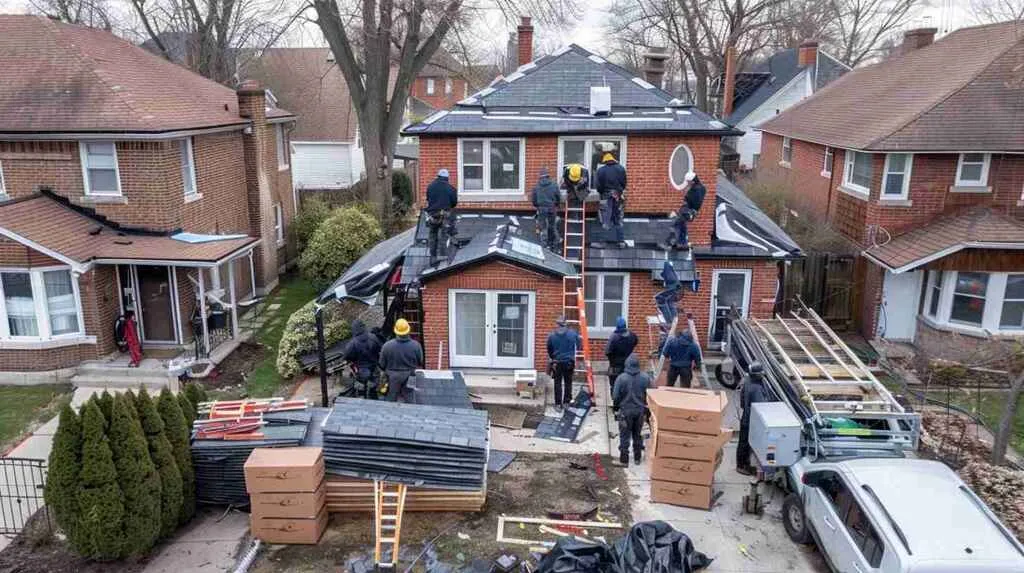
Shingle Roof Type Queens NY – What’s Right for Your Home? | Free Estimates
Sideways rain, wind that picks up speed across the block, and snow that sticks for three days – that’s Queens winter, and your shingle roof type either handles it or doesn’t. You can spend anywhere from $7,800 to $24,000 on a new roof and still be unhappy if you picked shingles that don’t match your house, your street, or how long you plan to live there. Think about it like shoes: the fanciest dress boots won’t help if you’re hauling groceries through slush, and flip-flops won’t cut it when you’re working a double shift on your feet – same idea with shingles.
Queens Shingle Roof Types in Plain English (and Real Dollars)
Here’s my honest opinion: most people don’t need the most expensive shingle – they need the most appropriate shingle. I’ve stood on roofs that cost a fortune and failed in five years because someone picked “luxury” shingles without thinking about wind exposure or slope. Compare shingle types to footwear and it gets clearer fast: basic 3-tabs are like cheap sneakers – fine for a quick errand but not built for heavy use; architectural shingles are solid work boots – reliable, good-looking enough, handle daily wear; and heavier luxury shingles are like insulated steel-toe boots – overkill for some jobs, perfect for others. I’ll keep hammering that analogy until you roll your eyes and say, “Luis, enough with the shoes.”
On 43rd Avenue last summer, I stood on a roof that was only eight years old and already failing because the owner had picked shingles based on a sale flyer without thinking about the fact that the house sits on a corner lot, fully exposed to nor’easter gusts. Three layers of wind had peeled back corners, water got under the underlayment, and the attic had stains spreading like spilled coffee. The fix? We tore it all off, upgraded to architectural shingles with proper wind rating, and used ice-and-water shield where it mattered. Could’ve saved $4,000 and a lot of stress if the first contractor had matched shingle type to block reality instead of just lowest bid. Below, I’ve broken down five realistic Queens scenarios so you can see what fits your situation and what it’ll actually cost.
| Scenario | House / Roof Description | Recommended Shingle Roof Type | Estimated Price Range (Queens, NY) | Why This Type Fits (Shoe Analogy) |
|---|---|---|---|---|
| Budget-Conscious Flip / Rental | 1,200 sq ft ranch, sheltered mid-block, planning to sell in 3-5 years | Basic 3-tab asphalt shingles | $7,800-$10,500 (includes tear-off, disposal, new underlayment, flashing) | Cheap sneakers for a short trip – gets the job done, passes inspection, nothing fancy |
| Standard Family Home | 1,800 sq ft two-story attached house, moderate wind, staying 10+ years | Architectural (dimensional) shingles, 30-year rating | $12,000-$16,000 (full system, quality underlayment, proper venting) | Good work boots – comfortable, durable, look decent, handle daily wear |
| Corner-Lot or Waterfront Home | 2,200 sq ft detached house, open exposure to wind, brick façade, staying long-term | Heavy architectural or luxury shingles (50-year, high wind rating) | $18,000-$24,000 (thicker shingles, reinforced underlayment, extra flashing) | Insulated steel-toe boots – built for tough conditions, worth it if you need the protection |
| Low-Slope Addition / Complex Roof | 1,500 sq ft with low-slope sections, multiple valleys, dormer, staying 10+ years | Architectural shingles rated for low slope, plus upgraded underlayment | $13,500-$17,500 (extra ice-and-water shield, careful flashing, longer labor) | Trail runners with good grip – need something that adapts to tricky terrain |
| Historic or High-Curb-Appeal Home | 2,000 sq ft Tudor or Colonial style, tree-lined block, owner wants premium look and longevity | Designer/luxury architectural shingles, color-matched to trim | $19,000-$26,000 (premium materials, custom colors, detailed install) | Leather dress boots – refined, impressive, last forever if you care for them |
How to Match Shingle Roof Type to Your Queens Block
One February afternoon during that ice-rain mess in 2021, I was on a two-family in Flushing where the owner had mixed three different shingle roof types over ten years – bargain 3-tabs, then architectural, then a ‘cool roof’ patch someone slapped on. The roof looked like a thrift store shoe rack, and every transition line was leaking. Standing up there in freezing drizzle, I realized most people don’t choose the wrong shingle – they just never get the full picture of how the whole system has to match, so they chase one ‘deal’ at a time and end up paying twice. In Queens, you’ve got attached row houses with zero wind exposure sitting right next to corner lots that catch every gust coming off the bay. You’ve got steep A-frames in Forest Hills and nearly flat sections on additions in Elmhurst. One shingle type doesn’t fit all that.
When I come to your place in Queens, the first question I’ll ask is, “Do you plan to sell this house in 5 years… or be carried out of it at 95?” That answer changes everything. If you’re flipping or planning to move, basic architectural shingles look great in photos and pass inspection without breaking your budget. If you’re staying put and the house sits on a corner lot where wind picks up speed, you want heavier shingles with a proper wind rating and underlayment that won’t peel back in the next nor’easter. I also look at roof slope – anything under 4:12 needs special attention and shingles rated for low-pitch applications. The decision tree below walks you through the same questions I’d ask standing on your driveway, so you know what direction you’re headed before you even pick up the phone.
Decision Tree: Choosing the Right Shingle Roof Type for Your Queens Home
START: Is your roof slope 4:12 or steeper?
YES → Proceed to wind exposure question
NO → You need low-slope rated architectural shingles + upgraded underlayment (jump to final recommendation)
Is your house on a corner lot, near open water, or taller than neighbors?
YES (high wind exposure) → Proceed to longevity question
NO (sheltered mid-block) → Proceed to budget question
HIGH WIND EXPOSURE PATH: Planning to stay 15+ years?
YES → RECOMMENDATION: Heavy architectural or luxury shingles (50-year, high wind rating, reinforced underlayment)
NO (selling within 10 years) → RECOMMENDATION: Standard architectural shingles with proper wind-rated installation
SHELTERED LOCATION PATH: Is curb appeal or premium look important?
YES (historic home, tree-lined block, care about aesthetics) → RECOMMENDATION: Designer architectural shingles with color customization
NO → Proceed to budget question
BUDGET QUESTION: Are you flipping, renting out, or selling within 5 years?
YES (short-term ownership) → RECOMMENDATION: Basic 3-tab shingles – passes inspection, lowest cost
NO (staying long-term) → RECOMMENDATION: Standard architectural shingles – best balance of cost, durability, and appearance
LOW-SLOPE FINAL RECOMMENDATION:
RECOMMENDATION: Architectural shingles rated for low slope (typically 2:12 to 4:12) plus double layer of ice-and-water shield and proper ventilation. Do NOT use basic 3-tab on anything under 4:12 – you’ll have problems within three years.
Pros and Cons of Each Shingle Roof Type (Sneakers vs Work Boots vs Dress Shoes)
On 43rd Avenue last summer, I stood on a roof that was only eight years old and already failing because the contractor had slapped luxury shingles on a low-slope dormer without checking the manufacturer’s minimum slope rating, then used roofing nails that were half an inch too short. Wind grabbed the edges, water pooled where it shouldn’t, and by the time I got the call, half the attic insulation was soaked. The homeowner kept saying, “But these were the expensive ones!” That’s the thing – expensive doesn’t mean appropriate. Below, I’ve broken down the three main shingle types you’ll actually see in Queens, with real pros and cons for our weather, our blocks, and how people live here.
If the wind can ‘grab’ your shingles from the street, you chose the wrong profile for this neighborhood.
| Shingle Roof Type | Queens-Friendly Pros | Potential Cons Here | Footwear Analogy |
|---|---|---|---|
| Basic 3-Tab Asphalt |
• Lowest cost ($7,800-$10,500 typical job) • Fast install, widely available • Fine for sheltered mid-block homes • Passes inspection for flips/rentals • Lightweight, no framing concerns |
• Wind rating often under 70 mph – risky on corner lots • Flat look doesn’t age well visually • 15-20 year lifespan in Queens weather • Shows wear and streaking sooner • Limited color/style choices |
Cheap sneakers – fine for a quick errand, but you wouldn’t run a marathon or work a roofing job in them |
| Standard Architectural (Dimensional) |
• Best cost-to-performance ratio ($12,000-$16,000) • 25-30 year warranty, actually lasts that long here • Good wind ratings (110+ mph common) • Dimensional look, nice curb appeal • Wide color selection, algae-resistant options • Handles Queens freeze-thaw cycles well |
• Costs 40-50% more than 3-tab • Heavier – very old framing may need check • Still not the fanciest look for high-end blocks • Some cheaper brands still streak over time |
Solid work boots – comfortable, reliable, handle daily wear, look good enough for most situations |
| Heavy / Luxury Architectural |
• 40-50 year (or “lifetime”) warranty • Highest wind ratings (130+ mph) • Premium appearance, deep shadow lines • Best impact resistance (hail, debris) • Excellent for waterfront, corner lots, high-exposure homes • Color stays truer longer |
• Most expensive ($18,000-$26,000+ jobs) • Heaviest – framing inspection required • Overkill for sheltered, mid-block attached homes • Longer install time • Not all roofers trained to install properly |
Insulated steel-toe boots – built for tough conditions, worth every penny if you need the protection, but don’t wear them to a backyard BBQ |
Real-World Queens Examples: Avoiding Patchwork Roofs and Fancy Failures
I’ll never forget a Saturday morning in June in Astoria, blazing sun, when a couple in their 70s pulled out a folder with every roof receipt since 1978. They were so proud of choosing ‘the strongest shingles’ back in the 90s, but the new addition they’d built had lighter-color, algae-resistant shingles, so now half the house looked brand new and half looked tired and streaky. They weren’t upset about the money; they were upset the house looked ‘patchwork.’ That was the day I started insisting we talk not only about durability, but how each shingle roof type will age visually over 10-20 years. If you’re planning to add a dormer, expand an addition, or re-roof just part of the house, think ahead – will the new shingles match the old ones in five years, or will your house look like it’s wearing two different shoes? Most manufacturers change their shingle lines every decade, so getting an exact color match later is nearly impossible. Worth mapping out the whole roof’s lifespan, not just the section that’s leaking today.
There was a windy October night in 2018 in Howard Beach when I got an emergency call from a guy whose ‘designer’ shingles were literally curling and breaking off in chunks. Turned out his previous contractor had installed heavy luxury shingles on a low-slope section without proper underlayment, and then used roofing nails that were too short. At 11 p.m., with the bay breeze cutting through my jacket, I was tarping a roof that was way too fancy for how it was built. That job drilled into me that picking a shingle roof type isn’t about what looks best in a brochure; it’s about what works with your slope, framing, and Queens weather. Here’s my insider tip: before you commit to any shingle, pull up the manufacturer’s technical data sheet – not the pretty brochure, the boring PDF with installation specs. Check the minimum slope rating, the required nail length, the wind zone rating, and whether it needs special underlayment. Then make sure your roofer is using all of those specs, not just the shingles. A $22,000 shingle job fails just as hard as an $8,000 one if the nails, underlayment, and flashing don’t match the shingle’s requirements.
Myth vs Fact: Common Shingle Roof Type Beliefs in Queens
MYTH: The most expensive shingle is always the best choice for my Queens home.
FACT: The “best” shingle is the one that matches your roof slope, wind exposure, how long you’ll own the house, and your budget. I’ve seen $24,000 luxury shingle jobs fail on corner-lot homes because the install was rushed, and $13,000 architectural jobs still looking great after 15 years on sheltered blocks. Appropriate beats expensive every time.
MYTH: Shingle color is just about looks – it doesn’t affect performance or aging.
FACT: Dark shingles absorb more heat, which can shorten lifespan in direct sun and make your attic hotter (higher AC bills). Light shingles reflect heat but show streaking and stains faster. Medium tones with algae-resistant granules are the sweet spot in Queens – they hide aging better and don’t cook your attic. Also, if you ever need to patch or add on, matching a discontinued color is nearly impossible, so think about the whole roof aging together.
MYTH: All asphalt shingles handle wind the same way in Queens.
FACT: Wind ratings vary wildly – basic 3-tabs often max out around 60-70 mph, standard architectural shingles hit 110 mph, and heavy luxury shingles go 130 mph or higher. If you’re on a corner lot, near open water, or your house is taller than your neighbors, you will see higher wind speeds during nor’easters. I’ve pulled shingles off roofs in Broad Channel and Howard Beach that were rated fine for inland but not for waterfront exposure.
MYTH: You can mix shingle types over time as you repair or expand – the roof will still be fine.
FACT: Mixing shingle types creates transition lines where water can get under, different aging rates (so your roof looks patchwork), and potential warranty voids. If you add a dormer or re-roof one section, plan to eventually re-roof the whole house with matching shingles, or accept that it’ll look like a quilt. I’ve seen too many Flushing and Elmhurst two-families with three different shingle brands installed over a decade – they all leaked at the seams.
MYTH: Shingle choice doesn’t matter much on low-slope roofs – they’re flat anyway.
FACT: Low-slope sections (under 4:12 pitch) are the most vulnerable part of any Queens roof. Water moves slower, snow sits longer, and if your shingle isn’t rated for low slope or you skipped the proper underlayment, you’ll have leaks within two winters. Some shingles can’t legally be installed below 4:12, and if a contractor does it anyway, your warranty is void. Always check the slope rating and use double ice-and-water shield on anything under 4:12.
Before You Call for a Shingle Roof Quote in Queens
Here’s my honest opinion: most people don’t need the most expensive shingle – they need the most appropriate shingle. Before you pick up the phone or fill out a contact form, take ten minutes to gather some basic info so the conversation is faster and more accurate. You don’t need to climb on the roof or know technical jargon – just note down what you can see from the ground and inside. Do you know roughly when the roof was last done? Any leaks, stains on the ceiling, or missing shingles you’ve noticed? Have you lived through a nor’easter here and seen your neighbors lose shingles while yours held, or vice versa? Are you planning to sell in a few years or pass this house to your kids? Snap a few photos from the street and from inside the attic if you can get up there safely. All of that helps me (or any honest roofer) steer you toward the shingle type that actually fits, instead of just quoting the cheapest or the fanciest option. Use the checklist below to get ready, then call Shingle Masters – we’ll handle the rest.
Before You Call Checklist: What to Have Ready
-
✓
Approximate roof age: If you don’t know the exact year, just note “before we bought it” or “about 10-15 years ago” – that’s enough. -
✓
Note any leaks or ceiling stains: Even old, dried water marks tell me where to look first. -
✓
Take photos of trouble spots: Missing shingles, curling edges, dark streaks, anything that looks off from the street or yard. -
✓
Check your attic if accessible: Look for daylight coming through, wet insulation, or mold spots – and yes, take a photo. -
✓
Think about how long you’ll own the home: Selling in 3 years? Staying until retirement? Passing it to your kids? That answer changes which shingle type makes sense. -
✓
Note your location and exposure: Corner lot? Near the water? Surrounded by taller buildings? Mid-block attached house? All of that affects wind and shingle choice. -
✓
Gather any old roofing paperwork: Warranties, past repair invoices, permits – helpful but not required. -
✓
Decide your budget comfort zone: You don’t have to announce a number, but knowing whether you’re thinking $10K, $15K, or $20K+ helps us focus on realistic shingle options.
Common Queens Shingle Roof Type Questions
Q: How long should a new shingle roof last in Queens?
A: Basic 3-tab shingles: 15-20 years in our freeze-thaw-wind cycle. Standard architectural shingles: 25-30 years if installed right. Heavy luxury shingles: 40-50 years, sometimes more. Those are real-world Queens numbers, not brochure promises. The actual lifespan depends on roof slope, ventilation, and whether the install followed manufacturer specs – a perfect shingle on a bad install still fails early.
Q: Are architectural shingles worth the extra cost in our wind and snow?
A: Absolutely, especially if you’re staying more than 10 years or your house has any wind exposure. The dimensional design and heavier weight help them resist wind lift, they handle ice dams better, and they look significantly nicer than flat 3-tabs. For most Queens homeowners, architectural shingles are the sweet spot – not the cheapest, not the fanciest, but the best return on investment.
Q: Can I just re-roof over my existing shingles to save money?
A: Legally in NYC, you can have up to two layers of shingles, but I almost never recommend it. You’re trapping any moisture or rot underneath, the new shingles age faster because they’re not lying flat, and you can’t inspect the decking for damage. If you’re spending $10K-$20K, do it right once: tear off, inspect, repair the deck if needed, then install new. The “overlay special” usually costs you more in the long run.
Q: What shingle colors look best on brick vs siding here in Queens?
A: On red or brown brick, go with charcoal, slate gray, or weathered wood tones – they contrast nicely without clashing. On tan or beige siding, medium browns or grays work well. On vinyl siding (white, cream, light gray), you have more flexibility – darker shingles add definition, lighter shingles keep it cohesive. Avoid trying to match exactly; you want the roof to complement the house, not disappear or fight with it. And pick a color with algae-resistant granules, or you’ll have dark streaks within five years.
Q: How fast can Shingle Masters come out after a storm?
A: If it’s an emergency – active leak, shingles gone, tarp needed – I usually get there same day or next morning, depending on how many calls came in. For inspections and estimates after a storm, we’re typically out within 2-3 days. I keep tarps, emergency flashing, and sealant in the truck so I can at least stop the bleeding while we schedule the full repair. Don’t wait a week hoping it won’t rain again – call right away.
Think about your roof the way you think about walking from the #7 train to your house in a thunderstorm – what ‘shoes’ does your house actually need for that walk? You don’t need the fanciest or the cheapest; you need the ones that match your slope, your block, your wind exposure, and how long you’re planning to stay. I’ve been doing this in Queens for 17 years, and the homes that still look great a decade later are the ones where we matched the shingle type to the actual conditions, not to what was on sale or what looked coolest in the showroom. You don’t have to figure this out alone – Shingle Masters will come to your house, look at your roof from the street and the attic, ask the right questions, and sketch out the best fit for your situation and budget.
Call Shingle Masters today for a free shingle roof estimate in Queens, NY. We’ll walk you through the options, show you what makes sense for your specific block and house, and give you a straight answer without the sales pitch. You can reach us by phone or request a quote online – either way, we’ll get back to you fast, especially if you’ve got an emergency. Let’s pick the right ‘shoes’ for your roof.