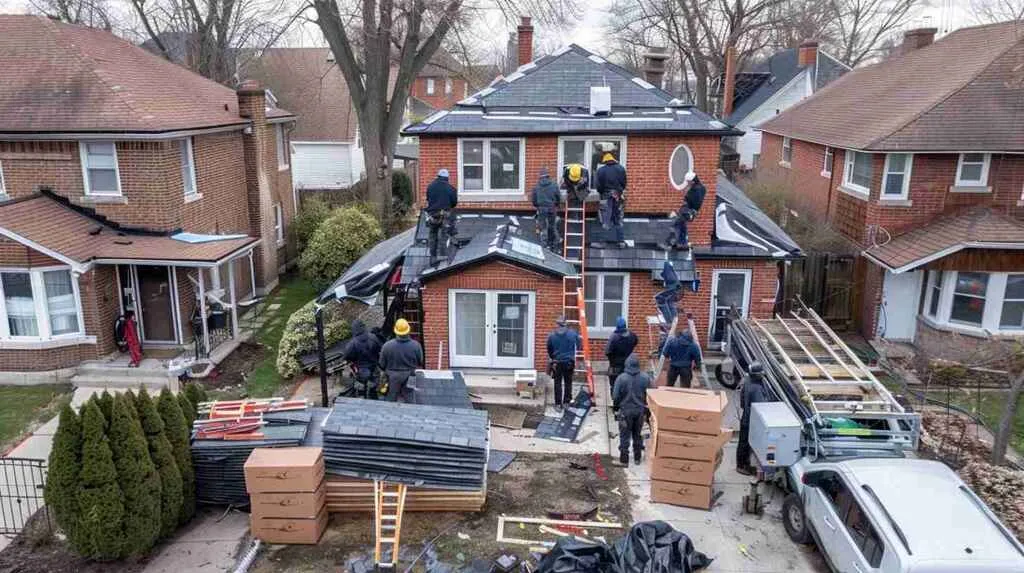
Rubber Roof Shingles Queens NY – Durable Option, Different Approach
Sideways rain hits Queens roofs about eight months a year, and here’s what most contractors won’t tell you upfront: a rubber shingle roof will cost you 20-40% more than standard asphalt to install-we’re talking $18,000-$24,000 instead of $12,000-$16,000 on a typical 1,800-square-foot house. But over 20 years, when you add up the repairs, the emergency patch calls after nor’easters, and that inevitable partial re-roof at year 14, the actual money you’ll spend usually flips the other direction. I learned to break down these numbers the way I used to calculate lighting rigs on film sets back in Long Island City-you can spend more upfront on gear that won’t fail under “bad lighting,” or you can rebuild the whole scene three times and blow your budget anyway.
What Rubber Roof Shingles Really Cost in Queens (Versus Asphalt)
One August afternoon in Astoria, about 4:30 pm, we were halfway through tearing off an old asphalt roof when a freak thunderstorm rolled in off the East River. The neighbor’s traditional shingles started curling up like potato chips in real time, while the small section we’d already covered in rubber shingles just sat there, totally unfazed. The homeowner was standing in the attic with me, watching water blow sideways, and he just said, “Yeah, finish the whole thing in rubber-whatever it costs.” That comparison isn’t just dramatic-it’s the pattern I’ve watched for over a decade: asphalt gets cheaper bids, rubber gets fewer callback repairs.
In Sunnyside, Bayside, and Flushing, the homes I’ve tracked since 2015 tell the real story. A standard asphalt roof might need three or four emergency visits after big storms-flashing repairs, lifted shingles around vents, a few sections re-done after hail-and by year 12 to 15, you’re looking at either a full tear-off or a costly overlay that still won’t last another 20. Rubber shingles? I get maybe one callback in the first decade, usually something unrelated like a skylight seal. The wind resistance alone cuts my repair schedule in half, and that directly changes what you’ll actually spend once you add it all up.
| Myth | Fact |
|---|---|
| Rubber is only for flat commercial roofs | Rubber shingles have been made specifically for pitched residential roofs since the early 2000s. They look like traditional shingles but use recycled rubber and synthetic polymers instead of asphalt. |
| Rubber roofs look like commercial buildings | Modern rubber shingles mimic slate, cedar shake, or architectural asphalt patterns. Most neighbors won’t notice the difference from 20 feet away-I’ve had people ask what brand of “fancy asphalt” we installed. |
| Rubber is always double the price of asphalt | Upfront it’s 20-40% more, not double. On a $12,000 asphalt job, rubber usually runs $18,000-$20,000 installed. The gap closes fast once you factor in Queens’ wind and repair history. |
| Rubber can’t handle Queens heat and cold swings | Rubber shingles are engineered for -40°F to 180°F without cracking or warping. They actually expand and contract less than asphalt in Queens’ freeze-thaw cycles, which is why fasteners stay put longer. |
Where Rubber Shingles Make Sense in Queens (And Where They Don’t)
Let me be clear: if you want the absolute cheapest roof today, rubber shingles are not for you. But if you’re in Astoria on a corner lot where wind screams off the river, or you’ve got one of those tricky Flushing setups where a garage roof meets the main house at a weird angle, or you’re in Jackson Heights dealing with attached row houses where one leak becomes your neighbor’s problem-that’s where rubber starts making financial sense. Bayside and Douglaston homes near the water? Same story. The initial price difference hurts, but I’ve watched too many Queens homeowners pay that gap back three times over in emergency repairs by year eight.
I still remember a December morning in Flushing when we redid a flat-to-pitched transition over an attached garage. The previous crew had tried to mix standard asphalt shingles with a torch-down membrane and left a tiny gap that became a waterfall every nor’easter. I redesigned the whole thing with rubber shingles that locked into a rubber membrane apron, and we tested it with a garden hose in 35-degree weather while the homeowner stood outside in a winter coat. Not a drop made it through, and that’s when I started telling people: “Rubber wins every time there’s a weird transition.” Those details-dormers, skylights, valleys where two roof planes crash together-are where asphalt shingles depend entirely on flashing and sealant, but rubber gives you a flexible, single-material system that moves with the house instead of fighting it.
| Pros of Rubber Shingles | Cons of Rubber Shingles |
|---|---|
| Superior wind resistance: Rubber shingles flex instead of lifting. In Queens coastal storms, they stay put where asphalt often curls or tears off entirely. | Higher upfront cost: 20-40% more than comparable asphalt, which can push a $14,000 roof into the $20,000+ range depending on complexity. |
| Long lifespan: 40-50 years typical in Queens climate vs 15-25 for asphalt, meaning you might never re-roof again if you’re over 50. | Limited color range: You’ll find grays, browns, blacks, some earth tones-but not the 40+ shades available in asphalt architectural lines. |
| Impact resistance: Hail, falling branches, debris from neighboring construction-rubber absorbs hits that would crack or dent asphalt or metal. | Installer experience matters: Not every Queens roofer knows rubber tie-ins and fastener specs. A cheap crew will waste the material’s advantages. |
| Seamless transitions: Works beautifully with rubber membrane systems on flat sections, eliminating the weak asphalt-to-membrane junction that always leaks. | No DIY repair: You can’t just run to Home Depot for a tube of roof cement. Repairs require the right adhesive and technique or you’ll void warranties. |
| Lower long-term maintenance: Fewer callbacks, less emergency patching, almost no granule loss issues-your biggest expense after install is maybe re-sealing a skylight in 15 years. | Requires ventilation planning: Dark rubber + poor attic airflow = interior heat problems. You can’t just slap it on and ignore what’s underneath. |
Rubber Shingles, Heat, and Ventilation in Queens’ Humid Summers
I still think about one storm in 2019 when the power went out across half of Astoria during a July heat wave, and I got six panicked calls in two days-not about leaks, but about upstairs bedrooms feeling like ovens. Three of those homes had dark asphalt roofs with zero ridge vents, and the heat radiating down through poorly insulated attics was unbearable. It’s the same problem I used to see on film sets when someone put hot lights too close to a ceiling without air flow-the whole environment becomes miserable fast. With rubber shingles, this issue gets amplified if you don’t plan ahead, because rubber holds and transfers heat differently than asphalt. My rule now: any conversation about installing rubber shingles in Queens includes a mandatory attic ventilation check and a blunt discussion about color choices, or I won’t even quote the job.
The only real nightmare I’ve had with rubber shingles was a summer job in Jackson Heights where the client insisted on a dark rubber shingle color over a poorly vented attic. By 2 pm the first day, my guys were cooking on that roof, and the homeowner complained their upstairs felt like a sauna. I ended up reworking the plan: added a ridge vent, swapped some of the shingle selection to a lighter rubber blend on the sunniest slope, and came back at 6 am both days to beat the worst heat. That job taught me to never talk rubber without also talking ventilation and color, especially in Queens humidity. Now I tell people straight: if your attic inspection shows inadequate soffit vents or no ridge vent, we’re adding them before rubber goes on, and if you want dark charcoal shingles on a south-facing roof, you’re signing off on the fact that your AC bill might tick up unless we upgrade your insulation too.
Installing dark-colored rubber shingles over an attic with inadequate ventilation in Queens will turn your second floor into a heat trap every summer. Surface temperatures on black rubber can hit 170°F in direct sun, and without proper ridge and soffit vents, that heat radiates straight down through your ceiling insulation.
The result: Air conditioning bills spike, upstairs bedrooms become uninhabitable by 3 pm, and in extreme cases the shingle manufacturer can void your warranty because you didn’t meet their ventilation requirements.
Do not skip the ventilation conversation. If a roofer quotes rubber shingles without asking about your attic or suggesting a ridge vent, walk away-they don’t know what they’re doing, and you’ll pay for their ignorance every July.
How I Install Rubber Roof Shingles on Queens Homes (Step by Step)
Picture your roof like the stage rig I used to build for film shoots-every cable, clamp, and light has to work together or something expensive falls. Same principle applies when we’re putting rubber shingles over a Queens attached house: the underlayment is your safety net, the fasteners are your load-bearing points, the flashing is your rigging around obstacles, and the shingles themselves are the finished “set” that faces weather instead of cameras. At Shingle Masters, we approach rubber installs with that same disciplined checklist mentality, because one shortcut-skipping a membrane tie-in, using the wrong fastener length, not accounting for that narrow side yard access between attached homes-turns a 40-year roof into a 10-year lawsuit.
Here’s an uncomfortable truth most roofers won’t say out loud: I’ve walked away from three rubber shingle jobs in the past two years because the homeowner didn’t want to pay for proper underlayment or insisted we skip the ridge vent to save $900. I’d rather lose the work than put my name on something that’ll fail. The crews that give you the cheapest bid? They’re cutting those corners, guaranteed-using leftover asphalt underlayment under rubber shingles, driving fasteners without checking deck thickness, slapping rubber over flat sections with no membrane apron. In Queens, where houses are crammed tight and one guy’s roof leak becomes the neighbor’s mold problem, that kind of sloppiness doesn’t just hurt you-it creates block-wide drama. We do it slow, we do it right, and if you’re in a rush or hunting for the absolute lowest price, I’ll give you three other names to call.
What to Ask Before You Commit to Rubber Shingles in Queens
When I come to your house in Queens, the first thing I’m going to ask is, “How long are you planning to stay here?” If the answer is less than eight years, I’ll probably talk you out of rubber shingles and into a good architectural asphalt instead, because you won’t recover the cost difference when you sell-and I’d rather be honest than make a quick buck on the wrong solution.
In Queens, where wind screams off Jamaica Bay, where nor’easters dump sideways rain six times a winter, and where every third house has some flat-to-pitched transition the original builder improvised with duct tape and prayer, rubber roof shingles are a different approach that usually pays off if you’re staying put for the long haul. Call Shingle Masters, and I’ll walk your roof, sketch options in my beat-up yellow notebook, ask you the uncomfortable budget and timeline questions nobody else wants to discuss, and tell you straight whether rubber shingles are worth it for your specific house-or if you should just get a solid asphalt roof and save the difference for something else.