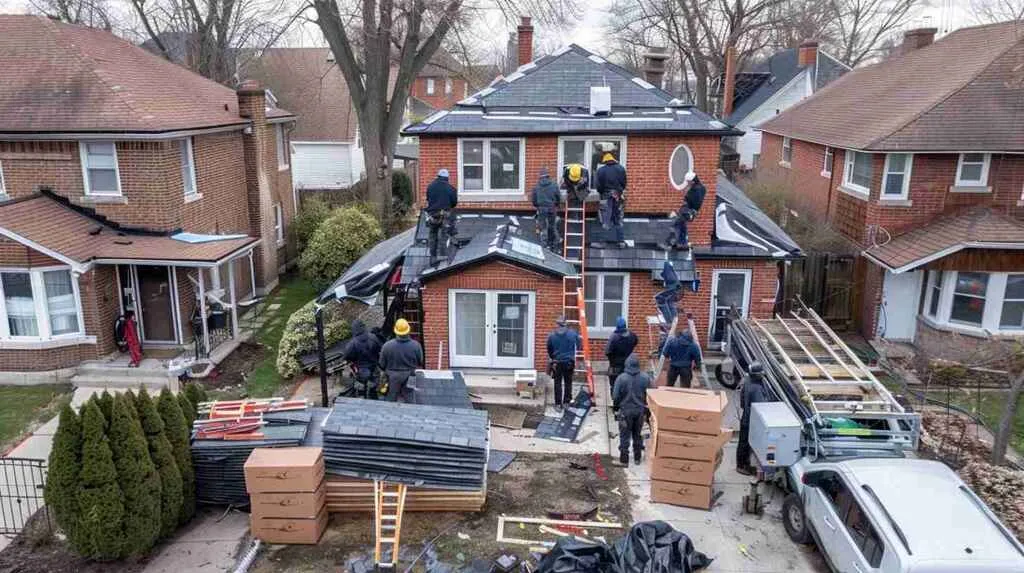
Roofing That Looks Like Shingles Queens NY – Other Options Compared
Sideways rain during a nor’easter doesn’t care how pretty your roof looks from the street. In Queens, roofing that looks like shingles will run you anywhere from $6.50 to $18 per square foot installed depending on which material you choose, but here’s what most contractors won’t tell you: picking only by appearance is the fastest way to either overpay for what you get or under-protect a Queens home that deserves better. I’ve been climbing roofs in this borough for 19 years, and I refuse to sell you something just because it looks nice in a brochure.
Sideways rain, Queens prices, and what “shingle-looking” really costs
On 46th Avenue last fall, I stood in a driveway with three sample boards and a homeowner who wanted “the shingle look” but didn’t realize she was really asking for one of five completely different roof systems. We spread the options out on her hood – architectural asphalt, stone-coated steel, composite, metal shingles, synthetic slate – and I asked her the sneaker question: are you buying these because they look good in the store, or because you plan to walk ten miles in them every week? That’s when the real conversation started.
One August afternoon in Forest Hills, it was 94 degrees and the asphalt on the street felt like it was melting around our boots. A homeowner wanted “the look of shingles” but was convinced metal panels would “look like a barn.” I ended up on the sidewalk holding two samples – a stone-coated steel panel and an architectural shingle – at arm’s length so she could see from across the street. When she realized the steel actually cast a nicer shadow pattern than the shingles, we changed the whole spec right there, and she still emails me every summer saying her attic is 10 degrees cooler. Think of it like picking sneakers: cheap fashion sneakers might look slick, but they won’t hold up when you’re running for the 7 train in February slush; daily trainers cost more but last three times longer; steel-toed work boots aren’t pretty but they save your feet from real damage.
Installed Cost Ranges in Queens, NY for Roofing That Looks Like Shingles
Based on typical Queens roof sizes (1 square = 100 sq ft). All prices include tear-off, disposal, labor, and standard materials in 2024.
Here’s my engineer brain talking: your main material options, side by side
Here’s my engineer brain talking: the phrase “roofing that looks like shingles” is a design requirement, not a material choice. What homeowners in Astoria, Bayside, Forest Hills, and Flushing actually mean is they want the dimensional texture and shadow lines of traditional shingles without necessarily committing to asphalt. That opens up five core families: architectural asphalt shingles (the baseline), composite or asphalt alternatives (newer polymers), stone-coated steel panels, metal shingles (individual pieces, not panels), and synthetic slate made from advanced polymers. Each one can mimic the shingle aesthetic from the curb, but they behave completely differently under Queens weather, weigh different amounts on your joists, and cost wildly different amounts per square. And here’s the local quirk: co-op boards in Forest Hills care about different things than HOAs in Bayside, and both care about different things than historic districts in Kew Gardens, so knowing which material families are already approved in your neighborhood saves you weeks of back-and-forth.
I’ll never forget a December job in Astoria where a client tried to save money by ordering an off-brand synthetic slate online because it “looked just like shingles” in the photos. At 7 a.m., with frost still on the neighboring roofs, the first box arrived and every piece was slightly warped – they wouldn’t sit flat no matter how we nailed them. We lost half a day sending that shipment back and pivoting to a reputable composite shingle that fit the same aesthetic but actually had testing data, and it cemented my rule: if I can’t see the product’s Miami-Dade or UL reports, it doesn’t go on a Queens rooftop. Think about counterfeit running shoes – they might look exactly like the real Nikes in a photo, but the first time you try to jog three miles, the soles crack and the stitching unravels, and suddenly that $40 savings cost you $120 in podiatrist visits.
Myth vs Fact: Shingle-Looking Roofs in Queens
| Myth | Fact |
|---|---|
| “Metal roofs that look like shingles will make my house look like a barn.” | Modern metal shingle profiles are engineered to cast the same shadow lines as asphalt. Most neighbors can’t tell from the sidewalk, and stone-coated versions add texture that’s indistinguishable from dimensional shingles at 20 feet. |
| “Synthetic slate is just cheap plastic that will fade in three years.” | Quality synthetic slate (from tested manufacturers) uses UV-stabilized polymers with 50-year fade warranties. Cheap knock-offs do exist, which is exactly why I only install products with independent lab certifications. |
| “All asphalt shingles are basically the same, so I should just buy the cheapest.” | Architectural shingles vary wildly in backing mat quality, granule adhesion tech, and wind rating. A $6.50/sq ft basic shingle might last 18 years in Queens; an $8.50 premium architectural can go 25+ years with better storm resistance. |
| “If it looks like shingles, it installs like shingles, so any crew can do it.” | Metal shingles and stone-coated panels require completely different underlayment, fastener schedules, and flashing details. Installing them with asphalt techniques voids warranties and causes leaks within two years in Queens weather. |
Most people in Queens don’t realize how these roofs behave in real storms
Most people in Queens don’t realize how different a roof can behave once you get a nor’easter blowing rain sideways for six hours. There was a rainy Saturday in Bayside where I got called to look at a so-called “shingle look” metal roof that another crew had installed three years before. The panels were fine, but they’d skipped the right underlayment and flashed the dormers like it was an asphalt job; water was wicking back under every course. I spent an hour in the drizzle showing the owner, row by row, how the system was supposed to shed water, and we ended up rebuilding the whole perimeter detail so the roof could finally perform to its potential instead of just looking the part. The surface material is only half the equation – what’s underneath and how it all connects at the edges determines whether you sleep dry or you’re moving buckets around your bedroom at 2 a.m.
Here’s the insider tip that saves homeowners thousands: when a roofer shows you shingle-looking options in Queens, ask exactly which underlayment type they’re planning, what fastener pattern they use for that specific material, and how they detail flashings around dormers, skylights, and parapets. If they answer “same as asphalt” for a metal or composite system, walk away. It’s like wearing waterproof running shoes with cotton socks in February slush – the shoes might be perfect, but the wrong layer underneath ruins the whole system.
Warning: Risks of Treating Advanced Shingle-Look Systems Like Basic Asphalt
Installing metal shingles, stone-coated steel, or high-end composite systems using standard asphalt installation methods is one of the most common mistakes I see in Queens. These advanced materials require specialized synthetic underlayments (not felt paper), specific fastener spacing to allow thermal movement, and completely different flashing profiles at transitions. When a crew treats a $14/sq ft metal shingle roof like an $7 asphalt job, you get water wicking back under panels during sideways nor’easters, premature fastener failure from thermal cycling, and voided manufacturer warranties. The material might look perfect from the street while quietly leaking into your walls for two years before you notice the damage. Always ask to see the manufacturer’s installation manual and verify your contractor is following those specs, not just doing what they’ve always done with three-tab shingles.
How a Proper Shingle-Look Roof Is Evaluated and Installed in Queens, NY
Structural Assessment and Load Calculation
We measure roof pitch, identify existing decking condition, and calculate whether your joists can handle the weight difference between options. Metal and synthetic slate are much lighter than asphalt, which sometimes opens up choices on older Queens homes that couldn’t support heavy slate.
Material Selection Based on Trade-Offs, Not Just Looks
I spread samples on your kitchen table and we talk through lifespan, cost, maintenance, and how long you plan to own the house. The goal is matching your timeline and budget to a material that won’t let you down in Queens weather, not selling you the prettiest sample.
System-Specific Underlayment and Deck Prep
Once we pick the surface material, we select the underlayment that manufacturer actually requires – synthetic for metal, high-temp for certain composites, slip-resistant for steep pitches. We repair or replace any soft decking and ensure ventilation pathways are clear before anything goes down.
Flashing and Transition Details Engineered for the Material
Valleys, dormers, chimneys, and sidewall flashings get detailed according to the specific material’s expansion behavior and water-shedding geometry. Metal expands and contracts; asphalt doesn’t. Treating them the same is how roofs fail in year three.
Installation Following Manufacturer Specs, Then Inspection
We install every row, every fastener, and every cap piece exactly per the manufacturer’s manual so your warranty stays valid. After installation, I walk the roof with you (or show photos if it’s too steep) and explain what we did and why, so you understand what you bought.
When I spread options on your kitchen table: how to choose like you choose sneakers
When I spread all the options out on a kitchen table, I divide them into three piles in my head: “looks nice,” “lives long,” and “handles Queens abuse.” Every material sits somewhere in that triangle, and your job is figuring out which corner matters most to you. If you’re planning to sell in five years, you might lean toward “looks nice” because resale perception matters and you won’t be there for the 30-year lifespan anyway. But what if you plan to age in place and never want to think about your roof again? Suddenly “lives long” and “handles abuse” jump to the top, even if it costs $4 more per square foot today. Not gonna lie, this is the conversation most roofers skip because it’s easier to just sell you whatever’s on the truck.
Here’s how to actually decide: if you’re a short-term owner (under 7 years), prioritize cost and curb appeal – architectural asphalt or basic composite will serve you fine and boost resale without breaking the budget. If you’re a long-term owner (10+ years, or this is your forever home), focus on lifespan and maintenance – stone-coated steel, metal shingles, or quality synthetic slate pay for themselves in fewer re-roofs and lower repair calls. And if low maintenance is your top priority regardless of timeline, metal options win because they don’t grow algae, don’t need periodic moss treatment, and shrug off hail that would shred asphalt. Think about it like sneakers: fashion sneakers look great for date night but fall apart if you wear them daily; serious running shoes cost more but last 500 miles; steel-toed work boots aren’t stylish but they protect your feet in conditions that would hospitalize you in Vans.
Pros and Cons of Each Shingle-Looking Option from a Queens Homeowner’s Perspective
| Option | Pros | Cons |
|---|---|---|
| Architectural Asphalt |
|
|
| Composite (Polymer-Enhanced) |
|
|
| Stone-Coated Steel |
|
|
| Metal Shingles |
|
|
| Synthetic Slate |
|
|
Decision Tree: Choosing the Right Shingle-Looking Roof System for Your Queens Home
Before you call a roofer in Queens about “shingle-looking” options
Let me be direct: if your HOA or co-op board only cares what it looks like from the sidewalk, you still don’t have to settle for the weakest option. A $1,500 difference in upfront cost between basic asphalt and premium composite can mean 10 extra years of lifespan and zero leak repairs, but you won’t know that unless you gather a few facts before you start calling contractors.
Having these details in your back pocket when you talk to me at Shingle Masters means I can act like that calm engineer-neighbor helping you think through trade-offs, not a salesperson trying to upsell you on whatever’s most profitable this month. When we spread your options out like sneaker categories – cheap fashion kicks, solid daily trainers, bombproof work boots – you’ll see exactly where your budget, timeline, and Queens weather priorities intersect, and we can spec a roof that actually fits your situation instead of just looking pretty in a brochure.
✓
What to Figure Out Before You Call Shingle Masters About Roofing That Looks Like Shingles
-
1.
Your realistic budget range per square foot – not just total budget, because roof size varies. Knowing whether you’re thinking $7/sq ft or $15/sq ft shapes the entire conversation. -
2.
How long you plan to stay in the house – selling in 5 years vs living there 20+ years completely changes which materials make financial sense. -
3.
HOA or co-op board requirements – some Queens neighborhoods pre-approve specific materials or colors. Find out before you fall in love with a sample that’s banned. -
4.
Current attic ventilation and insulation status – if your attic runs hot or you have ice dam history, that affects which roofing systems will actually solve the problem vs just cover it up. -
5.
Age and condition of roof decking – if your last roofer mentioned “soft spots” or you’ve had leaks, we might need to budget for deck repairs regardless of which shingle-look material you pick. -
6.
Whether you want to match neighboring homes or stand out – in some Queens blocks, blending in matters for resale; in others, a distinctive roof boosts curb appeal. -
7.
Your tolerance for future maintenance – some folks are fine treating moss every few years; others want a roof they never think about again. That preference eliminates or highlights certain materials. -
8.
Aesthetic preference: traditional vs modern, textured vs smooth – “shingle look” is broad. Knowing if you want deep shadow lines, slate-like variation, or clean uniform appearance helps me show you the right three samples instead of overwhelming you with twelve.
Queens Homeowners’ Most Common Questions About Roofing That Looks Like Shingles
How much more does metal that looks like shingles cost versus regular asphalt in Queens?
Stone-coated steel runs about $11.50-$14/sq ft installed vs $6.50-$8.50 for architectural asphalt, so roughly 60-80% more upfront. But over 30 years you’re looking at one metal roof vs two asphalt roofs, which narrows the lifetime cost gap significantly. Metal also drops your cooling bills and some insurers offer discounts.
Will a metal shingle roof be really noisy during rainstorms?
Not if it’s installed correctly with proper underlayment and insulation. Stone-coated steel is actually quieter than smooth metal panels because the stone layer dampens sound. I’ve had clients tell me they hear less rain noise than with their old asphalt because we upgraded the attic insulation at the same time. Bare metal over skip sheathing in an old barn? Loud. Modern metal shingle system over solid deck and synthetic underlayment in a Queens house? You won’t notice.
Can I use these shingle-looking materials on a Queens rowhouse or small gable roof?
Absolutely. In fact, rowhouses and small roofs are often ideal candidates for premium materials because the total square footage is low, so the price jump from asphalt to metal or synthetic slate is only a few thousand dollars, but you still get the full lifespan and performance benefits. I’ve done plenty of Astoria rowhouses with stone-coated steel where the whole roof was under 900 square feet.
Do I need special approval from my Queens co-op board for non-asphalt shingle-looking roofs?
Usually yes, but it’s often just a formality if the material looks like shingles from the street. I recommend bringing sample photos and spec sheets to your board meeting. Most co-ops care about aesthetics and fire rating, both of which metal and synthetic slate excel at. I’ve helped clients prepare those presentations dozens of times and the approval rate is high as long as you show it won’t look like a commercial building.
How long do these different shingle-looking options actually last in Queens weather?
Architectural asphalt: 20-25 years. Premium composite: 25-35 years. Stone-coated steel: 40-50 years. Metal shingles: 50+ years, often lifetime. Synthetic slate (quality brands): 50+ years. Those numbers assume proper installation and normal maintenance like keeping gutters clear. Queens weather – the freeze-thaw cycles, coastal humidity, occasional nor’easters – is tougher than, say, Arizona, but all these materials are tested for northeastern conditions and hold up well when installed right.
Why Talk to Victor at Shingle Masters About Shingle-Looking Roofs in Queens
Former structural engineering student turned roofer who treats every job like it’s protecting my own family. No sales pitch, just clear trade-offs and honest recommendations based on what actually works in Queens weather.
Treating shingle-looking roofs like sneaker categories – balancing appearance, durability, and price against your actual walking conditions – lets you choose a system that fits Queens weather and your timeline instead of just grabbing whatever sample looks prettiest. Call Shingle Masters and ask for Victor to walk your options on a simple T-chart at the kitchen table, the same way I’ve done it for hundreds of Queens homeowners who wanted the shingle look without settling for the weakest version of it.