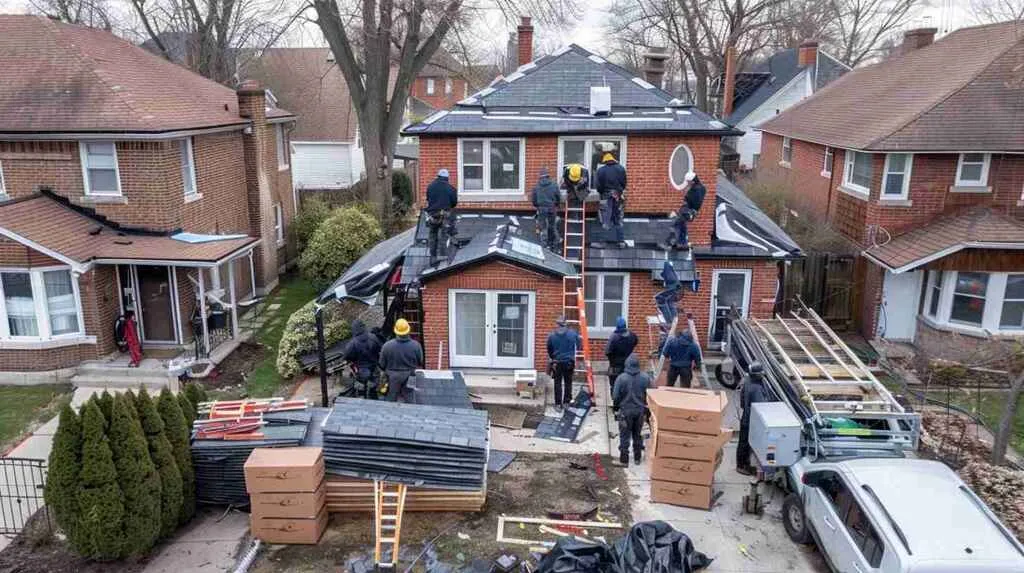
Roof Shingle Types Queens NY – A Clear Guide to Every Option | Free Quotes
Contrary to what you’ll see on most blocks, the shingle everyone’s using is probably the worst match for your house. Take 43rd Avenue last winter-I stood on a three-story walk-up and watched the wind peel 3-tab shingles off like sticky notes while the owner kept texting me from inside, asking why the noise was so loud. Those shingles weren’t bad; they were just the wrong choice for that exact corner exposure and height. This guide walks through the main roof shingle types you’ll actually encounter in Queens, and shows you how to pick the right one by imagining how it holds up in our specific storms, heat waves, and sideways rain-not by copying what your neighbor chose five years ago.
On Most Queens Blocks, the Popular Shingle Is the Wrong One
On 43rd Avenue last winter, I stood on a three-story walk-up and watched the wind peel 3-tab shingles off like sticky notes-one after another, flapping against the parapet before sailing into the alley. The owner had chosen them because they were the “standard” option, the cheapest bundle at the supply yard, and honestly, the same thing everyone on his block used. Here’s my opinion, and I’ll say it straight: the most common cheap 3-tab shingle fails Queens wind and sideways rain more often than any other type, even though it’s the default choice contractors keep pushing. Picture your roof at 2 a.m. in a nor’easter, with 50 mph gusts coming off the Whitestone Bridge or over the open stretches near Rockaway-those thin, flat shingles are the first to lift, the first to crack in the cold, and the first to let water creep under when the rain comes in sideways instead of straight down.
Queens isn’t like some generic suburb where roofing advice works the same for every house. We’ve got walk-ups on windy corners, detached colonials under old oak trees, two-families near highway overpasses, and coastal exposures that get slammed every February. This guide breaks down each main shingle type through a storm-scenario lens-what happens in heat, what happens in wind, what happens when ice builds up in the gutters and rain backs up under the shingles. I’ll walk you through it the same way I would at your kitchen table, with my pocket weather meter out and a mental movie of the worst weather your roof will face.
| Myth in Queens | Weather-Tested Fact |
|---|---|
| ‘Everyone on my block has 3-tab, so it must be fine.’ | 3-tab is usually the first to flap in a 50 mph Queens gust, especially on corners and top floors. |
| ‘Darker shingles are always better because they look sleek.’ | Dark shingles can run 15-25°F hotter in August on a Queens roof, stressing your AC and the shingles. |
| ‘Designer shingles are just about looks.’ | Many designer lines also bump up wind ratings and impact resistance-crucial near Rockaway and open exposures. |
| ‘Mixing brands to save a few bucks is no big deal.’ | Mixing systems can void warranties and leave weak spots that leak first in sideways rain. |
The Core Roof Shingle Types You’ll Actually See in Queens, NY
Here’s my blunt take: if you buy shingles by “what your cousin used in Long Island,” you’re doing it wrong in Queens. Long Island has different exposures, different building codes, and honestly, different weather patterns than what hits Rockaway, Flushing, Astoria, or Jackson Heights. A sheltered two-family tucked into a quiet Flushing block doesn’t face the same wind load as a house three blocks from the beach in Rockaway or up on a hill near the Grand Central. That’s local knowledge, and it changes which shingle type makes sense-not by a little, but enough to mean the difference between 20 years of solid protection and a roof that starts shedding pieces after the first real storm.
Let me walk you through the three main types you’ll actually encounter. 3-tab asphalt shingles are the flat, single-layer ones that look uniform and basic-cheapest upfront, shortest lifespan, and they handle wind about as well as a kite. Architectural (or laminate) shingles are thicker, with multiple layers bonded together for a dimensional look and better performance-this is what most Queens homeowners should be using. Designer or premium shingles come in higher wind ratings, specialty shapes, and often include better impact resistance for branches and debris-worth it if you’re near open water or planning to stay in the house for decades. Now, let’s see what happens to each type in a bad-weather mental movie: imagine your roof in August heat, in a January nor’easter, and during a September downpour with sideways rain. One August afternoon in Woodside, it was 96 degrees on the street and at least 140 on the roof, and a homeowner wanted the darkest, cheapest 3-tab shingle he could find “because it looks sleek.” I laid my infrared thermometer on his old shingles and showed him the surface temp-then walked him through how an architectural, lighter-colored shingle would knock that down and handle wind better come winter. Six months later, he called me during a January windstorm to say the new shingles weren’t flapping like his neighbor’s.
Another thing: mixing cheap, mismatched shingles is a disaster, and I’ll prove it with one rainy fall evening in Bayside. Around 7:30 on a rainy fall evening in Bayside, I got an emergency call from a landlord whose brand-new “bargain” roof was leaking into a tenant’s baby room. When I climbed up under my headlamp, I found mismatched shingles-three different brands, two different impact ratings-stitched together like a bad quilt. Explaining to that landlord why mixing shingle types voided his warranty and wrecked his protection is the moment I started refusing patchwork jobs that don’t respect manufacturer systems. You can’t just slap any bundle onto a roof and expect it to seal, shed water, or honor the warranty when things go wrong.
| Shingle Type | Best For Queens Homeowners Who… | Typical Lifespan (Queens Conditions) | Weather Scenario Performance |
|---|---|---|---|
| 3-Tab Asphalt | Tightest budgets, short-term holdover before a bigger renovation | 15-20 years, often less near Rockaway or open boulevards | Most likely to lift first in 50+ mph gusts and to age quickly under August sun on dark roofs. |
| Architectural / Laminate Asphalt | Most Queens homeowners who want value, better wind resistance, and a thicker look | 22-28 years with proper install and ventilation | Handles typical Queens nor’easters well when nailed and sealed correctly; better at shedding sideways rain. |
| Designer / Premium Asphalt | Exposed coastal blocks, higher-end homes, or anyone who never wants to watch shingles flap in a storm again | 25-30+ years when matched with a full system (underlayment, vents, flashings) | Higher wind ratings, often better impact resistance against tree branches and debris in bigger storms. |
How I Match Shingle Types to Your Queens Block
When I sit down at a kitchen table, the first thing I ask is: “What scares you more-heat, leaks, or storms?” That question tells me which shingle feature matters most-reflectivity and ventilation for heat, seal strength and underlayment for leaks, or wind rating and nail pattern for storms. Then I pull out my pocket weather meter and we imagine a bad-weather mental movie for that specific house: your roof at 2 a.m. in a nor’easter, your roof in a July heat wave, your roof when rain is coming in sideways off the Whitestone. One cold, clear morning in January in Rockaway, I was finishing up a job two blocks from the beach when an older neighbor wandered over with coffee and a story about losing half his roof during Sandy. He’d had basic 3-tab shingles while the house next door had upgraded designer shingles with better wind resistance-one roof scattered into the bay, the other stayed put. Listening to him, while I could still smell the salt off the water, cemented my obsession with pairing shingle types with micro-neighborhoods-Rockaway versus Flushing is a whole different shingle conversation, and I won’t recommend the same product for both.
Decision Flow: Which Shingle Type for Your Queens Home?
Start: What’s your biggest worry in a Queens storm scenario?
Question 1: Are you within a mile or two of open water or an elevated, windy exposure (Rockaway, by the bridges, near Queens Blvd)?
→ If Yes: Lean toward Architectural or Designer shingles with higher wind ratings.
→ If No: Continue to Question 2 ↓
Question 2: Is your top concern summer heat and AC bills?
→ If Yes: Architectural shingles in lighter colors, with proper ventilation.
→ If No: Continue to Question 3 ↓
Question 3: Are you planning to stay in the home at least 10 years?
→ If Yes: Architectural shingles as a solid long-term value.
→ If No: 3-tab may work as a short-term, budget-conscious option-but only with a proper installation and full manufacturer system.
Vic’s On-Site Shingle Matching Process in Queens
- Roof and Block Check: I look at your roof height, surrounding buildings, trees, and how the wind actually hits your house on that street.
- Weather Meter Snapshot: I pull out my pocket weather meter to check real wind and surface conditions, not just what the app says.
- Bad-Weather Mental Movie: Together we picture your roof at 2 a.m. in a nor’easter, in a July heat wave, and in sideways rain-then we rule out any shingle type that fails in those scenes.
- System, Not Pieces: I match a single manufacturer’s shingles, underlayment, and accessories so your warranty stays intact and you don’t get a patchwork roof that leaks first in storms.
What Your Budget and Timeline Mean for Shingle Choices in Queens
$1,500 saved on shingles can turn into $5,000 in leak damage if the wrong type fails over a baby’s room-and I’ve seen that exact scenario more than once. Here’s the thing about budget and shingle choices: total job cost in Queens is driven by your roof size, how many old layers need to be torn off, and which shingle type and system you choose. The goal isn’t chasing the absolute lowest material cost; it’s aligning your budget with realistic storm performance so you’re not calling someone back in two years to patch leaks or replace wind-damaged sections. Worth spending a bit more upfront on a better shingle type and upgraded underlayment at the eaves and valleys-those are the most common Queens leak spots in nor’easters, and an extra couple hundred dollars in materials there can save you thousands in interior damage and emergency repairs.
| Scenario | Typical Shingle Type | Relative Price Range | Storm-Scenario Notes |
|---|---|---|---|
| Small attached house in Jackson Heights, minimal exposure, owner staying 3-5 years | 3-Tab or entry-level Architectural | $$ (lower to mid) | Works if installed well and roof is inspected regularly; not ideal for extreme long-term storms. |
| Two-family in Astoria, moderate wind, owner-occupied | Mid-range Architectural | $$$ (mid) | Good balance of cost, curb appeal, and wind resistance for typical Queens storms. |
| Detached home in Bayside with tree overhangs and history of leaks | Architectural with upgraded underlayment and ice/water shield | $$$$ (mid-high) | Extra leak protection around eaves and valleys for heavy rain and ice in gutters. |
| Rockaway or coastal-exposed home, owner plans to stay 15+ years | Designer or premium Architectural with higher wind rating | $$$$$ (high) | Invests in wind and impact resistance where storms hit hardest. |
Quick Answers About Roof Shingle Types in Queens, NY
Does the picture make sense so far-storm scenarios, shingle types, and matching them to your specific block and timeline? Here are the last few common questions I hear before people pick up the phone to schedule a quote.
Do I really need architectural shingles, or are 3-tab okay in Queens?
3-tab can be acceptable in low-exposure, short-term situations-think a sheltered side street in Flushing where you’re only staying a few more years. But architectural is the smarter default for most Queens roofs because of wind and lifespan. The difference in upfront cost is usually $1,000 to $2,000 on an average roof, and you get better wind resistance, longer life, and a warranty that doesn’t leave you hanging when a shingle lifts in a storm.
How long should shingles last on a Queens roof?
3-tab shingles typically last 15-20 years in Queens conditions, architectural shingles run 22-28 years, and designer/premium shingles can go 25-30+ years. Keep in mind that Queens heat, pollution, and wind can cut 3-5 years off those brochure numbers, especially on roofs with poor ventilation or near highways and heavy salt spray. The lifespan also depends heavily on proper installation-nailing pattern, underlayment, and sealing matter as much as the shingle itself.
Can you just patch the bad shingles on my roof?
I avoid patchwork with mixed brands or different shingle ages because it creates weak spots that leak first and voids manufacturer warranties. That rainy Bayside roof with three different brands stitched together? It leaked into a baby’s room because the seals didn’t match and water found every gap. If your roof has isolated damage and the shingles are still available in the same line and color, a targeted repair can work-but if we’re mixing systems or cobbling together clearance bundles, you’re asking for trouble in the next big storm.
Are lighter-colored shingles really cooler in summer?
Yes, and it’s not a small difference. Lighter shingles can run 15-25°F cooler on the surface in August compared to dark shingles, which matters a lot on top floors and in attics without great ventilation. That Woodside job where I measured 140-degree surface temps on dark 3-tab? We switched to a light gray architectural shingle and proper ridge venting, and the homeowner’s AC bills dropped noticeably that first summer. Color affects both your comfort and your shingles’ lifespan.
How do I get a quote for my Queens home without a sales circus?
My process is low-pressure: you call, we set up a time, I come out and look at your roof with my weather meter and a ladder, we sit at your kitchen table and talk through a few shingle options tied to storm scenarios, and I email you a written estimate with everything spelled out-no surprise add-ons, no hard sell. You take your time, ask questions, and decide when you’re ready. That’s it.
Why Queens Homeowners Call Shingle Masters for Shingle Choices
-
✓
Licensed & Insured in NYC: Fully documented to work on residential roofs across Queens. -
✓
19+ Years on Queens Roofs: From Jackson Heights walk-ups to Rockaway colonials, we know the micro-climates. -
✓
Storm-First Planning: Every recommendation starts with a bad-weather scenario, not just a color chart. -
✓
Clear, Written Quotes: No surprise add-ons-every shingle type and accessory spelled out before work starts.
The right shingle type for a Queens roof depends on storms, heat, and how long you’ll stay-not what your neighbor used or what was on sale last month. Call Shingle Masters to have Vic come out with his weather meter, walk your roof and your block, and give you a clear, written quote with shingle options that are matched to your specific exposure, timeline, and the bad-weather scenarios your house will actually face.