Replace Slate Roof with Asphalt Shingles Queens NY – Full Guide
Blueprint for replacing slate with asphalt shingles in Queens? Most jobs run between $18,000 and $42,000 for typical two- and three-family homes, and that spread isn’t random-it’s driven mostly by what’s hiding under your slates, not the shingle brand you pick. In Queens, structure and weight drive the real cost and risk, and I’m going to walk you through it like a step-by-step diagnostic chart so you can spot the inputs, outputs, and failure points before you ever call for a quote.
What It Really Costs to Replace Slate with Asphalt Shingles in Queens
On my clipboard last week in Forest Hills, I had two nearly identical houses with slate roofs-but their quotes were $11,000 apart. For replacing slate with asphalt shingles in Queens, you’re looking at roughly $18,000 to $42,000 for the typical two- or three-family row houses and detached homes around here, and the wide spread is driven by structure and deck condition way more than shingle choice. Here’s my honest take: homeowners obsess over shingle brands and colors-architectural versus three-tab, designer versus basic-but they completely ignore the deck and framing that actually drive 80% of the cost and performance. Once you understand that roofs work like systems with inputs (the weight you’re removing, the deck condition you’re hiding, the underlayments layered over decades), outputs (leak-free years, insurance approval, structural safety margin), and failure points (rotted planks, bowed rafters, corroded fasteners), the price range stops feeling random and starts making perfect sense.
One February morning around 7:15 a.m., in Astoria, I was standing on a three-story slate roof that looked beautiful from the street but shook like loose teeth under my boots. The owner, an older lady who’d just inherited the place, thought she needed “a few tiles replaced.” Once I started pulling back slates, I found a patchwork of three different underlayments and rotted plank decking that crumbled in my hands. That job taught me the hard way that with older slate in Queens, you never quote a slate-to-asphalt conversion without planning for at least 20% extra deck repair-because what you see from the sidewalk is a total lie. In neighborhoods like Astoria, Jackson Heights, and Corona, those pre-war roofs often have multiple layers of felt, tar paper, and DIY patches hiding structural problems that only show up when you strip everything back. Once you understand those hidden deck variables-the rotten planks, the sagging rafters, the corroded nails that held a thousand pounds of slate for seventy years-the price range finally makes sense, and you stop wondering why one contractor is half the price of another.
Typical Queens Slate-to-Asphalt Replacement Scenarios & Price Ranges
| Scenario | Home Type | Approx Roof Size (sq ft) | Structural/Deck Condition | Estimated Range (installed) |
|---|---|---|---|---|
| Small attached row house in Corona | Attached row house | 1,200-1,400 sq ft | Mostly solid plank deck, minor spot repairs, basic architectural shingles, full ice & water eaves | $18,000-$24,000 |
| Semi-detached in Jackson Heights | Semi-detached | 1,600-1,900 sq ft | Mixed plank with 10-20% rot, full ice & water upgrade, mid-range architectural shingles, some rafter reinforcement | $24,000-$32,000 |
| Detached in Forest Hills/Bayside | Detached single-family | 2,200-2,800 sq ft | Older slate with multiple underlayments, 20-30% deck replacement, upgraded ventilation and flashing, premium shingles | $32,000-$42,000 |
| Large 3-story in Astoria/Long Island City | Three-story multi-family | 3,000+ sq ft | Complex slate tear-off, crane/dumpster logistics, 30%+ deck repair, narrow street staging, premium shingles | $40,000-$55,000 |
| Structural reinforcement case (any neighborhood) | Any home type | Any size | Rafters need sistering or engineer sign-off, weight reduction from slate is critical, permits required | Add $5,000-$15,000 on top of base ranges |
Why Roof Weight and Structure Matter More Than the Shingles
Here’s my honest take: most people in Queens overestimate how much their slate is “saving” them and underestimate how much risk it’s hiding. One summer night in Jackson Heights, around 9 p.m., a guy called me in a panic during a thunderstorm because a slate tile had slid and water was literally dripping into his baby’s crib. I went over in the rain, did a temporary tarp job, and when the storm cleared, we walked the entire roof together. That roof was a mix of old slate and DIY asphalt patches, and the weight had started to bow the rafters. We ended up doing a full replacement to lighter asphalt shingles, and I still remember showing him how the load calculations worked on a yellow legal pad at his kitchen table so he could see the safety margin we were gaining. In Jackson Heights, Corona, and similar pre-war neighborhoods, most homes were built in the 1920s through 1940s with framing designed for specific loads-and after sixty or eighty years of heavy slate pressing down, you often see rafters sagging, nails corroding, and deck planks slowly failing in ways that never show up from the street. Weight is a key input; the output is structural safety and long-term performance, and once you understand that, your choice of asphalt shingle grade finally makes sense.
In simple terms, slate weighs roughly 800 to 1,000 pounds per roofing square (100 square feet), while asphalt shingles come in at 200 to 275 pounds per square-so you’re cutting the load on your rafters by about 70%. Over fifty-plus years, that difference shows up in how the framing holds up, how nails grip the deck, and how the whole system responds to wind, snow, and thermal expansion. Once you understand load and structure, you realize that switching from slate to asphalt isn’t just about picking a new color-it’s about resetting the entire stress profile of your roof and giving the underlying framing a chance to stabilize instead of continuing to sag under weight it was never meant to carry for this long.
Old Slate System (Typical Queens)
- Weight per square: 800-1,000 lbs
- Load on rafters (50+ years): Often near or above original design limits, visible sagging
- Fastener/failure points: Corroded nails, slipping slates, mixed repairs create uneven stress
- Response to DIY patches: Mixed slate/asphalt patches create uneven loads, new leak paths
- Safety margin in storms: Over-weighted systems with sagging frames fail unpredictably
New Asphalt Shingle System
- Weight per square: 200-275 lbs
- Load on rafters (50+ years): Well under design capacity, framing can stabilize
- Fastener/failure points: Modern ring-shank nails, full-surface adhesion, uniform stress
- Response to DIY patches: Uniform lighter load across entire deck, predictable performance
- Safety margin in storms: Reinforced deck with lighter shingles and engineered nailing patterns
Common Myths About Slate Roofs in Queens
| Myth | Fact |
|---|---|
| “If the slates look fine from the street, the roof is good.” | Underlayments and plank decks in pre-war Queens homes often fail long before slate shows it. You can’t diagnose from the sidewalk. |
| “Slate always adds value, so you shouldn’t switch to asphalt.” | Unsafe framing, leaks, and insurance issues can erase any theoretical value bump. A sound asphalt system often sells better than a failing slate one. |
| “Swapping to asphalt will always be cheaper than fixing slate.” | Rot, multiple layers, and structural repairs can make a conversion more involved than expected. Deck surprises drive the final cost. |
| “Weight doesn’t matter because the house has ‘held it this long.'” | Long-term sagging and bowing often show up only after 60-80 years, and storms reveal the weak points you couldn’t see before. |
Step-by-Step: How a Slate-to-Asphalt Conversion Works in Queens
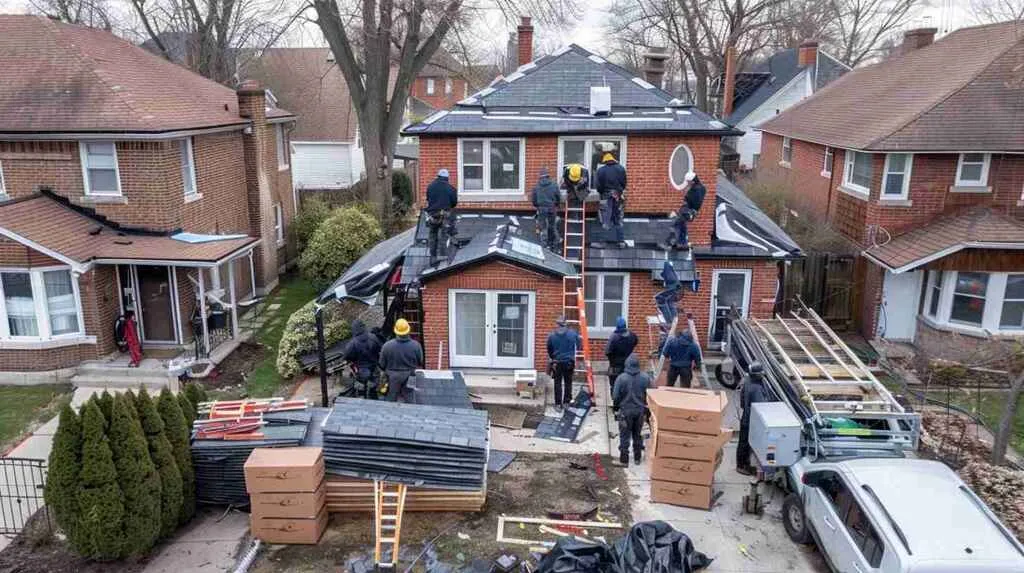
Blunt truth time: the shingles are the easy decision; it’s your roof deck and structure that decide 80% of this project. I treat every slate-to-asphalt conversion like a flowchart-each step checks an input (deck condition, framing integrity, logistics on narrow Queens streets), then defines the next action based on what we find. About four years ago in Bayside, I messed up on scheduling a crane for a slate tear-off on a narrow street; the crane permit was only good until 2 p.m., and the truck got stuck behind an accident on Northern Boulevard. We were halfway through removing the slate when I realized we’d never get the dumpster swapped in time. That near-disaster is why I now stage slate removal in zones and always plan for on-site sorting and palletizing-especially when converting to asphalt shingles-so we never leave an exposed deck overnight just because logistics went sideways. In Queens, you’re dealing with tight streets, parking restrictions, and neighbors who’ll call 311 if you block their driveway, so logistics aren’t optional-they’re an input variable that can turn a three-day job into a week-long nightmare if you don’t plan for it.
Once you understand the sequence-inspection, slate tear-off in zones, deck repairs, underlayment, shingles, ventilation-the whole job feels less mysterious and you can predict where surprises might pop up. The key is treating each step like a checkpoint: you don’t move to the next one until you’ve confirmed the deck is solid, the framing is stable, and the weather and logistics are under control. And here’s an insider tip: always ask the contractor, “What’s your plan if the crane, dumpster, or weather doesn’t cooperate-how do you keep my deck protected and my house dry?” If they don’t have a clear answer about tarps, staging zones, and backup schedules, that’s a red flag before you ever sign a contract.
Miguel’s Queens-Specific Slate-to-Asphalt Conversion Process
Attic check for sagging, walking the roof to probe suspect planks, looking for bowed rafters, checking fasteners and underlayment layers
Crane and dumpster timing, narrow Queens street strategy, zone-by-zone tear-off plan, backup tarps and weather monitoring ready
Remove slates systematically section by section, chute or hand-carry, on-site sorting and palletizing to keep deck exposure short and controlled
Replace rotted planks, add new sheathing if needed, sister sagging rafters, confirm nailing surface is solid and level throughout
Ice & water shield in valleys and eaves, synthetic felt elsewhere, new flashing at chimneys, walls, and penetrations
Starter strips, architectural shingles laid to manufacturer specs, proper nailing patterns for Queens wind loads, ridge caps installed
Ventilation balance confirmed, gutter tie-in inspected, full cleanup, and detailed walkthrough explaining what changed structurally and why
Risks of Partial Slate Tear-Off or Skipping Deck Repairs
- Leaving sections of rotten planks under new shingles can cause soft spots and early failure-you’ll see dimples, nail pops, and leaks within the first few years.
- Mixing heavy slate sections with new light asphalt creates uneven loading on the framing and new leak paths where the two systems meet.
- Rushing tear-off without a weather and logistics plan can leave your home exposed overnight in a Queens thunderstorm-I’ve seen ceilings collapse from one bad night.
Should You Replace Your Slate Now or Wait?
If we were standing on your sidewalk right now, I’d ask you one thing first: how long are you planning to keep this house? That single variable changes the whole decision tree-inputs like budget, resale timing, and risk tolerance affect whether you do a full conversion now, staged work over a couple seasons, or short-term repairs and hand the problem to the next owner. If you’re staying put for five to ten years or more, and you’re already seeing leaks, sagging, or a patchwork of DIY fixes, a full slate-to-asphalt conversion with structural review now gives you a known, stable roof system you can rely on-and it takes the guesswork out of every storm.
$4,000 of structural work today can be the difference between a clean sale and a deal-killing inspection later. Treating the roof like a system means you either address those failure points-rotted deck, bowed rafters, corroded fasteners-now, or you hand off a ticking clock to whoever buys the place.
Should You Convert from Slate to Asphalt Now?
What to Ask Your Roofer Before Replacing Slate with Asphalt in Queens
Think about your roof like a bus route-if one connection fails, the whole system gets delayed or breaks down completely. Your questions to a roofer should follow the system: structure first, then deck, underlayments, shingles, ventilation, and cleanup. Each question is about uncovering inputs (what you’re starting with) and possible failure points (what could go wrong if you skip a step or cut a corner). I walk through this same checklist with every homeowner in Queens, and it’s the same engineering-tradeoff mindset I use when I’m sketching system diagrams on scrap cardboard while we’re standing on the sidewalk-you want to see where the weak links are before the job starts, not after the crew is halfway through and you’re getting change orders.
Asking the right questions before you call for a slate-to-asphalt quote saves you from vague bids and surprise change orders that can blow your budget by 30% or more. Once you know what to ask about-deck surprises, permit logistics on narrow Queens streets, how they’ll handle weather delays-you can compare contractors on the stuff that actually matters, not just the shingle brand or the lowest number on the bid sheet. And when you’re ready for that conversation, Shingle Masters is the team I work with here in Queens-we treat every slate-to-asphalt conversion like a step-by-step plan with clear inputs, outputs, and no surprises on inspection day.
Homeowner Prep Checklist Before Calling for Slate-to-Asphalt Quotes
-
✓
Note any interior ceiling stains or recent leaks and where they appear-take photos if possible so you can show the roofer exactly where water is coming in. -
✓
Check the attic (if accessible) for visible sagging, dark water stains, or daylight shining through cracks in the deck. -
✓
Take clear photos of the roof from the street and any accessible windows-get shots of the slate condition, any patches, and chimney flashing. -
✓
Write down the age of the current roof if you know it and any past patchwork or repairs-even vague details help the roofer plan the tear-off. -
✓
List any storm events where you noticed new problems-hail, high winds, heavy snow-and when they happened. -
✓
Decide your time horizon in the house (under 5 years, 5-10, 10+) because that affects whether you do a full conversion, staged work, or short-term fixes. -
✓
Prepare to ask each roofer how they’ll handle deck surprises, permits, and narrow-street logistics in your part of Queens-you want a real plan, not “we’ll figure it out.”
Common Questions About Replacing Slate with Asphalt Shingles in Queens, NY
▸ Will replacing my slate with asphalt hurt my home’s value in Queens?
Not if it’s done right. Unsafe or leaking slate usually hurts value more than a well-installed asphalt system with documented structural upgrades. Buyers and their inspectors care about a roof that’s safe, watertight, and won’t need major work in the next five years-and a clean asphalt conversion with reinforced framing and modern underlayments checks all those boxes. If your slate is sagging, leaking, or has a patchwork of DIY repairs, switching to asphalt can actually make the house easier to sell and insure.
▸ How long does a typical slate-to-asphalt conversion take?
For most Queens homes, 2 to 5 days from tear-off to final cleanup. Larger three-story homes or jobs with major deck and structural repairs can stretch to a week or more. Weather delays and logistics on narrow streets can add time, which is why staging the tear-off in zones and having backup tarps ready is critical-you don’t want your house exposed overnight if the crane gets stuck in traffic on the BQE.
▸ Can I keep some slate sections and only replace part of the roof with asphalt?
Technically possible, but it often creates uneven loading on the framing and tricky detailing where the two systems meet. I’ve done partial conversions when one slope was failing but the rest was solid and the homeowner’s budget was tight-but I always explain the trade-offs: mixed weight, potential leak paths at the transitions, and shorter overall lifespan than a full conversion. If the slate is already showing signs of failure across multiple areas, I’d strongly advise going all the way to asphalt so you’re working with a single, uniform system.
▸ Do I need permits to replace my slate roof with asphalt in Queens?
Permit needs depend on the scope of structural changes and New York City Department of Buildings rules. A straight re-roof without framing changes often doesn’t require a full permit, but if you’re reinforcing rafters, replacing significant deck sections, or making structural modifications, you’ll need DOB sign-off-and sometimes an engineer’s letter. A local contractor like Shingle Masters will handle Queens-specific permitting, coordinate any engineer work, and make sure inspections are scheduled so you don’t run into problems down the line.
Once you treat your roof like a system-checking structure, deck, and weight first, then choosing shingles and underlayments based on those inputs-deciding to replace slate with asphalt in Queens becomes a clear engineering trade-off, not a guess. You’ll know what you’re starting with, what failure points to address, and what the outputs will be in terms of safety, lifespan, and resale value. Call Shingle Masters to have Miguel and the team walk your specific Queens roof through the same step-by-step slate-to-asphalt plan-you’ll get a clear quote, a detailed logistics plan, and no surprises on inspection day.