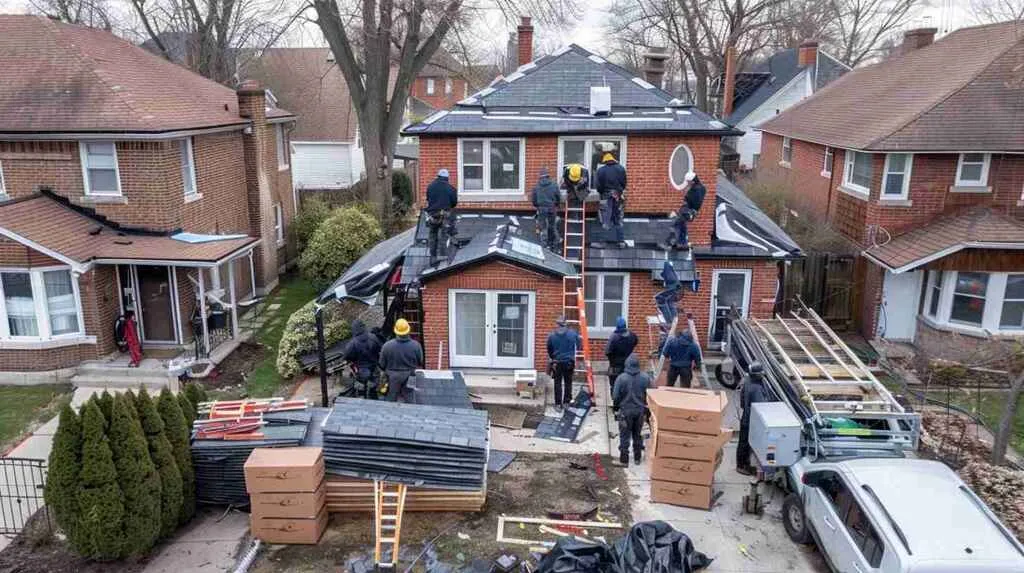
Blueprint first: most Queens homeowners pay between $11,000 and $22,000 for a new architectural shingle roof, and that wide swing comes down to tight access, multiple tear-off layers, co-op rules, and whether your house is attached or freestanding. This article breaks down exactly what moves that number, how your roof will read from across the street, and what to expect when you call for a free estimate.
What a New Architectural Shingle Roof Really Costs in Queens, NY
Most Queens homeowners end up between $11,000 and $22,000 for a typical one- to three-family house, and the spread is huge because this borough throws curveballs that don’t exist in the suburbs: attached rowhouses with shared walls, driveways so narrow you can’t fit a dumpster, strict co-op boards that dictate shingle colors, and old roofs with two or three layers that need tearing off before you can even start. The material choice matters, too-a premium architectural shingle with a deep shadow line and a 50-year warranty costs more per bundle than a builder-grade option, but it also changes how your house looks from across the street, and in Queens, that curb appeal matters as much as the invoice.
One August afternoon in Jackson Heights, about 94 degrees with humidity like soup, a client called me in a panic because her brand-new “architectural” roof looked patchy and streaky from the sidewalk. Turned out the previous contractor mixed two slightly different shingle dye lots to save a buck, and when she squinted one eye (yes, I make people do that), she could see the accidental checkerboard pattern the mismatched bundles created. That’s when I decided I’d never let a new architectural shingle roof go up in Queens without checking every bundle code myself-because honestly, saving $300 on materials isn’t worth a roof that looks like a quilt from the street. Your house is saying something to the block whether you think about it or not, and you want it saying “cared for,” not “cut corners.” If your cousin asked you to explain the cost difference between a $13,000 roof and a $19,000 one, you should be able to point to access, layers, materials, and how it all reads visually-and if you can’t, keep asking questions until you can.
Typical Queens Architectural Shingle Roof Scenarios and Price Ranges
These are ballpark estimates for complete jobs in Queens, NY-architectural shingles, full tear-off, standard flashing, disposal. Your actual price depends on the specifics of your house and block.
| Scenario | Home Type & Roof Details | Access / Complexity | Estimated Price Range (Queens, NY) |
|---|---|---|---|
| Single-Family Cape Bayside / Whitestone |
1,400 sq ft, simple gable, one layer to tear off | Driveway access, standard pitch, open lot | $11,500 – $15,000 |
| Attached Rowhouse Astoria / Jackson Heights |
1,100 sq ft, hip roof, two layers to tear off | No driveway, hand-carry materials, sidewalk protection required | $13,000 – $17,500 |
| Two-Family Detached Forest Hills / Kew Gardens |
1,900 sq ft, complex hip with dormers, three layers | Narrow driveway, steep sections, co-op color approval | $16,500 – $21,000 |
| Tudor-Style Home Forest Hills Gardens |
2,400 sq ft, multiple valleys and flashing points, one layer | Good access, but intricate roof geometry and historic district rules | $18,000 – $24,000 |
| Small Ranch Flushing / Bayside |
900 sq ft, low-pitch gable, one layer | Easy access, straightforward layout, minimal waste | $9,500 – $13,000 |
⚡Fast Facts About New Architectural Shingle Roofs in Queens, NY
| Typical Project Duration | 2-4 days for most single- and two-family homes, weather permitting |
| Warranty Expectations | 30-50 years on shingles (manufacturer), 5-10 years on workmanship (installer) |
| Wind Rating | Most architectural shingles rated 110-130 mph; critical in exposed Queens areas |
| Common Shingle Styles | Shadow-line architecturals in charcoal, weathered wood, or slate tones that hide city grime |
On a Typical Block in Queens-What Actually Pushes Your Roof Price Up or Down
On a typical block in Queens-think attached houses, narrow driveways, and no room for a dumpster-the practical stuff changes your price faster than the shingle brand. If we need to hand-carry bundles because your driveway’s too tight for a truck, that’s labor. If there are two or three old layers to tear off (which I see constantly in Astoria and Jackson Heights), that’s disposal weight and landfill fees. Hip roofs with multiple valleys cost more than simple gables because the waste factor goes up and the detail work takes longer. Add in co-op board approvals, DOB sidewalk shed rules, and the fact that many Queens blocks require scaffolding permits just to protect pedestrians, and you start to see why a house that looks identical to one in Nassau County can cost $3,000 more to roof. The thing is, when you’re standing across the street looking at your block, all those extra steps are invisible-but they’re exactly what keep your new roof looking clean and even from that view, not patchy or rushed.
I’ll never forget a November job in Bayside where we started tearing off an old three-tab roof at 6:30 AM, just as the sun was coming up over the Cross Island Parkway. The homeowner, an engineer, had a spreadsheet of questions about underlayment, wind ratings, and nail patterns, and he checked off each answer while we worked. Midway through, we discovered the previous roofer had skipped ice-and-water shield over the eaves-right where his daughter’s bedroom ceiling had water stains. We paused the whole crew for ten minutes so I could walk him through exactly how we were rebuilding that edge detail, sketching it on the back of his spreadsheet. Here’s the thing: hidden deck rot, missing drip edge, or cheap underlayment only show up during tear-off, and if you didn’t budget a small cushion for those surprises, you’re stuck making tough calls mid-job. Better underlayment and proper edge work might add $800 to your upfront estimate, but it’s the difference between a roof that protects your daughter’s bedroom and one that leaves you crossing your fingers every time it rains.
If someone waves a $6,000 architectural roof at you on a typical Queens two-family, stop. There’s only one way they got that number: cutting something you’d rather they didn’t.
⚠️Cheap Queens Roof Bids That Should Make You Nervous
- 1.Skipping ice-and-water shield on eaves and valleys-that’s where leaks start, especially when snow melts unevenly in Queens winters
- 2.No mention of plywood repairs in the estimate-you can’t know the deck condition until tear-off, so a legit bid acknowledges possible add-ons
- 3.Vague about disposal when your block has no driveway-hand-carrying debris and sidewalk permits cost real money; if they’re silent, they’re guessing
- 4.Mixing shingle brands or dye lots-a penny-pinching move that creates a checkerboard look from the street; always verify bundle codes match
The First Time I Saw Architectural Shingles Installed Wrong in Whitestone
The first time I saw architectural shingles installed wrong on a hip roof in Whitestone, I realized most folks don’t understand how much the roof shape changes the job. A simple gable roof is like hanging a picture frame on a flat wall-straightforward, predictable waste, and the pattern reads cleanly from the street. A hip roof with valleys, dormers, and multiple planes is more like building a museum exhibit (which I used to do in Long Island City): every angle changes how light and shadow hit the shingles, the waste factor jumps 15-20%, and if you don’t lay the courses carefully, the dimensional look gets lost and the roof reads flat from across the street, defeating the whole point of spending extra on architecturals. One rainy spring evening in Astoria, I was doing a free estimate for a young couple who’d just bought a brick rowhouse, and the guy was convinced they needed a flat roof specialist because “shingles won’t hold up with all the planes flying overhead,” which made me laugh harder than I should have. I took them up to the roof between drizzles, held my phone flashlight against the architectural shingle sample, and explained how the extra thickness and shadow lines would actually mask the minor soot and airplane dust they’d get-something three-tabs can’t do. A year later they texted me a sunset photo from their new roof deck, bragging that their “Instagram roof” got them three offers over asking when they refinanced. Here’s an insider tip on color: pick architectural shingle tones that hide city grime and look consistent under that mix of sunlight and airplane soot-darker charcoals and weathered woods read cleaner longer than lighter grays-and always check the color against your neighbors’ roofs from across the street before you decide, because on a Queens block, your roof either blends in tastefully or sticks out awkwardly, and there’s no middle ground.
📐Simple Gable Roof
- Appearance from street: Clean, predictable lines; shadow pattern reads evenly
- Labor needed: Straightforward layout, faster install, fewer cuts
- Waste factor: 10-12%, lower material cost
- Impact on price & curb appeal: Lower cost, solid curb presence if shingles are consistent
🏠Hip / Complex Roof
- Appearance from street: Dramatic shadow play, but only if installed carefully
- Labor needed: More detail work, valleys, hip caps, precise measurements
- Waste factor: 18-22%, higher material cost
- Impact on price & curb appeal: Higher cost, but strong architectural presence when done right
What to Expect Step-by-Step When You Call for a Free Roof Estimate
When I walk into a home for a free estimate, the first thing I ask is, “What’s keeping you up at night about this roof?” I’m not being dramatic-I genuinely want to know if it’s a leak over the bedroom, a neighbor’s comment about curb appeal, or just age and uncertainty. Once I understand that, I zoom out: I step across the street and look at how the house reads from that angle, because that’s the view that matters when you’re deciding on shingle style, color, and whether the investment makes sense. Then I get into the details-ventilation, flashing points, valleys, and what’s probably hiding under your current shingles-but I explain it all at your kitchen table in plain language, no jargon, because my rule is simple: if your cousin asked you to explain the plan back to them, you should be able to do it without hesitation.
From there, I walk the exterior, check the roof itself (safely-I’m not sending homeowners up ladders), and if there are ceiling stains or attic access, I’ll look inside to see what’s going on with the deck and insulation. Then we sit down and I walk you through options at different budget levels-maybe standard architectural shingles with solid underlayment, or premium options with thicker shadow lines and upgraded ice-and-water shield-and I’m honest about what each choice gets you in terms of longevity, appearance from the street, and how it fits your block. I’ll also set expectations on timeline (2-4 days for most Queens homes), crew behavior (we’re professional, not blasting music at 7 AM), and how we handle the mess when there’s no driveway. The goal is for you to feel like you made an informed decision, not like you got sold something.
Your Free Architectural Shingle Roof Estimate with Shingle Masters
Initial Phone Call
Quick conversation to understand your concerns, roof age, and any visible issues. We’ll schedule a convenient on-site visit, usually within 2-3 days.
On-Site Visit & Introduction
Victor arrives on time, introduces himself, and asks what’s keeping you up at night about the roof-your concerns drive the inspection.
Exterior & Roof Inspection
First, he steps across the street to see how your roof reads from that angle, then inspects the roof itself-layers, flashing, pitch, and condition.
Attic / Ceiling Check (if Needed)
If there are stains, leaks, or ventilation concerns, he’ll look in the attic or at ceiling areas to check deck condition and moisture issues.
Material & Color Discussion from the Street
He’ll show shingle samples against your house and neighboring roofs, explaining how different colors and styles read from the sidewalk and hold up against city grime.
Written Estimate with Timeline
You receive a clear, line-item proposal covering tear-off, materials, labor, disposal, and any extras-plus a realistic schedule and crew expectations for your block.
✅ Things to Note Before Calling for Your Queens Roof Estimate
- ☑Leak locations: Note where water stains appear on ceilings or walls
- ☑Roof age (if known): Even a rough estimate helps frame the conversation
- ☑Attic access: Let us know if we can get inside to check the deck and ventilation
- ☑Photos from the street: Snap a quick pic of your house from across the block if possible
- ☑Co-op / HOA rules: If your building has restrictions, mention them upfront
- ☑Preferred time windows: Tight Queens blocks often require specific work hours-let us know your constraints
Why Queens Homeowners Call Shingle Masters
| Licensed & Insured | Fully licensed to work in New York City, fully insured for your protection |
| Experience | 19+ years installing architectural shingle roofs across Queens neighborhoods |
| Response Time | Free estimates scheduled within 2-3 days; most projects start within 2 weeks |
| Service Areas | Astoria, Bayside, Jackson Heights, Forest Hills, Whitestone, Flushing, Kew Gardens, and throughout Queens |
| Commitment | Clear line-item estimates, no surprise charges, and roofs that look right from across the street |
Under the Shingles: The Details That Make or Break Your New Roof
Here’s a truth nobody likes to hear: most roof problems in Queens aren’t caused by the shingles-they’re caused by what’s underneath them. The deck condition, the ventilation setup, the flashing around chimneys and skylights, and whether anyone bothered to install ice-and-water shield along the eaves all matter more than the shingle brand in terms of how long your roof lasts and whether you get leaks. In older Queens housing stock-think 1920s rowhouses and 1950s capes-the deck might have soft spots or rot you can’t see until tear-off, and if the ventilation’s been blocked by insulation or never existed in the first place, your brand-new architectural shingles will age unevenly and start curling on the sunny side first. My big-picture-to-close-up approach means I’m always thinking about how those invisible details protect not just your ceilings and bedrooms, but also how evenly the roof ages visually, so five years from now it still looks sharp when you stand across the street, not tired and patchy on one side.
Queens Architectural Shingle Roof FAQs
How long does a new architectural shingle roof last in Queens?
Most architectural shingles come with 30- to 50-year warranties, but real-world lifespan in Queens is typically 25-40 years depending on ventilation, deck condition, and how well the underlayment and flashing were installed. Proper attic ventilation and quality ice-and-water shield at the eaves extend life significantly, especially in homes that get uneven sun exposure or deal with city soot and pollution.
What if my neighbors’ roofs are all different colors?
That’s actually common on Queens blocks, especially in neighborhoods with a mix of ages and styles. The key is choosing a shingle color that complements your house trim, brick, and siding without clashing with the immediate neighbors. I always recommend stepping across the street with samples to see how the color reads in context-sometimes a neutral weathered wood or charcoal works better than trying to match one specific neighbor’s roof. The goal is to blend in tastefully, not stand out awkwardly.
Can you install architectural shingles over my existing shingles?
Technically yes, but I almost never recommend it in Queens. Installing over old layers hides deck problems, makes ventilation worse, voids most manufacturer warranties, and adds weight to older framing that wasn’t designed for it. You also can’t inspect or repair flashing, which is where most leaks start. A proper tear-off lets us check the deck, upgrade the underlayment, and ensure your new architectural shingles perform the way they’re supposed to-and that they’ll actually last the 30-50 years you’re paying for.
How noisy and messy is the job on a tight Queens block?
It’s noisy during tear-off-think hammers, pry bars, and bundles sliding down-but most of that happens in the first day. We tarp walkways, protect landscaping, and use tarps to catch debris if there’s no driveway for a dumpster. On tight blocks with shared walls or narrow lots, we hand-carry materials and stage them carefully to avoid blocking neighbors. Crews arrive around 7:30-8 AM (respecting co-op and city rules), and we clean up daily so the block doesn’t look like a construction zone overnight. The whole job typically takes 2-4 days, weather permitting.
Do planes, soot, and city weather affect my shingle choice?
Absolutely. If you’re near LaGuardia or under flight paths in Astoria, Jackson Heights, or Bayside, you’ll get airplane soot and dust settling on your roof. Architectural shingles handle this better than three-tabs because the thicker, dimensional profile and shadow lines mask minor grime, and darker or weathered-wood tones hide it even better than light grays or whites. City pollution, uneven sun exposure, and the freeze-thaw cycles we get in Queens winters all argue for choosing mid-to-dark tones with good granule adhesion and a strong wind rating (110+ mph). It’s not just about performance-it’s about how clean and consistent your roof looks from the street five, ten, fifteen years from now.
Victor and Shingle Masters can walk your specific Queens house through these decisions in plain language-no jargon, no pressure, just an honest conversation about what makes sense for your block, your budget, and how you want your home to look from across the street. Call us today for a free on-site estimate and a curb-appeal review of your new architectural shingle roof options.