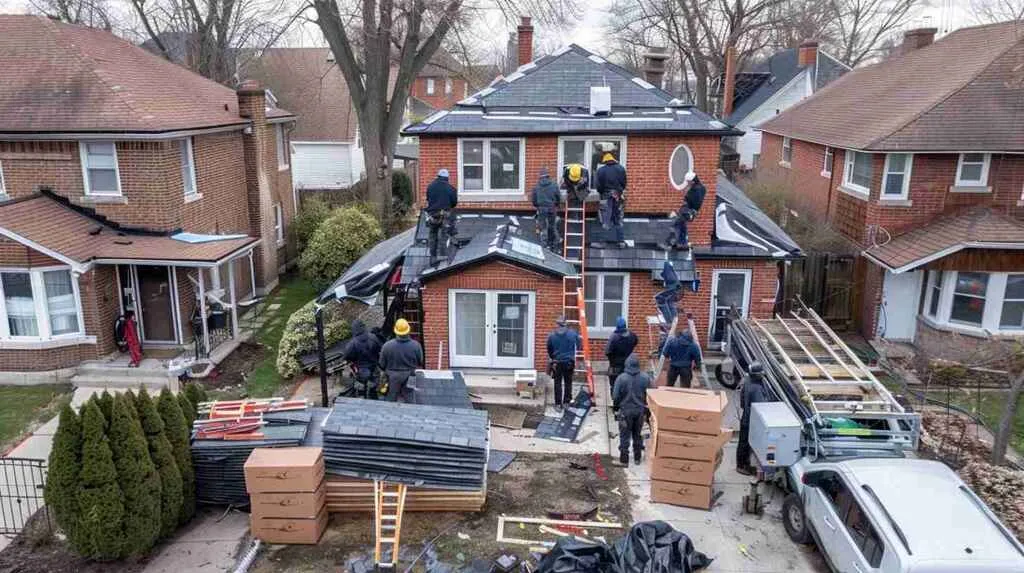
Laminate Shingle Roof Queens NY – Thick Profile, Long Warranty | Call Today
Offstage, before you write the check, here’s what you should know: a proper laminate shingle roof in Queens usually runs between $9,000 and $18,000, and that number isn’t just for pretty shingles. You’re paying for a complete, thick-profile system with real wind ratings, manufacturer warranties that hold up under scrutiny, and a roof that won’t peel off during the next coastal storm that whips across the borough. Think of it this way – you’re buying the whole song arrangement, not just a solo performance.
What You Really Get for a $9,000-$18,000 Laminate Shingle Roof in Queens
On a typical Wednesday in Queens, when I’m hauling bundles up a ladder on 37th Avenue, I still get asked why a laminate shingle roof costs more than the basic stuff. Here’s my honest take: that price range buys you thickness – real dimensional tabs that cast shadows and handle storm abuse. It buys you a warranty that’s actually enforceable, not some fine-print promise that evaporates the minute you mix brands or skip a starter strip. And it buys you wind ratings that matter when a microburst rolls off Jamaica Bay and tries to turn your roof into a kite. The shingles are the lead vocals, sure, but the whole arrangement – underlayment, deck prep, ventilation – has to play together, or the performance falls apart in the first downpour.
Typical Queens Laminate Shingle Roof Scenarios & Prices
| Scenario | Approx. Roof Size | Typical Price Range | Warranty (Material / Work) |
|---|---|---|---|
| Small attached brick rowhouse, simple pitch | 1,200-1,500 sq ft | $9,000-$12,500 | 30-yr / 5-10 yr |
| Medium detached two-family, one layer tear-off | 1,800-2,400 sq ft | $12,000-$16,000 | 30-50 yr / 10 yr |
| Larger corner property, complex rooflines and valleys | 2,500-3,200 sq ft | $16,000-$22,000 | Lifetime / 10-15 yr |
| Storm-damaged partial replacement, emergency work | 800-1,200 sq ft | $6,500-$10,000 | Match existing / 5 yr |
| Premium thick-profile upgrade on sound deck | 1,800-2,400 sq ft | $13,500-$18,000 | Lifetime / 10-15 yr |
One February afternoon during that weird warm spell in 2020, I was up on a detached in Ozone Park where the previous installer had mixed three different brands of laminate shingles on the same slope. The roof looked fine from the street, but the tabs had different thicknesses and the wind was lifting the thinner ones like playing cards. I remember standing there, sun on my back, explaining to the homeowner how the “band” didn’t match – different shingles aging at different tempos – and how that killed both the warranty and the curb appeal. We tore it all off and put down a single, heavy-laminate system with a proper manufacturer warranty, and the next windstorm that hit Queens barely ruffled a ridge cap. That’s the difference between buying shingles and buying a roof.
Here’s what’s actually included in that $9,000-$18,000 price when the job’s done right: ice-and-water shield along eaves and valleys, synthetic underlayment across the whole deck, starter strips at every edge, the laminate shingles themselves, ridge caps that match the shingle profile, proper attic ventilation upgrades if needed, and a full tear-off and disposal of the old layers. You’re not just paying for the lead vocals – the pretty shingles everyone sees from the sidewalk. You’re paying for the rhythm section: the underlayment that keeps water from ever touching wood, the starter strips that anchor the bottom row against uplift, the ventilation that’s the steady drumbeat keeping moisture from rotting your deck from the inside out. Skip any one of those instruments, and the whole arrangement falls apart the first time a nor’easter rolls through Flushing.
✅ Core Components in a Proper Laminate Shingle System (The Full Band)
- Ice-and-water shield – the safety net, catching anything that slips past the shingles at eaves and valleys
- Synthetic underlayment – the rhythm section, waterproofing the entire deck even before shingles go on
- Starter strips – the anchor, locking down that first course against wind uplift
- Thick-profile laminate shingles – the lead vocals, delivering curb appeal and storm resistance
- Ridge caps and hip caps – the high notes, sealing the peaks and finishing the look
- Attic ventilation (intake and exhaust) – the steady drumbeat, keeping heat and moisture from cooking your deck and shortening shingle life
How a Laminate Shingle Roof Is Built to Handle Queens Wind and Rain
Here’s my honest take, after nineteen years of torn-off shingles and warranty forms: Queens weather is sneaky. You get microbursts off the bay that funnel between attached homes in Astoria and Jackson Heights, turning rooflines into wind tunnels. You get coastal nor’easters that drench everything sideways, and then you get freeze-thaw cycles in winter that pry up any edge that isn’t nailed down tight. A laminate shingle roof survives all that only if the rhythm section – underlayment, starter strips, fasteners – is dialed in as carefully as the shingles themselves. One job that still sticks with me was a midnight emergency in Astoria after a summer microburst. A landlord called me in a panic because laminate shingles had literally peeled off one corner of his building like the cover of a book. When I got up there with a headlamp, I saw the shingles were fine – it was the cheap underlayment and almost no nails in the high-wind zone that caused the failure. I ended up explaining to him, in the dark, how laminate shingles are like lead vocals: powerful, but they still need a good rhythm section – underlayment, starter strips, and fasteners – or the whole song falls apart in a storm.
Blunt truth: a thick laminate shingle with a long warranty is worthless if it’s nailed like a rush job before a rainstorm. Manufacturers specify exact nailing patterns – usually six nails per shingle, placed just above the adhesive line – and if you skimp or miss that line, the warranty voids and the wind gets under the tabs. On corners and edges facing prevailing winds from the south and west, I add extra nails and upgrade to high-tack underlayment with rubberized edges. That’s not upselling – it’s keeping your roof on the house when the next big storm decides to test it. Check the manufacturer’s install guide before you hire anyone, and make sure they’re following the nail-line requirements to the letter, or your “lifetime” warranty is just paper.
⚠️ Installation Shortcuts That Make Laminate Shingles Fail in Queens Storms
Mixing shingle brands on the same slope: Different manufacturers use different adhesive strengths and tab thicknesses, so they age at different rates and your warranty becomes unenforceable. Wind lifts the weaker brand first.
Under-nailing (four nails instead of six): Saves the installer maybe 20 minutes but voids your warranty and lets wind peel tabs during the first serious storm. Every manufacturer requires six nails per shingle.
Skipping starter strips at eaves and rakes: The bottom course has no shingle underneath it to seal against, so wind drives straight up and lifts the entire first row. Starter strips are the anchor.
Using bargain felt underlayment instead of synthetic: Felt tears in high wind, absorbs water, and deteriorates in a few years. Synthetic costs more but actually protects your deck if a shingle ever fails.
Thick-Profile Laminate Shingles vs Basic 3-Tab in Queens Weather
| Pros of Thick Laminate Shingles | Cons of Thick Laminate Shingles |
|---|---|
| Wind rating typically 110-130 mph, far higher than 3-tab’s 60-70 mph, so they stay put during Queens microbursts and coastal storms | Higher upfront cost – usually $3,000-$6,000 more than basic 3-tab for the same roof size |
| Lifespan of 25-50+ years in Queens conditions vs 15-20 for 3-tab, meaning fewer replacements over the life of your home | Heavier weight (about 50% more than 3-tab), so older homes with questionable framing may need structural evaluation first |
| Dimensional shadow lines look like slate or wood shake from the sidewalk, boosting curb appeal and resale value on Queens rowhouses and two-families | More complex repairs – matching discontinued colors and profiles five years later can be tough, sometimes requiring full-slope replacement |
| Better granule retention, so the color stays consistent and UV protection lasts longer even with full southern exposure | Requires skilled installation – if nailed wrong, the extra thickness can actually trap water instead of shedding it, leading to faster failure than cheap shingles |
| Longer, transferable warranties (30-year to lifetime) that actually add value when you sell, vs 20-year warranties that expire before the shingles do |
How to Tell If You Actually Need a New Laminate Shingle Roof Right Now
If you stood on your sidewalk right now and looked up at your own roof, would you be able to tell if it’s laminate or 3-tab? The easiest check: thick laminate shingles cast shadows because they’re dimensional – you’ll see dark lines running horizontally across each course, like stair steps. 3-tab shingles lie flat, so they look smooth and uniform. If your laminate shingles are curling at the edges, lifting in corners, or showing black underlayment through missing tabs, you’re past the “monitor it” stage and into the “call now” zone. Back in 2015, I did a laminate shingle roof on a narrow, attached home in Flushing for an older couple who wanted “something fancy without Park Avenue prices.” Midway through, we hit a snag because the old decking had been patched three different times with mismatched boards that made the surface wavy. If we’d slapped thick-profile laminates on top, it would’ve looked like a warped record. I spent the extra day straightening and re-sheathing, then showed them from the sidewalk how the shadow lines of the laminates now ran smooth, like bars on a music sheet. They still send me photos every winter when the low sun makes that roof look like expensive stone.
Here’s a calm, practical checklist: if you’re seeing active leaks – stains spreading on ceilings, drips during rain – call someone within 24 to 48 hours. If you’re seeing missing shingles, exposed underlayment, or a visible sag in the roofline, schedule an inspection within the week. If your roof is over 18 to 20 years old or older than its stated warranty, plan a replacement in the next 12 to 24 months before a storm forces your hand. And if none of those apply but you’re noticing minor granule loss or a single lifted tab, you’re fine to stay on yearly checkups and small repairs. The whole “song” of your roof – shingles, underlayment, ventilation – has to hold together, and these checks tell you which instrument is starting to go out of tune.
Do You Need a New Laminate Shingle Roof or Just Repairs?
Start here: Are you seeing active leaks inside (ceiling stains, drips) during or right after rain?
YES → Call for an inspection within 24-48 hours. Active leaks mean water is already touching wood, and delay turns a roof problem into a ceiling-and-insulation problem.
NO → Next question below.
From the sidewalk, do you see missing shingles, exposed black underlayment, or a sagging roofline?
YES → Schedule a roof check in the next week. These are structural or storm-damage symptoms that get worse fast.
NO → Next question below.
Is your roof over 18-20 years old or older than its stated warranty period?
YES → Plan a replacement in the next 12-24 months. You’re past the design life, and waiting for a leak just means emergency pricing and storm damage.
NO → Stay on yearly checkups and minor tune-ups. Your roof is still in the safe zone.
Note: Queens rowhouses and attached homes often hide problems on shared party walls and in valleys between buildings – what looks fine from your sidewalk may be leaking into your neighbor’s attic. A real inspection walks the whole roof, not just the street-facing slope.
🚨 Call Shingle Masters ASAP
- Active leaks – water dripping or ceiling stains spreading during rain
- Shingles peeled at edges or corners after a storm
- Visible wood deck showing through missing shingles
- Sagging roofline or dips visible from the sidewalk
📅 Can Usually Wait a Week or Two
- Minor granule loss in gutters (normal aging)
- A single lifted or creased shingle on a low slope
- Cosmetic staining or algae streaks (doesn’t affect function)
- Age-only concerns with no visible damage or leaks
Queens-Specific Choices: Thickness, Color, and Warranty That Actually Make Sense
I still remember a homeowner in Maspeth asking me this same question while we watched the 7 train roll by: “Do I really need the thickest laminate shingle, or is that just marketing?” Here’s what I told him, and what I tell everyone now: there are usually three thickness tiers – good, better, best – and the right one depends on how long you’re staying in the house and what’s around you. If you’re in a brick rowhouse next to a dozen others that all look the same, a mid-tier laminate in a color that complements the brick gives you solid wind protection and curb appeal without going overboard. If you’re on a corner lot or a detached Cape where the roof is the first thing people see, stepping up to a premium thick-profile laminate in a shadow-rich color like weathered wood or charcoal makes the house look twice as expensive. Warranties follow the same logic: a 30-year warranty is plenty if you’re planning to move in ten years, but a transferable lifetime warranty adds real resale value if you’re staying put or selling to someone who cares about long-term protection. I frame all these decisions like arranging a song: the lead vocals are the shingles everyone sees, the backup singers are the warranty (important, but only if the performance is solid), and the rhythm section is ventilation and underlayment that keeps the whole thing from falling apart.
Warranty is like a backup singer – crucial support, but the performance still depends on the band showing up. Even a lifetime warranty can’t rescue a roof if it’s installed without proper ventilation or nailed in the wrong spots.
Recommended Laminate Shingle Options for Common Queens House Types
| House Type | Suggested Thickness | Color Families | Warranty Level | Why It Works |
|---|---|---|---|---|
| Narrow attached brick rowhouse | Good to Better | Browns, grays, earth tones | 30-year | Blends with red or tan brick, keeps costs reasonable on smaller roof |
| Semi-detached two-family | Better | Charcoal, slate gray, driftwood | 30-50 year | Higher wind exposure on open side, needs better wind rating and resale appeal |
| Detached single-family Cape | Better to Best | Shadow-rich blends (weathered wood, stone) | Lifetime | Roof is highly visible from street; premium look pays back in curb appeal and resale |
| Larger corner Tudor or colonial | Best | Deep browns, slate, designer blends | Lifetime transferable | Exposed on two or three sides to full wind; extra thickness and warranty protect investment and architectural detail |
Common Myths vs Facts About Laminate Shingle Warranties in Queens
| Myth | Fact |
|---|---|
| “Lifetime warranty means it’ll never leak.” | Lifetime covers manufacturing defects, not installation mistakes, wind damage, or lack of maintenance. If the installer skips ventilation or uses the wrong nails, your warranty is void before the first storm. |
| “Mixing shingle brands doesn’t affect the warranty.” | Every major manufacturer voids coverage if you mix brands or product lines on the same roof. They can’t guarantee performance when their shingles are married to someone else’s underlayment or starter strips. |
| “Any roofer can register a warranty the same way.” | Extended and transferable warranties usually require certified installers who’ve passed manufacturer training. A non-certified crew might give you a basic warranty, but you lose the upgrade options and transfer rights. |
| “Storm damage is always covered under warranty.” | Warranties cover defects, not acts of God. If a tree falls on your roof or wind exceeds the rated speed, that’s an insurance claim, not a warranty claim. The warranty only kicks in if the shingles failed below their rated wind speed due to a manufacturing flaw. |
| “You can skip attic ventilation and keep the warranty.” | Insufficient ventilation voids almost every laminate shingle warranty. Heat buildup cooks shingles from below, and manufacturers require proper intake and exhaust airflow to honor any claims. |
What Working With Shingle Masters Looks Like, Step by Step
Think of your laminate shingle roof like a good jazz trio – if one player is off, the whole song sounds wrong. When you call Shingle Masters, we start with a phone conversation about your roof’s age, any leaks you’ve noticed, and what you’re hoping to get out of a new roof – more curb appeal, better storm protection, a warranty you can actually use. From there, I come out for an on-roof inspection, take photos of the decking condition, measure the slopes, and check your attic ventilation to see if we need to upgrade intake or exhaust vents. You get a written proposal with three options – good, better, best laminate systems – each one listing the exact shingles, underlayment, warranties, and any deck repairs or ventilation work included in the price. Once you pick the arrangement that fits your budget and your house, we schedule the job, coordinate material delivery, and keep an eye on the Queens weather forecast so we’re not tearing off your roof the day before a storm. Installation day runs like a well-rehearsed set: tear-off and haul-away in the morning, deck inspection and repairs by midday, underlayment and shingles by afternoon, ridge caps and final cleanup before we leave. At the end, we walk the property together, register your warranty, and make sure every scrap of old shingle is out of your yard. Shingle Masters works only in Queens and the nearby borough blocks, so we know which streets flood in heavy rain, which blocks get hit hardest by microbursts, and which attached-home layouts need extra care on shared walls.
Shingle Masters Laminate Shingle Roof Process in Queens
Why Queens Homeowners Trust Shingle Masters for Laminate Shingle Roofs
- ✓ 19+ years installing roofs exclusively in Queens and nearby boroughs
- ✓ Licensed and insured in New York State, with proof available on request
- ✓ Manufacturer-trained and certified for major laminate shingle brands
- ✓ Photos and references from completed jobs in Ozone Park, Astoria, Flushing, Maspeth, and across Queens
- ✓ Typical response time for active leaks: within 24-48 hours, often same-day for emergencies
Common Questions About Laminate Shingle Roofs in Queens, NY
How long does a laminate shingle roof really last in Queens vs the brochure number?
Can you roof over old shingles or should you always tear off?
How much noise and mess should I expect during installation on an attached rowhouse?
Are laminate shingles worth the cost on a rental property in Queens?
How does scheduling work around Queens weather and street parking?
If you’re ready for a thick-profile laminate shingle roof that’s arranged the right way – with proper underlayment, real warranties, and installation that holds up in Queens storms – call Shingle Masters and ask for Rafael. I’ll walk you through your options like we’re planning a song setlist, show you exactly what each choice buys you, and schedule an on-roof inspection at a time that works for your schedule. Your roof is the whole band, not just a solo act, and we make sure every instrument plays its part.