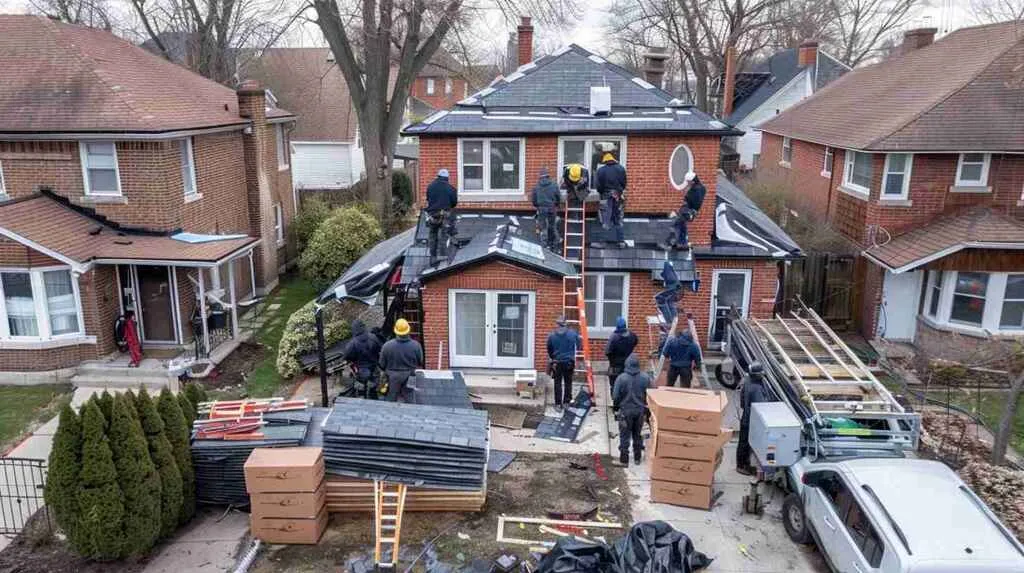
Tile Roof vs Shingles Queens NY – Which One Is Right for You? | Free Quotes
Between a classic tile roof and a modern shingle roof in Queens, most homeowners will find that a properly installed architectural shingle system is the smarter, safer, and more cost-effective choice-especially once you factor in the structural limits of older homes, the way our climate treats heavy materials, and what actually happens on a crowded Queens block. This isn’t some generic national brochure; it’s a straight-talking breakdown tailored to attached houses, narrow driveways, and the kind of nor’easters that funnel wind and rain sideways through your neighborhood.
Tile vs Shingle in Queens: The Quick Bottom Line
On a typical block in Queens-think attached houses, narrow driveways, and power lines everywhere-you’re not choosing in a vacuum. Your roof has to deal with freeze-thaw cycles, wet heavy snow, wind gusts that squeeze between buildings, and a house structure that was probably framed sometime between 1920 and 1960. And honestly? Most of those frames weren’t built with the weight of tile in mind. A high-quality architectural shingle roof fits the way Queens homes are actually built, handles our weather better when installed right, and won’t cost you the equivalent of a used car just to make sure your rafters can carry the load.
Quick Facts: Shingle vs Tile in Queens
Shingles 2-4 lbs, Tile 8-15 lbs
Shingles 2-4 days, Tile 5-8 days
Shingles flex, tile can crack
Shingles same-day possible, tile needs specialty crew
One August afternoon in Astoria, it was about 93 degrees, and I was standing on a half-finished tile roof for a retired couple from Greece who swore tile was “the only proper roof.” Mid-project, we realized their 1920s rafters were undersized for the tile weight-nobody had checked it properly before. I had to climb down, sit with them under their grapevine trellis, and walk them through why switching to architectural shingles would save their roof framing and still give them a Mediterranean-ish look. That was the first time I ever convinced a die-hard tile family to go shingles, and they still send me pictures every time it snows. Alright, let’s pretend this is your money and your mother’s house: if your framing wasn’t built for tile weight, no amount of wishing will make that tile safe, but a quality shingle roof will protect everything underneath without stressing the bones of your home.
How Queens Climate and Blocks Treat Tile vs Shingles
Here’s the blunt truth: our climate beats up roofs like the 7 train beats up rails. We get sideways rain during nor’easters, brutal freeze-thaw cycles from December through March, wet heavy snow that sits on low-slope roofs, and wind gusts that funnel between attached houses like a wind tunnel. In Howard Beach, you’re dealing with salt air and storm surge humidity. In Jackson Heights and Flushing, you’ve got tight blocks where debris from trees and neighbors’ buildings can hit your roof. In Bayside or Whitestone, you might have a detached house with more breathing room, but you’re still getting the same freeze-thaw and snow loads. When installed correctly-with the right underlayment, proper ventilation, and solid flashing-architectural shingles handle all of that better than tile does in our specific weather.
| Queens Condition | Architectural Shingles (Properly Installed) | Tile (Typical Install in Queens) |
|---|---|---|
| Heavy nor’easter with sideways rain | Good water shedding with correct flashing and underlayment; fewer uplift issues on steep and moderate slopes | Can allow wind-driven water under tiles if laps, clips, or underlayment aren’t perfect |
| Freeze-thaw cycles (Dec-March) | Flexible enough to tolerate expansion/contraction with proper ventilation | More brittle; edges can crack, and small movement can loosen pieces |
| Wet, heavy snow on a low to mid-slope roof | Performs well when rafters are sound and ice/water shield is used along eaves and valleys | Snow and ice add weight to an already heavy system; risk if framing is marginal |
| Wind gusts funneled between attached houses | Modern shingles rated for high wind, especially with correct nailing patterns | Individual tiles may lift, rattle, or dislodge without robust fastening |
| Wind-driven debris from trees and nearby buildings | Usually dents or scuffs but stays watertight; easy spot repairs | Impacts can crack tiles; replacement needs careful walking and access |
⚠️ Warning: Don’t assume a tile roof that looks great in Florida or southern California will perform the same way in Queens. Different climate, different framing standards, different slope requirements. What works in year-round warmth can crack, shift, or leak here after one winter of freeze-thaw cycles and wet snow loads.
Let’s park that for a second and look at a real example. I’ll never forget a windy November morning in Howard Beach, standing with a landlord who was furious because his tile roof had shed a couple of pieces into the neighbor’s driveway during a nor’easter. The tile was fine quality, but it had been installed like a shingle roof-wrong clips, wrong overlap, wrong everything. I walked him ridge to eave, tile by tile, and showed him how a cheaper, well-installed shingle roof would have outperformed his “fancy” tile here, especially with the kind of sideways rain we get in Queens. That’s when I started telling people: “Material is only half the story; the other half is how your neighborhood treats that material.”
Cost, Lifespan, and Maintenance: What Makes Sense on Your Block
When a customer in Queens asks me, “Is tile roof better than shingle?” I always fire back with two questions: How long are you staying, and how much do you hate maintenance? Because tile’s theoretical lifespan advantage-50 to 70 years in perfect conditions-doesn’t mean much if you’re planning to refinance or move in 10 years, or if you end up spending thousands on repairs because freeze-thaw cycles crack tiles every few winters. Around here, many homeowners move, renovate, or refinance before tile’s extra lifespan even starts to pay off. And here’s the insider tip: if you’re dead-set on tile, budget for an engineer and potential framing upgrades, because most Queens homes built before 1980 weren’t framed with tile loads in mind. That can add $5,000 to $15,000 before you even touch the roof surface.
Realistic budgets and timelines
Picture your house on your exact block, right now, with last winter’s snow sitting on that roof.
Typical Queens Roof Scenarios: Shingle vs Tile Ballpark Costs
| Scenario (Queens Home Type) | Architectural Shingles (Approx. Installed Range) | Tile (Approx. Installed Range) |
|---|---|---|
| Attached brick rowhouse, 1,200 sq ft roof | $8,500 – $12,500 depending on layers tear-off and flashing | $22,000 – $32,000 plus likely engineering review |
| Detached 2-story in Flushing, 1,800 sq ft roof | $11,000 – $16,000 depending on access and ventilation upgrades | $28,000 – $40,000 plus any structural reinforcement |
| Semi-attached in Jackson Heights, 1,400 sq ft roof with multiple valleys | $9,500 – $14,000 depending on complexity and chimney work | $25,000 – $36,000 with complex flashing and access challenges |
| Older 1920s wood-frame in Jamaica, 1,600 sq ft roof needing deck work | $13,000 – $18,000 including deck repairs and ice/water shield | $30,000 – $45,000 including probable framing upgrades |
| Newer build in Bayside, 2,200 sq ft engineered for heavier loads | $14,000 – $20,000 with upgraded underlayment and ridge vent | $32,000 – $48,000 if structure is already engineered for tile |
How long each roof can actually last here
There was a late-night emergency in Flushing-about 10:30 pm in a spring thunderstorm-where we tarped over a failing shingle roof on a small two-family home. The owner was debating replacing it with tile because her brother in Miami said tile “never dies.” I stood in her narrow kitchen, soaked socks and all, drawing a diagram on a paper plate showing why tile plus ice, snow, and heavy freeze-thaw cycles in Queens can crack and shift, especially on her low-slope roof. That paper plate talk turned into a full shingle replacement with upgraded underlayment, and she still keeps the plate on her fridge like it’s a diploma. And here’s the real-world truth from your street: a properly installed architectural shingle roof with quality underlayment will give you 25 to 35 solid years in Queens with basic maintenance, while tile might theoretically last longer-but only if your structure can handle it, you catch and fix cracks early, and you’re willing to pay more every time you need a repair.
| Ongoing Maintenance: Architectural Shingles vs Tile on a Lived-In Queens Block | |
|---|---|
|
Architectural Shingles – Pros
|
Architectural Shingles – Cons
|
|
Tile – Pros
|
Tile – Cons
|
Still Torn? Use This Simple Queens-Focused Decision Guide
If I’m being totally honest, tile is more often a “heart decision” and shingles are a “head decision” around here. You see a gorgeous tile roof in a magazine or on a trip somewhere warm, and you think, “That’s what I want.” But then you picture your house on your exact block-next to the neighbor’s three-story, with your driveway barely wide enough for the truck, and your framing that hasn’t been touched since Eisenhower was president-and suddenly the decision gets clearer. If you love the look of tile but you’re in an older, tighter urban setting, there are plenty of architectural shingles that mimic that Mediterranean or Spanish tile profile without putting your rafters at risk or your budget through the roof. Let’s park that for a second and look at how you’d actually decide this on your street.
Should You Choose Tile or Shingles for Your Queens Roof?
START: Was your house built after 2000 and specifically engineered for heavier loads?
YES →
Do you have a budget above $30,000 and plan to stay 15+ years?
NO →
Is your roof slope at least 4:12 and do you have solid access for heavy material delivery?
If YES to both above → Tile might work, but get an engineer’s sign-off first
If NO to either → High-quality architectural shingles are your best bet
Default recommendation for most Queens homes built before 2000:
→ Premium architectural shingles with upgraded underlayment, proper ventilation, and multi-layer ice/water shield on eaves and valleys
✅ Good Fits for Tile in Queens (Rare But Possible Situations):
- Newer engineered structure: Your home was custom-built or fully renovated with an engineer’s specs that account for tile weight
- Higher budget and long-term plans: You’re willing to spend $30K+ and plan to stay in the house for at least 20 years
- Steeper slopes: Your roof pitch is 5:12 or higher, which helps tile shed water and snow more effectively
- Access and expertise: You have clear access for heavy deliveries and a crew with proven Queens tile experience, not just generic roofing
Common Tile vs Shingle Questions from Queens Homeowners
On a typical Queens block, neighbors swap the same handful of questions about tile versus shingles-usually over the fence in Astoria or while shoveling snow in Howard Beach. I answer them the same way I would leaning on your railing: straight, no fluff, with real examples from your neighborhood.
Is it safe to put tile on my older Queens home without upgrading the structure?
Not unless an engineer tells you it’s safe. Most homes built before 1980 in Queens were framed for the weight of asphalt shingles-roughly 2 to 4 pounds per square foot-not tile, which can weigh 8 to 15 pounds per square foot. That’s two to four times heavier. If you skip the engineering review and just slap tile on old rafters, you’re risking sagging ceilings, cracked walls, or worse. The honest move? Get a structural engineer to assess your framing first, budget for any required upgrades, and then decide if tile is still worth it compared to high-end shingles that look similar but weigh way less.
Does tile really look that much better than shingles, and is it quieter during rain?
Tile has a classic, Old World look that some people love-no question. But modern architectural shingles come in profiles that mimic tile, slate, and cedar shake, and from the street, most neighbors won’t know the difference unless they’re up close. As for noise, both materials are quiet during rain if you have a proper attic and insulation. The rain noise you hear usually comes from poor attic insulation or ventilation, not the roof surface itself. I’ve been in plenty of Queens homes with shingle roofs where you barely hear a storm, and others with tile where it sounds like a drum because the attic isn’t finished right.
How do tile and shingles handle snow, ice, and freeze-thaw cycles in Queens?
Architectural shingles handle freeze-thaw better because they’re flexible and designed to expand and contract with temperature swings. When installed with ice and water shield along the eaves and valleys, they shed snow and ice without cracking. Tile is more brittle, and repeated freeze-thaw can crack edges, loosen fasteners, or shift individual pieces. Heavy wet snow also adds weight on top of an already heavy tile system, which stresses your framing even more. If you’re in Queens and you get nor’easters, heavy snow, and temperatures bouncing from 15°F to 50°F in a week, shingles are the safer bet unless your tile install is absolutely perfect and your structure is overbuilt.
Can I do half tile and half shingles to save money and get the look I want?
Technically possible, but not smart in most cases. Mixing materials on one roof means different expansion rates, different fastening systems, and tricky transitions where water can sneak in if the flashing isn’t perfect. You’ll also confuse future roofers who have to repair it. A better approach: use architectural shingles that mimic the tile look across your whole roof, or if you really want tile, limit it to a small, highly visible section like a front gable-assuming that section’s framing can handle it-and do quality shingles everywhere else. But honestly, in Queens, I’d just go with one good material and be done with it.
How long will a quality shingle roof actually last in Queens with proper maintenance?
With proper installation-good underlayment, correct ventilation, ice and water shield in the right spots, and solid flashing-a premium architectural shingle roof will give you 25 to 35 years in Queens. That assumes you keep gutters clean, check for damage after big storms, and address small issues before they become big ones. If you go cheap on materials or skip the underlayment upgrades, you might only get 15 to 20 years. Compare that to tile’s theoretical 50-plus years, but remember: tile only hits that number if your structure can carry it, you catch and fix cracks early, and you’re willing to pay more every time you need work done. For most Queens homeowners, 30 solid years from shingles is plenty.
Why Call Shingle Masters for a Queens Roof Comparison Visit:
Licensed & insured in New York with 17+ years on Queens roofs
Same-day or next-day on-site assessments, no waiting weeks
Detailed written estimates comparing tile vs shingle for your specific home
Honest advice about structure, budget, and what actually makes sense on your block
Look, every Queens block is different-your framing, your budget, your weather exposure, and how long you’re staying all matter. Some homes can handle tile; most do better with quality shingles. The smart move is to have someone come out, look at your actual roof and structure, and walk you through tile versus shingles as if it were their money and their mother’s house. Call Shingle Masters for a free, no-pressure roof quote and comparison visit in Queens-we’ll bring the straight talk, the real numbers, and a plan that fits your block, not some generic brochure.