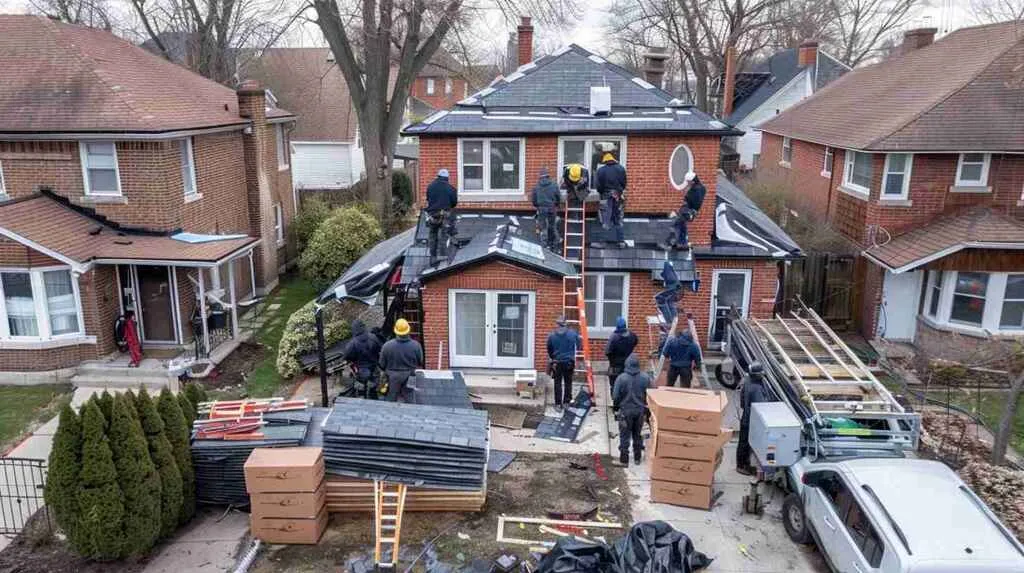
New Asphalt Shingle Roof Lifespan Queens NY – Real Expectations
Clockwork. That’s what the warranty pamphlet says – a nice, round 30 years of protection for your new asphalt shingle roof. But here in Queens, after 17 years climbing two-families from Bayside to Jackson Heights, I’m going to tell you what those numbers actually mean when your roof deals with our summers, winters, and everything in between: you’re looking at about 18 to 22 years of real life if everything goes right, and sometimes a lot less if it doesn’t.
Think of your roof like a three-set concert – the opening act, the main show, and the encore. The opening act (years 1-7) is when everything looks perfect and you barely think about it. The main set (years 8-18) is the real working phase where your roof does what you paid for. The encore (year 19+) is the final stretch, and just like at a concert, you never know exactly when the lights will come up. Queens weather – the full-blast sun, the freeze-thaw cycles, the occasional Nor’easter – compresses that show compared to gentler climates upstate or out west.
What a “30-Year” Asphalt Roof Really Means in Queens, NY
Let me be blunt: the number on the shingle package is not a promise, it’s marketing. If you ask me how many years should a new asphalt shingle roof last on a typical Queens home, I write down 18 to 22 years every single time, and that’s assuming proper installation, good ventilation, and you don’t do anything crazy like power wash your shingles. The printed warranty is testing done in a controlled lab, not on a brick two-family in Flushing where your attic hits 140 degrees in July and your neighbor’s HVAC exhaust blows right at your south-facing slope.
One evening in late spring, just before dark, I finished a roof in Bayside for a retired math teacher who had a spreadsheet of every quote she got. The old roof had lasted 28 years, and she quizzed me like I was in a calculus exam: “Rafa, give me your honest lower and upper range on how many years this new asphalt shingle roof should last.” I broke out my setlist analogy, walked her through weather, maintenance, and ventilation, and we wrote down a conservative 18-22 years. She called me last year – 6 years in – just to tell me her roof is still in the “opening act” and she’s tracking it like a science project.
Here’s how those 18 to 22 years break down in setlist terms. The opening act (years 1-7) means your roof looks brand new, shingles are sealed tight, and maintenance is basically “clean your gutters twice a year.” The main set (years 8-18) is when the roof is doing the heavy lifting – it’s not perfect anymore, you might see some granule loss in valleys, but it’s still keeping water out reliably. The encore (year 19+) is the end-of-life stage where you’re watching for curling edges, cracked shingles, and honestly planning your replacement budget before the next big storm makes that decision for you.
| Shingle Label on Package | Rafa’s Realistic Lifespan in Queens (Years) | Setlist Stage Breakdown | Assumptions |
|---|---|---|---|
| 30-Year Architectural | 18-22 years | Opening: 1-7 yrs Main Set: 8-18 yrs Encore: 19-22 yrs |
Proper install, good ventilation, normal maintenance, typical Queens weather exposure |
| 25-Year 3-Tab | 15-18 years | Opening: 1-5 yrs Main Set: 6-14 yrs Encore: 15-18 yrs |
Lighter-duty shingle, same install and ventilation standards, less tolerance for heat |
| 50-Year Premium | 25-30 years | Opening: 1-10 yrs Main Set: 11-24 yrs Encore: 25-30 yrs |
Heavier laminate, excellent attic airflow, owner keeps up with inspections and gutter cleaning |
| Lifetime “Designer” | 30-35 years | Opening: 1-12 yrs Main Set: 13-28 yrs Encore: 29-35 yrs |
Top-tier product, ridge vent plus soffit vents, low-slope or shaded exposure, proactive owner |
| Myth | Fact |
|---|---|
| A 30-year shingle will actually last 30 years in Queens. | In Queens, plan for 18-22 years on a standard architectural shingle. The warranty number assumes perfect lab conditions and doesn’t account for our freeze-thaw cycles, urban heat island effect, or typical attic ventilation problems. |
| All roofers install the same way, so lifespan is just about the shingle brand. | Installation quality – proper nailing placement, starter strip, drip edge, and ventilation setup – controls at least half your roof’s lifespan. A premium shingle installed poorly will age faster than a mid-grade shingle done right. |
| If your roof isn’t leaking, it’s still got plenty of years left. | By the time you see water inside, you’re usually deep into the encore and may already have decking damage. Curling edges, missing granules in concentrated areas, and cracked shingles are your real warning signs – not drips on your ceiling. |
| You can add years to an old roof by sealing or coating it. | Coatings can buy you 1-2 years of cosmetic improvement, but they don’t reverse UV damage, restore flexibility, or fix the underlayment. If your roof is at year 20+, budget for replacement, not Band-Aids. |
The Hidden Roof Killers in Queens: Ventilation, Pitch, and Microclimate
On more than half the roofs I inspect in Queens, the first thing I notice isn’t the shingles – it’s the attic temperature. About five winters ago, just after a nasty Nor’easter, I was on a two-family in Jackson Heights at 7 in the morning because the top-floor tenant had water coming through her bedroom light fixture. The roof was only 9 years old, but the installer had nailed high and skipped proper attic ventilation. I still remember seeing my breath in the attic while also feeling the heat from the apartment below – textbook condensation scenario. That job taught me how fast a supposedly “new” asphalt roof can age in Queens when people treat ventilation like an optional upgrade. Typical Queens building stock – attached brick homes, narrow two-families, smaller attics with limited airflow – makes good ventilation harder to achieve and twice as important.
Now, here’s the part nobody tells you: your roof’s pitch, how much shade it gets, and which Queens neighborhood you’re in each add or subtract years from that 18-22 range. A steep roof in Bayside under mature oak trees might squeeze 24 years out of the same shingle that only gives you 16 years on a low-slope ranch in full sun near the Rockaway-facing side of the borough. Proximity to salt air, prevailing wind direction, and whether you’re tucked between buildings or on an exposed corner lot all matter. Here’s my insider tip: on a hot summer day, go up into your attic around 2 p.m. and just stand there for 30 seconds. If it feels like a sauna and you can’t breathe comfortably, your ventilation isn’t doing its job, and your shingles are cooking from below every single day.
Top Quiet Roof Lifespan Killers in Queens Attics
Creates continuous airflow from eaves to peak, keeping attic temps closer to outside air and preventing moisture buildup.
Cuts off intake air, turning your attic into an oven in summer and a condensation factory in winter – both age shingles fast.
Keeps blown-in or batt insulation from blocking airflow channels, essential in Queens’ tight attic spaces.
“High nailing” means the shingle above doesn’t lock the nail down, so wind can lift edges and water can wick under faster.
Moisture should never dump into your attic; proper venting protects both your shingles and your decking.
Blocks air movement and traps heat, especially common in older Queens homes where insulation was added without rethinking ventilation.
Ignoring Attic Ventilation Can Cut a “30-Year” Roof to 10-12 Years
Poor ventilation creates a double attack: heat that literally bakes your shingles from below in summer, and condensation that rots your decking and curls shingle edges in winter. In Queens’ climate – humid summers, freeze-thaw winters – this isn’t some optional efficiency upgrade. It’s the difference between a roof that makes it to the encore and one that fails during the main set.
How Your Maintenance and Habits Change the “Setlist”
I still remember one roof in Rego Park where the homeowner thought “no leaks” meant “plenty of life left.” One August afternoon in Astoria, around 3 p.m., I was on a 12-year-old roof that looked 25 because the owner loved power washing everything, including his shingles. I remember my boots sticking to the overheated asphalt, and I could literally crumble the edges of the shingles with two fingers. That day I had to tell him, under that brutal sun, that his “30-year roof” was basically at the encore already – and that the pressure washing had cut off at least 8-10 years of its life. Power washing blasts off the protective granules, exposes the asphalt mat underneath to direct UV, and turns a roof that should still be in the main set into something that’s ready for the final song.
Here’s the thing: good maintenance keeps you in the main set longer, while bad habits rush you into the encore early. Think of it like a concert – if the band takes care of their voices, tunes their instruments between sets, and doesn’t trash the stage, they can play a longer show. Your roof’s the same way. My insider tip on what maintenance is actually worth doing: clean your gutters twice a year so water doesn’t back up under shingles, trim branches that scrape or drop constant debris, and leave the algae stains alone unless they’re structural (they’re almost never structural, just cosmetic). Don’t walk on your roof recreationally, don’t power wash it ever, and if you see a shingle or two blow off after a storm, get them replaced within a week, not next season.
Quick Self-Check: Is Your Roof in the Opening Act, Main Set, or Encore?
You can roughly estimate how many years your Queens roof has left by honestly placing it in one of the three setlist stages based on age, visible condition, and any symptoms you’re seeing. Just remember: Queens weather – the heat, the salt air if you’re near the water, the freeze-thaw – can shift you one stage ahead compared to what the same roof would look like in a quieter climate.
Where Is Your Roof in Its Setlist?
Straight Answers to Queens Roof Lifespan Questions
These are the real questions Queens homeowners ask me on the job, and these are Rafa’s real-world answers – not generic manufacturer copy or national averages that don’t account for our specific weather and building stock.
Why Queens Homeowners Trust Shingle Masters
All required permits, liability coverage, and worker’s comp – you’re protected on every job.
Rafa knows every neighborhood, building style, and microclimate quirk in the borough.
We tell you if you need a repair, a replacement, or just better ventilation – no upselling, just real answers.
Call us in the morning, and we’ll usually have someone on-site by afternoon or the following day.
When you ask me “how many years should a new asphalt shingle roof last,” I’m going to tell you 18 to 22 years in Queens if everything’s done right – and I’m going to explain exactly what “done right” means for your specific home. If your roof feels like it might be heading into the encore, or you just want to know where you stand in the setlist, give Shingle Masters a call. We’ll come out, take a real look at your attic ventilation, your shingle condition, and your local exposure, and tell you – within a few years – how much show your roof has left.