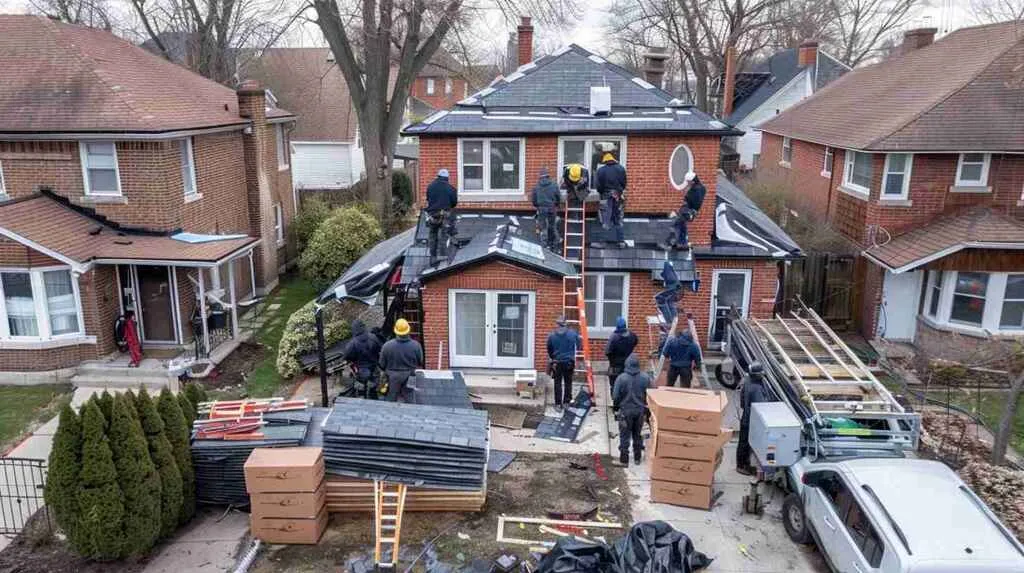
Faux Tile Roof Shingles Queens NY – Tile Look, Shingle Cost | Free Quotes
Quiet neighborhoods in Queens pay between $525 and $650 per square (100 sq. ft.) for faux tile roof shingles fully installed, while real clay or concrete tile routinely runs $950 to $1,400+ per square-meaning most homeowners pocket thousands in savings for a nearly identical street look. The rest of this article walks you through exactly how that price spread plays out on real Queens roofs once you understand where the water and wind actually hit your house, not just what glossy brochures promise.
Faux Tile Roof Shingle Cost in Queens vs Real Tile
On 89th Street last summer, I priced a faux tile shingle roof at $550 a square while the neighbor paid over $1,000 a square for real clay, and here’s what happened two winters later: my client’s roof sailed through back-to-back nor’easters and a freeze-thaw cycle that made parking lot potholes look tiny, while the neighbor had three cracked tiles and a call to an engineer about whether his rafters were sagging. That difference wasn’t about money-it was about physics. In Queens, where housing stock leans toward attached row homes in Jackson Heights, mid-century colonials in Bayside, and two- or three-family frames in Flushing, most structures simply weren’t engineered to carry the 900-1,200 pounds per square that real tile adds. So when I give you a faux tile price range of $525-$650 per square for a full tear-off, new underlayment, ice and water shield, and proper flashing, I’m not just talking about saving money-I’m talking about installing a roof your house can actually support without cracking ceilings or stressing joists. One August afternoon in Howard Beach, it was 94 degrees and the street was so hot it made that wavy mirage look, and I was standing on a low-slope roof explaining to a retired NYPD couple why real clay tile would snap under Queens freeze-thaw cycles. I pulled out two sample boards-real tile and faux tile shingles-and poured a water bottle over each while they watched it bead and run. When the husband saw how the faux tile shingles locked together and shed the water faster, he just nodded and said, “Yeah, I don’t want to be up here in February fixing this,” and that’s the day I realized demonstrations beat sales pitches every time. Here’s the thing: I judge every roofing choice by asking, “Where will the water try to go next?” and when you look at it that way, the cost difference between faux tile and real tile isn’t just about materials-it’s about every raindrop that slides off your roof during a wind-driven storm, and whether your deck can handle the weight without flexing and cracking the underlayment beneath.
Now, follow the water with me: when rain hits a pitched roof in Queens, it doesn’t politely trickle straight down-it gets shoved sideways by 30-mph gusts off the bay, forced under shingle laps by capillary action, and frozen into ice dams when your attic’s poorly vented. The heavier your roofing material, the more stress you put on every nail hole, every seam, and every rafter connection, which means water has more opportunities to wiggle through compromised spots. Real clay or concrete tile weighs enough that most Queens homes need structural upgrades-sistered rafters, thicker plywood, engineered trusses-before you even lay the first tile, adding another $3,000 to $8,000 to the bill depending on your attic situation. Faux tile roof shingles, on the other hand, weigh about the same as standard architectural shingles (roughly 240-350 pounds per square depending on brand), so your existing frame handles them fine as long as the deck’s solid. That weight difference also changes how water loads on the roof during a heavy rain: a tile roof can hold standing water between tiles if the pitch is low or the tiles aren’t perfectly aligned, while faux tile shingles lay flatter and shed water faster, reducing the chance of pooling and subsequent leaks. Most Queens homes-especially those built between the 1940s and 1980s-are structurally better suited to faux tile shingles than true tile, and once you add up materials, labor, and avoided structural work, the total savings usually lands between $8,000 and $15,000 for an average 2,000-square-foot roof.
Per-Square Faux Tile Roof Shingle Pricing Scenarios in Queens, NY
| Scenario | Roof Size | Complexity | Included Items | Estimated Faux Tile Shingle Price | Approx. Real Tile Price for Same Roof |
|---|---|---|---|---|---|
| Simple Ranch, Bayside | 15 squares (1,500 sq. ft.) | Low – basic gable, no valleys | Tear-off, standard underlayment, ice & water shield at eaves, faux tile shingles, ridge caps | $7,875 – $9,750 | $14,250 – $21,000 |
| Two-Story Colonial, Flushing | 22 squares (2,200 sq. ft.) | Medium – multiple valleys, chimney, skylight | Tear-off, synthetic underlayment, full ice & water shield, chimney flashing, faux tile shingles, hip & ridge system | $12,100 – $14,300 | $20,900 – $30,800 |
| Attached Home, Jackson Heights | 12 squares (1,200 sq. ft.) | Medium – shared walls, tight access, modest pitch | Tear-off, high-temp underlayment, flashing at parapets, faux tile shingles | $6,600 – $7,800 | $11,400 – $16,800 |
| Multi-Family, Astoria | 28 squares (2,800 sq. ft.) | High – multiple roof levels, parapets, HVAC penetrations, steep sections | Tear-off, synthetic underlayment, ice & water shield at all transitions, custom flashing, faux tile shingles, upgraded fasteners for wind | $16,800 – $18,200 | $26,600 – $39,200 |
| Rockaway Beach Bungalow | 18 squares (1,800 sq. ft.) | Medium-High – wind zone upgrade, hip roof, dormer, close to saltwater | Tear-off, high-wind rated underlayment, full ice & water shield, corrosion-resistant flashing, wind-rated faux tile shingles, upgraded nails | $10,800 – $11,700 | $17,100 – $25,200 |
Prices include labor, materials, tear-off, disposal, and standard warranties. Real tile prices assume no structural upgrades; add $3,000-$8,000+ for most Queens homes to handle tile weight.
Cost and Weight Comparison: Faux Tile Shingles vs Real Tile for Queens Homes
| Factor | Faux Tile Roof Shingles (Queens Typical) | Real Clay/Concrete Tile (Queens Typical) |
|---|---|---|
| Cost per Square | $525 – $650 installed | $950 – $1,400+ installed |
| Approx. Roof Weight Added | 240 – 350 lbs/square (similar to architectural shingles) | 900 – 1,200 lbs/square |
| Typical Install Time for 2,000 sq. ft. | 3 – 5 days (weather permitting) | 7 – 12 days, plus structural prep time |
| Typical Structural Upgrades Needed in Queens | Rarely; only if deck is rotten or undersized | Often; may require rafter sistering, thicker plywood, engineer sign-off |
Can Your Queens Roof Actually Handle Real Tile?
Let me be blunt: if your roof deck can’t handle the weight, real tile is a fantasy, not a project. One job that almost went sideways was in Bayside, late fall, clouds coming in fast, homeowner insisting we keep the existing flimsy decking to “save money” while switching to faux tile roof shingles for the look. Halfway through tear-off, we found a patchwork of three different plywood thicknesses and an old satellite dish bracket that had been leaking for years, soaking a hidden corner. I stopped the crew, brought the homeowner onto the scaffold, showed him how the rot lined up perfectly with the old penetrations, and we changed course on the spot-full re-sheet in that area and upgraded underlayment-saved the faux tile system from failing before it even went through a winter. Here’s what most people don’t realize: typical Queens housing stock-attached homes in Jackson Heights with shared trusses, Bayside colonials built in the ’60s with 2×6 rafters on 24-inch centers, Flushing two- and three-family frames that were balloon-framed before modern codes-was never designed for tile weight. Real clay or concrete tile adds roughly three to four times the load of asphalt or faux tile shingles, and that extra weight doesn’t just stress the rafters; it stresses every connection point, every nail plate, every ceiling joist tie, and every wall plate. In older homes, you’ll sometimes find rafters that are already slightly undersized by today’s standards, and slapping 20,000 pounds of tile on top is like asking a Honda Civic to tow a boat trailer-it might look fine parked, but the first big storm will expose the weakness.
Now, follow the water with me: when you have uneven decking-say, half-inch plywood in one section and three-eighths OSB in another-the roof surface isn’t uniformly rigid, so water running across it will find low spots and pool instead of shedding cleanly. Add the weight of real tile pressing down on those weak spots, and you’ve created a slow-motion failure where the deck flexes, the underlayment tears at the seams, and water starts wicking under the tiles at every fastener hole. I’ve seen it happen on a mixed-deck job in Whitestone where the homeowner wanted real tile for curb appeal but refused to pay for a full re-sheet; three years later, he had ceiling stains in two bedrooms and a $6,000 repair bill that could’ve been avoided with either a proper deck upgrade or a switch to faux tile shingles from the start. Lighter faux tile roof shingles sit flatter because they don’t sag the deck, they stress fasteners less, and they allow the underlayment to do its job without constantly being pulled and stretched by shifting weight. Don’t get me wrong-faux tile shingles still need a solid deck, proper nailing, and good underlayment-but they’re forgiving in a way that real tile isn’t, especially on homes that were built before anyone cared about snow load calculations or wind uplift ratings. If your home’s existing structure can’t pass a basic rafter-span table for tile weight, faux tile isn’t a compromise; it’s the smart play that keeps your roof on your house instead of in your living room.
Deciding Between Faux Tile Roof Shingles and Real Tile in Queens, NY
Start here:
❓ Is your home already engineered for heavy tile (confirmed by an engineer or original building plans showing tile-rated framing)?
✅ YES: You can consider real tile, but still compare total cost, freeze-thaw performance, and repair complexity to faux tile shingles before committing. Proceed to budget question.
❌ NO or UNSURE: Real tile will require structural upgrades (engineer report, rafter sistering, thicker deck). Recommend faux tile roof shingles unless you’re prepared to spend an extra $3,000-$8,000+ on framing work. Skip to roof pitch question.
❓ Is your total project budget above $25,000 and are you willing to invest in structural modifications if needed?
✅ YES: Real tile remains on the table; get a structural assessment and compare long-term maintenance. Proceed to pitch question.
❌ NO: Choose faux tile roof shingles-you’ll get the tile aesthetic and save thousands while avoiding structural work. End path: Faux Tile Roof Shingles Recommended.
❓ What is your roof pitch?
Low (3:12 or below): Real tile can trap water between tiles. Strongly recommend faux tile shingles with upgraded underlayment for better water shedding. End path: Faux Tile Roof Shingles Recommended.
Standard (4:12 to 7:12): Both options work if structure supports it; compare wind rating and freeze-thaw specs. Proceed to priority question.
Steep (8:12 or above): Both shed water well; real tile offers prestige but faux tile shingles are safer to repair and lighter. Proceed to priority question.
❓ Do you care more about authentic tile prestige or practical performance and cost?
Prestige & authenticity matter most: If structure and budget allow, real tile may be worth it-but understand you’re paying a premium for looks and accepting higher repair costs. End path: Real Tile with Full Engineering Assessment.
Performance, longevity, and value matter most: Choose faux tile roof shingles-better wind and freeze-thaw performance, lower lifetime cost, easier repairs, and nearly identical curb appeal. End path: Faux Tile Roof Shingles Recommended.
❓ Still not sure which direction to go?
End path: Schedule a Full Roof Evaluation First-we’ll inspect your deck, measure pitch, check rafter spans, and give you side-by-side written quotes for both faux tile shingles and real tile (with required structural work itemized) so you can make an informed choice based on your actual roof, not guesswork.
What Makes a Faux Tile Roof Shingle System Work in Queens Weather
Here’s the ugly truth about faux tile roof shingles: some brands are just painted rectangles pretending to be tile; others are engineered like a puzzle that refuses to leak. One January morning in Astoria, it was 26 degrees with that damp river wind, and I got a call from a landlord panicking because pieces of his old faux barrel tile panels were literally blowing down onto the sidewalk. When I arrived, you could see the plastic panels had become brittle and were cracking along every exposed edge, but his insurance only wanted “like kind” replacement. I spent two hours documenting and then showing him how modern faux tile roof shingles meet wind ratings, lay flatter, and interlock better than those old panels, and we used that to push the adjuster into approving a full upgrade-no more flying “tiles” in the next nor’easter. The difference between a faux tile system that lasts 25 years and one that starts falling apart in five comes down to three things: the shingle’s actual engineering (not just its color), how it interlocks at both the head-lap and the side-lap, and whether it’s rated for the wind and freeze-thaw cycles we actually see in Queens. When I’m quoting a job, I tell homeowners to ask two specific questions before they sign anything: What is the exact wind rating of this faux tile shingle in miles per hour? (anything under 110 mph for Queens is asking for trouble near the coast or on a corner lot), and Can you show me how the shingle locks at both the head-lap and the side-lap so I know it’s a real interlock system and not just overlapping tabs? If the contractor can’t answer those two questions with actual numbers and a physical demonstration, you’re probably looking at a product that’ll look great for two years and then start disappointing you every storm season.
$1,200 is about what it costs to fix one bad leak after a nor’easter in Astoria if the “tile-look” shingles weren’t detailed right-ask me how I know. Now, follow the water with me: when wind-driven rain hits your roof at a 45-degree angle during a coastal storm, it doesn’t just run down the slope-it actively tries to push up under every shingle edge, especially at the eaves, in valleys, and around any penetration like a chimney or vent pipe. In Queens, we deal with two specific enemies that most other places don’t see together: wind-driven rain off the Atlantic that can literally drive water uphill under poorly sealed shingles, and freeze-thaw cycles that turn any trapped moisture into expanding ice that pries apart seams and cracks underlayment. A faux tile roof shingle system that works here has to address both threats at every vulnerable spot. That means starting with a high-quality synthetic or high-temp underlayment that won’t crack when it freezes, laying ice and water shield not just at the eaves but in every valley and around every penetration where wind can push water backward, installing proper starter strips so the very first course of faux tile shingles has something to seal against, using manufacturer-approved hip and ridge pieces (not generic caps) so the peaks don’t become wind-lift points, upgrading to ring-shank or wind-rated nails that won’t back out when the shingles flex in 60-mph gusts, and flashing every skylight, chimney, and vent with step flashing and counter-flashing that anticipates where water will pool and redirects it before it finds a way in. If even one of those steps gets skipped or done wrong, you’ve handed the water an invitation-and in Queens weather, water always RSVPs.
Key Components of a Queens-Ready Faux Tile Roof Shingle System
-
✅
High-temp or synthetic underlayment that won’t crack in freeze-thaw cycles and provides secondary water barrier across the entire deck -
✅
Ice & water shield at eaves and valleys (minimum 3 feet up from edge, full-coverage in valleys) to stop wind-driven rain and ice dam infiltration -
✅
Proper starter strips along eaves and rakes so the first course of faux tile shingles has a sealed edge, preventing wind uplift at the most vulnerable row -
✅
Manufacturer-approved hip & ridge pieces designed to match the faux tile profile, installed with overlapping seals to resist wind and water intrusion at peaks -
✅
Upgraded nails for wind zone (ring-shank or high-wind rated, placed per manufacturer spec) to prevent fastener back-out during 50-70 mph gusts common in Queens coastal areas -
✅
Precise flashing around skylights, chimneys, and penetrations with step flashing, counter-flashing, and sealant applied where water will pool or be driven upward by wind
Evaluating Faux Tile Roof Shingles for Queens Homes
| Pros of Faux Tile Roof Shingles | Cons of Faux Tile Roof Shingles |
|---|---|
| Beautiful tile look at shingle cost-save $8,000 to $15,000 on a typical Queens roof compared to real clay or concrete tile | Doesn’t carry the same prestige or authenticity as real clay tile for historic or luxury homes where appearance matters more than practicality |
| Significantly lighter weight (240-350 lbs/sq vs 900-1,200 lbs/sq), allowing installation on most Queens homes without structural upgrades | Final performance depends heavily on installation quality-poor detailing around flashing or valleys can lead to leaks just like any shingle roof |
| Better performance in wind and freeze-thaw cycles-flexes without cracking, sheds water faster, and resists uplift when properly fastened | Cheaper products can fade, delaminate, or lose granules faster than premium architectural shingles; brand and warranty matter |
| Easier and cheaper repairs-individual faux tile shingles can be replaced without specialized labor, unlike real tile that often requires matching discontinued profiles | Not ideal for ultra-low slopes (below 3:12) where any shingle system can struggle with water pooling; real tile with proper underlayment may handle it better |
| Compatible with most existing Queens roof decks as long as plywood is solid-no need for rafter upgrades, engineering reports, or permit delays | Some HOAs or landmark districts in select Queens pockets may require real tile for aesthetic uniformity; always check local restrictions before committing |
Step-by-Step: How We Install Faux Tile Roof Shingles in Queens, NY
Picture your roof like a subway system-your faux tile shingles are the trains, but the underlayment and flashing are the tracks and signals keeping everything from crashing. When Shingle Masters shows up for a faux tile roof shingle install in Queens, we’re not just nailing down pretty rectangles and calling it a day; we’re building a water-management system that anticipates exactly where wind-driven rain and melting snow will try to sneak past your defenses, then blocking those paths before the first shingle ever goes down. The process starts with a full on-roof and attic inspection so we can see not just what the shingles look like from the curb, but what the deck looks like from below-sagging spots, water stains on rafters, ventilation issues, and any signs that previous leaks compromised the structure. Then we do a complete tear-off, photograph every inch of exposed deck, and walk the homeowner through exactly what we found: solid plywood that’s good to go, soft spots that need new sheets, old flashing that’s rusted through, or hidden rot around chimneys and vents. Now, follow the water with me: once the deck’s exposed, we map out where water will flow during a storm-down the slopes, into the valleys, along the eaves, around penetrations-and that map dictates our underlayment and ice-and-water-shield layout, because if we don’t stop the water at those choke points, no amount of pretty faux tile shingles will keep your ceiling dry. After any deck repairs or re-sheeting, we roll out high-quality underlayment across the entire roof, apply ice and water shield at every eave, valley, and penetration where wind can push water backward, install metal drip edge and proper starter strips so the first row of faux tile shingles has something to seal against, then methodically lay each course of faux tile shingles with precise alignment and interlock checks so the whole system works as one continuous water barrier. Hip and ridge detailing comes last, using manufacturer-matched pieces that lock into the field shingles and resist wind uplift at the roof’s most exposed points, and we finish with a full cleanup, magnet sweep for stray nails, and a final walkthrough where I literally show the homeowner the water path we just armored so they understand what they paid for and why it’ll still be working in 20 years.
Our Queens Faux Tile Roof Shingle Installation Process
-
1
On-roof and attic inspection – We check shingle condition, flashing, ventilation, and examine the underside of the deck for water stains, sagging, or structural issues before quoting -
2
Tear-off and deck assessment with photos – Complete removal of old shingles and underlayment, followed by a detailed photo inspection of the exposed deck so you see exactly what we see -
3
Deck repairs and re-sheeting as needed – Replace any soft, rotten, or undersized plywood; sister weak rafters if discovered; ensure a solid, uniform surface for the new system -
4
Underlayment, ice & water shield, and flashing layout – Roll high-temp or synthetic underlayment across the entire deck, apply ice and water shield at eaves, valleys, and penetrations, install drip edge and step flashing -
5
Faux tile shingle installation with pattern and alignment check – Lay starter course, then install each row of faux tile shingles with proper overlap, interlock, and fastener placement; periodically step back to verify pattern alignment -
6
Hip, ridge, and accessory detailing – Install manufacturer-matched hip and ridge caps with proper overlap and wind-rated fasteners; seal all penetrations (vents, pipes, chimneys) with approved flashing and sealant -
7
Cleanup, magnet sweep, and final water-path walkthrough – Remove all debris, run magnets across yard and driveway for stray nails, then walk the homeowner across the roof (or show photos) explaining the water path and how each layer protects their home
Before You Call: What to Know About Faux Tile Roof Shingles in Queens
Gathering these details ahead of time helps us give you a faster, more accurate quote and recommendation:
-
☑
Roof age – How old is your current roof, and do you know what material is up there now? -
☑
Known leak spots or problem areas – Any ceiling stains, attic dampness, or places where you’ve seen water during storms? -
☑
Attic access – Can we get into your attic to inspect the underside of the deck and check for ventilation or hidden damage? -
☑
Rough roof size or number of squares – If you know the approximate square footage or have an old estimate, it speeds up our ballpark pricing -
☑
Past structural issues – Any history of sagging, ceiling cracks, or prior roof repairs that might hint at deck or framing problems? -
☑
Your top priority: look, lifespan, or budget – Knowing whether you care most about curb appeal, maximum durability, or lowest upfront cost helps us recommend the right faux tile shingle system and options
Common Questions About Faux Tile Roof Shingles in Queens
First thing I ask a homeowner in Queens is, “Are you chasing a look, a lifespan, or a low bill-and which one do you actually care about when it’s snowing sideways?” Because the answers change depending on whether we’re talking about a Jackson Heights rental, a Bayside family home, an Astoria multi-family, or a Rockaway beach house where salt spray hits the roof every high tide. The FAQs below are based on where water and wind actually hit Queens roofs, not the glossy promises in a brochure, and every answer comes from fixing someone else’s mistake or preventing a new one before it costs you a weekend and a few thousand bucks.
How long do faux tile roof shingles last in Queens vs real tile?
Quality faux tile roof shingles typically carry 30- to 50-year manufacturer warranties and realistically last 25 to 35 years in Queens weather if installed correctly with proper underlayment and ventilation. Real clay or concrete tile can last 50+ years in ideal conditions, but Queens isn’t ideal-our freeze-thaw cycles crack tiles, high winds snap them, and the sheer weight stresses fasteners and deck over time, leading to earlier repairs and replacements than you’d see in, say, Florida or California. Here’s the kicker: faux tile shingles shed water faster because they lay flatter and interlock tighter, so even though the material itself might not outlive clay, the system often performs better longer because water doesn’t pool, freeze, and pry things apart. I’ve seen 20-year-old faux tile roofs in Bayside that still look tight, and 15-year-old real tile roofs in Astoria where half the ridge caps are cracked and the homeowner’s patching every spring. Lifespan isn’t just about the shingle; it’s about how well the whole assembly handles the water path during nor’easters and January thaws.
Will faux tile shingles really look like clay tile from the street?
From 30 feet away-the distance most people see your roof-a high-quality faux tile shingle system is nearly indistinguishable from real clay or concrete tile, especially if you choose a profile with dimensional depth and a color blend that mimics natural tile variation. Up close, say from a ladder or a neighbor’s second-story window, you’ll notice the difference: real tile has that chunky, handmade irregularity and a deep shadow line, while faux tile is more uniform and slightly flatter. But honestly, most Queens homeowners care about curb appeal, not whether a roofer standing on the ridge can tell it’s composite. The key is picking a faux tile shingle with actual texture and a multi-tone finish, not a flat stamped pattern that looks like someone printed “tile” on asphalt. I’ve had clients in Howard Beach fool their own contractors during inspections, and I’ve had others pick cheap faux barrel panels that looked like a cartoon from day one. Quality matters, and so does installation-if the rows aren’t straight and the pattern’s sloppy, even real tile looks bad.
Can you install faux tile shingles over my existing roof?
Technically, some building codes in New York still allow one layer of shingles over an existing roof if the deck is sound and you’re not exceeding weight limits-but I almost never recommend it for faux tile shingles, and here’s why: you’re covering up problems you can’t see, you’re creating an uneven surface that makes the faux tile pattern look wavy, and you’re trapping moisture between the old and new layers, which accelerates rot and kills your new roof’s lifespan before it even gets started. When we tear off the old roof, we inspect every inch of deck, find hidden leaks around chimneys and vents, replace soft plywood, and start fresh with flat, solid underlayment that lets the faux tile shingles interlock properly. Now, follow the water with me: if there’s a low spot or a rotted section under your old shingles, water will pool there under the new faux tile, freeze, expand, and crack the underlayment-and you won’t know until you’ve got a ceiling stain and a $2,000 repair bill. Tear-off costs an extra $100 to $150 per square in Queens, but it’s the difference between a roof that works and one that’s just prettier junk stacked on top of old junk.
How do faux tile shingles hold up to Queens wind and nor’easters?
When installed with proper fasteners, starter strips, and manufacturer-rated hip and ridge caps, quality faux tile roof shingles are actually better in high wind than real tile because they’re lighter, more flexible, and designed to interlock at multiple points so wind can’t pry them up. Real tile is rigid and heavy, which sounds tough until you realize that means each tile acts like a sail under uplift-if one cracks or the fastener loosens, the wind gets under it and the whole thing can blow off in chunks during a 60-mph gust. Faux tile shingles rated for 110 to 130 mph (which is what I spec for Queens coastal and corner-lot homes) flex slightly under pressure, then spring back without cracking, and the interlocking tabs mean even if one shingle loosens, the ones around it hold the system together. I’ve seen faux tile roofs in Rockaway and Astoria come through Sandy, multiple nor’easters, and winter wind events without losing a single shingle, while nearby real tile roofs had missing pieces and broken ridges. The catch is you have to use the right nails (ring-shank or high-wind rated, not smooth-shank staples) and you have to follow the fastener pattern-if the installer skips nails or rushes the hip caps, wind will find that weakness and exploit it every time the weather turns nasty.
How quickly can Shingle Masters inspect my roof and give a written quote in Queens, NY?
For most Queens neighborhoods-Jackson Heights, Bayside, Flushing, Astoria, Rockaway, Forest Hills, Whitestone, and surrounding areas-we typically schedule an on-roof inspection within 24 to 48 hours of your call, depending on weather and our current project load. The inspection itself takes 45 minutes to an hour: I get on the roof, check the deck from the attic if you’ve got access, take photos of problem spots, measure the roof, and walk you through exactly what I’m seeing and where the water’s going. You’ll have a written quote in your email or hand before I leave, itemizing faux tile shingle options, underlayment upgrades, flashing work, and any deck repairs we found, so there’s no waiting around wondering what it’ll cost. If I find something that changes the scope-say, unexpected rot or a structural issue-I’ll photograph it, explain it on the spot, and give you both a base price and an adjusted price so you can make an informed decision without surprises halfway through the job. No high-pressure sales, no vague “we’ll get back to you,” just a clear breakdown of what your roof needs, what it’ll cost, and why each piece matters for keeping water out of your house during the next Queens winter.
Why Queens Homeowners Trust Shingle Masters for Faux Tile Shingles
-
✓
NYC licensed and fully insured – We carry all required city and state licenses, plus comprehensive liability and workers’ comp so your property and our crew are protected -
✓
19+ years of roofing experience – Carlos has been working on Queens roofs since before smartphones, and he’s seen every type of deck, every weather pattern, and every way a roof can fail -
✓
Fast response time – Most Queens estimates scheduled within 24-48 hours; emergency inspections available for active leaks or storm damage -
✓
Photo documentation of every problem area – You get pictures of your deck, flashing, and any hidden damage with every quote, so you see what we see and understand exactly what you’re paying for -
✓
Written warranties on labor and materials – Our workmanship is guaranteed in writing, and we provide full manufacturer material warranties for the faux tile shingle brand you choose
In Queens, a faux tile roof shingle system only works if it’s designed around where the water and wind actually hit your house-not just the color on the brochure or the cheapest price you found online. Call Shingle Masters to schedule an on-roof inspection and free written quote for faux tile roof shingles in Queens, NY, where Carlos will literally walk you through the water path on your own roof, show you the weak spots, and explain exactly how we’ll armor them before you spend a dollar.