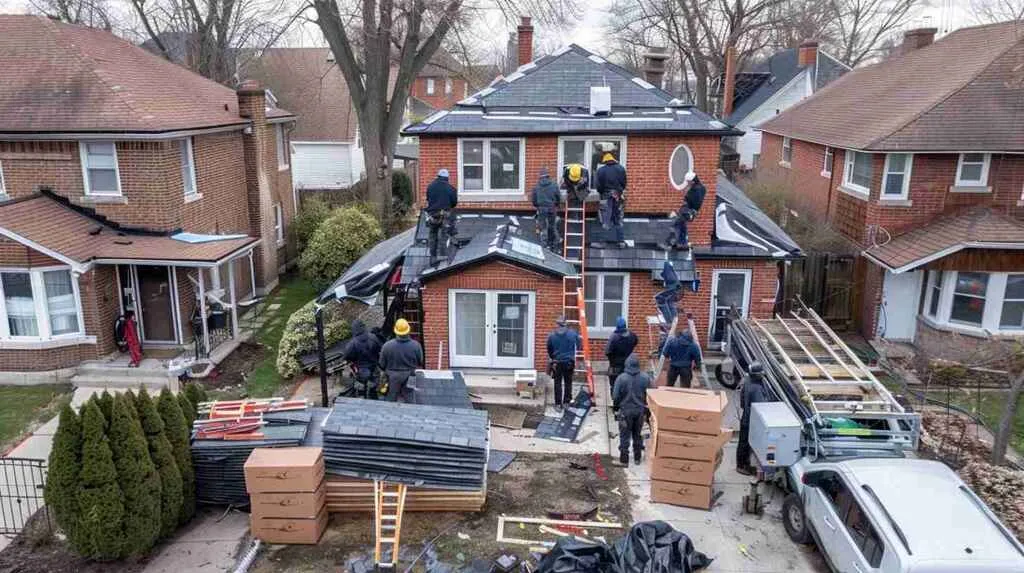
Double Shingle Roof Queens NYC – When It’s Done and What It Means
In Queens, that “cheap” double shingle roof almost always adds $6,000-$12,000 to what you’ll pay later when we have to tear everything off and fix what you can’t see. My name’s Rosa Delgado, and after 19 years roofing across Woodside, Jackson Heights, Ridgewood, and Bayside, I’ve watched this same story play out about twice a month-folks think they’re saving money today by laying a second layer of asphalt shingles right over the old ones, but they’re actually buying a much bigger problem down the road.
What a Double Shingle Roof Really Means in Queens
A double shingle roof is exactly what it sounds like: a contractor installs a brand-new layer of asphalt shingles directly over your existing shingles instead of tearing the old ones off first. On paper, it looks like a win-less labor, less mess, less money upfront. But that $6,000-$12,000 added cost I mentioned shows up a few years later when the real problems start and we have to haul away double the weight at the dump, pull twice as many nails, and replace all the decking that’s been quietly rotting under those stacked layers.
Here’s what most folks don’t realize until I show them a cut-out of their roof: one August afternoon around 4 p.m., the heat was bouncing off a two-family in Jackson Heights so hard my boots felt soft, and I found four layers of shingles under what the owner swore was “just a quick second layer from ten years ago.” When I showed him the cross-section I’d cut out, he went silent-he’d just gotten a letter from his insurance asking about “roof condition” and had no idea this could void his coverage. That job turned into a full tear-off that ran two extra days because every nail we pulled brought up rotten wood we couldn’t see under all those shingles. Picture your roof like the human body: the shingles are the skin, the decking underneath is the bones, and when you stack a second skin over the first, you’re not protecting the bones-you’re suffocating them with a damp, heavy blanket that never lets moisture escape.
If you asked me this over your front stoop right now, I’d tell you straight: in Queens, I almost never recommend a double shingle roof unless we’re talking about a very narrow set of conditions-steep pitch, solid structure, well-ventilated attic, currently only one layer, and you’re okay with shorter shingle life and a massive future tear-off bill. Our older Queens housing stock, the heavy snow we get some winters, the summer humidity that just sits on these roofs-all of it works against double layers. I’d rather do one proper tear-off now than patch layered problems twice.
| Myth about Double Shingle Roofs | Reality in Queens, NY |
|---|---|
| “A second layer is always cheaper and just as good.” | It’s cheaper today but usually adds $6,000-$12,000 to your eventual tear-off once we deal with disposal, extra labor, and hidden wood rot. |
| “If my house handled one layer, a second won’t matter.” | Older Queens framing and decking can be borderline; extra weight plus snow can overstress the “bones” of the house. |
| “Insurance doesn’t care how many layers I have.” | Many carriers flag multiple layers as a condition issue and can deny water damage claims once they see stacked shingles. |
| “You can always just add another layer later.” | Queens code and manufacturers usually limit you to two asphalt layers max, and most roofs here are already on their last legal layer. |
| “If the top looks ok, the bottom layer is fine too.” | The lower “skin” can be cracked and leaking while the upper looks decent; you don’t see the real damage until we cut a section out. |
Cost Breakdown: Double Layer vs Full Tear-Off in Queens, NY
Last week on a block in Woodside, I gave a homeowner two estimates-one for double-shingling her 1,400-square-foot two-family, one for a proper tear-off. She was leaning toward the $4,800 double-shingle quote until I walked her through what happens in five to seven years when that roof starts leaking and we have to strip both layers, haul them to the dump by weight, and replace all the decking that’s been quietly turning to mush because it couldn’t breathe. Typical Queens homes-your row houses, your attached two-families, your corner three-families in Ridgewood-run anywhere from 1,000 to 1,800 square feet of roof, and every one of those square feet gets heavier and more expensive to fix later when you stack shingles instead of starting fresh.
Disposal alone is brutal: the transfer station charges by the ton, and two layers of shingles weigh roughly double what one does. Then there’s the labor-pulling nails through two sets of shingles is slow, miserable work, and once we expose the decking, we’re almost always finding soft spots, cracks, or full-on rot that wouldn’t be there if the roof had been able to dry out. All those “hidden” repairs add up fast, and that’s before we even talk about the fact that shingles installed over a bumpy, uneven surface just don’t last as long as they should. The cheaper quote today becomes the expensive nightmare tomorrow.
| Scenario (Queens Home Type) | Double Shingle “Quick Fix” Now* | Proper Tear-Off & Single Layer Now* | Extra You’ll Likely Pay Later |
|---|---|---|---|
| Small attached row house (~1,000 sq ft) | $3,500-$4,500 | $6,000-$8,000 | $4,000-$6,000 added to future full tear-off because of extra labor and disposal |
| Typical 2-family in Woodside/Jackson Heights (~1,400 sq ft) | $4,500-$6,000 | $7,500-$10,000 | $6,000-$9,000 extra later once we strip two layers and repair hidden deck damage |
| Corner 3-family in Ridgewood (~1,800 sq ft) | $6,000-$7,500 | $10,000-$13,500 | $8,000-$12,000 extra at next tear-off, especially if wood sheathing is saturated |
| Low-slope addition over kitchen (~400 sq ft) | $1,500-$2,000 | $2,800-$3,800 | $2,000-$3,500 extra later due to frequent leaks and deck replacement |
| Older detached home with existing 2 layers | Usually not code-compliant to add a 3rd layer | $9,000-$12,000 for full strip to deck | Risk of fines/failed inspections and full redo if a third layer is discovered |
*These are ballpark ranges for Queens, NY as of current market conditions, assuming standard asphalt shingles and basic accessibility.
⚠️ Warning for Queens Homeowners: That cheaper double layer quote usually does not include: (1) future disposal of two full shingle layers by weight at the dump, (2) repairing rotten or spongy decking that’s been trapped under shingles, and (3) the risk of insurance denying a leak claim because the roof has multiple layers.
How Double Shingle Roofs Fail: Moisture, Weight, and Code
Moisture: Your Roof’s “Lungs” Can’t Breathe
On my moisture meter, anything over 16% in your decking is a red flag, and double shingles push it there faster. Think of your roof’s ventilation system like lungs: air needs to move in through the soffits, flow up under the decking, and out through ridge or gable vents. When you stack a second layer of shingles, you’re basically wrapping a second, damp skin around those lungs-the air can’t move, moisture gets trapped between the layers, and the wood underneath starts to break down. Before you even think about adding a second layer, check your ventilation: are your soffit vents clear, do you have ridge vents, are there any baffles in the attic to keep insulation from blocking airflow? If any of those boxes aren’t checked, a double shingle roof will turn your decking into a sponge within a few years, and once that moisture hits 16% or higher, you’re looking at mold, rot, and a much bigger repair bill.
Weight and Old Queens Framing
Picture your roof as a thick, damp blanket sitting on your house instead of a jacket that can breathe. A winter night at about 9 p.m., I was on a Ridgewood roof with a flashlight and headlamp because a landlord had tenants threatening to call 311 over ceiling stains. The top layer was newer architectural shingles, but the first layer underneath was from the late ’80s-thin as cardboard and brittle, and whoever did the double shingle roof had nailed high, right into the seams below. Ice had formed in those nail lines and opened them like zippers. I snapped a photo of the overlapping seams, showed it to the landlord on my phone in the hallway, and that’s what finally convinced him that “cheaper to double up” had already cost him two angry tenants and an emergency callout. Older Queens homes weren’t designed for the extra weight of two shingle layers plus snow and ice; the rafters and joists can handle it for a while, but eventually you start seeing sagging, stress cracks in ceilings, and nail pops where the structure is telling you it’s had enough.
Code, Inspectors, and Insurance
One rainy November morning in Bayside, a retiree called me in a panic because water was dripping from her recessed lights, and her “friend of a friend” had double-shingled the roof the previous spring. I climbed up between showers and could see the second layer already cupping and sliding because they’d skipped half the nails to “keep weight down”-which does the exact opposite of what they intended. We had to tarp it overnight, and the next day I walked her through why we’d strip everything, replace the soaked decking over the kitchen, and never put a second layer on that low a pitch again. NYC code generally allows up to two asphalt shingle layers, but that doesn’t mean inspectors and insurance adjusters are happy about it-they see multiple layers as a maintenance red flag, and if there’s any sign of leaks, sagging, or improper installation, they can call it out as a defect and require a full replacement. I’ve had insurance companies deny water damage claims the moment they see stacked shingles in a photo, and I’ve watched DOB inspectors write violations for double layers that were installed without permits or on structures that couldn’t handle the load.
| Option | Pros | Cons (Especially in Queens) |
|---|---|---|
| Second layer over existing shingles | Lower upfront cost; faster install; less mess inside and around the house | Adds weight to older framing; traps moisture in decking; can hide leaks until damage is severe; may conflict with manufacturer warranties; can trigger insurance issues; makes future tear-off much more expensive |
| Full tear-off to decking, then new single layer | Lets us inspect and repair the “bones” (decking and framing); better ventilation; shingles lay flatter and last closer to their rated life; inspectors and insurers are happier | Higher cost today; more labor and debris; slightly longer project timeline |
Call Right Away (Urgent)
- Active leaking around lights, fans, or along exterior walls under a known double-layer area.
- Ceiling stains growing after every storm on a low-slope section that has two layers.
- Shingles sliding, cupping, or missing on the newer top layer.
- Ice dams forming along eaves where multiple layers meet gutters.
Can Be Planned (Soon, But Not Tonight)
- Roof looks wavy or overbuilt, but no current leaks inside.
- You’ve been told you have two layers during a past inspection but everything is currently dry.
- Roof is near the end of its life and you’re considering options for replacement.
- You’re refinancing or changing insurance and want to know if the double layer will be a problem.
Should You Double Shingle Your Queens Roof at All?
If you asked me this over your front stoop right now, I’d tell you straight: don’t do it unless every single box is checked-steep pitch, solid structure, good ventilation, currently only one layer, and you’re willing to accept shorter shingle life and a massive future tear-off bill. In almost every Queens scenario I see, you’re better off biting the bullet and doing a proper tear-off now. The rare exception might be a well-maintained, structurally sound home with perfect airflow and a single layer that’s failing early, but even then I’d want to inspect the attic, check the decking with a moisture meter, and make sure your insurance won’t penalize you before I’d sign off on it.
Quick Check: Is a Double Shingle Roof Even on the Table for Your House?
Start: Do you currently have only one shingle layer on your roof?
↳ No → A double shingle roof is off the table; you need a tear-off to the deck.
↳ Yes → Next: Is your roof structure (rafters, decking) in good condition with no sagging?
↳ No → Full tear-off and structural check recommended; adding weight is risky.
↳ Yes → Next: Is the roof slope at least a standard pitch (not low-slope/flat)?
↳ No → Don’t double-layer low-slope in Queens; it leaks and traps moisture.
↳ Yes → Next: Are you okay with a shorter shingle life and higher future tear-off cost?
↳ No → Choose a full tear-off now.
↳ Yes → A carefully installed second layer might be possible, but only after an in-person inspection and code check.
Before You Call About a Double Shingle Roof in Queens
Let me put it the way I tell my stubborn uncles in Corona: gather your paperwork, take some clear photos of the roof and any inside stains, and dig up any old invoices or inspection reports that mention how many layers you’ve already got. Knowing your roof’s approximate age and whether someone’s ever “just gone over it” helps me give you a much tighter estimate and honest advice about whether Shingle Masters should tear everything off or if there’s any chance a second layer makes sense for your specific house.
What to Gather Before Calling Shingle Masters About Your Queens Roof
- ✅ Take clear photos of the roof from the street and backyard, plus any close-ups of curling or missing shingles.
- ✅ Snap pictures of any interior stains, especially around lights, fans, and along exterior walls.
- ✅ Check your paperwork: past roof invoices, inspection reports, or insurance documents that mention roof age or number of layers.
- ✅ Note any recent letters or emails from your insurance asking about “roof condition” or “updates.”
- ✅ Walk the top floor and attic (if safe) and write down where you feel drafts, see daylight, or smell damp wood.
- ✅ Have a rough idea of when the last roof was installed and whether anyone has ever mentioned layering or “just going over it.”
Common Questions Queens Homeowners Ask About Double Shingle Roofs
Is a double shingle roof legal in Queens, NY?
In many cases, NYC code and manufacturer guidelines allow up to two asphalt shingle layers, but that doesn’t mean it’s always wise. The existing layer has to be flat, the deck solid, and the structure strong enough. On a lot of older Queens homes I see, those boxes aren’t checked, so we recommend a tear-off instead.
Will a double shingle roof automatically fail inspection?
No, not automatically, but inspectors and insurance adjusters pay extra attention when they see multiple layers. If there’s any sign of sagging, moisture, or improper installation, they can call it out as a defect and require a full replacement.
How can I tell if I already have two layers of shingles?
From the ground, look at the roof edge: if it looks thick and chunky instead of a single clean profile, you may have two layers. The surest way is for a roofer to check at a vent or edge and physically see the layers.
Does a second layer shorten the life of the new shingles?
Often yes. The new shingles can’t lay perfectly flat, they hold more heat, and the trapped moisture below can age them faster. In Queens, I regularly see second-layer roofs failing years earlier than a proper single-layer job.
Can Shingle Masters remove my old double shingle roof and start fresh?
Yes. We specialize in full tear-offs on layered roofs in Queens-carefully stripping both layers, repairing any damaged decking, and installing a code-compliant single layer that inspectors and insurers are much happier with.
Why Queens Homeowners Call Shingle Masters for Layered Roofs
- Licensed and insured for roofing in NYC, including Queens.
- 19+ years of hands-on roofing experience across Woodside, Jackson Heights, Ridgewood, Bayside, and more.
- Special focus on code-compliant tear-offs and resolving double shingle roof issues.
- Typical on-site assessment scheduled within 24-48 hours for Queens properties.
Now, before that sounds too simple, let me show you the other side of it: a double shingle roof isn’t just a bad idea-it’s a gamble with your house’s health and your wallet. Shingle Masters can inspect your Queens roof, sort out exactly how many layers you’ve got, check the decking and ventilation with real tools instead of guesswork, and give you a straight answer on whether a tear-off is your only smart option or if there’s a narrow path to a second layer that won’t haunt you later. Don’t agree to any double shingle work until someone who knows Queens code, Queens weather, and Queens houses has looked at your specific roof and told you what’s really going on under those shingles.