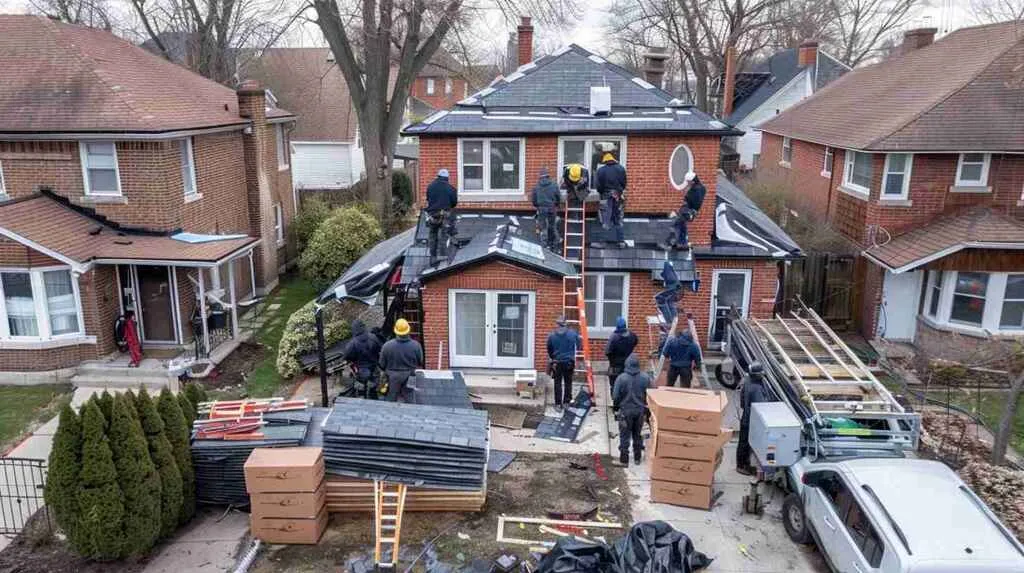
Asphalt Shingle Roofing Contractor Queens NY – Licensed Local | Free Quotes
Counterintuitive but true: a typical Queens asphalt shingle roof replacement costs $8,500 to $16,000 on average-about $425 to $650 per square installed-yet two identical-looking capes on the same Woodside block can be quoted thousands apart. The real price gap comes from variables most homeowners never see: how many layers need to be torn off, whether your deck is solid or rotted, what your attic ventilation is doing to your shingles, how steep the pitch is, and whether trucks can park close or we’re hauling everything from the alley.
Asphalt Shingle Roof Cost in Queens: What You’ll Really Pay
On a typical two-family house in Woodside with a simple gable roof, you’re looking at 20 to 25 squares of asphalt shingle coverage, which breaks down to roughly $10,000 to $14,000 when we include tear-off, disposal, basic ventilation adjustments, new underlayment, and labor. But that number shifts fast: if there are three layers of old shingles instead of one, we need a bigger dumpster and more labor hours; if the plywood deck has soft spots from old leaks, we’re adding deck replacement by the sheet; if your attic is cooking at 110° because ridge vents were never installed, we’re building in ventilation corrections so the new shingles don’t age twice as fast. I’ve seen Jackson Heights row houses quoted at $9,200 and Bayside colonials at $18,500 for roofs that looked nearly the same from the curb-the difference was always in those hidden variables.
I’m going to be direct here: if a Queens asphalt shingle roofing contractor won’t talk about ventilation, they’re not protecting your investment. Treating a roof like a lab experiment means identifying every variable before you spend a dollar-layers, access, pitch, decking, airflow-and any quote that just gives you one flat number without breaking down what drives that number is a red flag. I’ve worked in Woodside, South Ozone Park, Bayside, Jackson Heights, Corona, and Astoria long enough to know that transparency wins over rock-bottom bids every single time.
Queens Asphalt Shingle Roof Price Scenarios
| Home Type & Roof Style | Approx. Squares | Complexity | Typical Total Price Range (Queens, NY) |
|---|---|---|---|
| Single-family ranch, simple gable | 15-18 | Low (easy access, one layer, good deck) | $7,200-$10,500 |
| Two-family row house, gable or hip | 20-25 | Medium (one-two layers, alley access, minor vents) | $10,000-$14,000 |
| Cape with dormers, moderate pitch | 22-28 | Medium-High (dormer valleys, two layers, some deck repair) | $11,500-$16,000 |
| Colonial, multiple valleys, steep pitch | 28-35 | High (three layers, deck replacement zones, ventilation overhaul) | $14,500-$22,000 |
| Three-family apartment building, flat/low slope sections | 32-40 | High (limited access, parapet flashings, flat-to-slope transitions) | $16,000-$26,000 |
Prices include tear-off, disposal, standard architectural shingles, synthetic underlayment, basic ventilation adjustments, and labor. Does not include major structural repairs, skylights, or premium designer shingles.
Fast Facts: Carmen’s Queens Shingle Roofing Service
| Years Specializing in Asphalt Shingle Roofing | 17+ years in Queens, NY |
| Average Full Replacement Timeline | 2-4 days for typical two-family (weather permitting) |
| Typical Warranty Range | 5-year workmanship + manufacturer shingle warranty (25-50 years) |
| Primary Queens Neighborhoods Served | Woodside, Jackson Heights, Corona, Astoria, Bayside, South Ozone Park, Flushing, Forest Hills |
Why Ventilation and Insulation Change Your Roofing Price (and Comfort)
One August afternoon around 3 p.m., I was on a South Ozone Park cape with a homeowner who swore they needed a whole new asphalt shingle roof because their bedroom was “boiling.” I pulled out my infrared thermometer, showed them their shingles were actually okay, and then we crawled into the attic together-110° in there-where I used blue chalk to circle every spot the insulation was missing and red chalk to mark where the ridge vent should have been but wasn’t. We spent half their original budget on proper vents and baffles, and that roof stopped cooking the house without a full replacement. The shingles themselves were fine; the real problem was trapped heat shortening their lifespan and making upstairs unbearable every summer.
Here’s the thing: attic ventilation and insulation are two of the most powerful variables in your roofing equation, yet most contractors treat them like afterthoughts. In Woodside and South Ozone Park two-families especially, I’ve found blocked soffit vents where old insulation got stuffed right against the eaves, and missing or undersized ridge vents that turn attics into ovens. When your attic can’t breathe, your shingles age faster-heat bakes the adhesive strips and curls tabs prematurely-and your cooling bills spike. The insider tip I give every Queens homeowner: sometimes the smartest financial move is to adjust airflow and add insulation instead of re-roofing immediately, because fixing those variables can add five to seven years to the shingles you already have.
Key Ventilation & Insulation Checks Carmen Performs Before Quoting
-
✓
Soffit vents clear and unblocked: Checking that insulation or debris hasn’t choked off intake air at the eaves
-
✓
Ridge or gable vent presence and size: Measuring exhaust capacity to match the attic square footage for balanced airflow
-
✓
Attic temperature differential: Using infrared thermometer to compare attic temp to outdoor temp on a warm day
-
✓
Insulation depth and gaps: Noting bare spots, compressed areas, or missing baffles that let heat pool under the deck
-
✓
Moisture or condensation stains: Looking for dark spots on rafters or deck that signal trapped humid air
-
✓
Exhaust fan and vent pipe routing: Making sure bathroom and dryer vents exit outside, not into the attic space
Common Myths vs Facts: Hot Bedrooms & Shingle Roofs in Queens
Underlayment, Nailing, and Flashing: The “Invisible” Details That Make or Break Your Roof
I still remember the first time I saw shingles curling after only five years because someone tried to “save” a few hundred dollars on underlayment. During that freak October nor’easter a few years back, I got a 6 a.m. call from an elderly couple in Bayside whose “new” asphalt shingle roof was losing tabs in strips. When I got up there in the cold rain, I could see the installer had stair-stepped the shingles wrong and skimped on nails near the edges. I took photos, drew green chalk lines where the nail pattern should have been, and used that to help them get the manufacturer to honor the warranty and pay for a proper re-roof. The couple had no idea their roof was doomed from day one-underlayment was 15-pound felt instead of synthetic, and the nails were spaced to meet the absolute bare minimum, not best practice.
$3,500 later, that “cheap” roof wasn’t such a bargain.
One winter evening just after sunset in Jackson Heights, I was up on a three-family building looking for the source of a mysterious ceiling stain that only appeared after light snow. The owner kept patching inside paint. I waited for a light flurry, then went up with a headlamp and a notepad, watched where the snow was melting first, and marked it with yellow chalk-right over a row of raised nails and a badly flashed plumbing vent. We replaced a small section of shingles and the flashing instead of the whole roof, and that little science experiment saved them thousands. The takeaway: these “invisible” details-underlayment weight, nail count per shingle, and how metal flashing wraps around vents and chimneys-decide whether your roof lasts 15 years or 35. The insider tip I give to every Queens homeowner is blunt: always ask for specifics on underlayment brand and weight, nail count per shingle (should be a minimum of four, six in high-wind zones), and flashing materials (step flashing, not tar) in any bid you get, because contractors who won’t answer those questions are hiding cost cuts that’ll hurt you later.
⚠
Dangers of Cutting Corners on Nail Patterns, Underlayment, and Flashing
- Wind damage during nor’easters: Undersized or misplaced nails let shingles lift and blow off in 40+ mph gusts common to Queens winters.
- Leaks around vent pipes and chimneys: Tar-only flashing dries out and cracks within two to three years, allowing water under shingles at every penetration.
- Voided manufacturer warranties: Nearly every shingle warranty requires proper underlayment and nailing; installers who skip these steps leave you with no recourse when tabs fail early.
- Accelerated deck rot: Cheap felt underlayment absorbs water instead of shedding it, turning small leaks into $2,000+ plywood replacement jobs you didn’t budget for.
Step-by-Step: How I Diagnose Your Queens Asphalt Shingle Roof Like a Lab Experiment
When I step into your attic, the first thing I’m asking myself is, “Where is the heat trying to escape, and how is this roof helping or fighting it?” I move through an inspection the same way I used to run a chemistry lab-one variable at a time, collecting data before forming a hypothesis. I’ll start from the curb with binoculars, looking for shingle curling, missing granules, or sagging lines that hint at deck trouble. Then I’m up on the ladder checking flashing, valley condition, and nail pops. Finally, I’m in your attic with a moisture meter, infrared thermometer, and my colored chalk, marking problem zones so you can see the science yourself: blue for insulation gaps, red for blocked or missing vents, yellow for moisture stains or raised nails. Every inspection becomes a mini-experiment where the “data” your house gives me-temperature differentials, moisture readings, shingle wear patterns-tells me what variables we need to adjust.
Here’s the blunt truth most flyers tucked under your door won’t say out loud: cheapest and safest almost never show up in the same proposal. I’ve been doing this for 17 years in Queens, and the contractors who quote rock-bottom numbers are almost always skipping the data-collection step-they’re not checking your attic, not testing deck firmness, not asking how many layers are up there-so their “price” is fictional until they start tearing off and “discovering” problems that magically add thousands mid-job. My approach is the opposite: I’ll walk you through every finding at your kitchen table with color-coded chalk photos from your own roof, explain which repairs are urgent and which can wait, and give you a written proposal that breaks down labor, materials, ventilation corrections, and deck work by line item so you can challenge my recommendations before we shake hands.
Carmen’s Queens Asphalt Shingle Roof Inspection Process
Walk the property perimeter with binoculars, noting shingle condition, sag lines, chimney flashing, gutter state, and any visible damage or wear patterns from the ground.
Safely access the roof to check shingle tabs, granule loss, nail pops, flashing integrity around vents and chimneys, and valley condition; document with photos and chalk marks where needed.
Enter attic space with infrared thermometer to measure temperature differential, identify hot spots, check soffit and ridge vent function, and mark blocked or undersized vents with red chalk.
Scan insulation depth and coverage with moisture meter to detect hidden leaks or condensation; use blue chalk to circle gaps or compressed zones that need attention.
Walk the roof deck from below (in attic) and above, pressing to find soft or rotted plywood; mark zones that will need replacement before new shingles go down.
Sit down with homeowner to review color-coded photos, explain each finding in plain language, discuss repair vs replacement options, and provide a detailed line-item quote with no hidden variables.
Do You Need a Repair, Ventilation Fix, or Full Asphalt Shingle Replacement?
Start here: Is your roof more than 20 years old?
→ YES: Likely candidate for full replacement-inspect deck, ventilation, and shingle condition to confirm.
→ NO: Continue below ↓
Do you have active leaks in multiple rooms or widespread ceiling stains?
→ YES: Full replacement likely needed-deck may be compromised in several zones.
→ NO: Continue below ↓
Is your attic extremely hot in summer (90°F+) or do you see ice dams in winter?
→ YES: Ventilation and insulation fixes are your first priority-may extend current roof life by years.
→ NO: Continue below ↓
Are most shingles intact with only minor curling, a few missing tabs, or localized leak?
→ YES: Targeted repair (flashing, small shingle section, sealing) is often the safest, most cost-effective choice.
→ NO: Schedule an inspection-your roof is giving mixed signals and needs a professional diagnosis.
Why Queens Homeowners Hire Carmen and Shingle Masters
| Fully Licensed & Insured | NYC roofing license, general liability, and workers’ comp so you’re protected from first inspection to final cleanup |
| 17+ Years in Asphalt Shingle Roofing | Specialized focus on Queens neighborhoods-Woodside, Bayside, Jackson Heights, Corona, South Ozone Park-means I know your roof type and local weather challenges |
| Local Queens Focus | I live here, work here, and my reputation is built one Queens block at a time-you’ll see my truck around the neighborhood |
| Typical Response Time for Inspections | Usually within 2-4 business days for non-emergency inspections; same-day or next-day for active leaks |
Before You Call: Simple Checks and Common Questions for Queens Roofs
Think of your asphalt shingle roof like a layered lab experiment: change one variable-like the pitch or the deck condition-and the whole outcome changes. A steep-pitch colonial in Forest Hills needs more safety equipment, slower work, and careful staging, which adds labor hours; a low-slope ranch in Astoria might be faster to walk but has drainage challenges that require extra care with underlayment and flashing. In older Queens capes and row houses, I often find two or even three layers of shingles stacked on top of each other-perfectly legal up to a point, but each old layer means more weight on your deck, a bigger dumpster for tear-off, and more disposal fees. The number of existing layers is one of those hidden variables that can swing your quote by $1,500 to $3,000, and you won’t know until someone actually gets up there and looks.
When should you call urgently versus when can it wait? If you’ve got an active leak dripping into a bucket, a section of ceiling that’s sagging or discolored and growing, or you just lost shingles in a storm and can see exposed underlayment or deck, don’t wait-call that day so we can get a tarp up and prevent interior damage from getting worse. If you’re seeing minor granule loss in the gutters, a single curled tab, or you’re just curious about age and condition because you’re planning a sale or refinance, that can usually wait a few days or even a week without risk. Before you call Shingle Masters, it’s helpful to gather a few pieces of “data” about your roof-rough age if you know it, number of visible leaks or stains, whether your attic feels unusually hot in summer, and a quick photo from the curb or a safe window-because that helps me give you a faster, more accurate first opinion over the phone and prioritize your inspection if it’s urgent.
Before You Call Carmen: What to Note About Your Queens Asphalt Shingle Roof
-
☑
Approximate roof age: Check your closing documents, ask the previous owner, or estimate based on when the house was built or last renovated. -
☑
Number and location of leaks or ceiling stains: Note which rooms, how large the stains are, and whether they’re growing or static. -
☑
Attic temperature on a warm day: Step into your attic briefly and gauge whether it feels hotter than the outside air-extreme heat signals ventilation trouble. -
☑
Visible layers at roof edge (eaves): From the ground or a ladder, see if you can count how many shingle layers are stacked-one, two, or three. -
☑
Recent storm damage or missing shingles: Note if tabs blew off during a nor’easter, hailstorm, or high winds and approximately how many are gone. -
☑
Photos from curb or safe window: A few clear shots of the roof from different angles help Carmen see shingle condition and pitch before the visit. -
☑
Any prior repair attempts or quotes: Mention if you’ve had patches done, what other contractors quoted, or if this is a recurring issue in the same spot.
🚨 Call Now (Emergency)
- Active leak dripping into rooms or buckets
- Ceiling visibly sagging or bulging from water weight
- Large section of shingles blown off, exposing deck
- Ice dam causing water to back up under shingles in winter
- Storm damage with interior water entry
📅 Can Usually Wait a Few Days
- Minor granule loss in gutters, no leaks
- One or two curled shingle tabs, no water entry
- Old ceiling stain that hasn’t grown in months
- General age-related inspection before selling or refinancing
- Routine maintenance check or quote request for future work
Common Queens Asphalt Shingle Roofing Questions Carmen Gets
How long does an asphalt shingle roof last in the Queens climate?
In Queens, with our nor’easters, summer heat, and freeze-thaw cycles, a well-installed architectural shingle roof typically lasts 22 to 30 years. The wild card is ventilation-roofs with poor attic airflow often fail at 15 to 18 years because heat bakes the shingles from below. Proper installation, synthetic underlayment, and balanced ventilation can push you toward the upper end of that range or beyond.
How many layers of asphalt shingles are allowed in NYC?
New York City building code allows up to two layers of asphalt shingles on a residential roof. If you already have two layers, the next replacement requires a full tear-off to the deck. Even if code allows a second layer, I often recommend tearing off anyway if the first layer is badly curled or if we need to inspect and repair the deck-you can’t fix what you can’t see.
How long does a typical asphalt shingle roof replacement take in Queens?
For a standard two-family house with straightforward access and decent weather, expect 2 to 4 days from tear-off to final cleanup. Complex roofs with multiple dormers, steep pitch, or deck repairs can stretch to 5 to 7 days. Weather delays-rain, high winds, or extreme cold-can add time, but I’ll always keep you updated and protect your home with tarps if we have to pause.
Do I need a permit for asphalt shingle roof replacement in Queens?
Yes, in most cases. A full roof replacement in NYC requires an Alt-2 permit filed with the Department of Buildings. Shingle Masters handles the permit application, inspections, and sign-off as part of our service, so you don’t have to navigate the DOB process yourself. Simple repairs under a certain scope sometimes don’t require permits, but I’ll clarify that during your inspection.
Can repairs safely extend my roof’s life, or should I just replace it now?
It depends on age, condition, and what’s causing the problem. If your roof is under 15 years old and the issue is isolated-bad flashing around a chimney, a few storm-damaged tabs, or a single leak from a plumbing vent-targeted repairs can absolutely buy you another 5 to 10 years safely. But if the shingles are beyond 20 years, curling across the whole roof, or you’re patching new leaks every season, replacement is usually the smarter financial move. I’ll give you my honest assessment either way.
Treating your Queens asphalt shingle roof like a controlled experiment-checking every variable from deck condition to attic airflow before you spend a dollar-gets you the safest, longest-lasting result for your money. The difference between a roof that fails at 15 years and one that protects your home for 30 comes down to those “invisible” details: proper ventilation, quality underlayment, correct nailing, and honest diagnosis up front. If you’re ready to know what’s really happening on your roof and get a clear, written proposal that breaks down every variable so you can make an informed decision, call Shingle Masters to schedule an on-site inspection with Carmen-I’ll walk you through your roof’s data, answer every question, and give you a plan that makes sense for your house and your budget.