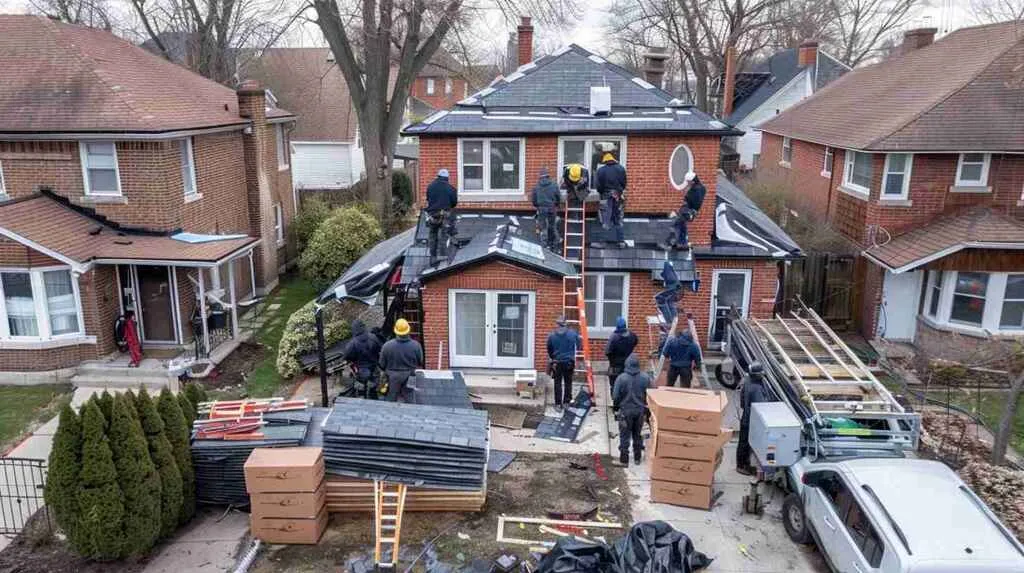
Asphalt Shingle Roof Construction Queens NY – Built to Last | Free Quotes
Blueprint time. In Queens, a real asphalt shingle roof-not just someone slapping new shingles on rotting wood-usually runs between $9,500 and $18,000. The number moves depending on which variables in your roof equation need attention: deck condition, the type and number of underlayment layers, flashing complexity around chimneys and walls, and whether your attic’s ventilation is helping or hurting. This article breaks down exactly which construction details push that price up or down, and how I treat every Queens roof like a math problem where all the layers, airflow paths, and structural pieces have to balance out-or you’ll be calling me back in three years with a leak.
What Your Queens Asphalt Shingle Roof Really Costs – And Why
The $9,500-$18,000 range isn’t just me picking numbers out of the air. It’s a roof equation: your project price equals deck repairs plus underlayment quality times shingle grade divided by how many flashing headaches your house has, all multiplied by whether your attic vents like a chimney or suffocates like a sealed bag. On a typical two-story colonial in Bayside, the first thing I look at isn’t the shingles-it’s the wood deck under them. If your deck’s spongy or I can see daylight through knotholes, those boards get replaced before I’ll nail a single shingle, and that deck work might add $2,000-$4,000 to your quote. If your pitch is low or you’ve got valleys and dormers everywhere, ice & water shield in critical zones, heavy-duty underlayment, and custom flashing all push the equation higher.
Here’s what actually drives the number. Queens roofs have specific challenges: wind tunneling between attached row houses in Jackson Heights and Maspeth, freeze-thaw cycles that crack cheap caulk every winter, and summer heat that can cook your attic to 140 degrees if you don’t vent right. The deck and hidden layers are the first variables I check before we even talk about shingle brand or color, because I’ve learned the hard way that no shingle, no matter how expensive, will save you if the bones underneath are wrong.
One January morning around 6:30 a.m., in Flushing, I was standing on a frosty two-family roof with my thermos, watching my breath turn to fog while we tore off three layers of ancient shingles. The owner kept asking why his brand-new shingles from five years earlier were curling, and when we opened it up, we found zero underlayment and a bathroom fan venting straight into the attic. That job taught me how useless “pretty new shingles” are if your ventilation and layers aren’t right, and now I won’t start a shingle install without mapping out airflow with the homeowner first. Rafael always maps airflow because shingles only do their job when the attic temperature stays close to the outside temperature-otherwise, you’re baking your roof from the inside out.
Queens Asphalt Shingle Roof Cost Scenarios
Fast Facts: Asphalt Shingle Roof Construction in Queens
The Roof Equation: Layers, Airflow, and Shingle Choices
In my opinion, the biggest lie people hear about asphalt shingles is that “they’re all the same if you install them right.” They’re not. In Rafael’s roof equation, shingle grade, underlayment type, and nail pattern all have to balance Queens wind speeds and freeze-thaw cycles, or you’re just buying expensive decoration that’ll fail in seven years instead of 25. Around here, especially in attached homes in Jackson Heights and Maspeth, wind channels between buildings like a concrete canyon-I’ve measured gusts 15 mph stronger at roofline than at ground level. That means your shingle needs a higher wind rating, your nailing pattern has to hit manufacturer spec for high-wind zones, and your underlayment can’t be the cheapest felt paper that rips when you sneeze near it. If you upgrade shingles but keep bargain underlayment and sloppy nailing, the equation doesn’t balance and you’ve wasted money on a system that looks good at the ribbon-cutting but fails at the first real storm.
A few years back in Astoria, a retired architect hired us and grilled me with a notebook full of questions about nailing patterns, wind ratings, and thermal movement. Halfway through, he challenged me on why I wanted to change his venting from two big box vents to a continuous ridge vent with soffit intake. Instead of arguing, I climbed up, measured, took photos, and brought down a quick sketch showing how hot air would bottleneck at his hip ends. He eventually laughed and said, “Fine, engineer it your way,” and that project became my favorite example of how asphalt shingle roofs in Queens need both structure and airflow, not just a nice color. Changing his venting from box to ridge altered the heat and moisture variables in the equation-attic temps dropped 20 degrees that summer, and his shingles stopped showing those weird wavy heat marks along the hips. Structure plus airflow. Every time.
✅ Key Parts of the Roof Equation Rafael Checks on Every Queens Job
-
✅
Roof Deck Condition: Check for soft spots, rot, sagging, or missing boards that need replacement before any shingles go on -
✅
Slope and Pitch: Measure pitch to determine minimum underlayment grade and whether low-slope details are needed (below 4:12 pitch) -
✅
Existing Ventilation: Map soffit intake, ridge or box vents, and attic space to calculate whether airflow is balanced or needs a redesign -
✅
Underlayment and Ice & Water Needs: Decide on felt vs synthetic, and where ice & water shield must go (eaves, valleys, walls, penetrations) -
✅
Flashing Complexity: Identify chimneys, skylights, dormers, walls, and parapet conditions that require custom metal work or step flashing -
✅
Local Wind and Sun Exposure: Note if the house faces open water, sits on a hill, or has tall neighbors blocking wind-affects shingle spec and nailing
How We Build a Queens Shingle Roof That Survives Wind, Heat, and Storms
On a typical two-story colonial in Bayside, the first thing I look at isn’t the shingles-it’s the wood deck under them. Then I map the construction sequence like this: we tear off in sections, never opening more than we can weatherproof in one day, because Queens summer storms are famous for rolling in out of nowhere. Any soft or rotten deck boards get replaced immediately-you can’t build a 25-year roof on spongy plywood. Next, we roll out underlayment-synthetic on most jobs because it doesn’t rip in wind and won’t wrinkle when it gets wet-and lay ice & water shield at least three feet up from the eaves, through every valley, and around every penetration (chimneys, pipes, skylights). Flashing comes next: step flashing at walls, custom-bent apron and cap flashing at chimneys, and careful attention to where dormers meet the main roof, because that’s where most leaks start. Then we install shingles to the manufacturer’s wind-rating spec, which in Queens usually means six nails per shingle instead of four and hand-sealing the edges on corner and ridge shingles. Finally, we balance the ventilation-ridge vent along the peak, matching soffit intake at the eaves-so your attic breathes and your shingles don’t cook from below. One July afternoon in Ozone Park, it was so hot the shingles felt like soft rubber under our boots, and a sudden thunderstorm rolled in out of nowhere-classic Queens summer. We had half the roof deck open on a row house, and a neighbor started yelling that water was coming through their shared wall. We scrambled a crew with tarps and temporary ice & water shield, and I stayed on that roof until almost midnight making sure every seam was tight. Since then, I obsessively stage every asphalt shingle job in phases so even if the sky betrays us, nobody’s living room becomes a swimming pool. That’s the insider tip I follow religiously: never open more roof than you can dry-in the same day, especially on Queens row houses, and always have tarps and backup ice & water shield staged before you pull the first shingle.
Step-by-Step: Shingle Masters’ Construction Process in Queens
Rafael climbs onto your roof, measures square footage and pitch, checks deck condition from below (attic) and above, photographs problem areas, and maps existing ventilation with a quick cardboard sketch at your kitchen table.
Before ordering materials, we calculate required net free area (NFA) for intake and exhaust, design ridge vent + soffit intake plan, and flag any attic obstructions (like bath fans venting into the attic) that need fixing.
Remove old shingles and underlayment in phases (typically one roof plane at a time), inspect every square foot of decking, replace soft or rotten boards, and cover exposed areas with tarps at end of each day or if weather threatens.
Roll synthetic underlayment across the entire deck, install ice & water shield at eaves (minimum 3 feet up), line all valleys fully, and wrap ice & water around chimneys, skylights, and wall penetrations.
Custom-bend and install step flashing at walls and dormers, apron and cap flashing at chimneys, drip edge at eaves and rakes, and valley flashing where needed-this is where most roofers cut corners and where most leaks start.
Lay starter strip at eaves, install shingles per manufacturer’s wind-rated nailing pattern (six nails for high-wind in Queens), hand-seal edges and ridge caps, cut and fit around penetrations, and inspect alignment every few courses.
Magnetic sweep of property for nails, haul all debris, inspect from ground and attic for any missed details, document completed work with photos, and walk you through warranty paperwork and maintenance tips.
WARNING: Storm Risk During Construction
Queens summer pop-up storms can arrive with less than an hour’s warning. Leaving your roof deck exposed-even for “just a few hours”-risks catastrophic water damage to ceilings, insulation, and belongings. That’s why proper phasing, temporary protection with tarps and ice & water shield, and obsessively watching weather radar are non-negotiable parts of responsible asphalt shingle roof construction. The Ozone Park thunderstorm job taught me to never gamble with the forecast. If a storm’s coming, we stop, seal, and wait it out-no exceptions.
Is It Time for a New Shingle Roof or Just Repairs?
I still remember a windy afternoon in Howard Beach where I watched a neighbor’s cheap, poorly nailed shingles fly off like playing cards. The owner called asking if we could “just nail down a few tabs,” and when I climbed up to look, I found three layers of old shingles, deck boards so soft my boot heel left a dent, and flashing that had been caulked over so many times it looked like a kindergarten art project. That’s when the roof equation told me repair wasn’t an option-too many broken variables, and patching one just loads stress onto the others until the next thing breaks. Rafael uses the equation to decide: if your roof’s under 12 years old, has one or two isolated leaks, solid deck, and decent ventilation, repair might make sense. If it’s over 18 years, has multiple problem zones, three layers of shingles, or widespread granule loss and curling, the math says full replacement is the only honest answer.
When I sit at your kitchen table, the first question I’ll ask is: “Do you want a 10-year Band-Aid, or a 25-year system?” A repair-patching flashing, replacing a few shingles, sealing a valley-typically runs $800-$2,500 in Queens and buys you peace of mind for maybe a decade if the rest of your roof is sound. A full system replacement means tearing everything down to the deck, fixing the bones, installing proper layers, and building a roof that’ll outlast your mortgage. The 10-year Band-Aid makes sense if you’re planning to sell soon or if the problem is genuinely isolated (one bad skylight, one torn shingle from a branch). The 25-year system makes sense if you’re staying put, if you’re tired of emergency calls every storm, or if an inspection shows that deck rot or ventilation issues are slowly killing your roof from the inside.
Are you honestly planning to move in the next three years, or are you here for the long haul? That’s the question that decides whether repair or replacement fits your roof equation-and your life.
Should You Repair or Replace? Decision Guide
This flowchart is a guide. Rafael confirms your best path with an on-site inspection of your deck, layers, flashing, and ventilation-all part of the free quote.
Before You Call: Quick Checks and Straight Answers
Here’s the blunt truth: in Queens, most leaks blamed on “bad shingles” are actually bad flashing or lazy underlayment work. Thinking in terms of the roof equation helps you describe symptoms-where water shows up inside, when it leaks (heavy rain? melting snow? both?)-so Rafael can narrow down which variables are broken before he even climbs the ladder. If water stains appear near a chimney or skylight, flashing is the prime suspect. If your bedroom ceiling drips only during ice dams, the equation says you’re missing ice & water shield at the eaves or your attic’s too hot and melting snow unevenly. If shingles are curling or lifting, check whether bath or kitchen fans vent into the attic instead of outside-that’s a ventilation variable poisoning the whole system.
Rafael will literally sketch a side-view of your roof on a scrap of cardboard at the table, labeling deck, underlayment, shingles, airflow paths, and problem zones so you can see how the equation fits together. Coming prepared with some basic observations saves time and money, especially on Queens row houses and two-family homes where shared walls, parapets, and complex flashing around adjoining structures make every roof a little different. The more you can tell me about when and where problems happen, the faster I can solve the equation and give you an honest answer about whether you need a $1,200 patch or a $14,000 rebuild.
✓ Before You Call Shingle Masters: What to Note
-
☑
Age of roof if known: Original install date or approximate age helps Rafael estimate remaining service life and whether repair makes sense -
☑
Number of visible shingle layers: Check at the eaves or rake edge-one layer is ideal, two is marginal, three means full tear-off required -
☑
Where leaks show inside: Bedroom ceiling? Near chimney? Along an exterior wall? Specific locations point to specific roof equation variables -
☑
When leaks happen: Only during heavy rain? After snow melts? Ice dams in winter? During wind-driven storms? Timing narrows the cause -
☑
Bathroom/kitchen fan venting: Check if fans exhaust outside through the roof/wall or just blow into the attic-attic moisture rots decks and kills shingles -
☑
Photos of suspect areas: Snap pictures of chimneys, skylights, valleys, curling shingles, or stains-helps Rafael prep before the site visit -
☑
Any prior roof work or patches: Knowing what’s been attempted before helps avoid repeating the same mistakes and shows repair history
Common Questions About Asphalt Shingle Roofs in Queens
How long does a typical asphalt shingle roof project take in Queens?
Most full replacements on 1,200-2,400 square foot Queens homes take 3-5 days, weather permitting. Day one is usually tear-off and deck repairs, day two is underlayment and flashing, days three and four are shingle install, and day five (if needed) is final details, cleanup, and inspection. We phase the work so your home is weatherproof every night, and we’ll delay or pause if storms threaten-never worth the risk of water damage to save a few hours.
How do you handle noise and disruption on attached row houses?
Attached homes in Jackson Heights, Maspeth, and similar neighborhoods require extra care. We notify your neighbors in advance, use tarps and plywood ramps to protect shared walkways, stage materials on your property (not theirs), and coordinate timing if they work night shifts. The tear-off phase is the loudest-expect hammering and scraping-but it’s usually done by mid-afternoon on day one. After that, shingle installation is much quieter. We also double-check that debris and nails don’t migrate to neighboring yards.
Is full tear-off always required, or can you install over the old shingles?
NYC code allows up to two layers of asphalt shingles, but I rarely recommend layering over. You can’t inspect the deck for rot, the added weight stresses your structure (especially on older Queens homes), heat gets trapped between layers and shortens shingle life, and most manufacturers void their warranty if you don’t tear off. The only time layering makes sense is if you have one layer of relatively new shingles in good shape, a solid deck confirmed from below, and you’re doing it purely as a short-term budget move before a planned sale. Otherwise, tear-off is the honest answer.
How do warranties work-materials vs workmanship?
Material warranty comes from the shingle manufacturer and covers defects in the shingles themselves (premature aging, cracking, granule loss not caused by wear). Depending on shingle grade, these run 10-50 years, often prorated after the first 10. Workmanship warranty comes from Shingle Masters and covers our installation-flashing leaks, improper nailing, underlayment failures, ventilation design errors. We typically offer 5-10 years on workmanship. Both warranties require proper maintenance (keeping valleys clear, trimming overhanging branches, addressing damage promptly). I’ll give you written warranty details with your contract so there’s no confusion.
Can you install asphalt shingles in winter or during Queens summer heat?
Yes, with adjustments. In winter (roughly December-February), we avoid installing when temps drop below 40°F because shingle adhesive won’t activate and the material gets brittle. We’ll hand-seal tabs with roofing cement in cold weather and sometimes use a propane torch to warm shingles just before nailing. In summer heat (July-August), shingles get soft and tear easily, so we stage materials in shade, work early mornings or late afternoons when possible, and walk carefully to avoid scuffing granules. Spring and fall are ideal, but we work year-round in Queens because leaks don’t wait for perfect weather.
Why Queens Homeowners Choose Shingle Masters
Think of your roof the way I do-a layered equation where attic temperature, slope, and wind exposure all have to balance out, or the answer is leaks. A Queens asphalt shingle roof lives or dies by how all those variables work together: deck condition plus underlayment quality times proper flashing divided by balanced ventilation. Get one variable wrong and the whole equation falls apart, usually right before a nor’easter or summer storm when you need it most. If you’re ready to stop guessing and start building a roof that actually lasts, call Shingle Masters for a free, no-pressure roof equation walkthrough and a written quote for your Queens home-Rafael will sketch it all out on cardboard at your kitchen table and show you exactly what needs fixing and why.