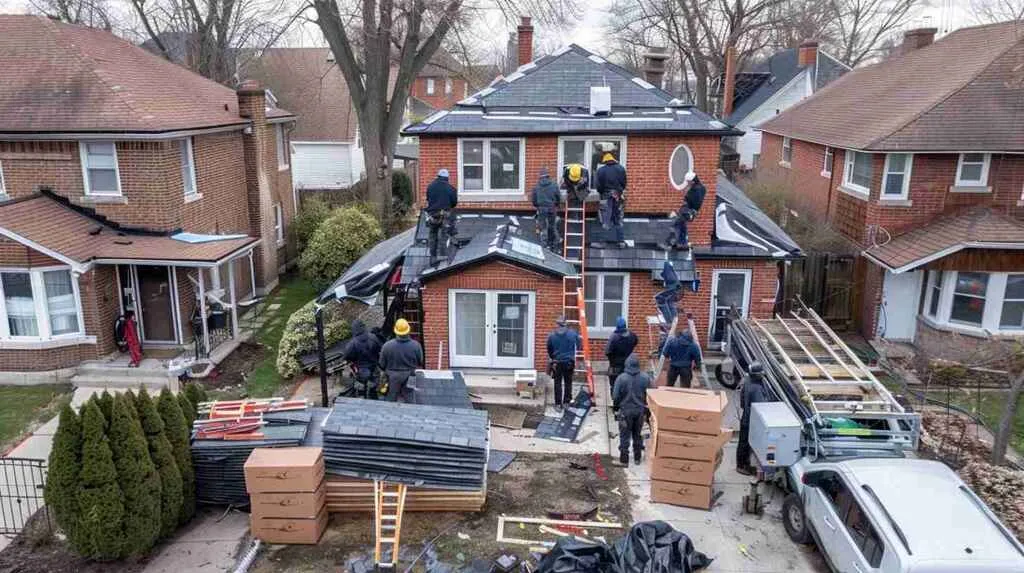
Architectural Shingle Products Queens NY – Top Options for 2026
Blueprint: two roofs across the street can face totally different wind, shade, and code nuances, so the “top” architectural shingle options for 2026 depend less on brand hype and more on the block you live on. One August afternoon around 3 p.m., we were on a two-family in Elmhurst, sun reflecting off every car hood, and the homeowner kept showing me Pinterest photos of high-end architectural shingle patterns – but halfway through tearing off the old 3-tabs, we found a soft, spongy corner where water had been sneaking in for years. I had to explain, right there on the hot roof, that the fancy shingle profile she liked would only matter if we rebuilt that entire edge properly first. I drew the whole thing on the back of a delivery receipt so she could see how underlayment, ice shield, and architectural shingle roof shingles all stack up. Think of your roof like a stage set: the shingles are the backdrop everyone sees from the sidewalk, but the rigging behind the scenes – the ice shield, the ventilation, the solid decking – that’s what holds the whole production together.
How Your Queens Block Changes Which Architectural Shingles Make Sense
The corner lot in Astoria with nothing blocking the wind off the East River doesn’t get the same architectural shingle recommendation as the tree-lined street in Forest Hills two miles away. In Astoria, Long Island City, and open corridors like Jackson Heights or Elmhurst, you’re dealing with consistent gusts that test adhesive strips and nail placement year-round. Head over to Bayside or Jamaica Estates, and suddenly you’re managing shade patterns, falling twigs, and different moisture cycles. Even the code enforcement can shift block by block – some corners of Queens get stricter DOB inspections, others fly under the radar. My honest take: the people choosing architectural shingles by brand name alone, or just by staring at a color chip under fluorescent lights at the big-box store, are missing the whole first act of the show.
Roof pitch matters too, and not just for water shedding. A steep-pitch Victorian in Kew Gardens shows off those dimensional shadow lines on architectural shingles in a way a low-slope two-family in Corona never will. Street-view distance changes everything – if your roof edge sits 12 feet from the sidewalk versus 40 feet back behind a front yard, the same shingle profile can read completely different. And then there’s the brick. Queens has red brick, yellow brick, painted brick, vinyl siding over brick, and every possible trim combo. An architectural shingle that looks crisp against white trim and red brick on one block can clash hard with brown aluminum siding and dark bronze gutters two streets over. I’ve sketched color combinations on napkins at kitchen tables enough times to know: matching shingles to your specific house and block is like choosing the right backdrop for a stage set where the audience (your neighbors and future buyers) never stops looking.
Bluntly, if you pick architectural shingle roof shingles without factoring in wind exposure, roof pitch, and what your house actually looks like from the street, you’re setting yourself up for regret in about three years when you realize the color looked great in the sample but reads too flat or too loud on your actual roof. The right shingle for 2026 isn’t the one with the slickest marketing or the longest warranty footnote – it’s the one that fits your Queens block’s wind, your home’s architecture, and how long you’re planning to stay.
Fact 1 – Typical roof age in Queens: 17-23 years before major work, shorter on unvented flats.
Fact 2 – Common wind exposure zones: Highest along the East River, Long Island City, and open corners in Jackson Heights/Elmhurst.
Fact 3 – Popular architectural shingle colors: Charcoal, weathered wood, and slate blends that play well with red and yellow brick.
Fact 4 – Local code nuance: NYC DOB generally limits roofing to two shingle layers; most 2026 projects in Queens are full tear-offs with architectural shingle upgrades.
Top 2026 Architectural Shingle Lines That Actually Hold Up in Queens
On 37th Avenue last fall, I stood on a three-story walk-up thinking about one thing most people never consider: wind direction. On a windy November morning in 2022, right off Northern Boulevard, a landlord called me in a panic because some “architectural shingles” he’d ordered online were already curling after just one winter. When I climbed up, I realized they were knockoff products with almost no asphalt content, installed straight over old shingles. I remember the wind whipping the loose tabs like playing cards while I explained to him that the good brands we spec for Queens – especially for those gusts coming off the East River – have weight, proper adhesive strips, and manufacturer specs you can actually enforce. The same thing happens near open corners by parks, along Northern Boulevard, and anywhere the buildings don’t block prevailing winds. Genuine heavyweight architectural shingles with NYC-compliant installation aren’t just marketing speak – they’re the difference between a roof that lasts 20 years and one that starts failing in year five because the mat couldn’t handle Queens’ stop-and-go heat cycles and salty coastal air.
When I call something a “top option for 2026” in Queens, here’s what I’m looking for: impact rating that handles falling branches and debris, wind rating of at least 110 mph with proper nailing (130+ for exposed corners), color blends that don’t fight with local brick tones, manufacturer support actually available through NYC suppliers, and good performance records on both overlay jobs (where code allows) and full tear-offs. I don’t care if the warranty says “limited lifetime” in tiny print – I care if the shingle holds its granules, stays sealed in wind, and looks decent from the sidewalk after a decade of Queens summers and nor’easters.
| Shingle Tier (Generic Group) | Typical Wind Rating | Weight per Square (Approx.) | Best For Queens Blocks | Notes for 2026 Installs |
|---|---|---|---|---|
| Standard Architectural (30-35 yr limited) | 110-130 mph | 200-230 lbs | Interior streets in Flushing, Corona, Elmhurst with moderate wind | Solid choice for owners planning to stay 10-15 years; cost-effective upgrade from 3-tab. |
| Enhanced Architectural (“HD” or “Plus” lines) | 130 mph+ with enhanced nailing | 230-260 lbs | Exposed corners in Jackson Heights, Astoria, Bayside | Better shadow lines and color blends; ideal when you care about curb appeal and wind. |
| Impact-Resistant Architectural (Class 3/4) | 130 mph+ with reinforced mat | 250-280 lbs | Near tree-lined streets in Forest Hills, Kew Gardens, Jamaica Estates | Extra durability against falling twigs/debris; higher material cost, often lower lifecycle cost. |
| Designer Architectural (slate/wood shake look) | 110-130 mph (varies) | 260-320 lbs | High-visibility facades and corner properties throughout Queens | Best when the house is a long-term hold and facade design matters as much as lifespan. |
| Enhanced Architectural (“HD/Plus” style) | Standard Architectural |
|---|---|
|
Pros: • Better wind resistance for corner lots • Deeper shadow lines that hide minor deck imperfections • Often longer algae-resistance warranties Cons: |
Pros: • Lower upfront cost • Still a big upgrade over 3-tab shingles • Wide color availability in NYC suppliers Cons: |
Now, if you follow that line a little further, ask yourself: is your next roof just a patch, or a full redesign of your house’s “set” for the next 20 years?
Match the Shingle to Your Roof Pitch, Brick, and How Long You’ll Stay
If you were sitting at your kitchen table with me right now, I’d ask you one question first: how long are you actually planning to stay in this house? One rainy evening in March, just at dusk, I was finishing an inspection in Jamaica for an older couple who’d just retired. They were worried their darker architectural shingles would overheat the attic in summer. I stood in their living room, shoes off, and showed them photos on my phone from a job I’d done two summers before in Astoria: same color, same roof pitch, and I’d logged attic temperatures before and after adding ridge vent and upgraded shingles. When they saw the numbers, not just the colors, they finally relaxed and picked the product that matched their brick instead of the one the big-box store was pushing. Here’s the practical insider tip: pair your chosen architectural shingles with proper ridge vents and upgraded underlayment to manage heat and extend shingle life in Queens summers. Ventilation matters as much as shingle color when it comes to attic temperature – dark shingles with good airflow can actually outperform lighter shingles on a poorly vented roof.
Selecting architectural shingle roof shingles is like arranging stage lighting and backdrop for a performance. Roof pitch, sunlight angle, and street-view distance all change how the shingle pattern and color read from the sidewalk. A steep Victorian shows off dimensional profiles beautifully; a low-slope ranch needs careful color planning or the roof looks washed out. I help owners plan for 10-, 20-, or 30-year horizons, because the shingle choice that makes sense when you’re selling in five years is totally different from the one you’d pick if you’re planning to hand the house down to your kids. And honestly, the brick color, trim, and how afternoon sun hits your front facade all feed into that stage-set composition – get one element wrong and the whole thing feels off.
How to Choose Your 2026 Architectural Shingle Tier
Start: Are you planning to keep the property at least 10 years?
Yes → Do you have strong wind exposure (corner lot, open view, near water)?
• Yes → Consider Enhanced or Impact-Resistant Architectural (better wind + durability).
• No → Standard or Enhanced Architectural depending on budget and curb appeal goals.
No (under 10 years) → Is the roof deck in good shape with no sagging or soft spots?
• Yes → Standard Architectural can be the sweet spot for resale.
• No → Budget for full tear-off with at least Standard Architectural and upgraded underlayment to reset the roof for the next owner.
✓ Visual Cues I Check to Match Architectural Shingles to Queens Brick and Siding
- ✓ Dominant brick color from the street (red, brown, yellow, mixed)
- ✓ Presence of contrasting trim (white, black, dark bronze)
- ✓ Distance from sidewalk to roof edge (short/medium/long)
- ✓ Neighboring roof colors on the same side of the block
- ✓ How afternoon sun hits the front facade (flat vs angled)
Avoid Common Architectural Shingle Mistakes in Queens
Here’s my honest take: most homeowners in Queens are choosing architectural shingles with their eyes, not with a plan. The most common mistakes I see? Buying off-brand online knockoffs with no published wind ratings or verifiable manufacturer support, skipping tear-off when there are already two layers (which NYC code usually prohibits anyway), ignoring ventilation completely, and assuming any label that says “premium” or “architectural” automatically fits Queens’ heat cycles and salty coastal air. Material quality and installation details matter just as much as shingle style. A beautiful designer profile installed wrong over bad decking with no ice shield is a disaster waiting to happen – and it’ll cost you twice as much to fix in three years when leaks start showing up in the ceiling.
⚠️ Watch for These Red Flags Before You Sign a Roofing Quote in Queens:
- Online-only “architectural shingles” with no recognizable brand or published wind rating.
- Contractors proposing to install new architectural shingles over two existing layers (NYC typically prohibits this).
- No mention of ice & water shield at eaves/valleys, which is critical on older Queens framing.
- Bids that skip ridge vent or any ventilation plan, especially on dark shingle colors.
- Quotes with no written manufacturer, line name, or warranty details – just “30-year architectural.”
| Myth | Fact |
|---|---|
| “All architectural shingles are basically the same; just pick a color.” | Weight, wind rating, and algae resistance vary a lot between lines – crucial for Queens’ wind and humidity. |
| “Dark architectural shingles will always overheat my attic.” | Ventilation and underlayment matter more; with proper ridge and intake vents, dark shingles can perform just fine. |
| “If it says ‘lifetime,’ I’ll never have to re-roof.” | Lifetime is a marketing term with conditions; installation quality and local code drive real-world lifespan. |
| “A second layer of architectural shingles is always cheaper and just as good.” | On many older Queens homes, full tear-off is safer, helps with warranties, and reveals hidden deck damage. |
| “Thicker designer shingles are always better in every situation.” | Heavier shingles need solid framing and may not be the best value if you plan to sell within a decade. |
What Working With Shingle Masters Looks Like, Step by Step
Think of your roof the way I used to think about stage lighting: the angles, the layers, and the background all change how the main piece – your shingles – actually look and perform. When you call Shingle Masters, that’s the lens we bring to your block. We don’t show up with a one-size-fits-all pitch or a binder full of stock photos – we walk your property, check the wind exposure and roof pitch, note what your brick and trim look like from the street, and then sit down at your kitchen table with real samples to sketch out a plan that fits your house and your timeline.
From first call through final inspection, here’s how the process actually works: you get a roof and block assessment where we check existing layers and take street-view photos, a set-design style consultation where we match architectural shingle colors and profiles to your specific facade using real samples (not just brochures), a written 2026 product plan naming the exact shingle line and underlayments with warranty terms spelled out, permit and scheduling handled through NYC DOB where required, a tear-off and repair day where damaged decking gets fixed and new ice shield and architectural shingles go on to spec, and a final walkthrough with photos so you know exactly what to watch for over the next decade. No surprises, no vague “we’ll figure it out on the roof” promises.
- Roof & Block Assessment: Dennis or a team member walks the property, checks wind exposure, roof pitch, existing layers, and takes photos from the street.
- Set-Design Style Consultation: At your kitchen table, they match architectural shingle colors and profiles to your brick, siding, and trim using real samples.
- Written 2026 Product Plan: You receive a clear proposal naming the exact shingle line, underlayments, ventilation upgrades, and warranty terms.
- Permit & Scheduling: Shingle Masters handles NYC DOB permitting where required and schedules around weather and your building’s needs.
- Tear-Off & Repair Day: Old materials come off, damaged decking is replaced, and new ice shield, underlayment, and architectural shingles are installed to spec.
- Final Walkthrough & Photos: Dennis reviews the finished roof with you, provides photos, and explains maintenance checkpoints for the next 5-10 years.
Why Queens Homeowners Choose Shingle Masters for Architectural Shingles
- Licensed & Insured in NYC: Up-to-date city licensing and full liability/worker’s comp coverage.
- 19+ Years on Queens Roofs: From Flushing to Jamaica, focused on local rowhouses, two-families, and small multi-family buildings.
- Architectural Shingle Specialists: Daily work with standard, enhanced, impact-resistant, and designer profiles.
- Block-by-Block Design Help: Product and color recommendations tailored to your exact street, not just your ZIP code.
Common Questions Queens Homeowners Ask About Architectural Shingle Roofs for 2026
Can I keep my existing 3-tab shingles and just overlay architectural shingles?
On many Queens houses, especially if you already have two layers, NYC code and manufacturer warranties push us toward full tear-off. Even with one layer, we usually recommend starting fresh in 2026 so we can inspect the deck and install modern underlayments and ventilation.
How long does a typical architectural shingle roof install take on a two-family?
Most two-family roofs in Queens take 1-2 working days with a full crew, depending on access, number of layers to remove, and carpentry repairs needed once we open the roof.
Are impact-resistant shingles worth it in Queens?
If you have big trees overhanging the roof or you’re in a debris-prone block, Class 3/4 shingles can be a smart long-term choice. We’ll compare the cost difference and expected lifespan for your exact property.
Will new architectural shingles really improve curb appeal that much?
Yes – especially on brick homes. Because of their thicker profile and shadow lines, architectural shingles can make an older Queens facade look sharper and more modern from the sidewalk.
Matching architectural shingle products to a Queens roof is like designing a stage set for your house – every element from underlayment to color blend has to work together so the final composition looks right and performs for decades. Give us a call, and we’ll walk your block, sketch out options at your kitchen table, and schedule a 2026-ready roof upgrade that fits your timeline and your street.