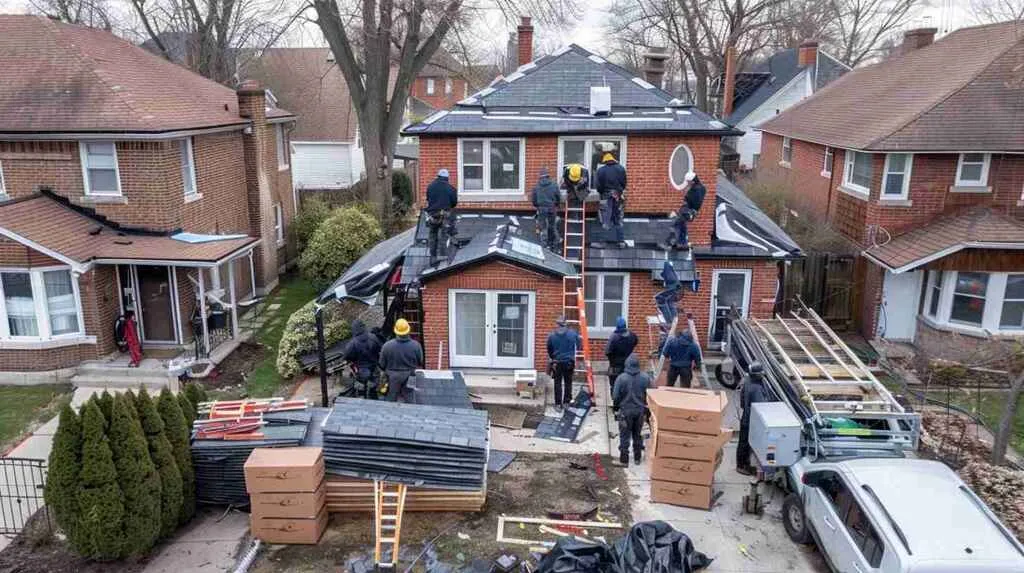
Architectural Shingle Roof Lifespan Queens NY – Real Expectations
Unpacked: that “30-year architectural shingle” roof sitting over your Queens home right now will probably give you somewhere between 17 and 25 years of honest service, and that’s not a defect – it’s real life bumping up against marketing. The label on the wrapper assumes perfect lab weather, no coastal wind, no attic that bakes like an oven in July, and an installation crew that nailed every ridge, valley, and hip exactly right, which is just not how Queens roofs age in the real world.
What you’re about to read breaks down why two identical roofs can look a decade apart, what actually controls how long your architectural shingles last, and how to tell if yours is sliding toward replacement or still has good years left. I’ll walk you through the same checks I use when I’m standing in someone’s driveway, and by the end you’ll know whether that number on the shingle wrapper means anything for your specific house.
What “30-Year” Really Means for Architectural Shingle Roofs in Queens
Let me be blunt: the number on the shingle wrapper is mostly a marketing story, not a weather report for Queens. One January morning at 7:15 a.m., I was standing on a frosty porch in Bayside with a retired MTA conductor who swore his “30-year” architectural shingles should have lasted exactly 30 years like a pension. I showed him how the south-facing slope had cooked faster than the north side, how the granules had piled up in his gutters, and why his 19-year-old roof was actually on borrowed time, not “cheated” time. On my notepad right now, I’d draw you three little roof slopes side by side – one at 10 years looking tight and granular, one at 20 years starting to cup and lose color, and one at 25 years with brittle tabs and exposed fiberglass showing through like bone – that’s the real time-lapse of Queens architectural shingle aging, not a flat countdown from 30.
The label is tested in a controlled environment with zero salt air, no hurricane-force nor’easters, no summer attic temperatures that climb past 140 degrees, and perfect ventilation that almost no Queens cape or Tudor actually has. When you fold in our wind coming off the bay, the sun hammering south-facing slopes for eight months a year, and the reality that maybe half the roofs I inspect have ventilation problems nobody’s noticed yet, you land in that 17-25 year band for architectural shingles. And honestly, I’d argue lifespan splits about 50% installation quality, 25% ventilation and decking condition, and only 25% the actual product name stamped on the bundle – get the first two wrong and even a premium lifetime shingle won’t save you.
| Shingle Label on Wrapper | Typical Real Lifespan in Queens, NY | Main Limiting Factor in Queens | Best-Case Scenario (Perfect Install & Ventilation) | Common Scenario I Actually See |
|---|---|---|---|---|
| 20-Year 3-Tab | 12-18 years | Wind uplift, thin profile, aging decks | 18-20 years | 14-16 years |
| 30-Year Architectural | 17-25 years | Sun exposure, ventilation, install quality | 25-28 years | 19-22 years |
| Lifetime Architectural (Queens Install) | 20-28 years | Installation quality, attic heat, severe storms | 28-30+ years | 22-25 years |
Why Two Queens Roofs the Same Age Can Look Ten Years Apart
I still remember one Tuesday in late fall, standing on a Rego Park balcony, looking straight at a south-facing slope that had aged ten years faster than its twin on the back. Same shingles, same install date, totally different condition – the south side was curling, faded, shedding granules into the gutter like sand, while the north slope still had color and flexibility. Orientation matters that much. If you’re in Bayside with a roof that gets afternoon sun and offshore wind, you’re playing a harder game than someone in Corona whose north-facing slopes stay cool and shaded most of the day. Out in the Rockaways, add salt spray and storm surge anxiety, and you’re looking at even faster UV and granule loss on windward exposures.
One sticky August afternoon, thunderheads building over Flushing Meadows, I got called to a house in Corona where a flip-team had installed architectural shingles right on top of an old 3-tab layer. The new owner was furious because her “brand-new” roof was already curling at the eaves after just six years. When I peeled back a course and found moldy felt and soft decking underneath, it was the perfect, ugly demonstration that lifespan starts with what you don’t see – the wood and ventilation – not just the pretty shingle on top. Picture a roof in cross-section: if the decking is spongy from trapped moisture, or if there’s no ridge vent and the attic is trapping 150-degree heat all summer, your shingles are aging from below like bread left on a radiator, even when the surface looks new from the street.
Installation, Ventilation, and Wind: The 50/25/25 Lifespan Formula
When I walk into a home in Maspeth or Astoria, the first question I usually ask isn’t “How old is your roof?” but “How hot does your top floor get in July?” About five years ago, during a windy March evening, I climbed onto a steep Tudor in Forest Hills for an emergency leak check with the last of the daylight burning out and a nor’easter on the way. The architectural shingles were only 11 years old, but every ridge and hip had been nailed too high and too few, so gusts had started lifting them like playing cards. We tarped what we could, but that night cemented a lesson I repeat all the time: in Queens, architectural shingle roof lifespan is at least 50% installation quality, 25% ventilation and decking, and only 25% the actual product name on the bundle. You can spot bad nailing from the street sometimes – look along the ridge line after a windy day and if you see raised edges or tabs that don’t lie flat, that’s your first clue the crew rushed the nail pattern or skipped the starter strip.
Picture wind as invisible fingers trying to pry up every hip, eave, and ridge tab during a 40-mile-per-hour gust off the Sound. If the nails are placed wrong or there aren’t enough of them, or if the decking underneath is old and soft so nails pull through, your architectural shingles start to lift and flex with every storm, and that flexing cracks the sealant strip and lets water creep under. Add poor attic ventilation – no soffit intake or a blocked ridge vent – and you’re baking those shingles from below while the wind beats them from above, which is why a well-installed roof with proper baffles and ridge venting in a typical Queens cape or colonial can hit 25 years, while a sloppy job on the same house barely makes it to 18.
Top Queens Factors That Add or Subtract Years From Architectural Shingle Roof Lifespan
Simple Checks to Estimate Your Roof’s Remaining Years
Here’s the uncomfortable truth that even some contractors avoid saying out loud: an architectural shingle roof can die young without ever having a dramatic leak. From the sidewalk, walk around your house on a sunny day and look for shingles that are curling up at the edges, tabs that look wavy instead of flat, or patches where the color has faded to dull gray – those are signs the asphalt is drying out and the granules are washing away. Go up to your top floor on a hot July afternoon and feel the ceiling in the hallway; if it’s warm to the touch, your attic is cooking and so are your shingles from below. Pop the attic hatch with a flashlight and check for daylight peeking through the roof deck, dark water stains on the rafters, or that sour smell of trapped moisture – any of those mean your roof’s lifespan is shorter than the calendar says.
Picture your own roof right now and think about the granules piling up in your gutters every spring, or how the top floor feels like a sauna in summer even with the AC cranking. If you’re honestly not sure whether your roof has another five years or five months, it’s time for a pro inspection instead of waiting for a ceiling stain to make the decision for you.
Before You Call: Quick Self-Check for Your Queens Roof
-
□
Walk your property perimeter and look for curled, cupped, or missing shingle tabs, especially on south-facing slopes and along ridge lines. -
□
Check your gutters and downspouts for heavy granule accumulation that looks like coarse sand – a little is normal, a lot means the shingles are aging fast. -
□
Feel your top-floor ceiling on a hot summer afternoon – if it’s noticeably warm, your attic ventilation is probably inadequate and cooking your shingles. -
□
Pop your attic hatch with a flashlight and scan for daylight holes, water stains on rafters, or that musty smell that means moisture is trapped. -
□
Look at your roof after a windy day – if tabs are lifting along hips or ridges, or if you see raised edges instead of a flat profile, nailing was probably rushed. -
□
Ask yourself when the roof was last inspected – if you can’t remember or it’s been more than three years, schedule a pro condition check before small issues turn expensive.
When to Repair, When to Replace, and When to Call Shingle Masters
Think of your roof like a layered sandwich – decking, underlayment, shingles, ventilation – and then imagine what happens if one slice of that sandwich is moldy or missing. If you’ve got a newer architectural shingle roof that took storm damage in one valley or lost a few tabs during a windstorm, a targeted repair makes sense and can buy you another five years before full replacement. But if your roof is pushing 20 years, especially if it’s an old 3-tab that’s curling across multiple slopes, or if your attic ventilation has been ignored the whole time and the decking is soft, patching one spot won’t fix the systemic aging happening underneath. And here’s how that plays out on your roof: Shingle Masters focuses on dialing in those layers for Queens weather – proper nailing for our wind, ridge and soffit venting for our summer heat, and honest condition assessments so you’re not surprised by a failure during the next nor’easter. The real goal isn’t chasing the number on the wrapper; it’s getting a calm, predictable roof lifespan that matches how you actually live in and use your house.
Should You Repair or Replace Your Architectural Shingle Roof in Queens?
→ NO → MONITOR with annual inspections
→ YES → Are multiple slopes curling, losing granules, or showing brittle tabs?
→ NO → Is your attic poorly ventilated or is the decking soft in spots?
→ NO → REPAIR isolated issues and plan for replacement in 3-5 years
Common Queens Homeowner Questions About Architectural Shingle Roof Lifespan
How do I know if my 18-year-old architectural shingle roof needs replacing or just repairs?
Look at how many slopes are showing age – if it’s just one valley or a few tabs near a chimney, a repair works. If curling, granule loss, and brittleness are spread across the whole roof, replacement is smarter because patching won’t stop the underlying aging process.
Does my shingle warranty actually cover a full replacement after 20 years?
Almost never – most architectural shingle warranties are pro-rated and product-only, so after 20 years you might get a fraction of the material cost but zero labor coverage. They also void if installation or ventilation wasn’t done to manufacturer specs, which is tough to prove years later.
Can a big storm suddenly end my roof’s lifespan even if it looked fine before?
Yes, especially if the roof was already near the end and high winds exploited weak nailing or old sealant strips. A nor’easter can lift tabs that were barely holding on, turning a roof with maybe two good years left into an emergency replacement overnight.
How often should I have my architectural shingle roof inspected in Queens?
Every two to three years during the first 15 years, then annually once you’re past the 15-year mark. After any major storm – hurricane, nor’easter, serious hail – get a pro up there even if you don’t see obvious damage from the ground.
Is it worth replacing an architectural shingle roof in winter or should I wait until spring?
You can replace a roof in winter as long as temperatures stay above freezing during install so the sealant strips activate properly. Winter replacement can actually mean faster scheduling and sometimes better pricing, but avoid work during active storms or when ice is on the deck.
Why Queens Homeowners Call Shingle Masters for Architectural Shingle Roofs
-
✓
Licensed & insured in NYC – Full compliance with New York City building codes and insurance requirements for every Queens roofing project. -
✓
19+ years hands-on Queens roofing experience – We know how wind, sun, and coastal weather age roofs differently in Bayside, Rego Park, Corona, and the Rockaways. -
✓
Priority storm-response for existing customers – When a nor’easter or hurricane hits, our established customers move to the front of the emergency tarp and repair list. -
✓
Written workmanship warranty tailored to Queens wind and ventilation details – Coverage that actually reflects how we nailed your ridges and vented your attic, not just boilerplate language.
Your architectural shingle roof’s real lifespan in Queens comes down to the details hidden under the surface and the conditions it faces every day – not the promise printed on the wrapper two decades ago. If you’re staring at a roof that’s approaching year 20, or if you’re seeing curling and granule loss on slopes that should still look good, it’s worth getting a condition-based assessment instead of guessing how much time you have left.
Shingle Masters focuses on architectural shingle systems tuned for Queens wind and ventilation, and we’ll give you a clear plan – whether that means a few smart repairs to stretch another five years, or a full replacement done right so you’re not back on the phone after the next big storm. Call us for a condition-based lifespan assessment and a straightforward conversation about what your roof actually needs, not what a sales pitch says it needs.