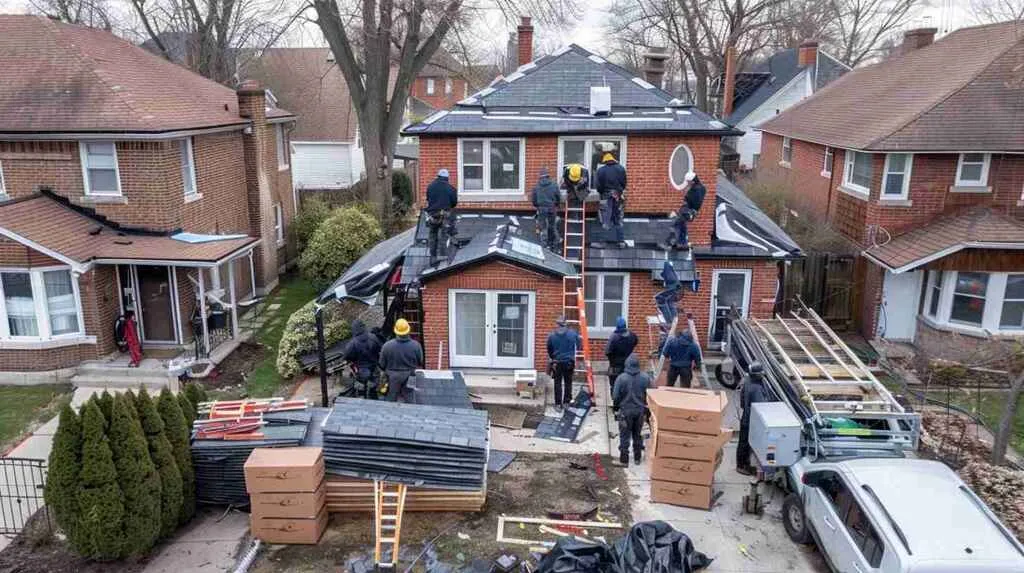
Ice Melt on Roof Shingles Queens NY – What’s Safe, What Damages
Chemistry doesn’t care about good intentions. Most sidewalk ice melt-rock salt, blue pellets, the stuff you grabbed at the hardware store on Astoria Boulevard-will quietly destroy your shingles and metal over a single Queens winter, stripping granules, pitting gutters, and leaving stains that show up the moment spring sun hits. The good news: there are one, maybe two roof-rated products that can help you through an ice dam emergency tonight without sacrificing the roof you’ll need for the next fifteen years.
What Ice Melt Does to Roof Shingles and Metal in Queens Winters
Here’s my honest take: if the jug says “great for concrete steps,” I already don’t trust it on your shingles. Most sidewalk ice melt is tested for exactly that-sidewalks-not asphalt roofing or aluminum gutters. In Queens freeze-thaw cycles, where mornings start at 18 degrees and afternoons hit 38, those chemicals you scatter to clear your front stoop will turn into concentrated brine that slides right down your roof, soaks the same three courses of shingles over and over, and starts breaking down the asphalt binders and protective granules. Follow the path of the water with me for a second: the pellets dissolve, the brine runs down slope, pools along your eaves where it’s coldest, and then sneaks under the shingle tabs at the edge or into the gutter seams. Every time it refreezes and thaws again, it pulls a little more material with it.
One January morning at 6:30 a.m., in that gray half-dark over in Bayside, I climbed up a two-story colonial where the owner had dumped three different kinds of ice melt along the gutter line. It looked like a salt tasting menu-blue pellets, white crystals, and some mystery green stuff. The shingles were bleached in stripes, the aluminum gutters were pitted, and the downspouts were already starting to crumble. I still remember watching the first bit of sunlight hit that roof and seeing the granules sliding down like sand, all because they thought “if it melts ice on the sidewalk, it must be fine on the roof.” What nobody tells you on the label is that chloride salts react with asphalt oils, dry out the mat underneath, and attack aluminum oxide. In plain English: your shingles get brittle and your gutters corrode from the inside out.
Queens roofs-especially the attached colonials and row houses from Flushing to Astoria-have low-slope sections, valleys where additions meet the main house, and long runs of metal flashing along party walls. When dissolved ice melt brine flows down those slopes and settles into a valley or pools against a step flashing, it sits there during the refreeze, getting more and more concentrated. That’s where the real damage happens: not in one dramatic moment, but in a slow, quiet dissolving of the protective layers you’re counting on. The granules wash away faster. The underlayment softens. The metal pits. And by the time you notice brown stains or a sag in the gutter, you’re already a season or two into repairs.
⚠️ Critical Warning
Never pour or scatter rock salt, generic ice-melt pellets, or driveway/sidewalk products directly on roof shingles or in gutters. In Queens’ freeze-thaw cycles, these chemicals create concentrated brine that strips shingle granules, pits aluminum gutters, stains siding, and can void your roofing warranty even if you only do it for one bad winter.
| Myth | Fact |
|---|---|
| “If it’s safe for sidewalks, it’s safe for my roof.” | Sidewalk-safe products are tested for concrete, not asphalt shingles or aluminum gutters; many will strip shingle granules and corrode metal. |
| “Rock salt is the strongest, so it’s best for thick roof ice.” | Rock salt (sodium chloride) is cheap but extremely corrosive to gutters, flashing, and can stain and dry out shingles in a single season. |
| “A little ice melt along the gutter line can’t do much harm.” | Concentrated brine always flows to the eaves, soaking the same few courses of shingles and metal over and over, causing localized failure. |
| “Colored pellets mean premium protection for my roof.” | Coloring is just dye; the active ingredient is usually a chloride salt that doesn’t belong on shingles at all. |
| “If the ice disappears, the product worked and the roof is fine.” | Ice can vanish in hours while chemical damage to shingles, underlayment, and metal quietly builds up under the surface. |
Safe vs Dangerous Ice Melts for Roof Shingles: A Quick Chemistry Guide
Here’s my honest take: if the jug says “great for concrete steps,” I already don’t trust it on your shingles. Most of what you’ll find at the hardware stores along Roosevelt Avenue or in Astoria are blends designed for driveways and sidewalks-sodium chloride (rock salt), magnesium chloride marketed as “pet-safe,” and generic calcium chloride pellets in bright blue or white. Their labels say concrete, asphalt pavement, maybe brick. Not one mentions roofing systems. The only products I’ll even consider on a shingle roof are explicitly labeled “for roofs” or “ice dam relief,” usually calcium chloride in controlled fabric sock form, and even then only in very specific situations. Sodium chloride is the worst offender-cheap, aggressive, and absolutely murderous on aluminum and asphalt. Magnesium chloride sounds gentler because the marketing says “safe for pets and plants,” but it’s still a chloride salt that softens asphalt binders and corrodes metal over time. Urea-based products are occasionally sold for concrete, but they’re not tested or rated for roofs and can promote algae growth and staining.
One of my strangest calls was a Sunday afternoon in February after a freezing rain, in Jackson Heights. A retired teacher had carefully laid those long ice-melt socks across her roof from a second-floor window using a broom handle, like she was playing rooftop shuffleboard. The problem? One of the socks had busted open right above a valley where two roofs met, and the calcium chloride had sat in a puddle for days. When I peeled back the shingles, the underlayment was bubbled like old wallpaper, and the plywood was already dark and soft. She had done everything “carefully”-just with the wrong product in the wrong place. Follow the path of the water with me for a second: that calcium chloride dissolved into a super-concentrated brine, heavier than plain water, and it settled right into that valley like syrup in the bottom of a bowl. Every freeze-thaw cycle after that pushed it a little deeper through the shingle seams, through the underlayment, into the decking. Valleys and low spots in attached houses are especially vulnerable because they’re the natural collection points for runoff, and once brine pools there, it doesn’t just evaporate-it attacks.
| Ingredient | Typical Use | On Shingles? | On Gutters/Metal? | Notes for Queens, NY Roofs |
|---|---|---|---|---|
| Sodium Chloride (Rock Salt) | Driveways, streets | ❌ No – accelerates granule loss, stains, dries out asphalt | ❌ No – heavy corrosion on aluminum/steel | Most damaging choice; avoid completely on pitched shingle roofs. |
| Calcium Chloride (generic pellets) | Sidewalks, steps | ⚠️ Risky – can damage shingles if piled or pooled | ⚠️ Corrosive to metal with repeated use | Only consider in roof-specific products and very controlled use. |
| Roof-Rated Calcium Chloride in Fabric Socks | Ice dam relief | ✔️ With caution – place perpendicular to eaves, not in valleys | ⚠️ Keep off exposed metal edges and gutters | Look for packaging that explicitly says “for roofs/ice dams.” |
| Magnesium Chloride Blends | “Pet safe” sidewalk products | ❌ No – still chloride-based, can soften asphalt binders | ❌ No – corrodes metal over time | “Pet friendly” doesn’t mean “roof friendly.” |
| Urea-Based Melts | Occasional concrete use | ⚠️ Generally not recommended | ⚠️ Can stain and promote algae | Lower corrosion but not tested or rated for roofing systems. |
Quick Label Check: Roof-Safer vs Roof-Killing
-
✓
Look for: Packaging that says “roof ice dam,” “safe for shingles,” or “aluminum-safe formula.” -
✗
Avoid: Any label that only mentions sidewalks, driveways, concrete, or asphalt pavement. -
✓
Check ingredients: Roof-rated calcium chloride in fabric or mesh delivery, not loose pellets. -
✗
Red flag: “Works on everything!” or “heavy-duty rock salt formula.” -
✓
Temperature rating: Should list working temps down to at least 0°F without massive quantities. -
✗
Skip it if: The only instructions are “scatter liberally” with no mention of roofing precautions.
Tonight’s Emergency vs Protecting Your Roof Long-Term
The first question I always ask a homeowner is, “Are you trying to save the roof, or just get through tonight?” because those are two different strategies. If water’s already dripping into your dining room and you’ve got a two-inch ice dam glowing under the streetlight, yeah, you might need to act fast-but that doesn’t mean grabbing whatever’s under the sink and dumping it on the shingles. The job that really made me strict about what I recommend was a Thursday night emergency in Flushing after a nor’easter. A restaurant owner called me because water was literally dripping into his dining area over the bar. He’d hired a handyman to “solve ice dams” a week earlier; the guy had scattered rock salt across the flat roof and along the sloped shingle section over the entrance. Under the streetlights I could see corrosion circles around every pile of salt, and when I walked the shingles, they felt crunchy, like stepping on stale chips. We had to tarp the whole entrance and later replace a strip of shingles and a section of metal flashing that the salt had eaten through in a single season. He stopped the leak for one night and bought himself fifteen thousand dollars in repairs by spring.
Before you reach for that blue or white pellet jug, stop.
Getting through tonight means making a careful choice-maybe one or two roof-rated calcium chloride socks laid perpendicular to the eave to carve narrow drainage channels, placed from a window so you’re not climbing on ice, and keeping them off valleys and exposed metal. Protecting your roof long-term means fixing the real problem: attic insulation that’s thin or uneven, ventilation that’s blocked or missing, and details like ice-and-water shield at the eaves that should’ve been there from the start. Follow the path of the water with me for a second: warm air from your living space rises into the attic, heats the underside of the roof deck, melts the snow on top even when it’s 28 degrees outside. That meltwater runs down the slope until it hits the cold eave overhang where there’s no heat below, and it refreezes into a dam. More melt backs up behind the dam, and eventually it sneaks under the shingle tabs and into the house. No amount of ice melt fixes that cycle-you’ve got to address the heat loss and the airflow.
Should You Try DIY Ice Melt Tonight or Call a Queens Roofer?
Start: Is water already leaking inside (ceilings, walls, around windows)?
- Yes → Do you see thick ice built up along the eaves (overhang) or in valleys?
- Yes → Avoid scattering pellets. Place 1-2 roof-rated calcium chloride socks perpendicular to the eave to carve channels, then call a roofer like Shingle Masters within 24 hours.
- No → This may be a flashing or attic moisture issue; skip ice melt and call a roofer to inspect.
- No → Are gutters or downspouts visibly sagging or tearing from ice weight?
- Yes → Do not add chemicals or more weight; call a pro urgently for safe ice removal.
- No → Light frost/ice only? Do nothing tonight; plan an inspection for insulation, ventilation, and roof details before next freeze.
| Call Shingle Masters Now (Urgent) | Can Wait a Few Days |
|---|---|
| Water stains or active dripping under sloped roof areas after a freeze. | Visible icicles but no interior leaks or ceiling stains. |
| Ice dams thicker than 2-3 inches running along more than half the eave. | Small ice patches over a porch or unheated garage. |
| Gutters pulling away, bending, or making popping sounds under ice weight. | Minor shingle overhang icing with good attic ventilation already in place. |
| Previous salt use has left rusted gutters or soft, curling shingles. | You’re planning a spring roof tune-up and want ice-prevention advice. |
How to Handle Roof Ice Safely in Queens: Rafa’s Game Plan
Truth is, water doesn’t care about your intentions; it only cares about slope, temperature, and the path you accidentally gave it. On every Queens roof I’ve ever worked on-colonials in Bayside, attached row houses in Astoria, semi-detached homes with side driveways in Middle Village-the story is the same: meltwater follows gravity and cold. If you want to understand where ice will form and where chemicals will pool, you’ve got to see the water moving in your head. Start at the ridge, picture snowmelt running down the shingles, hitting the cold eave overhang, freezing, building up, backing up under the tabs. Now add a valley where two roof planes meet, or a low spot behind a dormer. That’s where water naturally collects, and that’s where any ice melt brine you introduce will settle and concentrate.
Step-by-step: Follow the path of the water
Stand on your sidewalk-don’t climb on an icy roof-and trace the slope with your eyes. On a typical Queens colonial, you’ll see the main roof pitching front to back, maybe a cross gable over the garage, and valleys where additions or dormers intersect. Meltwater flows down those valleys faster than anywhere else, so that’s where ice dams get thickest and where brine will pool if you scatter pellets. For attached row houses or semi-detached homes, look at the party wall where your roof meets your neighbor’s; that shared valley or step flashing is a natural trap. On a flat-roof section with a low parapet, water pools at the drains or scuppers. Wherever you see thick icicles hanging, that’s where water is running, refreezing, and backing up. That’s your danger zone-and that’s exactly where you don’t want concentrated ice melt sitting.
Before you even touch an ice-melt product
Clear your walkways so you can move safely. Have a helper inside watching for leaks so you’re not guessing. Read the product label all the way through-if it doesn’t say “for roofs” or “ice dam relief,” put it back. Don’t toss loose pellets or crystals; they’ll scatter, concentrate in random spots, and you’ll have no control over where the brine goes. Here’s the insider move I teach homeowners: if you absolutely need to use a roof-rated calcium chloride sock tonight, gently lay it perpendicular to the eave from a second-floor window using a broom handle or extending pole, so it crosses the ice dam and carves a narrow melt channel straight down. Never pile socks in a valley, never drape them along the gutter, and keep them off exposed metal edges. The goal isn’t to melt every ounce of ice-it’s to create one or two controlled drainage paths so backed-up water can escape before it finds a way into your house. And honestly, that’s a short-term patch. The real fix is adding insulation in the attic so heat stops escaping through the deck, improving ventilation so cold air circulates under the sheathing, and-if your roof is old or wasn’t done right the first time-installing ice-and-water shield membrane at the eaves during your next re-roof.
Safe Same-Night Actions for Roof Ice Without Wrecking Your Shingles
-
1
Stay off the icy roof. Work from the ground or a window only, using a roof rake with a long handle to gently pull snow down off the first 2-3 feet above the gutters. -
2
Open drainage paths. If gutters and downspouts are clogged with snow at ground level, carefully clear what you can so meltwater has somewhere to go. -
3
Use roof-rated calcium chloride socks only, and sparingly. Place them perpendicular to the eave where ice dams are thickest to cut narrow channels, never in valleys or piled in one spot. -
4
Protect what’s below. Move vehicles, trash cans, and planters away from the drip line where salty slush will fall and splash. -
5
Schedule a follow-up inspection. Once the thaw passes, have a roofer check shingle edges, gutters, and attic insulation/ventilation so you’re not repeating this next winter.
Before You Call: What to Note About Your Roof Ice or Ice Dam Situation
- ✅ Where exactly do you see ice dams (front, back, over porch, in valleys)?
- ✅ Any active leaks or just stains? Take pictures of both inside and outside.
- ✅ What, if any, ice melt products have already been used this season?
- ✅ Type of roof (asphalt shingles) and approximate age, if you know it.
- ✅ Are gutters original or recently replaced? Any visible rust or sagging?
- ✅ Note the worst time of day for leaking (during thaw, evening refreeze, etc.).
Why Queens Homeowners Call Rafa at Shingle Masters
- Licensed and insured roofing contractor serving Queens, NY exclusively.
- 19+ years of local roofing experience in neighborhoods from Astoria to Bayside.
- Special focus on winter leak tracing, ice dam prevention, and shingle protection.
- Rapid response for active leaks impacting living spaces or businesses.
The safest long-term fix isn’t a jug of pellets-it’s understanding why your roof forms ice in the first place and addressing the heat loss, ventilation gaps, and missing water barriers that turn every Queens freeze into a roofing emergency. If you’re dealing with ice dams tonight, water stains on your ceiling, or shingles and gutters that already show damage from past ice melt use, call Shingle Masters. I’ll walk you through exactly where the water is traveling on your own roof, step by step, and we’ll figure out whether you need an emergency patch or a real fix before next winter hits.