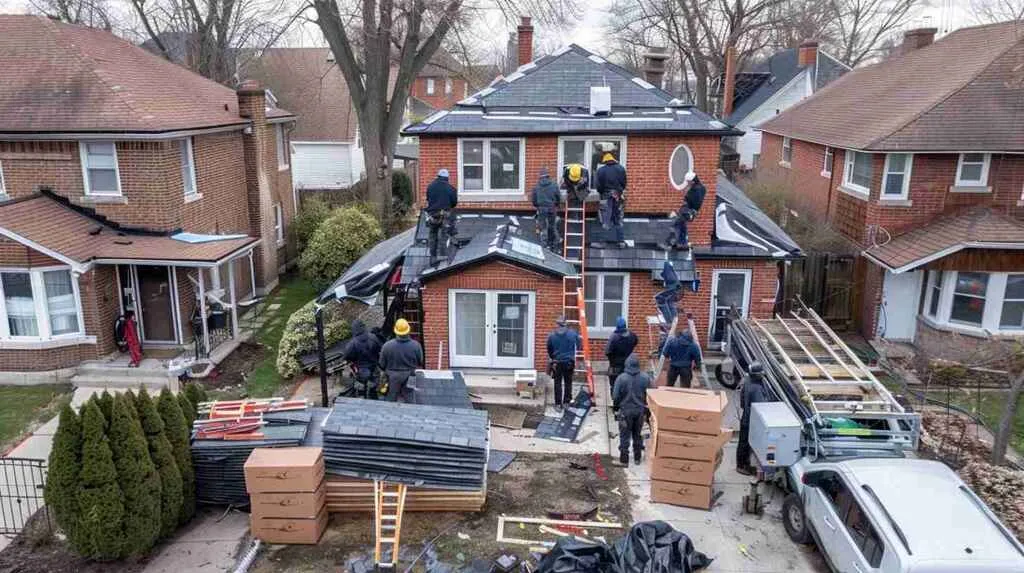
Types of Residential Shingles Queens NY – Performance Differences
Layers of cheap roofing shingles stacked on a Queens roof often cost homeowners more by year 10 than a single quality system would have upfront. In our climate-brutal nor’easter wind gusts, summer UV strong enough to crack asphalt, freeze-thaw cycles that pry nails loose-cutting corners on shingle choice is like casting the wrong actor in a high-stakes scene: it shows, it fails, and someone pays for the reshoot.
I see three main residential shingle “characters” every week: budget three-tabs (the disposable extra), architectural or laminated shingles (the dependable lead), and luxury designer shingles (the glamorous star who commands every frame). Here’s my honest take: in Queens, basic three-tab shingles are usually the wrong answer unless you’re flipping a property or patching in a hurry. Performance, not just price, is what keeps your roof on the house when the next storm hits.
And performance means different things on different blocks. A corner-lot Colonial in Whitestone catching full bay winds needs a different cast than a sheltered rowhouse in Flushing. A south-facing Cape baking all summer in Maspeth ages shingles differently than a north-facing roof tucked behind taller buildings in Forest Hills. Exposure-wind, sun, surrounding structures-changes what “best” actually means for your roof.
Queens Roofing Reality Check
Three-Tab vs Architectural vs Luxury: Head-to-Head for Queens Homes
On a cold Tuesday in Flushing not long ago, I was standing on a roof that was only 8 years old-but the three-tab shingles looked like they’d lived a hard 25. One August afternoon, right after a crazy thunderstorm, I got a call from a homeowner in Maspeth whose three-tab shingles had peeled back like pages in a book. I remember climbing up there, shoes still squeaking from the wet, and you could see exactly where the wind had ripped along the ridge. That job is when I really started pushing architectural shingles in wind-prone parts of Queens; I literally showed the homeowner the tear pattern and said, “This is what a cheap shingle looks like in a fight.” Three-tabs are thin, single-layer asphalt with cut-outs that make them even weaker; in our gusts they flutter, lift, and tear. They’re the disposable extra in the cast-they show up, get one scene, and you replace them when the action heats up.
Architectural shingles-also called laminated or dimensional-are thicker, multi-layer products with better adhesives, no cut-outs, and reinforced nailing zones that grab the deck harder. They’re the reliable lead: they carry the movie through wind, sun, and freeze without drama. Luxury shingles take that further-heavier weight, slate or wood-shake profiles, premium granules-and they’re the glamorous star who steals attention from the street. On a tight-packed Queens block where every house is brick or vinyl rowhouse style, luxury might be overkill. On a detached Tudor or a corner-lot Colonial where the roof’s a big part of the curb appeal, that “star power” actually pays off in resale and stability.
| Shingle Type | Typical Installed Cost* (per sq. ft. in Queens) | Realistic Lifespan | Wind Performance | Curb Appeal | Best Cast As |
|---|---|---|---|---|---|
| Basic Three-Tab Asphalt | $4.25-$5.75 | 8-15 years in wind-exposed spots | Often rated 60-70 mph; prone to tearing and lifting in nor’easters | Flat, repetitive; looks “builder basic” | Background extra: cheap, replaceable, not built for action scenes |
| Architectural / Laminated Asphalt | $5.75-$7.75 | 18-28 years with proper ventilation | Commonly rated 110-130 mph with proper install | Dimensional, shadow lines; suits most Queens blocks | Reliable lead: carries the movie without drama |
| Luxury / Designer Asphalt | $7.75-$10.50 | 22-30+ years on well-built roofs | Up to 130+ mph; heavier weight resists uplift | High-end, slate/wood shake look; ideal for Tudors and larger Colonials | Glamorous star: steals the scene and the neighbors’ attention |
How Queens Weather Beats Up Different Shingle Types
Blunt truth: if your shingles can’t hold a nail properly, I don’t care what the brochure says about their “lifetime” color. In January a few years back, I was in Whitestone on a south-facing Cape where the homeowner swore their “30-year shingles” were only 12 years old but curling like potato chips. It was 27 degrees, sun blasting one side of the roof, and the other side still had frost. I could see clear as day how the dark, low-quality shingles had baked over time-granules gone, fiberglass mat showing. That job made me start carrying a little infrared thermometer; now I show people how different shingles absorb heat right there on their own roof. Cheap three-tabs with thin mats and weak adhesive strips literally cook themselves to death on south slopes; architectural shingles with thicker construction and better granules handle that UV abuse longer, and luxury shingles with premium coatings last even longer still. And when winter freeze-thaw hits, water works into tiny gaps around nails, expands, loosens the shingle-so if the nail-strip is flimsy or the installer rushed the job on a cold morning, you’re asking for blow-offs by spring.
I’ll never forget a Saturday morning in Forest Hills, early fall, when a retired engineer had a spreadsheet printed out comparing impact ratings on shingles. He’d had hail damage once in the Midwest and was convinced he needed Class 4 impact-resistant shingles here in Queens. We stood on his driveway, drizzle coming down, and I walked him through how our local risk is more about wind, ice dams, and UV than baseball-sized hail. He appreciated that I didn’t just upsell him; we picked a mid-range laminated shingle with reinforced nailing zones instead of the most expensive impact product. Here’s the insider tip: Class 4 impact shingles make sense if your insurer gives a real discount and you want the extra thickness for wind and debris, but in Queens they’re usually overkill. A solid architectural with strong nail-strip adhesion and good ventilation underneath will outperform a cheap impact shingle every time, because wind and heat are your real enemies, not occasional hail.
Queens-Specific Shingle Performance Traps
- Don’t rely on the printed “30-year” or “lifetime” label-on a south-facing Queens slope with dark shingles, you may see serious aging in 12-18 years.
- Avoid installing new shingles directly over old layers just to save money; trapped heat and uneven surfaces shorten shingle life here.
- Be skeptical of upsells to high-priced impact-resistant shingles unless your insurer gives a discount and your main risk isn’t wind-driven rain and ice.
What Our Climate Does to Your Shingles Over Time
Cast Your Queens Roof: Which Shingle Type Fits Your House?
Think of your roof like a film set: the rafters are the steel trusses, the underlayment is the safety net, and the shingles are the actors that take all the hits on camera. Your Queens house is the main character, and you’re the director deciding which cast-three-tab extras, architectural leads, or luxury stars-best fits the script your block, your budget, and your timeline just handed you.
Simple Path to the Right Shingle Type in Queens
Start: Are you planning to keep this Queens home for at least 8-10 years?
  ├─ Yes → Is your roof clearly exposed to strong winds (corner lot, hill, near open water)?
  │      ├─ Yes → Do you care about curb appeal and resale on this block?
  │      │      ├─ Yes → Architectural shingles (mid- to upper-tier) are your lead actor.
  │      │      └─ No  → Solid mid-range architectural shingles with reinforced nailing zone.
  │      └─ No  → Architectural still wins; consider lighter colors to cut attic heat.
  └─ No  → Is this a flip or short-term rental you're freshening up?
         ├─ Yes → Basic three-tabs only if code and HOA allow-and only for quick resale.
         └─ No  → You're in a gray zone; lean architectural for fewer headaches when you sell.
Queens Shingle Questions I Answer Every Week
When I meet a homeowner who asks, “So which shingle is actually best?” I always fire back with, “Best for what-wind, looks, lifespan, or noise when it rains?” Because that’s the whole point: your roof is the set, and you’re picking actors who need to handle what gets thrown at them. These are the five questions I hear most often right before someone commits to a shingle type or signs an estimate with Shingle Masters.
Common Shingle Selection Questions in Queens, NY
▸
Do architectural shingles really last that much longer than three-tabs here?
On the Queens roofs I’ve torn off, properly installed architectural shingles usually outlive three-tabs by 5-10+ years. The thicker laminate, better adhesives, and stronger nailing zones handle our wind and temperature swings better, especially on exposed ridgelines and south-facing slopes.
▸
Are luxury shingles overkill for most Queens houses?
They’re overkill if you’re planning to move in a few years or your house is a simple box where curb appeal isn’t a priority. They make sense on higher-end Tudors, Colonials, and corner-lot homes where the roof is a big part of the look and you want that slate or wood-shake effect with serious weight and stability.
▸
Will heavier shingles make my old Queens house sag?
If the framing is already spongy or there are multiple old layers, we address that before adding any weight. Going from three-tab to architectural is usually a non-issue on sound framing, but we always inspect the deck and structure and recommend repairs if needed so the new shingles have a solid stage to perform on.
▸
Is it okay to put new shingles over my old ones to save money?
Technically, it’s sometimes allowed, but I strongly advise against it in Queens. You trap heat, hide deck problems, add weight, and shorten the life of whatever shingle you’re paying for-especially on complex roofs or ones that already see high attic temperatures.
▸
Which colors handle Queens heat best without looking out of place?
Mid-tone grays and weathered wood blends are the safe bet: they don’t bake as hard as solid black in July, but they still look right next to typical Queens brick and siding colors. On very sunny, south-facing slopes, I often nudge clients a shade lighter than their first instinct.
Why Queens Homeowners Call Shingle Masters
Picking the right shingle type for a Queens roof is about matching performance to your block, your budget, and how long you’ll stay-not just chasing the lowest bid or the fanciest name on a sample board. Three-tabs might work on a quick flip, architectural shingles are the reliable choice for most long-term owners, and luxury shingles earn their keep on homes where the roof truly matters to curb appeal and resale. Call Shingle Masters and I’ll walk your roof with you, explain the options on-site where you can see exactly what exposure and slope you’re dealing with, and price out an architectural or luxury system that won’t let the next nor’easter push it around.