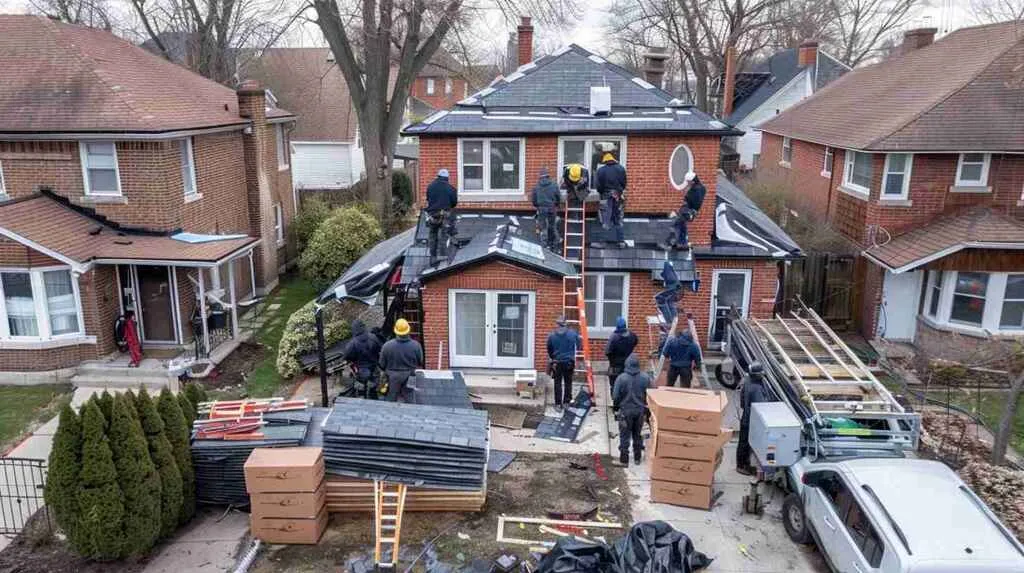
Shingle Roof Replacement Contractor Queens NY – What Matters | Free Quotes
Blueprint first: a full residential shingle roof replacement in Queens runs between $9,000 and $18,000 for most one- and two-family homes, and the single biggest factor that makes that number jump is the condition of your existing roof deck and how many layers of old shingles are already up there. I’ve spent 19 years stripping shingles across Jackson Heights, Forest Hills, Astoria, and Woodside, and guessing cost from the sidewalk is pure wishful thinking-it’s like rigging a stage show without climbing the grid to check the beams.
I started in theater lighting, designing off-Broadway shows, then switched to roofs one rainy Saturday when helping a buddy patch a dormer turned into a full-career pivot. Turns out I like fixing real leaks more than faking sunsets with LEDs, and roofs speak the same language I learned backstage: systems, weak links, and consequences when opening night hits during a nor’easter.
What Queens Homeowners Really Pay for Shingle Roof Replacement
Most two-families in Queens carry between 1,400 and 2,000 square feet of roof surface, and that translates to somewhere between $8,500 and $20,000 depending on how many surprises are hiding under your current shingles. The biggest cost swing isn’t the shingle brand or the color-it’s whether your decking is solid plywood or a soft, spongy mess that needs replacing sheet by sheet. I’ve opened roofs where the first layer looked fine from the ladder, but once I stripped it, I found two brittle layers underneath with zero underlayment at the eaves and a bathroom vent dumping steam straight into the attic. That’s the difference between a quote holding firm and adding $3,000 in deck replacement.
On a typical two-story in Queens with about 1,600 square feet of roof, here’s what I actually see when I strip the first shingle: one owner in Elmhurst had insisted on “just patching” a blown section from the previous winter. August afternoon, humidity like soup, 3 p.m., and when I peeled back three courses I found two brittle layers, no underlayment, and that vent problem. That was the day I stopped saying “maybe we can get you a few more years” and started saying, “Look, this whole system is failing, and you’re paying for it in slow motion.” We did a full replacement, and her ConEd bills dropped so much she called me back just to tell me. Think of your roof like planning a live performance-either you’re building for a one-season run or a long-term production, and cheap patches don’t survive opening night when the next big storm rolls in off the East River.
Queens Shingle Roof Replacement Price Scenarios
| Scenario | Roof Description & Conditions | Typical Price Range (Queens, NY) | Biggest Price Shifters |
|---|---|---|---|
| Small & Simple | 1,200-1,400 sq ft, single layer, solid deck, basic gable or hip, no skylights or complex valleys | $8,500-$11,000 | Number of vents, flashing linear feet, shingle grade (3-tab vs architectural) |
| Typical Two-Family | 1,600 sq ft, one or two layers, minor wood replacement (2-4 sheets), average complexity, updated vents | $11,500-$15,000 | Hidden decking rot, number of existing layers, upgraded underlayment (synthetic vs felt) |
| Moderate Complexity | 1,800 sq ft, multiple layers, deck replacement (6-8 sheets), skylights or dormers, step flashing at brick walls | $15,000-$18,000 | Deck condition, skylight flashing overhaul, architectural shingle upgrade, ice & water shield coverage |
| Older Home, Heavy Work | 2,000+ sq ft, three layers (full tear-off required), 10+ sheets of deck, rotten fascia or soffit, full vent overhaul | $18,000-$24,000 | Structural wood replacement, waste removal for triple layers, permit and DOB requirements, lead time |
| Emergency or Storm Damage | Any size, urgent timeline, partial tear-off and tarp, immediate moisture intrusion, possible interior damage | +20-35% premium | Availability, rush material sourcing, tarp and emergency dry-in, coordination with insurance adjuster |
The Hidden Roof System: Where Queens Shingle Costs Really Creep Up
Let me be blunt: most of the cost surprises on a shingle replacement in Queens come from what you *can’t* see from the sidewalk. I’m talking about decking softness under the shingles, rotten fascia boards behind the gutters, old metal flashing that’s cracked along the chimney, and how many layers of shingles are already stacked up there like a bad set design. Older two-families in Elmhurst and Jackson Heights regularly have two or three layers, which means heavier tear-off, more dumpster runs, and a much higher chance of hidden wood rot once we expose the deck. Eastern Queens neighborhoods with newer construction from the ’80s and ’90s tend to have cleaner decks but often skimp on underlayment and proper vent terminations-different problems, same cost creep. The system is deck, underlayment, flashing, vents, and then shingles, in that order. Miss one weak link in that chain, and you’re not getting the lifespan you paid for.
$4,000 is the difference between catching soft decking early and paying for emergency mold cleanup later.
Around 9 p.m. on a cold November night in Astoria, I was up on a roof under a headlamp because a landlord had delayed replacing a 25-year-old shingle roof and finally called when water started pouring into his tenant’s nursery. Wind-driven rain, baby’s crib under a tarp-that one stuck with me. We got emergency tarps down and, two days later, stripped the entire roof to find deck rot spreading from a failed valley and bathroom vents dumping straight into the attic, no exit to the outside. That job taught me to be blunt during estimates: if I can see daylight through your decking from the attic, we’re not having a “maybe next year” conversation. Here’s an insider tip-ask your contractor exactly how many sheets of deck replacement are included in the quote and what the per-sheet cost is if more are needed when they open it up. And have them sketch or show you where your attic ventilation actually flows, because venting into the attic instead of outside is like running fog machines with the exit doors locked-it just traps the problem and accelerates rot.
✅ System Parts You See on a Quote
- Shingles (brand, type, color, square footage)
- Underlayment (felt or synthetic, coverage area)
- Ridge vent or cap shingles
- Starter strips at eaves and rakes
⚠️ System Parts That Bite You Later If Ignored
- Roof deck sheathing (plywood or OSB replacement)
- Step flashing at side walls and chimneys
- Ice & water shield at eaves and valleys
- Bathroom and kitchen vents (proper termination to outside)
⚠️ Dangers of Stacking New Shingles Over Old Layers in Queens
Installing a new shingle layer over an old one is like hanging a new set on a rotten backstage frame-you’re adding 300+ pounds per square of extra weight to a deck you can’t inspect, hiding any existing rot or failed flashing, and making future leak tracking nearly impossible. Most shingle manufacturers void the warranty if you install over more than one layer, and Queens’ freeze-thaw cycles plus wind off the East River accelerate the failure of those double-stacked systems. I’ve stripped roofs where the bottom layer was so brittle it turned to powder, and the middle layer was holding water like a sponge against the deck. That’s not a repair-it’s a slow-motion collapse waiting for the next big storm.
Cheap vs Built-to-Last Shingle Roofs: What Actually Changes on Your Queens Home
I still remember a small semi-attached in Woodside where a “cheap” roof from ten years ago ended up costing double in the end. The original contractor had used 3-tab shingles, skipped ice and water shield except at the very edge, hand-nailed in a 4-nail pattern instead of the manufacturer’s 6-nail spec, and left the old metal valley flashing in place. Within eight years, the valley was leaking, shingles were blowing off in moderate wind, and granule loss was so bad you could see the fiberglass mat. Compare that to a “long-term production” roof on the same house: architectural shingles rated for 110 mph winds, synthetic underlayment across the whole deck, ice and water shield from eaves to at least two feet past the exterior wall, all new step flashing at the brick sidewall, proper nailing per the spec, and ridge and soffit vents balanced for real airflow. One mild March morning in Forest Hills, I met a retired engineer who had spreadsheets of shingle brands, warranties, and color fade rates-he knew more marketing jargon than some reps I deal with. He wanted the “cheapest 30-year roof” but also demanded high wind resistance and algae protection. We went up together, and I walked him through the nailing pattern, the starter strip layout, and why his old roof had failed along the north-facing valley. By the time we were done, he upgraded to architectural shingles and a full ventilation package, not because I sold him hard, but because the system finally made sense to him on paper and on the plywood in front of us.
Focus on the small choices-ice and water shield that extends past the eaves, upgraded synthetic underlayment that doesn’t tear in wind, proper flashing lapped in the right direction-and you change the entire service life and resale value of your home. My personal opinion: I’d rather lose a job than install a roof I know won’t survive Queens storms for a full expected lifespan, because when it fails in ten years, my name’s still on it and someone’s nursery is under a tarp at 9 p.m. in November. That’s not a risk I’m willing to take, and it’s not one you should ask your home to carry either.
Budget ‘One-Season Run’ vs Long-Term ‘Full Production’ Roof
| Element | Basic Patch-and-Replace Job | Full System Replacement |
|---|---|---|
| Shingles | 3-tab, 60-70 mph wind rating, 20-year warranty (realistic 12-15 year life in Queens) | Architectural, 110+ mph wind rating, 30-50 year warranty (realistic 25-35 year life) |
| Underlayment | 15 lb felt, partial coverage, tears easily during install | Synthetic (e.g., Titanium, FeltBuster), full deck coverage, high tear strength, UV stable for weeks |
| Ice & Water Shield | Eaves only, 3 feet up (code minimum) | Eaves to 2+ feet past exterior wall, all valleys, around penetrations (vents, skylights) |
| Flashing Approach | Reuse old metal where possible, minimal step flashing replacement | All new step flashing at walls and chimneys, proper lap and sealant, counterflashing where needed |
| Ventilation | Existing vents left in place, no balance check between intake (soffit) and exhaust (ridge) | Balanced intake/exhaust, continuous ridge vent or multiple box vents, soffit vents verified open |
| Realistic Lifespan (Queens) | 10-15 years before major issues | 25-35+ years with proper maintenance |
✅ Pros of Architectural Shingles
- Wind resistance: 110+ mph ratings vs 60-70 for 3-tab, critical for Queens coastal exposure
- Lifespan: 25-35 realistic years vs 12-15 for budget options
- Curb appeal: Dimensional look, better resale value, wider color range
- Warranties: Stronger coverage, often transferable to next owner
⚠️ Potential Drawbacks
- Material cost: Roughly 20-30% more per square than 3-tab
- Labor: Slightly higher install time due to alignment and weight
- Weight: Heavier; very old framing (pre-1940s) may need structural review before install
- Overkill risk: If selling within 5 years, ROI may not fully materialize
How a Shingle Roof Replacement with Shingle Masters Actually Works
When I show up for a free quote, one of the first things I ask is, “Are you planning to sell in the next five years, or is this house your long-term base camp?” That single question changes the spec-finish choices, ventilation upgrades, and warranty level. If you’re flipping or selling soon, I’ll focus on curb appeal, solid basics, and a transferable warranty that adds resale value without over-engineering. If this is your forever home or a long-term rental, we’re talking about a full system designed for 30+ years of Queens freeze-thaw, summer heat, and nor’easters rolling in off the water. Think of it like planning a show’s run length: a limited engagement gets one set of rigging choices, a long-running production gets another, and I design your roof accordingly so it doesn’t fail halfway through the season.
From that question, we zoom into the on-site process: I’ll walk the roof (if it’s safe) and check the attic, looking for soft spots in the deck, daylight through seams, vent terminations, and how many layers are already up there. I take photos, sketch a quick diagram on the back of my quote or a piece of cardboard-complete with arrows and stick-figure raindrops-so you can actually see how water flows and where the weak links are. The written quote includes material specs, labor breakdown, and an allowance for deck replacement (usually 4-6 sheets as a starting estimate), with a clear per-sheet cost if we find more rot once we strip it. Here’s an insider tip: ask every contractor to show you where your attic ventilation actually flows and how your bathroom vents terminate, because I’ve seen too many jobs where vents dump steam straight into the attic like that Elmhurst job-no exit to the outside, just trapped moisture accelerating rot and mold. Make them sketch it or take you up to see it, because that’s the stuff that doesn’t show on a material list but determines whether your new roof lasts 15 years or 35.
Step-by-Step Queens Shingle Roof Replacement Process with Shingle Masters
- Phone Consult and Rough Range: We discuss roof size, age, visible issues, and your timeline; I give you an honest ballpark so you’re not wasting time if budget and reality don’t match.
- On-Roof and Attic Inspection: I walk the roof (weather permitting), check for soft decking, count layers, inspect flashing and vents, then head to the attic to look for daylight, moisture stains, and vent terminations.
- Written Quote with System Diagram: You get a detailed quote breaking down shingles, underlayment, flashing, deck allowance, vents, labor, permits, and waste removal, plus my cardboard sketch showing water flow and weak points.
- Tear-Off and Deck Repairs: We strip all old shingles and underlayment, inspect every sheet of decking, replace soft or rotten plywood/OSB, and call you immediately if we find more damage than the allowance covered.
- New System Install: Ice and water shield at eaves and valleys, full synthetic underlayment, new step flashing at walls, drip edge, shingles nailed per manufacturer spec, ridge vent or cap, and all penetrations (vents, pipes) properly flashed and sealed.
- Final Walkthrough and Photo Report: We clean up, magnet-sweep the yard for nails, show you the finished roof and attic (to confirm vents are working), and send you before/during/after photos plus warranty docs within 48 hours.
✓
Why Queens Homeowners Hire Shingle Masters for Shingle Replacement
- Fully licensed and insured in NYC (DOB, liability, workers’ comp-ask to see current certificates)
- 19+ years replacing shingle roofs specifically in Queens, with deep knowledge of neighborhood building types, common failure points, and local permit processes
- Experience with 1-3 family homes, semi-attached, and row houses-we know the tight spaces, shared walls, and access challenges unique to Queens residential
- Manufacturer-trained on major shingle brands (GAF, CertainTeed, Owens Corning) so we install to spec and preserve your warranty
- Typical crew size: 3-5 skilled installers; typical project duration: 2-4 days for a standard 1,600 sq ft roof, weather permitting, with daily cleanup and progress updates
Deciding If It’s Time: Leaks, Age, and Queens Weather Reality
Here’s the unglamorous truth most ads skip: shingles are just the costume; the real performance is in the deck, flashing, and ventilation. When replacement is urgent versus when you can plan it over a season depends on whether you’re seeing active leaks during rain, missing shingles after wind, or just age-related wear like granule loss and curling edges. If water’s coming in now or you can see daylight through the attic, that’s a call-today situation-like calling cues before a stormy opening night when the rigging’s already creaking. If your roof is 18-25 years old with visible wear but no active leaks, you’ve got time to plan, get multiple quotes, and schedule during the shoulder seasons when crews have more availability and you’re not racing a nor’easter.
🚨 Call Now (Urgent)
- Active leaks during rain or snow melt
- Shingles missing or blown off after wind event
- Sagging or soft spots visible on the roof deck from the ground
- Daylight visible in the attic through roof seams or around vents
- Water stains near electrical fixtures or spreading on ceilings
⏰ Plan Soon (Can Wait a Bit)
- Roof is 18-25+ years old with visible granule loss in gutters
- Shingle edges curling or cracking, but no active leaks yet
- Past patch jobs in multiple spots (sign the system is failing incrementally)
- Moss or algae growth on north-facing slopes (indicates trapped moisture)
Common Queens Shingle Roof Replacement Questions
How long does a typical Queens shingle roof replacement take for a 1-2 family home?
Most 1,600-2,000 sq ft residential roofs take 2-4 days of actual work, weather permitting. Day one is usually full tear-off and deck inspection/repair. Days two and three are underlayment, flashing, shingles, and ridge work. Day four (if needed) is detail work, cleanup, and final inspection. Rain delays can add days, and if we find major hidden deck rot, that can extend the timeline-but I’ll call you immediately if that happens so there are no surprises.
Can you do replacements in winter, and is it safe?
Yes, but with limits. Most shingle manufacturers require temps above 40°F during install so the adhesive strips seal properly. In Queens, that means November through early March can be hit-or-miss-we watch the forecast closely and sometimes hand-seal shingles with roofing cement in colder conditions. Winter installs are slower and riskier if snow or ice is present, but for emergency repairs or if you’re closing on a sale, we can make it work safely with the right precautions.
What about permits and DOB rules for roofing in Queens?
In NYC, a full tear-off and replacement on a 1-3 family home typically requires a permit from the Department of Buildings, especially if you’re changing the roof structure or doing major deck work. We handle the permit application and coordinate inspections-it adds a bit of time and cost (usually $300-$600 depending on scope) but it’s non-negotiable and protects you legally. Some contractors skip this step; don’t let them. An unpermitted roof can cause serious issues when you sell or file an insurance claim.
Do I need to be home during the work?
Not necessarily. Once we’ve done the walkthrough and you’ve signed off on the plan, most of the work happens outside and doesn’t require you to be there. We do recommend someone be around on day one (tear-off) in case we find unexpected damage and need a quick decision, and again on the final day for the walkthrough. Otherwise, we’re self-sufficient-we bring our own power, handle dumpster placement, and clean up daily so your property stays safe.
How do warranties work-materials vs workmanship-and what voids them in our climate?
Shingle manufacturers offer material warranties (typically 30-50 years limited, sometimes lifetime) that cover defects in the shingles themselves-but they’re prorated, so after 10 years you’re only getting partial credit. Our workmanship warranty covers installation errors (missed nails, improper flashing, etc.) for 5-10 years depending on the package you choose. What voids them? Installing over more than one layer, improper ventilation, using the wrong nails or nailing pattern, and in Queens specifically, ignoring ice dam prevention at eaves. That’s why I insist on doing it right the first time-I don’t want a callback in year three because someone cut corners to save $600.
A shingle roof is a full system-deck, underlayment, flashing, vents, and then shingles-not just a pretty surface. Shingle Masters designs that system for Queens weather like a long-running production, not a one-night event, because your home deserves rigging that holds up under nor’easters, freeze-thaw cycles, and summer heat for 30+ years. Call us today for a free, on-roof quote and that cardboard diagram I’m known for, so you can see exactly what your own roof needs before the next big storm rolls in off the East River.