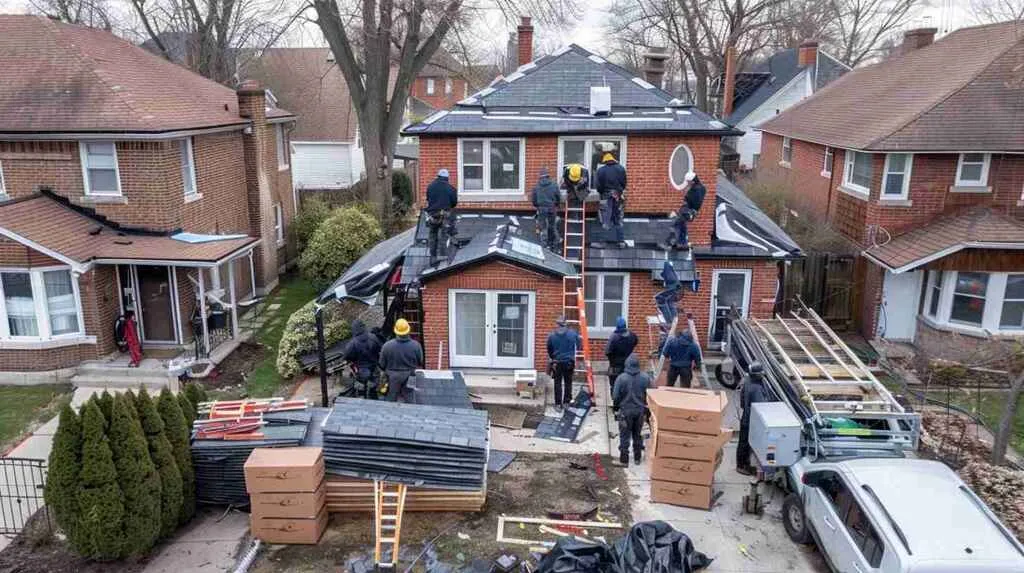
Suddenly the ceiling in your Queens living room has a brown stain spreading like spilled coffee, and you realize you just spent twenty minutes watching water drip onto your couch during that last rainstorm. A fast residential shingle roof repair in Queens typically runs between $350 and $1,200 for localized fixes-and paying that now almost always costs less than waiting for one more storm to turn a $600 repair into $4,000 worth of soaked drywall, ruined insulation, and mold remediation down the line.
Residential Shingle Roof Repair Queens NY – Fast and Affordable
Fast, Affordable Shingle Roof Repair in Queens: What It Really Costs
Here’s my honest opinion: if one more person in this borough slaps roofing cement over a cracked shingle and calls it fixed, I’m going to start handing out buckets to their neighbors preemptively. A real residential shingle roof repair in Queens means tracking down where water is actually entering, cutting out the compromised section, replacing sheathing if it’s wet or punky, and installing matched shingles with proper flashing and nailing-not smearing tar and hoping for the best. Think of a shingle roof like the 7 train: if one section is busted, the whole line backs up. A leak enters where wind lifted a tab near your chimney, transfers sideways under the underlayment, rides down a rafter like an express train, and exits three feet away at your bathroom ceiling. That’s why cheap patches fail-they seal the surface but leave the leak route wide open underneath, and in Queens, where we get wind off the East River, snowmelt, August thunderstorms, and January freeze-thaw cycles all in one calendar year, those hidden routes just keep spreading until you’ve got water in rooms that shouldn’t even be near the original problem spot.
One January morning right after a snowstorm, about 6:30 a.m., I got a call from a retired school secretary in Bayside who woke up to water dripping right onto her kitchen table. Her nephew had “fixed” a few missing shingles the fall before with three different brands from Home Depot and not a single nail in the right place. I remember standing up there, wind hitting my face, watching meltwater slide under those mismatched shingles like it had an express ticket straight into her soffit. That job taught me how fast a cheap patch job can fail in Queens when we get that freeze-thaw cycle-looked fine in October, disaster by January. She ended up paying roughly $850 for the proper repair plus another $400 to fix the ceiling and soffit damage that wouldn’t have happened if the first patch had been done right. The difference between doing it correctly the first time and redoing failed work isn’t just a few hundred bucks-it’s the cost of everything that got ruined while you waited.
Typical Residential Shingle Roof Repair Costs in Queens, NY
These are real-world ranges for typical Queens residential jobs, not national averages. Final cost depends on roof pitch, access difficulty, material matching, and extent of hidden damage discovered during inspection.
How I Diagnose Your Shingle Roof Like a Queens Subway Map
When I come to your house, the first thing I’m going to ask you is, “Where did you see the water-and what was the weather doing that day?” Most people point at the ceiling stain and assume the problem is directly above, but water on a sloped shingle roof travels like the 7 train during rush hour-it enters at one station, transfers at the next, and exits somewhere completely different. I map your leak route the same way: entry point where wind lifted the shingle or flashing failed, transfer point where water rides down underlayment or between sheathing seams, and exit point where it finally drips through into your living space. In Queens, that mapping changes depending on your house style. Jackson Heights and Corona row houses have shared walls and parapets that create unique leak paths where water backs up at the edge. Bayside capes often have dormer valleys that funnel water like express tracks. Middle Village two-families have that classic steep front pitch and low back slope where heat damage on one side and shade rot on the other create totally different repair needs. Knowing the neighborhood and the housing stock means I can narrow down the leak route faster, because I’ve seen how water moves through these specific roof styles a hundred times before.
One August afternoon during that nasty heat wave in 2019, I was in Jamaica doing a residential shingle roof repair for a young couple who just had twins. Their attic was 110 degrees, easy, and their shingles were curling like potato chips on the south side. The husband kept asking if he really had to fix it “now-now” or could wait till spring. While I was there, a thunderstorm rolled in out of nowhere, and we watched from the second-floor window as wind ripped one of the already-loose tabs clean off and threw it into the neighbor’s yard. After that, he didn’t ask about waiting till spring again. That job hammered home for me that in Queens, heat damage weakens the “stations” on your roof-the spots where shingles overlap, where nails hold tabs down, where flashing seals against brick-and then a sudden summer storm acts like a packed train slamming into a weak platform. You can’t diagnose one without the other. I look for curling, granule loss, cracked sealant strips, and lifted edges during my walk, and I explain each weak station in terms of what happens when the next weather event hits: does water back up here, does it transfer there, or does it exit into your house? Once you see your roof as a system with routes and bottlenecks instead of just a pile of shingles, the repair priorities become obvious.
Step-by-Step: How Your Queens Shingle Roof Inspection Works
- Brief conversation at the door – I ask where you saw water, which rooms, what the weather was like (heavy rain, wind direction, snow, thaw), and if you’ve had any past roof work done. Takes 3-5 minutes and gives me the starting station on your leak route.
- Attic and ceiling check – I go up into your attic or top floor to spot stains, mold, wet insulation, or active drips. This shows me the exit point and helps confirm the leak path direction.
- Exterior roof walk – I inspect shingles, flashing around chimneys and vents, skylights, valleys, and gutter edges. I’m looking for missing tabs, curling, granule bald spots, cracked caulk, lifted flashing, and anything that’s letting water transfer under the surface. I note issues common to Queens corner lots (extra wind exposure) and older attached homes (shared wall drainage problems).
- Map the “leak route” from roof to room – Using what I found outside and inside, I explain in plain language how water is traveling over your shingles like a subway line: where it enters, where it transfers along underlayment or rafters, and where it exits into your ceiling. This makes the invisible damage visible and helps you understand why certain repairs matter more than others.
- Present written options with timing and cost – I hand you a clear breakdown of what needs to be done now (active leaks, compromised flashing, exposed sheathing) versus what can safely wait (cosmetic curling on a dry section, gutter tweaks). You get a dollar figure, a timeline, and the straight truth about what happens if you delay each item.
Finding Your Roof’s “Leak Route”
On a typical Tuesday in Queens, I can drive from Astoria to Howard Beach and spot at least ten “repairs” that are already failing from the street. You see a patch of shingles that don’t quite match the rest, or a line of roofing cement smeared across a ridge like someone drew it with a trowel, or flashing that’s been painted over three times without ever being resealed properly. These band-aid jobs all have one thing in common: they treat the symptom-the visible damage-without tracing the leak route back to the entry point. If you’ve got a stain in your bedroom but the actual problem is a lifted chimney flashing on the opposite side of the roof, slapping new shingles over the stain does absolutely nothing except waste your money and buy you maybe two more months before the next storm proves it. Finding the leak route means working backwards from where water exits (your ceiling) to where it transfers (along rafters, under underlayment, through gaps in sheathing) to where it enters (the compromised shingle, flashing, or vent). And in Queens, where houses are packed tight, share walls, and face different wind exposures depending on whether you’re on a corner or mid-block, that route isn’t always a straight line-it’s more like the G train trying to get to Manhattan, with transfers and delays you didn’t see coming.
When a Shingle Roof Leak in Queens Is an Emergency (and When It’s Not)
Blunt truth: fast and affordable doesn’t mean “cheap and sloppy”; it means “planned and precise.” You can get a targeted residential shingle roof repair done quickly in Queens because the guy doing it knows exactly where to look, what to cut, and how to seal it so it lasts-not because he’s rushing or skipping steps. The question most people ask me is whether their situation counts as an emergency or if they can schedule it for next week when the weather’s better. Here’s the insider tip that’ll save you from making the wrong call: if water is doing something right now-dripping, pooling, soaking insulation, running toward wiring or a light fixture-then yeah, it’s an emergency, and waiting even a few hours can turn a $600 repair into a $3,000 insurance claim. But if you’ve got a brown stain that’s been there since the last storm, no new drips, attic’s dry, and the forecast is clear for three days, you’ve got time to schedule a proper inspection and repair without panic-paying for a weekend call. The goal of a fast repair isn’t just stopping the leak; it’s stopping the leak route before it spreads into new sections of ceiling, walls, or insulation that are currently still dry and salvageable.
One job that stuck with me was a Sunday evening emergency call in Middle Village, right after the Giants lost in overtime-so everyone on the block was already in a bad mood. A landlord had ignored granule loss and cracked shingles on his two-family for three years, just kept sending guys up with tar buckets. During a heavy fall storm the water finally found a gap around a bathroom vent where the shingles had been hacked up, and it ran straight down into the ceiling of a tenant’s nursery. I was up there with my headlamp in the drizzle, cutting out rotten shingles and installing new ones properly, thinking, “If he had let me do a clean repair two summers ago, this baby’s crib would be dry right now.” The band-aid repairs had actually made it worse-they trapped water under the tar, which then spread sideways and rotted the sheathing in a six-foot circle around the vent. That’s why I refuse to do patches I know will fail. If I can’t fix it right because of access, weather, or budget, I’ll tell you to wait or I’ll do a temporary tarp and come back when conditions are better. But I won’t smear cement over a problem, charge you $200, and pretend it’s solved when I know you’ll be calling me back in three months with twice the damage.
Should You Call for Emergency Shingle Roof Repair Right Now?
Call Shingle Masters Immediately
- Water dripping actively from ceiling or light fixtures
- Sagging, bulging, or discolored ceiling that feels soft to the touch
- Visible daylight through roof boards from attic
- Large section of shingles missing after high wind
- Water near electrical panel, outlets, or wiring
Can Usually Wait 24-72 Hours
- Small brown stain with no active drip and dry attic
- A few curled or cracked shingles but no water inside
- Minor granule loss or fading on south-facing slope
- Older patch that looks worn but isn’t leaking yet
- Gutter overflow not backing water into house
⚠
Why Tar-Only Patches and DIY Cement Smears Fail in Queens Weather
- Roofing tar and surface cement create a waterproof cap but don’t repair the underlayment or flashing, so water that’s already traveling under the shingles just detours around the patch and keeps going.
- In Queens freeze-thaw cycles, tar cracks and cement shrinks, opening new gaps within one winter while looking fine from the ground.
- On sloped shingle roofs, especially two-families and row houses, these band-aids trap moisture between layers, rotting sheathing and creating hidden damage that doesn’t show up until you’re replacing entire sections.
- A tar patch over a cracked shingle is like putting duct tape over a subway leak-it holds for a few stops, then fails spectacularly during rush hour when you need it most.
DIY vs Pro Shingle Repairs in Queens: What’s Really Cheaper?
Think of your shingle roof like the 7 train: if one section is busted, everything behind it backs up until the whole line is a mess. A DIY patch with mismatched shingles from the hardware store, wrong nails that pop in six months, and no attention to underlayment or flashing is like choosing the wrong train line and ending up in the Bronx when you were trying to get to Brooklyn-you moved, sure, but you didn’t actually solve the problem, and now you’re further from where you need to be. I see it constantly in Queens: homeowner watches a YouTube video, grabs a bundle of three-tab shingles that don’t match the architectural shingles already on the roof, nails them down on a sunny Saturday, and feels great about saving $400. Then the next storm hits, wind gets under the mismatched tabs because they don’t seal the same way, water finds the gaps around those crooked nails, and suddenly that $400 savings turns into a $1,200 redo plus interior repairs. The wallet math isn’t “DIY costs less”-it’s “DIY might cost less if you diagnose the leak route correctly, use compatible materials, have safety gear and ladder skills, and get lucky with weather.” Professional residential shingle roof repair in Queens means I show up, trace the route, fix the actual entry point, match your existing shingles or explain why I’m recommending a different approach, and give you a written warranty that the repair will hold. You’re not paying for the shingles; you’re paying for the diagnosis, the precision, and the guarantee that the leak route is closed for good.
Is saving $300 on a DIY patch worth risking $3,000 in ceiling, insulation, and mold damage when it fails during the next freeze or thunderstorm?
Before You Call Shingle Masters for Residential Shingle Roof Repair
Having a few details ready when you call helps me move faster once I’m on site-it’s like giving me the starting and ending stations on the subway map so I can trace the most direct route in between instead of checking every possible transfer. Jot down where you saw the water (which room, which part of the ceiling or wall), what the weather was doing each time you noticed it (heavy rain from the east, snow followed by a thaw, wind gusts during a thunderstorm), and if you’ve had any past roof work done in that area. If you can safely snap a couple of photos from the street or a window showing the outside of your roof near the problem spot, even better-I can sometimes tell you on the phone if it’s an emergency or if we can schedule it for the next clear day. Clear a path to your attic or top floor if possible, move or cover anything valuable under the leak, and don’t stress if you don’t have all the answers. I’ll ask the right questions when I arrive, and we’ll map the leak route together so you understand exactly what’s broken and what it’ll take to fix it for good.
Simple Checklist to Get Ready for Your Roof Repair Visit
-
1
Note where you saw water or stains – Write down the room and whether it’s on the ceiling, wall, or both. If it’s near a corner, chimney, or bathroom, mention that. -
2
Jot down the weather each time – Was it heavy rain, wind from a specific direction, snow, or a thaw after a freeze? This helps me narrow down the entry point fast. -
3
Clear access to attic or top floor – If you have attic stairs or a pull-down ladder, make sure I can get up there. If not, no problem-I’ll work from below and the roof. -
4
Move or cover furniture under the leak – If water is still dripping, put a bucket down and move anything you don’t want to get wet. Covering helps too. -
5
Gather past roof paperwork or photos – If you have old invoices, warranties, or before/after pictures from previous work, bring them. It helps me see what’s already been patched. -
6
Take 2-3 quick phone photos – If you can safely see the roof from a window or the street, snap a few pics of the area above the leak. Not required, but useful.
Why Queens Homeowners Call Shingle Masters First
Common Questions About Residential Shingle Roof Repair in Queens, NY
How fast can you usually get to my house in Queens for a leak?
Will you tell me if I really need a full roof replacement or just a repair?
Can you work around attached row houses and shared walls?
What if it’s raining when you arrive-can you still help?
Do you offer any warranty on shingle roof repairs?
Shingle roof problems in Queens don’t pause for your schedule-they spread like a crowded E train backing up during rush hour, pushing water into new rooms, soaking insulation, and rotting wood while you’re deciding whether to call. The longer you wait, the more stations get flooded and the more expensive the cleanup becomes. Call Shingle Masters now for a fast, precise residential shingle roof repair estimate, and let’s close that leak route before the next storm proves why cheap patches and wishful thinking never work in this borough.