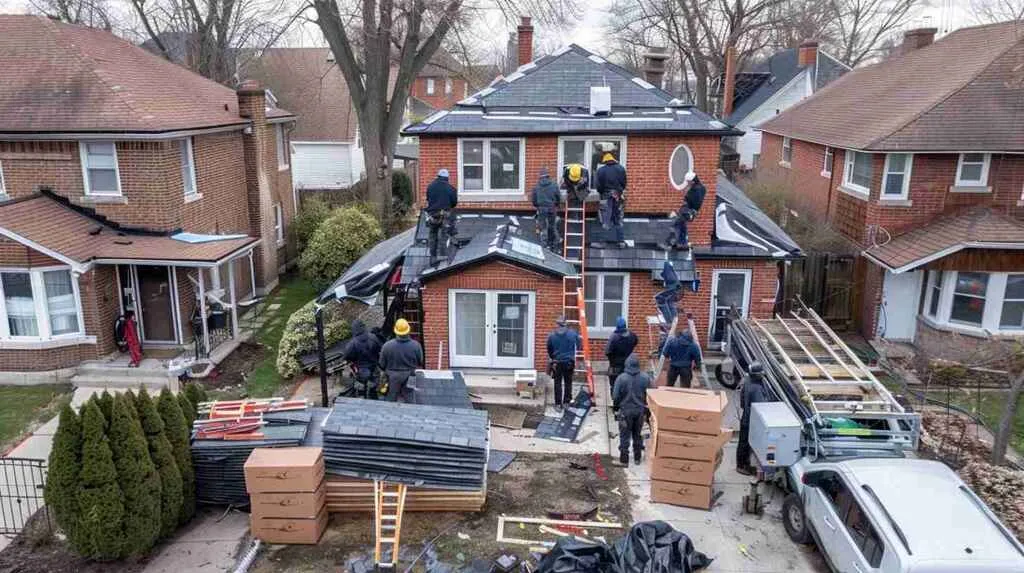
When to Replace Asphalt Shingle Roof Queens NY – The Real Signs
Blueprint: the calendar age of your asphalt shingle roof is one of the least reliable ways to decide when to replace it. The first real sign that matters more? Noticeable changes in how your roof looks and behaves over the last year or two – not the number printed on an old warranty card tucked in a kitchen drawer.
The First Real Sign: Changes You Can See and Feel, Not the Roof’s Birthday
When I meet a homeowner, the first thing I ask is not “How old is the roof?” but “What have you noticed changing in the last two years?” That question tells me everything I need about whether we’re dealing with a sprained ankle or stage-four pneumonia. Your roof’s “health chart” isn’t the install date – it’s the pattern of symptoms that have developed recently, the way small issues either stay isolated or start multiplying. I think of it like body health triage: rest for minor aches, medicine for infections, surgery for organ failure. Calendar age alone just doesn’t capture that reality.
One January morning, around 6:45 a.m., I was on a flat-ish shingle roof in Corona after an overnight freeze, and the homeowner swore they needed a full replacement because of a tiny leak by the bathroom vent. I walked the roof, found one cracked boot and three nails backing out, all in the same corner where the afternoon sun hits hard. We spent a few hundred on targeted repairs instead of dropping ten grand on a new roof, and that job still sticks with me as the perfect example of not confusing a “headache” with a “brain tumor” when it comes to shingles. Most Queens roofs I see are misdiagnosed by age alone – owners assume a fifteen-year-old roof is automatically dying when it might have another five to eight good years if the underlying structure is healthy.
Before you panic and start gathering quotes, there are early visual and behavioral changes worth checking – these mean it’s time for a pro inspection but not automatically a replacement. If your attic feels more stuffy or humid than it used to, or you’re seeing piles of coarse granules at the bottom of your downspouts, or the roofline looks slightly wavy when you stand across the street, those are yellow flags. They tell you the roof is aging, moving from “rest” to “medicine” territory, but it’s not necessarily time for surgery yet.
Early “Symptom” Changes That Matter More Than the Age of Your Asphalt Shingle Roof
- ✅ You’ve started seeing shingle granules collecting in your Queens gutters or at the bottom of your downspouts.
- ✅ A few shingles look slightly curled, cupped, or wavy when you stand across the street and look at the roofline.
- ✅ Rooms directly under the roof feel hotter in summer or draftier in winter than they did a couple of years ago.
- ✅ You’ve noticed small, recurring stains on ceilings that fade after drying but keep coming back near the same spot.
- ✅ Your last 1-2 repairs seem to be creeping closer together in time, like your roof is “catching colds” more often.
| Myth | Fact from Luis |
|---|---|
| If my shingles are under a 30-year warranty, they’ll last 30 years. | In Queens sun, wind off the East River, and winter freeze-thaw, a “30-year” shingle often shows end-of-life signs in 18-22 years. |
| No leaks inside means the roof is fine. | I’ve stood in Bayside attics where the first leak showed up years after shingles were already curling and losing granules. |
| A couple of missing shingles always means full replacement. | Isolated blow-offs can be like a sprained ankle – annoying but fixable – if the surrounding field shingles are still healthy. |
| Dark streaks on shingles mean the roof is shot. | Those streaks are usually algae, more of a cosmetic issue than a health crisis for your roof. |
| If a neighbor just replaced their roof, mine must be next. | Two houses on the same Queens block can age totally differently depending on slope, shade, and how the last roofer installed them. |
Visible Damage: Curling, Bald Spots, and Shingle “Organ Failure”
On a typical Tuesday morning, when I climb up on a Queens colonial, the first things I check are curling edges, cupping across the field, cracked tabs, and bald patches where granules – and sometimes even the black asphalt underneath – are completely missing. South-facing slopes in neighborhoods like Bayside, Maspeth, and Jackson Heights take a beating from sun and prevailing wind, so they age noticeably faster than north-facing sections on the same house. When these signs cover big areas instead of isolated corners, the roof is moving from minor injury to organ failure, and patching one spot won’t stop the systemic decline happening across the whole surface.
A summer thunderstorm rolled in out of nowhere while I was inspecting a steep Cape in Bayside for an older couple thinking about selling. Before the rain, they were convinced the roof was fine because “it never leaked,” but I’d already noticed granules clogging the back gutter and shingles curling like potato chips along the south-facing slope. As the rain hit, water started tracking under those curled edges exactly where I’d pointed, and we stood at the attic hatch watching the first brown ring appear on the insulation – that moment made them understand the difference between waiting and waiting too long. Consistent, widespread curling plus heavy granule loss is a red flag for replacement, even if leaks are minimal so far, because those curled edges will only lift higher with every storm, inviting water deeper into the roof deck.
| Shingle Sign | What It Looks Like From the Sidewalk | Roof Health Diagnosis (Luis) | Likely Next Step |
|---|---|---|---|
| Light curling on edges | Edges look slightly raised or wavy, but shingles still lie mostly flat | Minor joint pain – roof is aging but not in crisis | Schedule inspection within 6-12 months and budget for replacement in a few years. |
| Heavy curling / cupping | Shingles look like potato chips or cups catching wind along a whole slope | Arthritis in both knees – every storm stresses the roof | Plan full replacement soon, especially on south- and west-facing slopes. |
| Bald spots and exposed black asphalt | Patches where color looks blotchy or shiny, with bare black areas | Skin worn through to the bone – UV damage is accelerating | Get quotes for replacement now; repairs will be short-lived. |
| Multiple cracked or missing tabs across the roof | Random gaps or broken pieces scattered around, not just one corner | Systemic weakness – not just a sprain, but a chronic condition | Replacement is typically more cost-effective than chasing repairs. |
Leaks, Stains, and Backyard Clues That You’ve Waited Too Long
I still remember a Woodside duplex where the first clue wasn’t on the roof at all – it was in the garden. The owner found shingle pieces, piles of coarse granules, and rusty roofing nails scattered across the patio after a windy weekend, and that debris trail told me the roof system was shedding like hair during major illness. I’ll never forget a Sunday afternoon call from a young family in Jackson Heights who’d just had a baby and found pieces of shingles in their backyard after a windy night. The roof was only nine years old, but a previous contractor had mixed three different brands and used cheap nails, so whole sections were slipping in the prevailing wind direction. We had to tell them a full replacement was smarter than chasing blow-offs every storm – it was a tough conversation, but it taught me how important it is to explain that “age” isn’t the only clock ticking on an asphalt shingle roof. Sometimes installation quality and material compatibility matter more than the number of birthdays.
Recurring ceiling stains, musty attic smells, or daylight visible around vents and chimneys are internal signs of “stage-four pneumonia” for a roof, indicating it’s time to think surgery (replacement) instead of medicine (repairs). Here’s my insider tip: after every nor’easter or strong coastal wind, do a simple circuit of your yard and top floor to check for shingle pieces, fresh stains, and musty smells. Note what you find, snap a quick photo, and keep that record so when you call, we can spot patterns instead of guessing.
Urgent – Call Right Away
- Active dripping during normal rain (not just driving wind) anywhere in the house.
- Ceiling or wall stain that grows noticeably darker or larger overnight.
- Multiple shingle pieces or whole tabs on the ground after a storm, especially on more than one side of the house.
- Soft, spongy spots when lightly stepping on accessible areas (porch roof, garage roof).
Can Usually Wait a Few Weeks
- Small, old water stains that haven’t changed in size for months.
- A single missing shingle visible from the street with no attic moisture.
- Minor granule build-up in gutters without bald spots on the roof.
- Cosmetic algae streaks with no curling or cracking of shingles.
Should You Be Thinking Repair or Replacement for Your Queens Asphalt Shingle Roof?
Start: Are shingle problems limited to one small area (like around a vent or along one edge)?
YES → Next: Are the surrounding shingles still flat with decent granule coverage?
YES → Likely a repair (medicine) is enough for now – call for a targeted fix.
NO → Damage is spreading – lean toward planning a replacement.
NO → Do you see curling, bald spots, or repeated leaks in different rooms?
YES → Your roof is in organ-failure territory – start gathering quotes for a full replacement.
NO → You may be in a gray zone – schedule an inspection so we can triage whether you’re closer to rest, medicine, or surgery.
Cost Reality in Queens: When Repairs Stop Making Financial Sense
$950 later, that homeowner finally admitted we should have talked about a full replacement two years earlier. Repeated repair bills on an aging asphalt shingle roof in Queens can add up to a slow-motion replacement, and at some point it’s smarter to invest in a full system instead of band-aids. Think of your roof like a winter coat – at some point, patching one more rip just doesn’t make sense. Once repairs in the last 2-3 years total more than roughly 15-25% of the cost of a new roof, that’s a strong sign it’s time to talk replacement instead of chasing problems around the roof deck one corner at a time.
| Scenario | What You’re Seeing | Typical Cost Range in Queens | Luis’s Take |
|---|---|---|---|
| Minor localized leak | One ceiling stain near a vent, shingles mostly flat | $350-$850 for targeted repair | If the roof is otherwise healthy, this is like antibiotics – no need for surgery yet. |
| Multiple leaks on an older roof | Stains in two or more rooms, shingles show curling | $1,200-$3,000 for patchwork vs. $10,000-$18,000 to replace a typical Queens colonial roof | If you’re in this zone, replacement often saves money over the next 5-10 years. |
| Widespread wind damage | Shingle tabs missing on more than one slope after storms | $1,000-$4,000 for recurring repairs each storm season | This is chronic – it’s usually smarter to rebuild the system once. |
| Approaching end-of-life with no leaks yet | Heavy granule loss and curling but dry ceilings | $10,000-$20,000+ for full replacement depending on house size and layers | You’re choosing timing, not wondering if – planning now avoids emergency pricing. |
| Botched previous installation (mixed shingles, bad nailing) | Uneven colors, shingles sliding, nails backing out | $2,000-$6,000 to chase issues vs. full replacement | As I saw in Jackson Heights, surgery beats endless band-aids here. |
What to Check Before You Call a Roofer in Queens
Here’s the thing: simple, safe checks you can do from the sidewalk, a downstairs window, and inside the house before calling will help me give you better triage over the phone. This is like taking your own temperature before calling the doctor – you’re not diagnosing yourself, just gathering the basic facts so we don’t waste time guessing. Don’t climb a ladder if you’re not comfortable; most of what I need to know is visible from ground level or through an attic hatch you can peek through safely.
Quick Self-Check for Your Queens Asphalt Shingle Roof (No Risky Ladder Climbs)
- ✅ From the sidewalk, scan each visible slope: do you see obvious curling, missing shingles, or shiny bald patches?
- ✅ Look in your gutters or at the bottom of downspouts: do you notice piles of coarse, sand-like granules?
- ✅ Walk the top floor and check ceilings, especially under bathrooms and near chimneys, for new or growing stains.
- ✅ If you have an attic, peek inside safely with a flashlight: any damp insulation, darkened wood, or daylight at roof penetrations?
- ✅ After the next normal rain (no wild wind), check again for fresh spots or damp smells upstairs.
- ✅ Make a quick list of when past roof repairs happened in the last 5-10 years so we can see if the “illness” is accelerating.
Common Questions Queens Homeowners Ask About Replacing Asphalt Shingle Roofs
How long should an asphalt shingle roof really last in Queens, NY?
Most 25-30 year rated shingles I see here honestly give 18-25 years, depending on sun exposure, ventilation, and how well they were installed. Some fail sooner if they were nailed wrong or baked on a south-facing slope.
Is winter a bad time to replace my roof in Queens?
We avoid extreme cold and active snow, but we do clean, safe replacements all winter long on the milder days. The real limit is temperature for the shingles to seal, not the calendar month.
Can I just replace one side of the roof?
Sometimes, especially if one slope gets punished by sun and wind, but we have to look at how the whole system ties together so you don’t end up with mismatched ages fighting each other.
Will a new roof help with my upstairs being too hot in summer?
Often yes – new shingles plus proper ventilation and sometimes a lighter color can cool those top rooms, but I’ll tell you honestly if insulation or AC is the bigger issue.
Why Call Shingle Masters When Your Queens Roof Starts Showing These Signs
-
✓
Licensed and fully insured for residential roofing in NYC, including Queens -
✓
17+ years of hands-on experience on Queens row houses, colonials, and two-family homes -
✓
Emergency leak response available the same or next day in most Queens neighborhoods -
✓
Detailed, photo-backed inspections so you see exactly why we recommend repair, monitoring, or full replacement
If your Queens asphalt shingle roof is showing several of these “organ failure” signs at once – widespread curling, recurring leaks in multiple rooms, granules piling up after every rain – it’s time to stop guessing and get a professional opinion. Call Shingle Masters and I’ll walk you through whether your roof needs rest, medicine, or full replacement surgery, with no pressure and plenty of sketches on cardboard to show you exactly what I’m seeing.