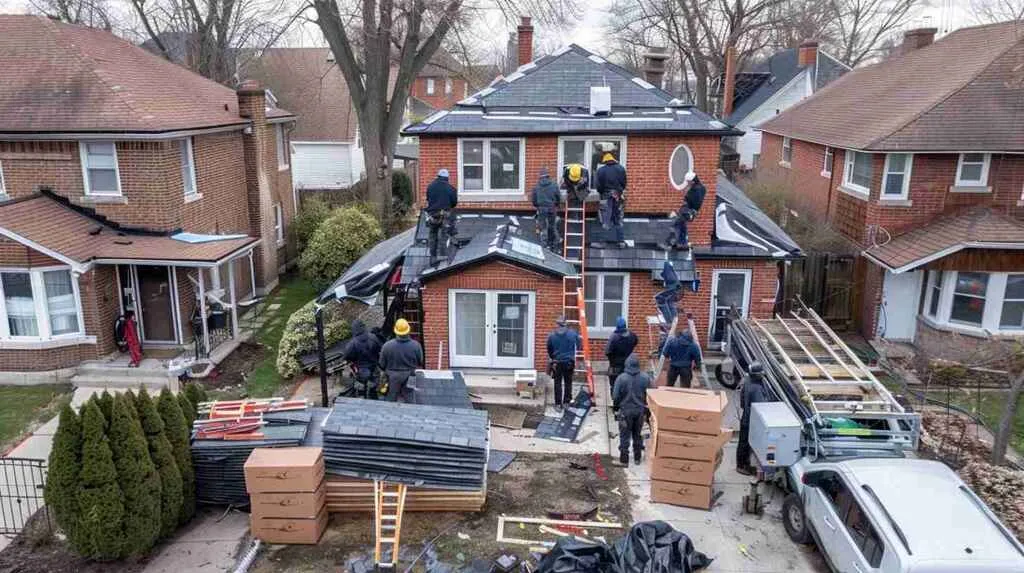
Roof Shingle Tear Off Shovel Queens NY – What Pros Actually Use
Honestly, if you see my crew show up for a tear-off in Queens and we’re carrying spring-steel, serrated-edge tear off shovels with angled handles, a built-in fulcrum on the back, and a nail-puller tip, you’re watching the real thing. The difference between that style and a generic flat scraper isn’t subtle-it’s the difference between finishing a 2,500-square-foot tear-off by lunchtime and still being up there when the streetlights come on, and on these older layered roofs in Queens, it can also be the difference between clean decking and three puncture holes you’ll pay to fix.
On a typical two‑story in Flushing, the first thing I carry up the ladder isn’t a hammer – it’s my tear off shovel.
One August afternoon in Jackson Heights, it was 94 degrees and the shingles on this little Cape had basically melted into one black sheet. The homeowner thought my crew would just grab any old flat shovel and start prying. I pulled out my heavy duty tear off shovel with the serrated teeth and the fulcrum on the back, and in the first twenty minutes we filled more tear-off carts than the guy before us had done in a half day, which is why they fired him. I remember the owner standing in the driveway with an umbrella for shade, laughing that my “angry pizza cutter on a stick” was the real star of the job. That shovel-the kind with spring steel that flexes instead of snapping, teeth that bite under the shingle tabs, and an angle to the handle that lets you slide instead of stab-saved maybe four hours and a couple thousand granules in his gutters. Think of it like using a good offset spatula to flip pancakes instead of trying to wrestle them with a butter knife; same motion, completely different control.
Dense older roofs all over Jackson Heights, Flushing, and Bayside have two or even three layers of asphalt baked together over decades, and a basic straight shovel will either slip off the surface or punch through the sheathing when you muscle it. The angled handle and fulcrum point on a proper tear off shovel let you lever the shingle up instead of hammering down, which protects your siding when shingles fly off in sheets, keeps your gutters attached, and doesn’t scalp the hostas by the front steps. Speed matters, but so does cleanup-tight Queens lots mean your neighbor’s driveway is six feet away, and nobody wants a hailstorm of nails and shingle chips landing on their Honda. A pro shovel controlled by someone who’s done this a few hundred times finishes faster and leaves the yard looking like we were never there, which is the whole point of hiring a crew instead of renting a dumpster and hoping for the best.
| Tool Type | Efficiency on 2-layer asphalt roof | Built-in Nail Handling | Risk of Damaging Decking | Best Use Case |
|---|---|---|---|---|
| Spring-steel serrated tear off shovel (pro choice) | Fast – clears 100 sq ft in 15-20 min per worker | Yes – integrated nail puller slot and fulcrum | Low – angled blade slides under shingles, not through them | Queens multi-layer tear offs on wood decking |
| Flat garden shovel | Extremely slow – straight edge slips and stabs | None – nails get missed and left in decking | High – wide flat blade punches holes when forced | Digging dirt, not roofing |
| Cheap flat tear off shovel | Moderate – bends or snaps on layered shingles | Sometimes – shallow notch that clogs easily | Moderate – thin metal warps and loses angle | Single-layer new construction, smooth conditions |
| Straight-handle scraper | Slow – no leverage, all arm strength required | Rarely – must stop and use separate claw tool | Moderate – vertical angle makes it easy to jab too hard | Ridge caps, detail work, not full tear offs |
Let me be blunt: the flat garden shovel in your garage has no business anywhere near your shingles.
I’ll never forget a Sunday emergency in Astoria after a windstorm, when a DIYer had tried to “help” by starting the tear-off himself with a regular garden shovel. By the time I got there, around 3 p.m., he’d punched through his own decking in three spots because he was jamming the blade straight down instead of sliding under the shingles. I showed him my tear off shovel with the built-in nail puller and the angled handle, and in ten minutes on the roof he could feel the difference in leverage and control; that job turned into a whole conversation about why professionals in Queens spend good money on the right shovels for these old wood-framed homes. A garden shovel is meant for dirt-it’s wide, it’s flat, the edge is rounded, and the handle angle is designed for digging straight down. Using that on shingles is like trying to cut a porterhouse steak with a soup ladle: sure, you’ll eventually damage something, but it won’t be pretty and it definitely won’t be the thing you meant to cut.
All over Astoria, Jackson Heights, and Bayside you’ve got these wood-framed attached and semi-attached houses from the 1940s and ’50s, and the roof decking is often original pine or fir, sometimes only five-eighths of an inch thick in spots where moisture got in over the years. When you stab down with a flat shovel instead of levering up with a serrated blade at the right angle, you’re betting your plywood can handle the impact-and I’ve seen that bet lose more times than I can count. You end up with torn underlayment, splintered sheathing, maybe even a puncture that lets rain straight into your attic until you patch it, and plenty of manufacturers will void the warranty on your new shingles if the deck wasn’t properly prepped because the tear-off damaged it. Wrong tool, wrong technique, wrong outcome.
Dangers of using garden shovels or random scrapers for roof shingle tear offs
- Puncturing roof decking: Flat blade hits resistance and goes straight through soft or thin sheathing instead of sliding under the shingle
- Tearing underlayment: Jagged scraping motion rips felt or synthetic paper, leaving gaps that leak until you re-cover the entire section
- Bending gutters: Shingles fly off in wild directions without control, slamming into aluminum or vinyl gutters and denting or pulling them off fascia
- Sending shingles flying into neighbor’s yard: Tight Queens lots mean six feet of clearance; a mis-levered shingle sheet can land on cars, AC units, or gardens next door
I still remember the first time I switched from a straight-handle scraper to an angled tear off shovel and cut my tear‑off time in half.
One of the worst mornings I’ve had on a roof was in Bayside in late October, 6:30 a.m., drizzle turning to a cold rain, and we were trying to finish a rush tear-off before a nor’easter rolled in. A new helper had brought a bunch of bargain-bin flat tear off shovels he found on sale instead of the spring-steel models I told him to get. The first time we hit a layer of old cedar shakes under the shingles, two of those cheap shovels bent like aluminum foil, and we lost almost an hour running back to my van for the good ones; since then I tell every customer that the wrong shovel can literally cost you a day. Spring steel flexes when you hit a nail head or a knot in the decking, then snaps back into shape-cheap stamped metal just warps and stays warped. The angled handle matters because it positions your hands and shoulders above the work instead of forcing you to crouch and stab, which on a steep 8/12 pitch in Queens means you can actually stay on your feet and keep moving instead of shuffling around on your knees. Especially on these layered roofs where the bottom course might be 40-year-old organic felt shingles glued to cedar, leverage is everything.
Now, here’s where that matters for you: when your roofer shows up, look for multiple spring-steel tear off shovels with angled handles and serrated teeth, plus tear-off carts and tarps already staged in the driveway. If you see only a couple of flat shovels and everybody’s borrowing the same claw hammer to pull nails, that’s a red flag-it means they’re improvising instead of running a system, and improvisation on a roof costs time and quality. Compare a straight scraper to using a dull paring knife to butterfly a chicken breast: sure, you’ll get through it eventually, but a sharp chef’s knife with the right angle does it in one smooth motion and doesn’t mangle the meat. Same principle-right tool, right motion, clean result.
How a Professional Tear Off with the Right Shovel Works in Queens, NY
When I walk a homeowner through tools, I always ask: do you want it done cheap, or do you want it done once?
Paying a crew with good tear off shovels and the experience to use them right costs more up front than hiring the lowest bidder who shows up with whatever’s in the back of his truck, but the difference shows up in your decking, your siding, and how long the new roof actually lasts. Think of it like buying a solid cast-iron skillet instead of a flimsy nonstick pan-you spend more today, but ten years from now you’re still using the same pan and it’s only gotten better, while the cheap one is warped and peeling in a landfill somewhere.
The cheapest tools end up being the most expensive once you add the cost of repairing punctured decking, replacing torn underlayment, and re-doing the tear-off that should’ve been done right the first time.
| Scenario | Roof Size / Layers | Tool Setup | Estimated Tear Off Cost Range | Time Impact of Pro Tear Off Shovels |
|---|---|---|---|---|
| Small 1-layer Cape in Flushing | 1,400 sq ft, single layer 20-year shingles | Two workers, two spring-steel shovels, hand cart | $900-$1,400 labor + disposal | Saves 2-3 hours; done in half a day instead of full day |
| 2-layer attached home in Jackson Heights | 2,200 sq ft, two layers asphalt over original felt | Three workers, four pro shovels, dump trailer on-site | $1,800-$2,600 labor + haul | Saves 4-5 hours; finished in one day, decking stays clean |
| 3-layer with cedar under in Bayside | 2,800 sq ft, three layers including old wood shakes | Four workers, six spring-steel shovels, pry bars, extra tarps | $3,200-$4,500 labor + disposal + deck repair allowance | Saves a full day; wrong tools would take two days and risk major deck damage |
| Emergency post-storm partial tear off in Astoria | 600 sq ft section, single layer but wind-damaged and urgent | Two workers, two shovels, immediate response, tarp and patch same visit | $700-$1,100 emergency rate | Saves 1-2 hours and prevents interior water damage while waiting for full re-roof |
| Option | Pros | Cons |
|---|---|---|
| Hiring a pro crew with proper tear off shovels |
• Fast, clean tear-off protects decking and siding • Nails removed as you go, minimizing puncture risk • Experienced workers spot deck damage early • Tarps and carts keep debris contained on tight Queens lots • Job done in one day instead of dragging into weekend |
• Higher upfront labor cost • Need to schedule in advance during busy season • Requires driveway or street access for equipment |
| Hiring the cheapest bidder (random shovels, minimal gear) |
• Lower quoted price on paper • Sometimes faster to book on short notice |
• Slower tear-off means extra days on schedule and weather risk • Higher chance of deck punctures, torn underlayment, bent flashing • Poor debris control-nails in yard, shingles on neighbor’s property • Deck repairs discovered mid-job with no budget or plan • Final cost climbs once you add repair work and cleanup |
Think about cutting a lasagna: you wouldn’t use a butter knife if you had a good, sharp spatula – same idea with shingles.
When you’re slicing through a pan of baked lasagna, a butter knife just mashes the layers together and tears the noodles, but a sharp offset spatula with a serrated edge cuts clean lines and lifts each piece out intact. Teeth on the blade grab the top layer, the angle lets you slide under instead of pressing down, and the fulcrum point-where the handle meets the blade-gives you leverage so your wrist isn’t doing all the work. That’s exactly what’s happening with a spring-steel, serrated, angled-handle tear off shovel on a layered Queens roof where decades of sun have baked the asphalt into something close to tar. The teeth bite under the shingle tab, the fulcrum on the back edge lets you lever the whole strip up in one motion, and the angled handle keeps your body in a position where you can repeat that motion a hundred times without your shoulders giving out. Compare that to a straight scraper or a flat shovel, which is like using a butter knife-you’ll get there eventually, but you’re fighting the tool the whole way and the result looks ragged.
Which tear off shovel matters most for your Queens roof?
If you’re calling around for quotes and you want to know whether a crew is serious, ask what shovels they’re bringing. You’re listening for “spring steel,” “serrated edge,” “angled handle,” and “integrated nail puller.” If the answer is vague or they say “we bring whatever works,” that tells you they’re improvising, and improvisation on a 40-degree pitch over your bedroom is not a good plan.
What to check before you call a roofer
Walk around your house and take note of what’s actually up there, because the more you know, the better the conversation when Shingle Masters or another local crew shows up to give you an estimate. Are we talking one layer or two? Do your gutters look packed with black granules? Any soft spots you can feel when you step near the edge? The answers help us bring the right shovels, the right number of people, and the right plan for keeping your siding, plants, and driveway in one piece while we work.
✓ Before You Call: What to Look at on Your Queens Roof
-
✓
Visible shingle layers at edges: Look at the rake edge or eave-can you count one, two, or three distinct color bands stacked on top of each other? -
✓
Gutters filled with granules: Black, gray, or brown grit piling up in downspouts means your shingles are shedding their coating and probably ready to come off -
✓
Soft spots when walked: If you can safely step near the roof edge from a window or porch, do you feel any give or sponginess under your feet? -
✓
Evidence of past patch jobs: Mismatched shingles, visible tar patches, or newer sections that don’t blend in suggest layered repairs that complicate tear-off -
✓
Distance to neighboring houses or driveways: On attached or semi-attached Queens homes, measure how much clearance there is for tarps, carts, and falling debris -
✓
Access points for ladders and tear off carts: Can a crew set up in your driveway, or will they need to go through a side gate or negotiate with the neighbor for shared access?
Common Questions Queens Homeowners Ask About Roof Shingle Tear Off Shovels
Why Queens Homeowners Trust Shingle Masters for Clean Tear Offs
-
✓
Fully licensed & insured in NYC – all required permits, liability coverage, and workers’ comp so your property and our crew are protected -
✓
19+ years hands-on tear off experience – Carlos and his team have stripped thousands of roofs across Queens, from single-layer Capes to triple-layer nightmares in Bayside -
✓
Same-day response for active leaks when weather allows – we know a storm doesn’t wait for business hours, and neither do we -
✓
Specialization in shingle tear offs on attached and semi-attached homes – tight lots, shared driveways, close neighbors; we handle the logistics so you don’t have to -
✓
Written cleanup and property protection guarantee – tarps, magnetic sweeps, inspection before we leave; your yard looks the same or better than when we arrived
The right roof shingle tear off shovel isn’t just about speed-it’s about protecting your decking, keeping your siding intact, and making sure the new roof goes down on a solid, clean surface that’ll last twenty years instead of needing repairs in five. When you hire a crew that shows up with spring-steel, serrated, angled-handle shovels and the experience to use them, you’re paying for precision, not just labor. If you’re in Queens, NY and you’re ready for a clean, professional shingle tear off that treats your home like it matters, call Shingle Masters and let Carlos and his crew show you how the job should be done-fast, thorough, and with your property protected every step of the way.