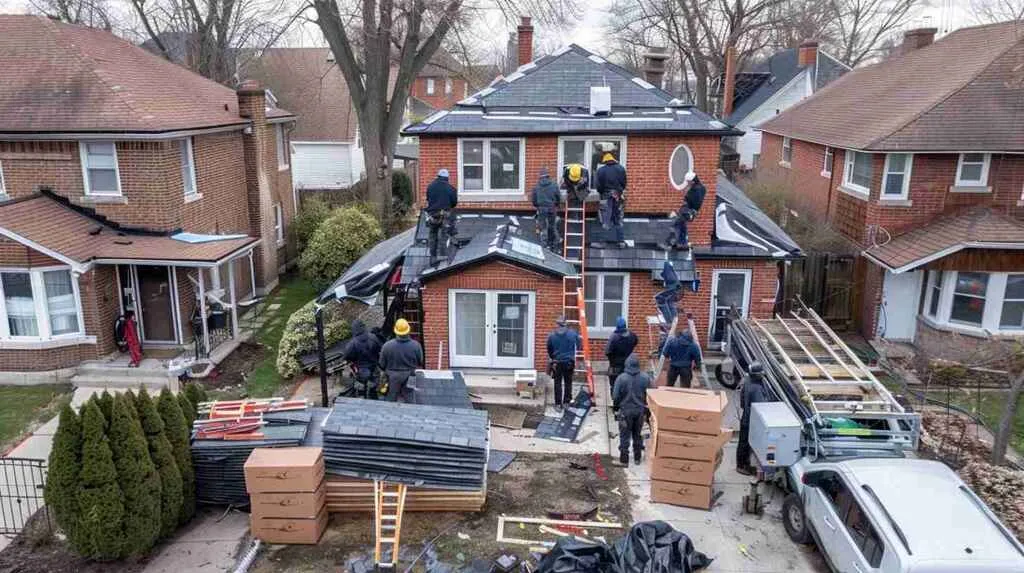
Roof Shingle Dumpster Queens NY – What Every Homeowner Should Know
Layers of old shingles, the weight of three decades of wear, and one overlooked detail can burn through $600-$900 before your roof job even starts in Queens. That detail? Your roof shingle dumpster plan. I’m Remy Calderon, and after 19 years running roofing jobs on tight blocks from Astoria to Jackson Heights-plus a decade before that stage-managing theater productions-I’ve learned that the dumpster is the backstage that makes the whole show work, and when it’s placed wrong or sized wrong, the entire production falls apart.
Why Your Roof Shingle Dumpster Plan Can Blow the Budget in Queens
On 34th Avenue last fall, I watched a homeowner pay almost as much in extra dumpster fees as they did in labor for their shingle tear-off. They’d ordered a 20-yard container without measuring their driveway or checking the school bus schedule. The hauler had to make three trips-failed drop, relocation, and finally a successful placement two blocks away-racking up $850 in fees before a single shingle hit the bin. One August afternoon around 3:30, sun beating off the brick in Corona, I showed up to a job where the homeowner had ordered their own roof shingle dumpster and had it dropped right in front of the neighbor’s shared driveway. By the time I got there, the neighbor had already called 311 twice and was standing outside in slippers and a bathrobe, filming everyone. We had to get the hauler back, pay a same-day relocation fee, and I ended up standing in the street directing traffic like I was back stage-managing a musical, just to get that container tucked into the exact three-car-length space where nobody could complain.
Here’s my blunt take: in Queens, the dumpster is just as important as the shingles when you’re planning a roof job. The cast is your crew and hauler; the set is your house, sidewalk, and the eight feet of curb in front of it; the props are the dumpster, tarps, and safety cones. Neighbors, DOT inspectors, and anyone calling 311? They’re your audience and critics. When the show’s badly directed-wrong container size, blocking a hydrant, sitting through alternate-side parking day-you’re looking at extra rental days at $75-$150 each, relocation fees starting at $200, overweight charges if you misjudged debris volume, tickets from the city for blocking access, and in the worst case, paying for an emergency second container because the first one’s full and the roof is still open.
Picture your block at 7 a.m. on a Tuesday-double-parked cars, school buses, sanitation trucks-now imagine dropping a 20-yard container right into that chaos. In Queens, you’re not just dealing with your property; you’re navigating shared driveways in Jackson Heights row houses, hills in Whitestone that trucks struggle with when wet, narrow one-way streets in Ridgewood where a hauler’s rig barely fits, school zones in Flushing with strict drop-off windows, and co-op buildings in Astoria where board approval is required before anything larger than a mailbox touches the curb. Every one of those realities changes the math on your roof shingle dumpster, and ignoring them is what turns a smooth three-day tear-off into a two-week neighborhood drama with fines piling up.
Common Queens Roof Shingle Dumpster Scenarios: Poor Planning vs Smart Planning
Roof Shingle Dumpster Myths vs Facts in Queens
| Myth | Fact |
|---|---|
| You don’t need a permit or DOT approval to put a roof shingle dumpster in the street in Queens. | If the dumpster sits in the street for more than a few hours or blocks a lane, you likely need a permit from NYC DOT, especially in high-traffic areas. Some blocks require advance notice to local precincts. Skip this step and you’re risking tickets, forced removal, and 311 complaints that can shut down your job until paperwork’s filed. |
| Bigger is always better-order the largest dumpster so you don’t run out of room. | On a narrow Queens street, a 20-yard container might not even fit in front of your house without blocking your neighbor’s stoop or a hydrant. Oversize dumpsters also mean higher rental fees and potential overweight charges if debris isn’t packed right. Often two smaller low-boy dumpsters swapped mid-job are faster, cheaper, and cause zero access problems. |
| Your driveway is always the safest, easiest place to put the dumpster. | In Queens, many driveways are shared, and even private ones can be too narrow for a hauler’s truck to maneuver safely. Pavers, concrete, and asphalt can crack under the weight of a loaded container, and if you’re in a co-op or attached house, placing a dumpster in a common area without board or neighbor approval is a one-way ticket to disputes and fines. |
| The hauler handles all the logistics-timing, placement, cleanup-so you don’t need to plan anything. | Haulers drop and pick up on their schedule, and in Queens that schedule hits school buses, alternate-side parking, and double-parked chaos. If you don’t coordinate drop time, exact placement, protection for your curb, and pickup window, you’ll end up with a container sitting in the wrong spot for extra days, surprise fees, and neighbors who know your name for all the wrong reasons. |
Choosing the Right Roof Shingle Dumpster Size and Setup for Queens Streets
Here’s my blunt take: in Queens, the dumpster is just as important as the shingles when you’re planning a roof job. Think of a roof shingle dumpster like a backstage area for a theater production: if it’s crowded, badly placed, or under-sized, the show falls apart no matter how good the actors are. Your house is the stage, the sidewalk and curb are the wings, and that container is where all the old material exits so the new roof can go up clean. When I walk a block-say, a tight row of attached houses in Astoria with cars nose-to-tail and a bus stop on the corner-I’m visualizing the whole scene: where the hauler’s truck can back in, where my crew will stand with the tear-off chute, where shingles will slide down without hitting a fence or stoop, and where that dumpster can sit for 24 to 48 hours without causing a 311 call or blocking someone’s morning commute. One winter morning, just after a freezing rain in Whitestone, we were stripping an old three-layer shingle roof when the hauler called to say his truck couldn’t make the hill safely with the dumpster. The shingles were already piling up on tarps in the yard, and the homeowner was panicking about the mess. I ended up renting two smaller “low boy” roof shingle dumpsters from a different company on the fly, staggering their arrival so one could be swapped while we filled the other, all while watching the sky because another icy squall was moving in. It turned into a ballet of timing instead of a disaster.
Size isn’t just about how many shingles you’re pulling off; it’s about the physics of your block. In flat, wide Astoria near the waterfront, you can often fit a 15- or 20-yard container at the curb and the hauler can get in and out in under 10 minutes. But in hilly Whitestone or Bayside, where driveways slope and streets curve, a tall-sided container can be a tipping hazard and a heavy truck on wet pavement is a liability-so we go with low-profile 10- or 12-yard bins and plan for a swap if there are three layers of shingles coming off. In Jackson Heights or Woodside, where houses are attached and driveways are shared, you’re often better off coordinating street placement early in the morning before the block wakes up. And in Ridgewood or Sunnyside, where some streets are so narrow two cars can barely pass, the only safe move is a low-boy dumpster dropped at dawn and picked up by 3 p.m. before school traffic starts. Pitch matters too: a steep 9/12 roof in Whitestone with three layers might fill a 20-yard container, while a shallow 4/12 ranch in Auburndale with one layer of shingles fits comfortably in a 10-yard, leaving room for old flashing and a few sheets of damaged plywood.
Street Placement
- Easiest access for hauler trucks, especially on wider blocks in Astoria or Bayside
- Keeps your driveway and yard clear for crew staging and material delivery
- No risk of damaging private pavers, asphalt, or landscaping
- Can be dropped and picked up quickly if timed around traffic and parking rules
- Alternate-side parking rules can force expensive timing gymnastics or extra rental days
- Neighbors may call 311 if they feel blocked or if the container sits too long
- Risk of city tickets for blocking hydrants, bike lanes, bus stops, or crosswalks
- In Queens, double-parked cars and school buses can prevent drop or pickup, triggering rescheduling fees
Driveway Placement
- No need to navigate city parking rules or risk tickets from DOT
- Keeps debris and mess off public sidewalks and away from neighbor properties
- Can sit for multiple days if job runs long without triggering 311 complaints
- Works well in areas like Whitestone or Bayside with wide private driveways
- Many Queens driveways are shared-requires neighbor approval or risks serious conflict
- Heavy container can crack pavers, damage asphalt, or sink into soft ground, costing hundreds to repair
- Narrow or sloped driveways may not allow safe access for hauler’s truck
- In co-ops or attached homes, board rules may prohibit driveway placement entirely
Timing, Neighbors, and Permits: Keeping the ‘Audience’ Happy
I’ll never forget a Saturday in Jackson Heights, late afternoon in Ramadan, where the homeowner’s family had people coming over to break fast at sunset. The original plan was to have the dumpster gone by noon, but the hauler was five hours late. We had a full container of torn-off shingles sitting basically at their front gate with guests starting to arrive. I called the dispatcher three times, negotiated a priority pickup fee, and then had my crew sweeping and power-washing the sidewalk behind that truck’s wheels as it rolled out so guests walked up to a clean, open entryway like nothing ever happened. That’s the level of choreography you need on a Queens block, because your neighbors are the audience, the city inspectors are the critics, and if you don’t coordinate delivery, placement, and pickup like you’re blocking a stage production, someone’s calling 311, someone’s getting a ticket, and someone’s reputation-yours or your roofer’s-is taking a hit that lasts longer than the job itself.
Queens-Specific Problems When You Don’t Coordinate Your Roof Shingle Dumpster Timing
- 311 complaints leading to NYPD or DOT visits: Neighbors who feel blocked, annoyed by noise before 8 a.m., or who see a dumpster sitting for days will call the city, triggering inspections that can halt your job until paperwork is filed or the container is moved.
- Tickets for blocking a bus stop, hydrant, or crosswalk: NYC issues hefty fines-$150 to $250-for obstructing public access or safety zones, and these tickets go to the homeowner or the hauler, not the roofing crew, creating dispute and delay.
- Blocked shared driveway leading to neighbor disputes: In Jackson Heights, Woodside, or Elmhurst, many driveways serve two or more families. Place a dumpster without coordination and you’ll have neighbors unable to get to work, calling tow companies, and possibly suing for damages.
- Hauler refusing to drop or pick up due to double-park chaos: Queens streets during rush hour are a nightmare for large trucks. If the hauler arrives and can’t safely maneuver, they’ll leave-and you’ll pay a rescheduling fee plus at least one extra day of rental.
- Dumpster stuck an extra day during alternate-side, causing tickets: Alternate-side parking rules shift which side of the street is clear, and if your dumpster is on the wrong side when enforcement happens, you’re looking at tickets that add $45 to $65 each, plus the cost of the extra rental day.
Step-by-Step: How We Stage a Smooth Roof Shingle Dumpster Job in Queens
When I first walk a job, one of the first things I ask is, “Where can we put 10,000 pounds of old roofing so your neighbor doesn’t hate you?” I’m not being dramatic-that’s the real weight of an average Queens roof tear-off, and if you don’t block the set like you’re planning a one-act play, somebody’s going to be standing in the wrong spot when the curtain goes up. I walk the block like I’m stage-managing opening night: where do cars normally park, which side has alternate-side on which days, where’s the school drop-off zone if there is one, where does the sanitation truck stop on garbage day, and most important, where can the hauler’s rig actually get in and out without scraping a parked car or getting stuck behind a double-parked delivery van. Insider tip: I walk the block the evening before delivery, around 6 or 7 p.m., and again at 7 a.m. the day of, just to see the rhythm-rush hour, school buses, when people leave for work. That tells me if we can drop at 6:30 a.m. and be golden or if we need to wait until 9 a.m. after the morning chaos clears.
Most folks don’t realize this, but your sidewalk, your stoop, and even your front fence are more at risk from a bad dumpster plan than from the actual roofing work. We stage the whole production: plywood goes down under the dumpster if it’s on pavers or a delicate curb, tarps line the chute path so nails and shingle grit don’t scatter, cones and caution tape mark the drop zone for neighbors and pedestrians, and we map exactly where the crew will stand with their tools so nobody’s in the path when a 60-pound bundle of shingles slides down. I’ve done this in Astoria where the block is wide and forgiving, in Corona where every inch matters and you’ve got three families watching from windows, in Whitestone where hills and rain change the equation, and in Jackson Heights where a shared driveway means I’m coordinating not just with the homeowner but with the neighbor who parks behind them and the tenant upstairs who uses the side gate. Every neighborhood has its own rhythm, and the dumpster is the metronome that keeps the whole job on beat.
Exact Sequence Shingle Masters Follows to Plan and Run Your Roof Shingle Dumpster in Queens
Before any dumpster is ordered, we walk your property and the surrounding block-measuring curb width, noting hydrants and bus stops, checking for shared driveways, observing traffic flow and school zones, and identifying the safest, most neighbor-friendly placement. This is where the “stage” is designed.
We measure your roof’s square footage, count visible shingle layers at the edge, check pitch, and estimate total debris weight. A 1,200-square-foot roof with two layers of asphalt shingles plus old felt and flashing typically generates 4-6 tons of material, which determines whether you need a 10-, 15-, or 20-yard container.
Based on debris volume, street layout, and access constraints, we select the right dumpster-standard vs low-boy, single large vs two smaller swaps-and mark the exact placement spot on your block with cones or chalk, ensuring hauler truck access, no obstruction of neighbors, and compliance with local rules.
We schedule delivery for early morning (6:30-7:30 a.m.) before traffic builds or after morning school rush if near a school zone, and coordinate pickup for late morning or early afternoon to avoid alternate-side parking windows, bus routes, and double-park chaos. We confirm the hauler’s route and provide a contact number for real-time adjustments.
Before the dumpster arrives, we lay plywood under the drop zone if it’s on pavers or fragile asphalt, set tarps to catch stray debris, place safety cones and caution tape around the perimeter, and mark a clear crew pathway from roof edge to container. This protects your property and signals to neighbors that the job is professionally managed.
Once the dumpster is picked up, we do a final walk of the site: sweep sidewalk and curb, inspect for any surface damage, remove all cones and tarps, and confirm with you and the hauler that no tickets were issued and no neighbor complaints were filed. If any issues arose, we document and resolve them before closing the job.
📋
What Queens Homeowners Should Note Before Calling About a Roof Shingle Dumpster
- Take 2-3 phone photos of front of house and curb line-wide shots showing sidewalk width, nearby hydrants, bike lanes, and parked cars help us plan exact placement remotely.
- Note if driveway is shared or private-shared driveways require neighbor coordination and often can’t accommodate a dumpster at all; private driveways need width and weight checks.
- Check which days/hours are alternate-side parking on your block-this determines delivery and pickup windows and can prevent costly extra rental days and tickets.
- Notice any nearby bus stops, hydrants, or bike lanes-these are no-go zones for dumpster placement and violating them brings instant fines.
- Count visible shingle layers at roof edge if possible-one layer is easy; two or three changes dumpster size and cost significantly.
- Ask super or co-op board about any building rules-co-ops and some multi-family buildings have strict policies about where dumpsters can sit and for how long.
- Think about any upcoming events during the job window-family gatherings, holidays, religious observances-so we can schedule around them and avoid adding stress to an already busy time.
Straight Answers to Queens Roof Shingle Dumpster Questions
These are the questions I field every week on jobs from Astoria to Jackson Heights, and they’re the ones that keep homeowners up at night before a roof project starts. Here’s what you actually need to know, based on 19 years of running roof jobs on Queens streets where every block has its own rules, rhythms, and risks.
Q
Do I need a permit for a roof shingle dumpster in front of my house in Queens?
If the dumpster will sit in the street for more than a few hours or if it blocks a travel lane, you typically need a permit from NYC Department of Transportation (DOT). Some haulers include basic street-use permits in their fee, but you need to confirm that in writing. In high-traffic areas-near bus routes, bike lanes, or school zones-enforcement is strict, and an unpermitted dumpster can trigger fines of $150 to $250 plus a forced removal.
If the dumpster stays entirely on your private property (driveway, yard), no city permit is required-but if you’re in a co-op or attached building, your board or neighbor may have rules you’re legally required to follow. Always check local regulations and coordinate with your roofer and hauler at least a week before delivery to avoid surprise costs and job delays.
Q
Can a dumpster sit in a shared driveway during my roof job?
Technically yes, but practically it’s a minefield. In neighborhoods like Jackson Heights, Woodside, and Elmhurst, many driveways serve two or more families, and placing a dumpster without written consent from every affected neighbor can lead to 311 complaints, blocked access disputes, and even police involvement if someone claims they were prevented from leaving for work or an emergency.
If you must use a shared driveway, get signed approval from all parties, schedule the dumpster for the shortest possible window (ideally same-day drop and pickup), protect the surface with plywood, and provide alternative parking or access arrangements. Often, street placement coordinated around alternate-side parking rules is less risky and cheaper than dealing with angry neighbors.
Q
What if the hauler can’t get down my narrow one-way block?
This happens more often than you’d think in Ridgewood, Sunnyside, and parts of Astoria where streets are barely wide enough for two cars to pass. If the hauler’s standard truck can’t navigate your block, they’ll either refuse the job or charge a premium for a smaller, more maneuverable vehicle. Some haulers offer “low-boy” dumpsters with compact delivery trucks designed for tight urban spaces.
The solution is to walk your block with your roofer and hauler before committing to a container size and type. In extreme cases, you may need to schedule delivery and pickup during off-peak hours (very early morning or late evening) when traffic is minimal, or coordinate with local police for temporary traffic control. Expect these adjustments to add $100 to $300 to your dumpster cost, but it’s far cheaper than a failed drop and multi-day delay.
Q
How long does a typical shingle tear-off dumpster need to stay on-site?
For a straightforward one- or two-layer shingle tear-off on a typical Queens single-family home, the dumpster usually stays on-site for 24 to 48 hours. A fast crew can strip a roof in a single day, fill the dumpster by late afternoon, and have it picked up the next morning. If you’re dealing with three layers, a steep pitch, or bad weather delays, the container might sit for two to three days.
The key is coordinating pickup timing around alternate-side parking, neighbor schedules, and city regulations. Most haulers include one to two days of rental in the base price; each additional day costs $50 to $100. A good roofer will schedule the tear-off for a clear weather window and confirm pickup before the dumpster is even delivered, so you’re not stuck with an extra-day charge because the hauler got delayed across the borough.
Q
How does Shingle Masters handle cleanup so my sidewalk and stoop aren’t a mess when the dumpster leaves?
We treat cleanup like the final scene of a production-the audience (your neighbors and guests) shouldn’t see any evidence that the backstage was ever there. As soon as the dumpster is picked up, my crew sweeps the sidewalk, curb, and any driveway or yard areas that were part of the debris path. We use a power washer if there’s any shingle grit or tar residue stuck to concrete, and we inspect for nails or small debris that might have scattered.
We also photograph the site after cleanup and compare it to the “before” photos we took during the walk-through, so if there’s any damage to curbs, pavers, or landscaping, we can address it immediately. On jobs in Queens, where neighbors are close and reputation matters, a clean exit is as important as a smooth start-and it’s included in our service, not an add-on you negotiate after the fact.
Your roof shingle dumpster in Queens isn’t just a metal box for debris-it’s the backstage that makes the whole show run smoothly, and when it’s planned right, you get through the job without tickets, neighbor wars, or that sinking feeling you just paid $700 for a mistake you didn’t know you were making. With Shingle Masters planning the dumpster like a well-blocked stage set-right size, right spot, right timing, coordinated down to the hour with hauler, crew, and the rhythm of your block-you’ll never wonder if you’re about to be the house everyone’s talking about for the wrong reasons. Call Shingle Masters, and I’ll walk your block, map out a clean, efficient dumpster plan, and make sure the only drama on your roof job happens above the roofline, not at the curb.