Recovering a Shingle Roof Queens NYC – New Over Old, When Allowed
Layers matter. In Queens, recovering a shingle roof-that is, installing a new set of shingles right over an existing layer-can save you $3,000 to $7,000 compared to a full tear-off, but only when you meet very specific NYC building code and structural conditions. I’m Carlos Dominguez, I’ve been doing this work for 17 years all over Queens, and I refuse to stack shingles over rotten wood or bad decking no matter how much the price difference tempts you. The smart play here is to picture your roof as a cross-section-shingles, underlayment, deck, rafters-and understand that cost should never override code or structural honesty.
When Recovering a Shingle Roof in Queens Actually Makes Sense
Let’s talk money first. If you have a single-layer asphalt shingle roof on solid decking and no major code violations, a legal recover can save you anywhere from $3,000 to $7,000 on a typical Queens house, depending on size and pitch. That savings comes from skipping the tear-off labor, dumpster fees, and all the extra time it takes to strip down to bare wood. But-and this is the first rule I tell every homeowner who sits down at their kitchen table with me-that cost break only applies when NYC building code and your roof’s structure actually allow a second layer. Saving money by breaking code or burying problems isn’t saving anything; it’s just pushing the repair bill down the road with interest.
So what is a shingle recover? Picture a slice through your roof from the top down: you’ve got your visible shingles, then an underlayment layer, then the plywood or OSB decking, then the rafters holding it all up. A recover means you’re nailing a brand-new layer of shingles and underlayment directly on top of the existing shingles, instead of stripping everything off first. In Queens, and under NYC code, you’re generally allowed a maximum of two total shingle layers-so if you already have one, you can add one more, but if you’ve got two (or worse, three from decades of quick fixes), the only legal path forward is a full tear-off to bare wood. One layer max to start is the bright line.
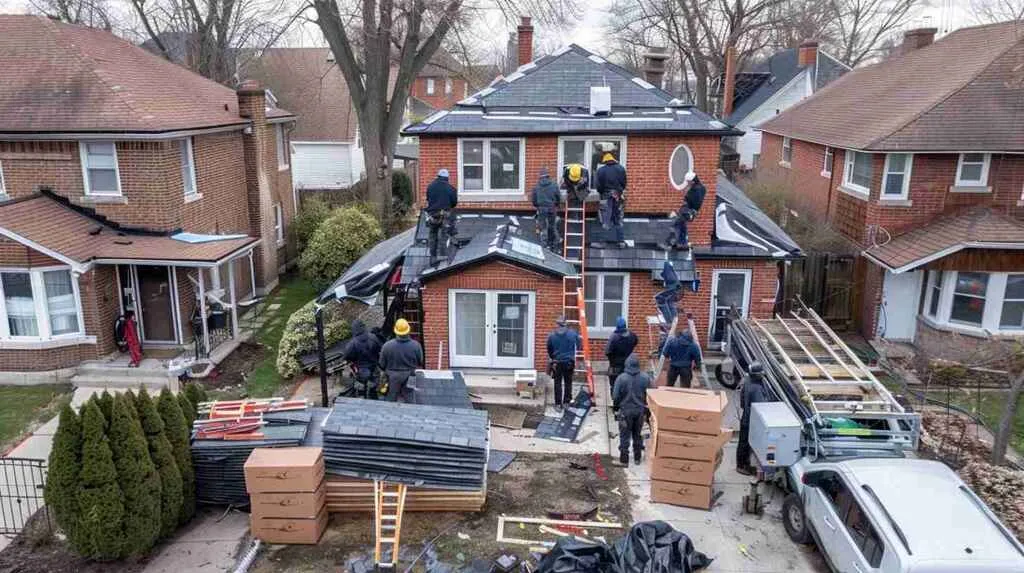
A few years back in Flushing, I did a recover over an old, single-layer roof for an elderly lady who was on a fixed income and terrified of a big tear-off bill. It was a cool, dry April morning, and I’ll never forget how carefully we walked that roof, feeling for soft spots and checking every seam, because I knew this was her one shot to do a legal, safe recover instead of a full replacement. We documented everything with photos, checked the deck from the attic, and I spent an extra hour labeling each photo on her kitchen table so she’d have proof if the next owner ever questioned the work. That job reinforced for me that recovering can be a smart move-but only when you inspect the structure like your own ceiling depends on it, because it does. Careful documentation, code-compliant layer count, and solid decking are the three pillars that make a recover worth doing.
Cost Comparison: Recover vs Full Tear-Off on Queens Roofs
| Queens Roof Scenario | Approx. Size | Recover Over 1 Layer (Legal) | Full Tear-Off & New Shingles | Estimated Savings |
|---|---|---|---|---|
| Small single-family in Jackson Heights | 900-1,100 sq ft | $4,500-$6,000 | $7,500-$10,000 | $3,000-$4,000 |
| Typical two-family in Jamaica | 1,200-1,600 sq ft | $6,000-$8,500 | $9,500-$13,500 | $3,500-$5,000 |
| Attached row house in Astoria | 1,000-1,300 sq ft | $5,000-$7,000 | $8,500-$12,000 | $3,000-$5,000 |
| Larger colonial in Bayside | 1,600-2,200 sq ft | $7,500-$11,000 | $11,500-$17,500 | $4,000-$7,000 |
Queens Recover Rules at a Glance
- Max shingle layers allowed: 2 total (1 existing + 1 new), when conditions are right.
- Typical savings vs tear-off: $3,000-$7,000 depending on roof size and complexity.
- Best timing in Queens: Cool, dry days in spring or fall for clean installation.
- Code focus: NYC building code and manufacturer warranties must both approve a recover.
Code Hawk Check: Can Your Queens Roof Take Another Shingle Layer?
On a typical two-family in Jamaica, I start by counting layers at the edges-eaves, rakes, around the chimney-because that’s where you can see the cross-section for real, not just guess from the top. Then I walk the roof slowly, in cool weather if I can, feeling with my feet for any soft spots or trampoline bounce that tells me the decking’s shot. And here’s the move that sets me apart from guys who just eyeball things and promise you a deal: I cut what I call a “truth window,” a small controlled opening through all the shingle layers down to the bare deck, usually in a spot you won’t notice much, like near a vent or up high on a back slope. One winter night in Astoria, about 7:30 p.m. with a light snow coming down, I got a call from a couple who had just bought a small brick row house. Their home inspector told them the roof was “recent,” but the ceiling in the back bedroom had a wet ring. When I got there and cut a small inspection square, we discovered someone had recovered the roof over rotten decking, using the new shingles basically as makeup. That night taught me to never trust a visual from the top only, and it’s why I insist on opening at least one truth window on every serious recover conversation. Queens housing stock-especially the two-families in Jamaica, the brick row houses in Astoria, and older additions all over the borough-often hides previous quick-fix recovers, so you need to see the layers with your own eyes, not gamble on what someone told you five owners ago.
Now step back and picture the whole roof from the side, like you’re looking at a slice of layer cake: shingles on top, then underlayment, then your plywood or OSB decking, then the rafters underneath holding the weight. If any part of that deck is rotten, spongy, or sagging between rafters, a recover is off the table in Queens-period. Same deal if you’ve got more than one existing layer; code says two total max, and I won’t break that rule no matter how tight your budget is. And if those current shingles are curled, buckled, or blistered, the new layer you put over them will just follow every bump and look terrible in two years. The mental image I want you to hold is that cross-section: every decision about recovering versus tearing off comes down to what’s happening in those layers, not just what you see from the driveway.
Should You Recover or Fully Replace Your Shingle Roof in Queens?
Start: Do you have MORE than one existing shingle layer?
- Yes → Full tear-off required. Recovering over 2+ layers is not code-compliant in Queens.
- No / Not sure → Make a small inspection opening (a “truth window”) down to the decking in at least one area.
Next: Is the roof deck solid (no softness, no mold, no visible rot)?
- No → Full tear-off. Rotten or spongy decking must be replaced, not covered.
- Yes → Check for sagging between rafters and nail penetration depth.
Finally: Do current shingles lie flat without major curling, buckling, or blisters?
- No → Full tear-off is the smart choice. A new layer will mirror every bump and speed up failure.
- Yes → You may qualify for a legal recover, pending NYC code, snow-load considerations, and manufacturer guidelines.
⚠️ Warning: A roof that “looks recent” from the outside can still be hiding rotten decking and illegal extra layers underneath. In Astoria and similar Queens neighborhoods, quick flip jobs sometimes use a fresh shingle layer as makeup over structural problems. Without cutting at least one inspection opening through all layers, you’re guessing with your ceiling and your warranty.
Weight, Weather, and Weak Decks: When Recovering Becomes Risky
Think of your roof like a backpack-every extra layer of shingles is weight on your shoulders, and Queens snowstorms are those heavy textbooks you forgot to leave at school. A second layer of standard architectural shingles adds roughly 250 to 350 pounds per square (that’s per 100 square feet), and when you add wet snow on top of that, your roof framing is carrying a serious load. If your deck feels bouncy when you walk on it, that’s your structure telling you it’s already flexing too much, and piling on another shingle layer is a hard no. Here’s a trick I use: walk the roof slowly, in the morning when it’s cool, and pay attention to any give under your feet. Then go into the attic with a flashlight and look up at the underside of that deck-if you see sag lines between rafters or any daylight gaps, you’ve got framing issues that a recover will only make worse. Keep picturing that mental cross-section: shingles, underlayment, deck, rafters. If the deck or rafters are flexing, adding weight is asking for ceiling cracks and leaks.
One August afternoon in Richmond Hill, it was 93 degrees and the shingles were so hot they felt like chewing gum, and a landlord begged me to just “slap another layer on” over two existing ones. I climbed up, peeled back a section by the vent pipe, and found the first layer so warped you could slide a screwdriver under the bumps. I remember standing there, sweat running into my eyes, explaining that if we tried a third layer the roof would look like rumpled bedsheets and he’d be chasing leaks every storm. He finally let me do a full tear-off after I showed him, layer by layer, how the nails were barely grabbing wood anymore. The lesson? If your deck feels like a trampoline or your existing shingles are warped and wavy, recovering isn’t just risky-it’s a setup for failure, and no amount of cost savings makes that worth it.
Recover vs Full Tear-Off: What You Gain and Give Up
| Recover Over 1 Layer (Legal) | Full Tear-Off & New Roof |
|---|---|
Pros:
|
Pros:
|
Cons:
|
Cons:
|
When to Call Based on Roof Weight or Deck Weakness
Call Shingle Masters ASAP
- Roof deck feels bouncy or “trampoline-like” when walked.
- Ceiling cracks or new sagging lines after a snowstorm.
- Multiple visible shingle layers at edges or around vents.
- Active leaks during moderate rain, not just extreme storms.
Can Schedule an Inspection Soon
- Minor granule loss on a single-layer roof.
- Small, one-time stain that has fully dried.
- Shingles nearing 18-20 years but still lying flat.
- Home inspection report mentioning “possible second layer” but no leaks yet.
How I Inspect for a Legal, Safe Recover in Queens, Step by Step
When I walk into a house and the owner asks, “Can we just go over what’s there?” my first follow-up is always the same: “How many layers do you think you have?” Most people guess one, but I’ve found two or even three on roofs where the owner swore it was brand new. I’m detail-obsessed about this stuff-my guys joke that I check roof layers like my father used to check suit seams back in his tailor shop in Jackson Heights-and that obsession means I won’t give you a yes or no on recovering until I’ve physically seen what’s under those top shingles. Here’s where my quirk comes in: I’ll sit at your kitchen table and move the salt shaker to represent the top shingle layer, the pepper shaker for the layer below, and drag a butter knife between them to show the decking. I want you to picture that roof sandwich in your head, because once you see it mentally, you’ll understand why I can’t just eyeball from the driveway and promise you a legal recover.
A few years back in Flushing, that elderly homeowner job I mentioned earlier, I spent extra time documenting everything with labeled photos right there on her kitchen table, and that habit has stuck with me ever since. Now, a proper recover inspection always covers the same ground: I count layers at every edge and penetration, walk the roof slowly to feel for soft spots, cut at least one truth window down to bare wood, check the attic and ceiling for stains or daylight gaps, review all the ventilation and flashing to make sure they’ll tie into a new layer without trapping moisture, and then photograph and document every finding against NYC code and the shingle manufacturer’s guidelines before I tell you whether recovering is even an option. That process takes longer than a quick “looks good from here” estimate, but it’s the only honest way to know if your Queens roof can legally and safely carry another shingle layer.
Carlos’s Recover Inspection Process on a Queens Shingle Roof
- Layer count at edges and penetrations: Check eaves, rake edges, vents, and chimneys to see how many shingle layers are present.
- Walk the roof slowly: Feel for soft spots, humps, and dips that suggest rotten decking or framing issues.
- Cut a controlled “truth window”: Open a small square through all shingle layers down to the deck in a discreet spot to inspect wood condition.
- Attic and ceiling check: Look under the deck for stains, mold, or daylight gaps, especially over back bedrooms and additions common in Queens.
- Ventilation and flashing review: Confirm that vents, pipes, and chimney flashings can be properly tied into a new layer without trapping moisture.
- Photo and code documentation: Take labeled photos and compare findings against NYC code and manufacturer recover guidelines before giving a yes/no on recovering.
✓ Before You Call: Check These Things First
- ✅ Look at the roof edge and see if you can spot more than one shingle layer.
- ✅ Note any ceiling stains, even faint rings, especially in back bedrooms or additions.
- ✅ Check your paperwork or permits for any past roofing jobs and approximate dates.
- ✅ Walk your top floor and note any floors or ceilings that feel uneven after storms.
- ✅ Take clear photos of any curling, buckling, or missing shingles from the ground.
- ✅ Write down your address and neighborhood (e.g., Flushing, Maspeth, Bayside) so a roofer can plan access and debris removal routes.
Straight Talk: Myths About Recovering a Shingle Roof in Queens
$5,000 doesn’t sound like pocket change, so I get why homeowners want to believe a recover is always the smarter play-but here’s the thing: if you’re stacking new shingles over rotten decking or illegal third layers just to save that money short-term, you’re going to pay double when the ceiling starts dripping and you have to tear it all off anyway. Now zoom out mentally and picture that roof cross-section one more time-shingles, underlayment, deck, rafters-and ask yourself whether you’d rather spend the money once to do it right or twice to fix a bandaid that didn’t hold.
Myths vs Facts: What Queens Homeowners Get Wrong About Recovers
| Myth | Fact |
|---|---|
| “More layers mean more protection from leaks.” | Extra layers mostly add weight and heat. Once the bottom layer is failing or warped, another layer follows those problems, it doesn’t fix them. |
| “If the top layer looks new, the roof must be fine.” | A fresh recover can sit on rotten decking or over old layers. Only a cut-through inspection and attic check tell you the real story. |
| “Recovering is always the cheaper option in the long run.” | If you recover over bad decking, you usually pay twice-once for the recover, then again for a tear-off and deck repair when leaks show up. |
| “Everybody in Queens has two or three layers; it’s normal.” | NYC code limits how many layers are allowed. Older houses in places like Maspeth and Richmond Hill sometimes have illegal third layers that need full removal. |
| “Inspectors never check roof layers when you sell.” | Good home inspectors and appraisers do look at roof edges and may flag multiple layers or poor recovers, which can affect sale negotiations. |
Common Questions Queens Homeowners Ask About Recovering a Shingle Roof
Is it legal to install new shingles over old ones in Queens, NY?
Yes, but only under strict conditions. You can’t exceed the maximum number of layers allowed by NYC code, the existing roof must be flat and sound, and the decking has to be solid. A proper inspection is the only way to know for sure.
Will a recover void my shingle warranty?
Some manufacturers allow a recover over one existing layer if their guidelines are followed; others limit coverage or require a tear-off. Your contractor should match the product and method to the written warranty, not guesses.
How long does a recovered shingle roof usually last in Queens?
On a solid deck with a proper install, you may see 12-18 years, depending on materials and exposure. Over marginal decking or wavy old shingles, the life can be much shorter.
Can I recover a roof that already leaks?
If leaks come from failed flashing or a small localized issue on an otherwise solid single-layer roof, maybe. If leaks are widespread or tied to rotten decking, a recover is just a bandage and a tear-off is the honest answer.
Do you always cut a “truth window” when you inspect?
On any serious recover question, yes. A small, controlled opening is far cheaper than guessing wrong and dealing with ceiling damage later.
If you’re in Queens and want a code-honest answer on whether your roof can legally and safely take another shingle layer, call Shingle Masters for an inspection-we’ll walk you through labeled photos and simple cross-section sketches at your kitchen table before any work starts. No guessing, no quick promises, just the truth about your roof from the shingles all the way down to the rafters.