How to Reshingle a Roof Queens NY – Full Re-Shingling Process | Free Quotes
Blueprint: When most Queens homeowners search for “how to reshingle a roof,” they’re usually thinking about nail guns, shingle colors, and contractor quotes-but the real first decision isn’t about any of that. It’s whether your existing roof can safely be reshingled over as an “overlay,” or whether it absolutely must be torn down to the deck for a full tear-off and rebuild. I’m Luis from Shingle Masters, and I’m going to walk you across a typical Queens roof step-by-step, like you’re on the ladder with me, so you’ll know exactly what a proper reshingle looks like and when it’s time to stop guessing from the sidewalk and call a local pro.
Do You Overlay or Fully Tear Off? The First Big Queens Roofing Decision
Here’s the part most folks don’t love hearing: before you pick a shingle color or even get serious quotes, you have to figure out whether your existing roof is healthy enough to reshingle over or whether it needs to come off entirely. Think of your roof like a body-the shingles are just the skin, but underneath you’ve got the underlayment and deck, which are the organs and bones. If those are compromised, putting new shingles on top is like giving a fresh coat of makeup to someone who’s got internal bleeding. In Queens, where we’ve got a lot of older housing stock-especially two- and three-family homes in Jackson Heights, Elmhurst, and Astoria-it’s super common to find homes that already have two or even three layers of shingles from decades of quick patch jobs, and code generally doesn’t let you add a fourth. The reality is, most of the time when I climb onto a Queens roof that’s been leaking or shedding granules, the homeowner is hoping for an overlay to save money, but once I pull up a corner or two, we’re looking at a full tear-off.
One August afternoon around 3 PM, I was on a small Astoria townhouse roof, 92 degrees, sun bouncing off every flat surface, reshingle job over an old layer the owner insisted we keep. Mid-strip, I found someone had nailed shingles straight into paper-thin, rotted sheathing with no underlayment at all-literally nothing between the bedroom ceiling and the sky. I had to stop, bring the owner up to the top step of my ladder, and show her the daylight coming through a knothole; that was the moment she agreed to a full tear-off and proper reshingling, even though it blew up her original budget. My personal opinion? Once you see daylight or feel soft spots under your feet when you walk the deck, a full tear-off is non-negotiable-not to pad the bill, but because anything else is just buying time before a bigger disaster.
Decision Tree: Can I reshingle over my existing Queens roof or do I need a full tear-off?
Start: Standing on your roof in Queens, NY, ask:
Q1: Are there already 2 layers of shingles?
- Yes → Stop. Queens code and shingle manufacturer rules generally require a full tear-off. Decision: Full tear-off.
- No → Go to Q2.
Q2: Do you see or feel soft spots, sagging, or spongy areas when you walk?
- Yes → Deck is likely rotted or weakened. Decision: Full tear-off and deck repair.
- No → Go to Q3.
Q3: Inside the top floor/attic, do you see active leaks, stained ceilings, or daylight at nail holes/knots?
- Yes → Water is already bypassing the “skin.” Decision: Strongly favor full tear-off.
- No → Go to Q4.
Q4: Are existing shingles lying flat (no major curling, cupping, or blisters)?
- No → Overlay will telegraph defects and fail early. Decision: Full tear-off.
- Yes → Go to Q5.
Q5: Is your budget very tight and are you planning to stay less than 7-10 years?
- Yes → Decision: Overlay can be a short-term, budget-conscious option if all above checks are safe.
- No → Decision: Full tear-off for best long-term value in Queens climate.
| Option | Pros | Cons |
|---|---|---|
| Overlay (reshingle over existing layer) |
• Lower upfront cost • Faster install, less mess • Can be reasonable if first layer is flat and deck is solid |
• Adds weight to older Queens framing • Hides deck problems until they’re severe • Shorter shingle life, may void some warranties • Harder and more expensive to tear off next time |
| Full Tear-Off |
• Exposes and fixes rotten or thin sheathing • Allows proper ice & water, underlayment, and flashing • Longest lifespan and best manufacturer warranties • Clean slate if you ever sell or refinance |
• Higher immediate cost • More labor, debris, and truck traffic on narrow Queens blocks • Slightly longer project timeline |
Step-by-Step: How We Reshingle a Typical Two-Family Roof in Queens, NY
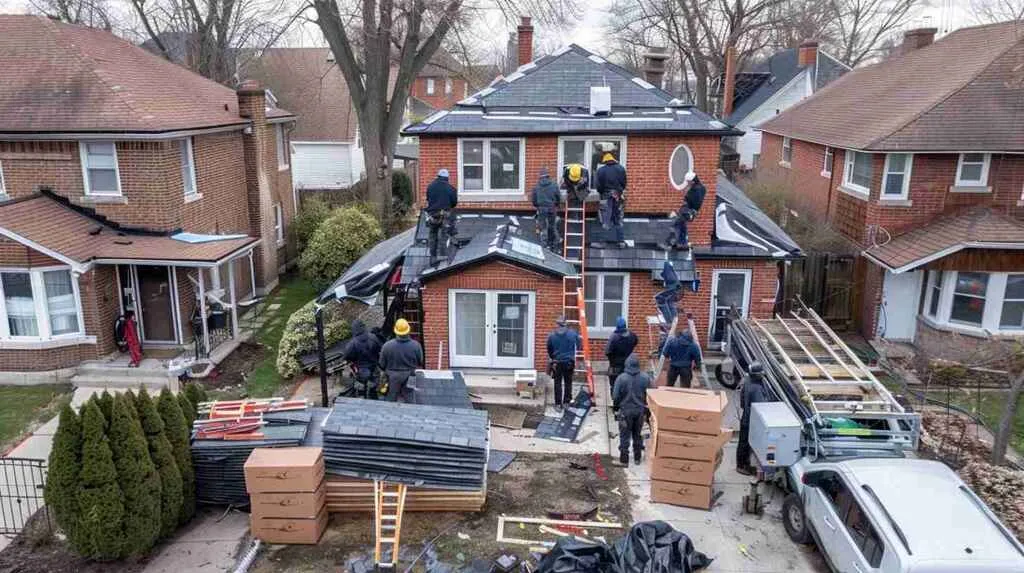
On a typical two-family house off Roosevelt Avenue-maybe in Jackson Heights or Elmhurst-here’s how I’d walk you through a full tear-off and reshingle from your perspective as the homeowner. You’ll see our truck pull up early, probably squeezing into a tight driveway or parking on the street with cones. We’ll lay tarps over your front garden and any AC units, set up ladders on both sides if there’s alley access, and I’ll meet you at the front door with a quick sketch on cardboard showing the layers we’re about to expose. Most Queens roofs in these neighborhoods are standard asphalt shingle over wood sheathing, pitched just enough to shed water but not so steep you need ropes-though in Forest Hills and Kew Gardens, we do hit steeper Colonial-style pitches. I’ll explain each step as we go, pointing at the specific valleys, chimneys, and party walls that make your roof unique, so by the end you’ll know exactly what we did and why it matters for the next 20 years.
Before we even touch a shingle, though, I’ll make sure materials are staged smart-no piles near edges, especially on windy days. It’s a short reminder, but it foreshadows something I learned the hard way, and I’ll get to that story in a minute.
Step-by-Step Process: Full Tear-Off and Reshingle on a Queens Two-Family Roof
- Protection & Setup – Park carefully on the block, lay tarps over landscaping, set up ladders and, if needed, a simple “wind fence” with tarps to keep debris in your yard.
- Strip Old Shingles – Remove shingles (and any old felt or patch layers) down to the wood deck, using roof jacks on steeper slopes common in Forest Hills and Kew Gardens.
- Inspect & Repair Deck – Replace any soft, delaminated, or moldy sheathing, especially over bathrooms and dormers where leaks often hide in Queens homes.
- Install Ice & Water Shield – Run self-adhered membrane at eaves, valleys, and around chimneys/sidewalls to protect against wind-driven rain and winter ice along Queens Boulevard-facing roofs.
- Underlayment & Flashing – Roll synthetic underlayment, replace or re-step flash chimneys and sidewalls, and install new drip edge at all eaves and rakes.
- Shingle Installation – Snap lines, nail shingles in staggered courses with manufacturer-specified patterns, paying extra attention to valleys and transitions near party walls.
- Ventilation & Details – Cut ridge vents if appropriate, flash pipe penetrations, and seal all exposed fasteners with high-quality sealant rated for our freeze-thaw cycles.
- Clean-Up & Walk-Through – Magnet-sweep for nails in tight driveways and sidewalks, remove all debris the same day, and do a final walk-through from the ground and, if safe, from a ladder with the homeowner.
Wind, Neighbors, and Narrow Yards: Queens-Specific Reshingle Safety
I still remember one Flushing job where-actually, it was Forest Hills, not Flushing, my bad-one windy November morning on a steep slate-look asphalt roof for an older couple who’d just had a baby move into the top floor. Halfway through, a sudden gust tore a bundle of unfastened shingles right off the staging and into the neighbor’s yard-no damage, but it forced me to rethink staging and material placement on that slope. Since then, anytime I’m reshingling in Queens with narrow side yards and close neighbors, I set up what I call the “wind fence” using tarps and staging, and I always share that story so clients understand why we stage the job slower but safer. Queens lots are tight-sometimes just three feet between houses-and one rogue bundle or piece of flashing can ding a neighbor’s car, crack a skylight, or worse. The relationships you’ve got with the people next door matter way more than shaving 20 minutes off a job, and honestly, most Queens neighbors are super understanding if you just give them a heads-up and keep things tidy.
If you were standing on your own roof with me right now, I’d point at the spot about three feet back from every edge and say, “This is the safety zone-bundles, tools, and tear-off debris stay inside this invisible line.” On windy days, we move that line even farther in, and we never leave loose materials overnight or when gusts are forecast. It sounds simple, but it’s the difference between a smooth reshingle and a neighbor relationship that’s permanently damaged, or worse, someone getting hurt.
⚠️ Wind and Material Safety During a Queens Reshingle
- Never leave loose bundles or tools near the eave or ridge when gusts are in the forecast.
- Avoid stacking more than 2-3 bundles in one place on older framing, especially over front rooms or bay windows.
- Keep tear-off debris in controlled piles away from shared driveways and directly above entrances.
- Insist your roofer uses toe-boards, harnesses on steeper slopes, and stages materials at least 3 feet back from all edges.
| Call a Pro Right Away | Maybe DIY / Can Wait |
|---|---|
|
• Roof slope steeper than 6/12 on a two- or three-story building • Houses just a few feet apart and you’re worried about debris blowing into neighbors’ yards • You see power lines within 10 feet of the roof edge • You’re not comfortable working at height with a harness |
• Single-story low-slope porch or rear addition • Small, isolated repair well away from edges • You already own proper PPE and fall protection • You’re only inspecting and taking photos for a quote |
What It Really Costs to Reshingle a Roof in Queens, NY
$7,500 to $18,000 is the range you’ll see for most full tear-off and reshingle jobs on typical Queens two- and three-family homes, depending on pitch, access, number of existing layers, and how much plywood needs replacing. Tight lots in Astoria or Flushing mean more hand-carry labor; wider lots in Jamaica or Bayside might let us use a conveyor or crane, which speeds things up and trims cost a bit.
| Scenario | Home Type & Area | Scope | Ballpark Price Range |
|---|---|---|---|
| Basic Tear-Off & Reshingle | 2-family, ~1,200 sq ft roof, Jackson Heights | 1 layer tear-off, architectural shingles, standard vents | $7,500 – $10,000 |
| Steep Roof with Limited Access | 2.5-story, ~1,400 sq ft, Forest Hills | 1-2 layers off, steep pitch, extra staging and safety | $10,000 – $14,000 |
| Multiple Layers + Deck Repairs | 3-family, ~1,600 sq ft, Flushing | 2-3 layers off, 10-20 sheets sheathing replaced, full flashing upgrade | $13,000 – $18,000 |
| Rear Addition Only | Single-story rear extension, ~400 sq ft, Corona | Full tear-off of small area, ice & water, new shingles | $3,000 – $5,000 |
| Overlay (Where Safe) | 2-family, ~1,200 sq ft, Elmhurst | No tear-off, 1st layer flat and sound, new shingles over | $5,500 – $8,000 |
Quick Facts: Shingle Masters in Queens
- Free Quotes: On-site inspections for Queens homes, usually within 24-48 hours.
- Typical Project Duration: 1-3 days for most two-family full tear-offs, weather permitting.
- Warranty: Manufacturer shingle warranty plus labor warranty (details explained at quote).
- Service Area: All of Queens, including Astoria, Jackson Heights, Elmhurst, Flushing, Forest Hills, Jamaica, and surrounding neighborhoods.
How to Read the Health of Your Roof Before You Call
The honest truth is, your shingles are just the skin; the real health is in the deck, underlayment, and flashing-those are the organs and arteries of your roof system. You can slap new shingles over a dying body and it’ll look fine from the street for six months, maybe a year, but eventually the underlying rot or missing ice shield will show up as a ceiling stain, mold in the closet, or worse. One late evening in January, under those orange streetlights in Flushing, I finished a rush reshingle for a landlord who’d ignored leaks until his top-floor tenant’s closet grew mold mushrooms. We were racing a forecasted freezing rain, and when we stripped the old shingles, we discovered three different patch jobs from three different decades, each layered over the last like geological strata. I still remember the sound of the first raindrops hitting the new underlayment just as we got the last course of shingles nailed-if we’d skipped the proper ice and water shield in the eaves and valleys to “save time,” that roof would’ve been leaking again before the tenant unpacked their boxes. Chasing symptoms-patching one shingle here, sealing a valley there-doesn’t cure the disease if the underlayment is shot or the deck is spongy.
Think of your roof like a layered sandwich: at the bottom you’ve got the wood deck (the bread), then ice and water shield in critical spots (like mayo in the corners where it matters most), then the underlayment (lettuce, the protective barrier), and finally the shingles on top (the pretty wrapper). Each layer has a job. In Queens, where we get baking summer heat that cooks asphalt and then winter freeze-thaw cycles that crack it, plus Nor’easters that drive rain sideways under shingles, every one of those layers needs to be intact and working together. You can’t diagnose that system from the sidewalk with binoculars-you need someone up there who knows what soft plywood feels like underfoot, what a failed valley looks like from above, and what the difference is between a cosmetic curl and a structural problem. So before you call, do the simple checks I’ll list below, but don’t skip getting a real inspection from a pro who’ll climb up, poke around, and give you the truth.
Before You Call: Simple Checks to Do First
- Walk around your house and note any missing, curled, or sliding shingles, especially along eaves and valleys.
- Look at ceilings on the top floor for fresh stains, bubbling paint, or peeling tape lines.
- Peek in the attic (if accessible) during or right after a rain for active drips or damp insulation.
- Check gutters for excessive shingle granules and confirm they’re not overflowing at corners.
- Take clear photos from the ground and out of upstairs windows of problem areas.
- Write down how old you think the current roof is and whether you know of past overlays or patches.
Can you reshingle in winter in Queens, NY?
Yes, we can reshingle through most of the winter here, but we watch temperature and wind closely. Adhesive strips on shingles need enough warmth and sun to seal, so we may recommend scheduling on milder days or using specific cold-weather installation techniques.
How long does a new shingle roof usually last in Queens?
Architectural asphalt shingles are often rated 30 years, but with our hot summers, wind, and occasional ice, a realistic expectation is 20-25 years when the roof is properly ventilated and installed over a sound deck.
Will a full tear-off be noisy for my tenants or neighbors?
Yes, there will be daytime noise from tear-off, nail guns, and cleanup. We minimize disruption by planning staging, giving neighbors a heads-up when needed, and working within reasonable daytime hours only.
Do I need permits to reshingle my roof in Queens?
Often, basic reshingling with no structural changes may not require a full DOB permit, but rules can change and multi-family or major structural repairs can trigger permit requirements. We’ll advise you during the quote and help make sure the job is done to code.
Your roof is more like a living system than just a static layer of shingles, and an on-site inspection is the only way to know for sure what it needs-overlay, tear-off, deck repair, or just a valley patch. If you’re in Queens and you’re wondering whether your roof can be safely reshingled or whether it’s time for the full treatment, call Shingle Masters for a free, no-pressure quote and a clear explanation of your options, from someone who’ll walk you through it like we’re neighbors standing on the ladder together.