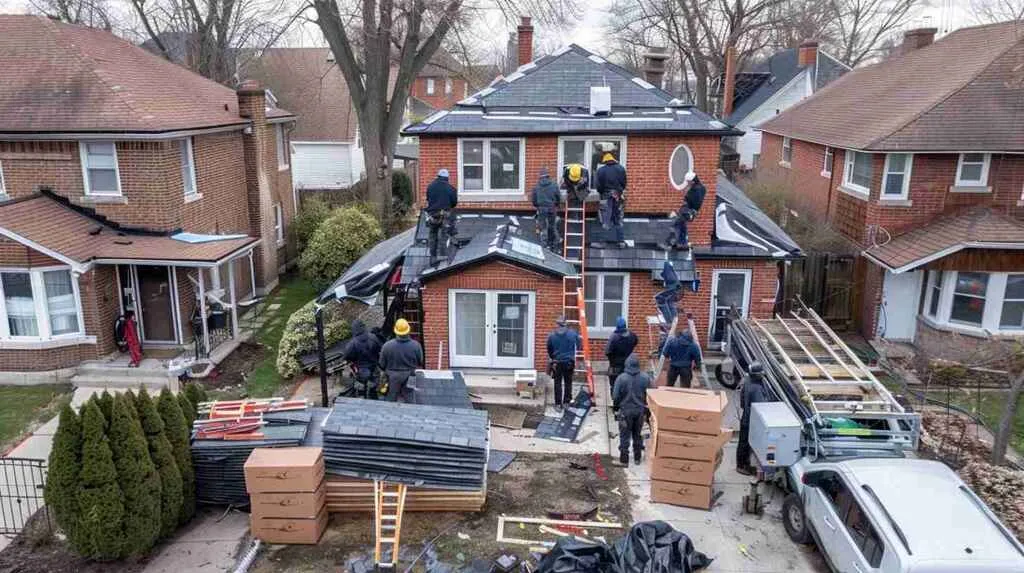
Replace a Shingle on Your Roof Queens NYC – Know Before You Climb
Picture this: you’re standing on the sidewalk in front of your house in Queens, looking up at one curled shingle flapping in the breeze, and your first thought is “I can just pop that thing back down.” Before you even touch that ladder, I need you to understand the first move that separates a clean repair from a disaster-sliding a flat pry bar under the shingle course above the damaged piece and gently popping the nails that lock it in place. If you can’t picture that move in your head right now, you’re not ready to be on that roof.
Start at the Shingle Above: The First Move You Can’t Get Wrong
Here’s where most people go sideways: they grab the torn shingle and yank, or they pry straight up like they’re pulling a nail out of a board. But shingles aren’t boards-they’re layers of a map that shows water exactly where to run off your house. Each course overlaps the one below it, and the nails holding your damaged shingle are hidden under the course above. If you don’t free those top nails first, you’re going to crack the shingles around the problem like dominoes, and suddenly your “one shingle” job is a patch job covering half a side.
One January morning, about 7:15 a.m., I was on a narrow two-family in Ridgewood after an overnight windstorm; the owner swore she’d “just lost one shingle.” When I got up there, I saw someone had tried to replace that “one” shingle themselves with roofing cement smeared like peanut butter and three different sizes of nails-water had been driven sideways under the surrounding shingles for weeks. I had to peel back a whole section, show her photos on my phone, and explain how a “little DIY patch” turned into replacing about 40 square feet of roof. That’s what happens when you don’t understand how water travels across these overlapping courses-you think you’re fixing a shingle, but you’re actually creating a new highway for leaks.
Freeing the Damaged Shingle Without Cracking the Neighbors
- Locate the nails in the course above – they’ll be about 5-6 inches above the top edge of your damaged shingle, hidden under the next layer.
- Gently lift the overlapping shingle with a flat pry bar, just enough to see and access the nail heads without bending or creasing the good shingle.
- Slide the bar under each nail head and rock it side to side, popping the nail straight up-never yank at an angle or you’ll tear the top shingle.
- Remove the nails holding the damaged shingle itself, working from top to bottom, keeping constant gentle upward pressure to avoid ripping the felt below.
- Slide the damaged shingle out horizontally, not down, so the tabs don’t catch on the course below and tear more material.
DIY First-Move Mistakes That Destroy Surrounding Shingles
- Prying straight up instead of rocking side-to-side – you’ll crack the shingle above and create two problems.
- Using a claw hammer instead of a flat bar – the claw punches through brittle shingles and leaves ragged holes.
- Working when shingles are brittle from cold or too soft from extreme heat – below 45°F they snap; above 85°F they tear like wet paper.
- Yanking nails through the shingle face instead of lifting the course above – leaves holes that water will find in the next rain.
Tools, Safety, and Queens Roof Conditions: Should You Even Be Up There?
Here’s my honest opinion: if you can’t name the tools before you climb the ladder, you shouldn’t be up there yet. Most Queens roofs sit at a 4/12 or 5/12 pitch-walkable if you’re comfortable, but steep enough that a slip means you’re sliding fast toward the gutter. Add in narrow side yards in Jackson Heights or Astoria where there’s barely room to set a ladder without leaning it against the neighbor’s fence, or wind channeling between attached rowhouses that’ll knock you sideways when you stand up, and you’ve got conditions that punish mistakes hard. I’ve been on these roofs long enough to know: the geometry is simple until you’re actually standing on hot shingles with your weight on one foot, trying to pry a nail you can’t quite see.
One August afternoon, we were on a brick rowhouse in Jackson Heights, 95 degrees, sun bouncing off every surface, and the homeowner’s teenage son kept asking if he could “just swap a shingle real fast” instead of paying us. I actually let him watch over my shoulder while I removed one torn shingle, showed him how the nails from the course above lock it in, and how easy it is to crack the neighboring tabs when it’s that hot. By the time he saw the care it took not to damage the rest of the roof, he admitted if he’d tried it himself he probably would’ve created three new leaks. That’s the thing about these Queens roofs-they look straightforward from the sidewalk, but once you’re up there reading the map of how the courses lock together and where the wind has lifted edges you couldn’t see from below, it’s a whole different conversation.
Minimum DIY Kit Before You Think About Replacing a Shingle
Flat pry bar (at least 12 inches)
Roofing hammer or hatchet
Galvanized roofing nails (1¼” for standard shingles)
Replacement shingles (matching or close to existing)
Utility knife with hook blades
Ladder rated for your weight + 50 lbs
Thick-soled shoes with grip (not sneakers)
Heavy gloves and eye protection
DIY vs Call a Queens Roofing Pro for a Missing or Damaged Shingle
Urgent – Call Shingle Masters Now
- Active interior leak or water stains spreading
- More than 3-4 shingles missing or torn
- Damage near skylight, chimney, or valley
- Roof pitch too steep to walk safely
- Rain or wind still forecast in next 48 hours
Can Watch Overnight (Then Decide)
- One torn tab, no exposed black felt visible
- Minor nail pop you can see from the sidewalk
- Cosmetic edge lifting after a windstorm
Step‑by‑Step: How to Replace a Shingle on Your Roof in Queens, NY
When a customer asks me, “Can I just slide a new shingle in there?,” I know we need to talk about how shingles actually lock together. Think of your roof like a deck of cards spread just enough that water runs off the edges, not down into the stack-that’s how gentle you have to be when you’re working on one “card.” Every shingle overlaps the one below it by at least five inches, and the nails from the course above pin your target shingle in place. Water doesn’t drip straight down; it flows along that overlap, riding the path you’ve built with each course. Mess with one card without understanding the whole deck, and you’re giving water a shortcut straight through your roof into the attic.
Map the Courses, Then Move One Piece at a Time
Before you even open the toolbox, stand on the sidewalk and count shingle courses from the gutter up to the damaged spot-I’m serious about this. Take a photo with your phone, zoom in, and count the horizontal lines. That’s your map. When you get up on the roof, you’ll know exactly which course you’re on, and you won’t accidentally start prying on the wrong shingle two rows away. Here’s a practical trick I use in the field: mark the course number on a long level or a piece of painter’s tape stuck to your pry bar, so when you’re crouched up there with the sun in your eyes, you don’t lose your place. You’re not just replacing a piece of asphalt-you’re navigating a grid that has to shed water in one direction, and knowing where you are on that map keeps you from punching holes in the wrong spots.
The weirdest one was a late-night emergency in Astoria, 10 p.m., during a sideways rainstorm from the remnants of a hurricane. A landlord had tried to replace a shingle earlier that week, nailed right through a hidden seam in the underlayment, and left the nail heads exposed because “it looked secure.” Wind drove rain along the nail shaft into the attic and through a bedroom ceiling. I went up with a harness and headlamp, pulled that shingle, re-nailed properly under the overlap, installed a new shingle, and then used my flashlight to send him real-time photos so he understood exactly why “just one wrong nail” matters. Every nail has to sit in the right zone-far enough under the next course to be sealed by the overlap, but not so high that it punctures the underlayment seam or misses the shingle edge below. Get it wrong, and you’ve just created a tiny pipe that funnels water straight into your house.
Full DIY Swap: Removing One Damaged Shingle and Installing a New One
Should You Finish This DIY or Stop and Call Shingle Masters?
If you feel even a little lost reading that flowchart, you have no business learning this on a live roof in Queens.
Cost, Damage Risk, and What “Just One Shingle” Really Means in Queens
On a typical Queens two-family with a 4/12 pitch and three-tab shingles, the first battle is not falling in love with the idea of “just one shingle.” What looks like a single torn tab from the sidewalk often involves two or three courses once you’re up there with a pry bar, and sometimes the underlayment below has been leaking for weeks before the shingle visibly failed. Water doesn’t respect the boundaries you imagine-it travels along nail lines, it sneaks under good shingles adjacent to the bad one, and it finds the path of least resistance down into your attic. That Ridgewood job I mentioned earlier, where the DIY cement patch became a 40-square-foot replacement? That’s the reality of small damage on these roofs. And that Astoria emergency with the misplaced nail? The landlord thought he was saving a couple hundred bucks and ended up with ceiling damage, a ruined bedroom, and an overnight emergency call that cost triple what a proper daytime repair would’ve been.
| Scenario | What It Usually Involves | Typical Range in Queens, NY |
|---|---|---|
| Single torn or missing shingle | Remove damaged shingle, inspect underlayment, install matching replacement, re-seal course above | $150-$300 |
| Storm damage (3-5 shingles) | Multiple shingle removal, check for lifted edges around damage zone, match existing color, minor felt patching if needed | $400-$700 |
| Shingle + underlayment tear | Cut out damaged felt section, install new underlayment patch, replace shingles across affected area, emergency tarp if actively leaking | $600-$1,200 |
| Mystery leak trace + repair | Attic inspection, dye test or water trace from interior stain back to roof entry point, shingle replacement, possible flashing adjustment | $800-$1,500 |
| DIY Replacement | Hire Shingle Masters |
|---|---|
Pros:
Cons:
|
Pros:
Cons:
|
Before You Call (or Climb): Quick Checks and Straight Answers
The blunt truth is, most DIY shingle replacements fail not because of the shingle, but because of what people do to the shingles around it. You pry too hard, crack a good tab, leave a nail head exposed, or miss a torn piece of underlayment, and suddenly you’ve got a leak that wasn’t there before you “fixed” it. Treat the roof like a deck of cards-work gently, understand the overlap and how water flows down that path, and know that sometimes the smartest DIY move is to take photos from the sidewalk, note what you see, and call someone who’s done this exact repair on a hundred Queens roofs instead of learning on yours.
Things to Note From the Sidewalk Before You Call Shingle Masters
- Location on roof – note if the damage is near the ridge, in a valley, close to a chimney, skylight, or vent pipe (these are trickier repairs).
- How many tabs or full shingles are missing – count as accurately as you can from the ground; take a zoomed-in photo.
- Any visible exposed black felt or wood decking – if you can see black paper or raw wood, it’s already beyond a simple shingle swap.
- Any interior ceiling stains or drips – mark the room, measure from a corner or window so we can trace the leak path from inside out.
- Recent storm details – wind direction, date and time, whether you heard impact (branch, debris) or just saw damage afterward.
- Roof age if you know it – helps us understand whether this is isolated storm damage or a sign the whole roof is nearing end-of-life.
- Photos from multiple angles – sidewalk, backyard, any second-story window view; the more angles we see before we arrive, the faster we diagnose.
Common Queens Shingle-Replacement Questions
How soon after a storm should I replace a missing shingle?
If the underlayment (black felt) is still intact and no interior leak has started, you can usually wait a day or two for good weather and daylight. But if you see exposed felt or wood, or if rain is forecast in the next 24 hours, get it covered (tarp or emergency patch) immediately and schedule a proper repair within a week. In Queens, our weather can flip fast-don’t gamble on a “maybe” forecast.
Can I match old shingles, or will the new one stand out like a patch?
Honest answer: if your roof is more than 5-7 years old, the new shingle will likely be a slightly different shade because the old ones have weathered. We carry a wide range of colors and can usually get close enough that it’s not obvious from the sidewalk. If you’re very particular about appearance, we can sometimes source “weathered” surplus shingles from recent tear-offs, but that’s hit-or-miss.
What if the shingle is near a skylight or chimney-does that change the repair?
Absolutely. Shingles around penetrations (skylights, chimneys, vents, pipes) interact with flashing-the metal or rubberized strips that seal the gap between the roof and the object. A damaged shingle there often means the flashing has lifted or corroded, so we’ll inspect and possibly re-seal or replace the flashing at the same time. DIY near flashing is where most serious leaks begin, so that’s a strong “call a pro” zone.
What if it rains before I can get the shingle replaced?
If the underlayment is intact, one or two light rains usually won’t cause interior damage-the felt acts as a temporary barrier. But don’t push your luck. If you’re expecting heavy rain or wind-driven rain (common with storms off the Atlantic), cover the area with a tarp weighted down securely, and call us to schedule a repair as soon as the weather clears. We offer same-day emergency slots for active leaks in Queens.
Does one missing shingle mean I need a whole new roof soon?
Not necessarily. If your roof is under 15 years old and only one or two shingles failed due to a storm or a manufacturing defect, replacing them should buy you years more life. But if you’re losing multiple shingles every season, seeing widespread granule loss (bald spots), or the roof is 20+ years old, that missing shingle is often the canary in the coal mine-time to budget for a replacement in the next year or two. We’ll give you an honest assessment when we’re up there.
Why Queens Homeowners Call Shingle Masters for Mystery Leaks and Shingle Repairs
- Licensed & insured in NYC – full liability and workers’ comp coverage, so you’re protected if anything goes wrong.
- 19+ years roofing experience in Queens – we know the common roof styles, pitches, and weather patterns from Astoria to Jamaica.
- Fast response for storm damage – same-day emergency slots available for active leaks; typically on-site within 4 hours of your call.
- Experience with complex roofs – dormers, skylights, tight rowhouse access, steep pitches-we’ve seen it all in Queens and have the gear to work safely.
- Photo documentation from the roof – we send you pictures of what we find up there, so you can see the “map” of your roof and understand exactly what we’re fixing (and why).
On a Queens roof, knowing when not to touch a shingle is just as important as knowing how to replace one. If you’ve read this far and you’re still not sure whether you should climb that ladder or make a phone call, lean toward the call-because the difference between a clean $200 repair and a $1,500 leak-chase usually comes down to one wrong move with a pry bar. Give Shingle Masters a ring for a proper on-roof inspection and shingle replacement before that small problem you can see from the sidewalk turns into a mystery leak dripping through your bedroom ceiling at 2 a.m.