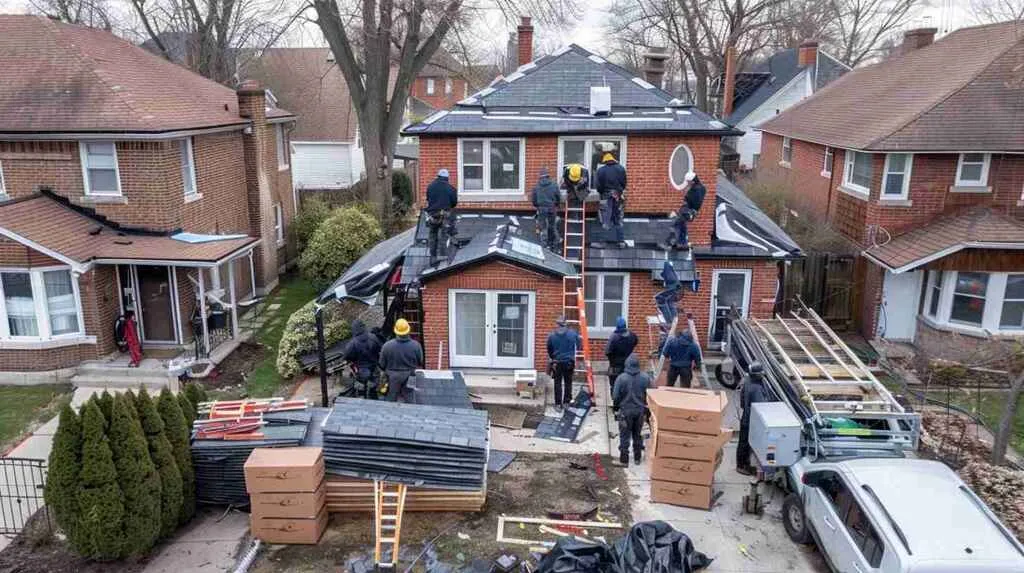
Best Way to Tear Off Shingles Queens NY – Fast and Clean Method
Blueprint matters. The best way to tear off shingles in Queens, NY isn’t about throwing more crew at the problem-it’s a tear-off shovel and a dumpster you can actually reach without backing over your neighbor’s mailbox. Get those two right and you’ve protected your property, your time, and the sidewalk traffic that’s absolutely filming you on their phone.
The Fast, Clean Tear-Off Setup That Actually Works in Queens
Here’s my blunt view: if your roofer shows up without a tear-off-specific plan, you’re about to pay extra for chaos. The single biggest efficiency trade I learned after 19 years is this: a proper tear-off shovel with a pry slot and blade costs about $40, and a dumpster placed within ten feet of your roof edge-even if the spot’s not perfect-cuts your tear-off time in half. That trade beats five guys with random shovels and a pickup truck backed into the street every single time. The shovel moves shingles in continuous strips instead of chip-by-chip, and the close dumpster means your crew’s not dragging bundles across the yard, crushing plants, or leaving debris trails that multiply your cleanup window by three.
One August afternoon in Jamaica, we started a tear-off at 6:15 a.m. because the forecast said 95° and thunderstorms by 3. At 10:30, the homeowner came home early from a night shift and freaked out because the yard looked like a war zone. I walked him through our “mess-to-clean” timeline, step by step, and by 2:45 p.m., right before the storm rolled in, the roof was dried in, the gutters were hand-cleaned, and he apologized for doubting us. That job drilled into me that speed means nothing if you don’t have a cleanup plan synced to the clock and the weather. Zoom out: your tear-off day is controlled by lot layout, forecast windows, and neighbor sightlines. Zoom back in: tarps go under every drop zone, one crew member stages debris as it comes off, and you never-ever-let material pile up on the ground longer than it takes to fill the next dumpster section.
| Setup Option | Speed & Efficiency | Cleanliness & Neighbor Impact |
|---|---|---|
| Basic: Pickup Truck + No Dedicated Tear-Off Shovel | Slow – constant trips, crew fatigue, roof open longer | High mess risk, blown debris, nails everywhere |
| Standard: Rented Dumpster + Mixed Tools | Moderate – better than basic, but bottlenecks in tight driveways | Medium mess – depends on crew discipline, more chance of stray nails |
| Queens-Optimized: Close Dumpster + Tear-Off Shovel + Mapped Tarps | Fast – continuous flow off roof, shorter “roof open” window | Low mess – controlled drop zones, faster cleanup, fewer complaints |
✅
Non-Negotiables for a Clean Queens Tear-Off Setup
-
✅
Tear-off shovel with blade and pry slot – not a garden shovel or flat spade -
✅
Dumpster within 12 feet of roof edge – even if you have to pay for a smaller driveway-friendly size -
✅
Heavy tarps mapped to drop zones – not scattered randomly after the crew arrives -
✅
Weather cutoff time written on the schedule – you need to know when the roof gets dried in, not “hopefully by dark”
Protecting Driveways, Yards, and Neighbors While You Rip
At 6:30 a.m. on a typical Queens tear-off, the first thing I’m looking at isn’t the roof-it’s where I can put the dumpster without making enemies. In Astoria, Woodside, and Jackson Heights, you’ve got driveways that barely fit a sedan, shared garages with temperamental neighbors, and alternate side parking that makes every placement decision feel like chess. The efficiency trade is simple: pay an extra $75 for a 15-yard dumpster positioned tight to your house instead of a 20-yard parked in the street, and you’ve just saved yourself from cracked pavers, blown shingles into traffic, and the headache of moving it twice. Local knowledge matters-if your driveway’s Belgian block or stamped concrete, you’re one bad drop away from a $3,000 hardscape repair that could’ve been avoided with two sheets of plywood and a hand-stacked buffer zone.
There was a job in Jackson Heights where the previous contractor had “saved time” by throwing torn-off shingles straight into the driveway without tarps-cracked pavers everywhere, oil stains, and nails in the neighbor’s tire. The new owner hired me two years later and specifically said, “I want the opposite of that.” I broke down our step-by-step tear-off and protection plan like a project manager: tarps mapped, chute placement, staged dumpsters, and live cleanup. That job is why I now treat every tear-off like I’m working over a museum floor, not a random backyard. Your yard protection isn’t extra-it’s part of the system. We double-layer tarps where the chute hits ground, we cover AC condensers with plywood caps, and if your driveway’s tight, we stage the dumpster on one side and use a wheelbarrow relay instead of dragging bundles across Italian tile you installed five years ago.
⚠️
Common Property Damage Risks During Tear-Off
Cracked pavers and stamped concrete – happens when bundles get dropped from height onto hard surfaces with no buffer
Dented cars and punctured tires – one stray nail or a shingle blown off the pile during windy conditions
Damaged gutters and siding – crew using the wrong tool or rushing the tear-off at edges without finesse
Landscaping destruction – flowerbeds, shrubs, and sod crushed under tarps that weren’t placed before debris started flying
✅
Driveway & Yard Protection Checklist Before Tear-Off Starts
-
✅
Double-layer tarps in impact zones – where chutes land and where crew stages debris bundles -
✅
Plywood over decorative pavers or concrete – ¾-inch minimum, spread across traffic paths -
✅
All cars moved or covered – yours, your neighbor’s if they’re parked close, and any street spots in the drop zone -
✅
AC units, vents, and outdoor equipment covered – plywood caps or heavy tarps secured with bungees -
✅
One crew member assigned as “ground control” – watches for blown debris, repositions tarps, runs magnet sweeps live
Controlling Debris, Nails, and Street Politics in Tight Queens Blocks
I still remember a Saturday in Woodside when one $40 magnetic sweeper saved me a lawsuit and a friendship between neighbors. On a windy November morning in Bayside, we were tearing off three layers of old shingles from a steep colonial when a guy across the street started filming us with his phone, yelling about nails in the sidewalk. I stopped the crew, walked over, and showed him our magnet sweep schedule on my clipboard, then invited him to check the sidewalk with us. By the end of the job he actually brought us coffee, and I learned that when you’re ripping a roof apart in a tight Queens block, your process has to reassure the whole street, not just your client. Debris control isn’t about one big cleanup at the end-it’s baked into the flow. Every time we fill a dumpster section, someone walks the perimeter with the magnet. Every time wind picks up, we pause and re-tarp loose piles. You’re not just protecting your client’s property; you’re protecting the sidewalk his kid rides a bike on and the driveway his neighbor backs out of every morning.
Here’s my insider tip after 19 years: schedule at least three magnet sweeps and write them on the schedule like checkpoints-mid-job when you’re halfway through the tear-off, after the dumpster gets its first major load, and final walk before you pack tools. On busy streets or shared driveways, I sometimes add a bonus sweep the next morning because wind and overnight traffic shake loose nails you swear you already picked up. Each sweep is an efficiency trade: it costs you 12 minutes and burns a little crew energy, but you’ve just avoided a flat tire, a kid’s scraped knee, or a neighbor who calls 311 because your nails migrated into their roses. The magnet doesn’t lie-you’ll pull up 40, 50, sometimes 80 nails per sweep on a big job, and every one you grab is a future problem you didn’t create.
Debris & Nail Control by the Numbers
Nail, Debris, and Neighbor Concerns
How do you keep nails out of my driveway and my neighbor’s sidewalk?
What if wind picks up while you’re tearing off?
Will you clean my gutters after the tear-off?
Do you cover cars or ask neighbors to move them?
Step-by-Step: My Queens Tear-Off Method From First Shingle to Final Sweep
The truth is, most of the “best way to tear off shingles” videos online are filmed on big open suburban lots, not tight Queens driveways and shared alleys. You’ve got no staging yard, you’re watching the weather like a trader watches the market, and the neighbor’s filming you from their stoop because last year some contractor left nails in their hedges. Think of your roof tear-off like rush hour on the Van Wyck: if you don’t control the flow of traffic, everything backs up and something gets hit. A good tear-off day is a system where material moves from roof to dumpster in a continuous stream, cleanup happens live instead of piling up, and your roof gets dried in before the forecast window closes. Miss any one of those checkpoints and you’re suddenly dealing with exposed sheathing in a thunderstorm or a yard that looks like a construction zone three days later.
When I sit at your kitchen table, the first question I ask is, “Do you care more about how fast we finish, or how invisible the mess is while we work?” Honest answer: you want both, and the only way to get both is sequencing and roles. My personal opinion after almost two decades on Queens roofs is that the “best way” isn’t a single miracle tool or crew size-it’s a balanced system where speed and cleanliness reinforce each other instead of fighting. You map the protection setup before the first shingle comes off, you assign one person to debris control while the others rip, and you schedule drying-in by a specific hour, not “whenever we’re done.” That’s the system. That’s the trade-off that works.
If we can’t explain your tear-off day on one sheet of paper, it’s not a real plan.
Queens-Optimized Shingle Tear-Off Sequence
Pre-job walk and tarp/plywood layout
Map drop zones, stage tarps and plywood before crew starts, identify flower beds, pavers, and AC units to protect
Dumpster positioning and access path setup
Place dumpster within 12 feet of roof edge, confirm it’s not blocking your neighbor’s driveway, establish chute or hand-pass route
Edge-to-peak tear-off using tear-off shovel in controlled sections
Start at eaves, pry shingles in strips using the blade slot, work in 10-foot sections so debris doesn’t pile up on the roof
Live debris management and mid-job magnet sweep
Ground control crew member stages bundles as they come off, runs first magnet sweep when dumpster’s half full, adjusts tarps if wind shifts
Sheathing inspection and immediate repairs
Check every sheet of plywood or OSB for soft spots, cracks, or rot; replace damaged sections before any new material goes down
Roof dried-in (underlayment/ice + water) before forecast cutoff
Roll synthetic underlayment and install ice-and-water shield in valleys and eaves by the scheduled cutoff time, not “whenever we finish”
Final magnet sweeps, gutter clean-out, and neighbor-side check
Run magnet over driveway, sidewalk, and 25-foot perimeter; hand-clean gutters; walk neighbor’s side if it’s close to the drop zone
| Myth | Fact |
|---|---|
| “It’s fine to leave one or two old layers and just roof over.” | Extra layers trap heat, hide rot, and often violate code-full tear-off gives you a reset and protects warranties. |
| “I’ll save money by doing the tear-off myself and just hiring a roofer to install.” | DIY tear-offs in Queens usually lead to damage, exposed roofs overnight, and higher labor costs to fix the chaos. |
| “We can just throw shingles into the yard and clean it all at the end.” | Uncontrolled dumping cracks pavers, destroys landscaping, and leaves nails everywhere-the yard isn’t a dumpster. |
| “The fastest jobs are the ones where the crew just rips and worries about mess later.” | Fastest overall jobs bake cleanup into the schedule so nothing piles up and the roof can be dried-in on time. |
When to DIY, When to Call a Queens Pro Like Shingle Masters
Think of your roof tear-off like rush hour on the Van Wyck: if you don’t control the flow of traffic, everything backs up and something gets hit. Controlling that flow-material off the roof, into the dumpster, swept before it migrates-is where a pro crew adds value, especially on multi-layer or steep roofs where one mistake costs you days and dollars. The efficiency trade is simple: pay a bit more for a systemized tear-off and you’ve bought speed, neighbor peace, and no guessing whether your roof gets dried-in before the rain.
Should You DIY Tear-Off or Hire a Pro in Queens?
Why Queens Homeowners Call Shingle Masters for Tear-Offs
-
✓
Licensed & insured in NYC – full liability and workers’ comp coverage on every job -
✓
19+ years shingle tear-off experience in Queens – we’ve worked every block type from Astoria to Jamaica -
✓
Same-day dry-in on tear-offs scheduled around weather – your roof never sits exposed overnight -
✓
Written cleanup and magnet sweep schedule provided before work starts – no guessing, no surprises
✓
Info to Have Ready Before You Call Shingle Masters
-
✅
Roof age and number of shingle layers (if known) – helps us estimate labor and dumpster size -
✅
Photos of driveway/yard access – shows us where we can place the dumpster and stage materials -
✅
Whether there’s a shared driveway or party wall neighbors – affects our protection and communication plan -
✅
Any prior leak or decking issues – tells us if we need to budget extra sheathing repairs -
✅
Your priority: fastest finish vs. lowest visible mess during the day – helps us sequence the job to match your concerns
The best way to tear off shingles in Queens, NY isn’t a stunt-it’s a system where every step from tarp placement to final magnet sweep is mapped before the first shingle comes off. You get speed, you get cleanliness, and you get a roof that’s dried-in on schedule without destroying your yard or making enemies on the block. Call Shingle Masters and we’ll walk through a custom tear-off plan that fits your roof, your driveway, and the weather window-no spreadsheets required, just the same efficiency mindset that’s kept Queens roofs watertight for 19 years.