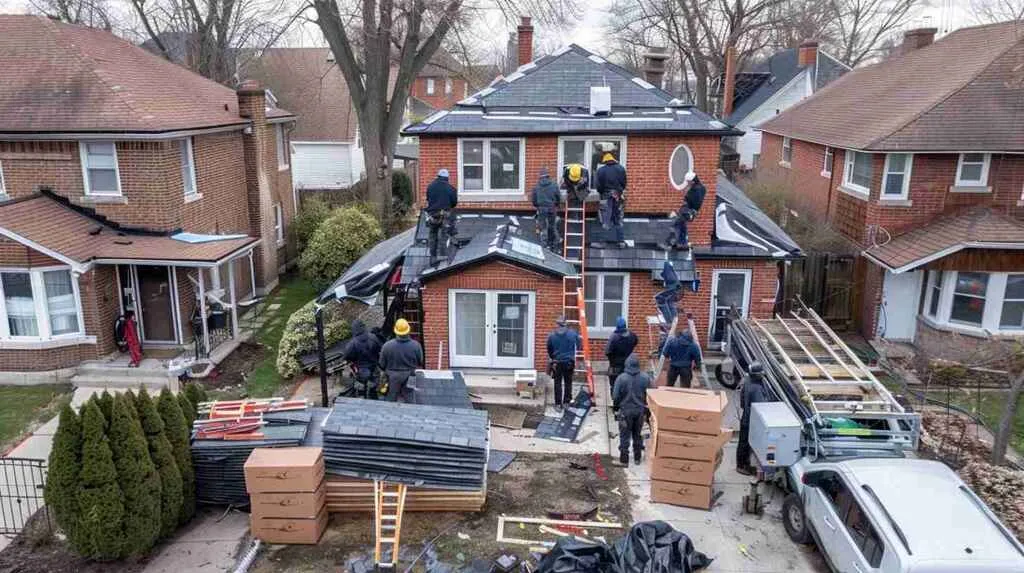
Asphalt Shingle Roof Replacement Queens NY – Free Quote Today | Free Quotes
Blueprint for a real asphalt shingle roof replacement in Queens: a small single-family rowhouse will typically run $6,500-$9,500, a standard two-family brick house hits $10,000-$16,000, and larger multi-families or complex older properties can push $18,000-$28,000 when done right. When quotes come in at half those numbers, it’s almost always because critical layers-underlayment, ice & water shield, proper flashing, or even a full tear-off-are being skipped to chase a cheap headline price.
What a Real Asphalt Shingle Roof Replacement in Queens Actually Costs
I’m not going to sugarcoat it: the lowest quote you get is rarely the honest one. A proper asphalt shingle roof replacement in Queens includes a full tear-off to bare wood, disposal of old layers, new drip edge, ice & water shield along eaves and valleys, synthetic underlayment across the field, quality architectural shingles installed with the correct nailing pattern, new flashing around chimneys and walls, proper ventilation, and a thorough cleanup. When contractors cut any of those steps-especially underlayment or the tear-off-you’re basically hearing the beat drop out of a track and being told the song still sounds fine. It won’t. The first Nor’easter will prove it.
On a typical two-family in Queens, you should expect full tear-off of one or two existing layers, haul-away with dumpster fees, replacement of any soft plywood (which we almost always find on at least one section), ice & water shield at the eaves and in every valley, synthetic underlayment from ridge to gutter, starter strips, architectural shingles nailed at the factory-specified exposure, new step flashing along brick walls, ridge cap shingles with proper ventilation underneath, new pipe boots, and a magnetic sweep for nails when we’re done. I learned this the hard way one August morning around 6:15 AM in Ridgewood, right before the sun turned the roof into an oven. I was up on a two-family doing a replacement when I realized the previous “roofer” had nailed straight through the top of every shingle, right into the exposure where wind could grab them. I sat on the ridge, sweating through my shirt, tapping each wrong nail with my hammer so the owner could hear the hollow sound. That job taught me you can’t just “fix” a corner-if the nailing pattern is wrong across the whole plane, you strip it all and start fresh or you’re stealing their money. That’s also why I sketch a quick roof map on cardboard or the back of a permit before we start, so you can see exactly where every problem spot is and what we’re upgrading.
Estimated Price Ranges (labor + materials)
⚠️ Why That Super-Cheap Quote Should Worry You
- Skipping the full tear-off: They’ll just nail new shingles over old layers, which traps moisture, voids warranties, and guarantees premature failure.
- Using felt instead of synthetic underlayment: Felt paper tears easier, degrades faster in heat, and doesn’t seal around nail penetrations the way modern synthetics do.
- Omitting ice & water shield: Without it at eaves and valleys, wind-driven rain and ice dams go straight through to your ceiling-usually in the first serious storm.
- Wrong nailing patterns or too few nails: Shingles rated for high wind require specific placement and count; cutting corners here means tabs blow off in anything over 50 mph.
- Hiring unlicensed subs with no insurance: If someone gets hurt on your property or the work fails inspection, you’re the one left holding the liability and the repair bill.
Bottom line: These shortcuts often void manufacturer warranties entirely and lead to active leaks within the first year, costing you far more than the “savings.”
Layer by Layer: How a Proper Queens Shingle Roof Is Built
Think of your roof like a layered track in a song-you need the beat, the bassline, the melody, and the subtle background instruments all working together or the whole thing falls apart. The roof deck and sheathing are your drum pattern: if the wood is soft or rotten, everything on top goes off-beat and fails. Ice & water shield plus synthetic underlayment are the bassline-low, steady protection against wind-driven rain and ice dams that you don’t notice until it’s missing and water’s pouring in. The starter shingles and field shingles are the main melody, the part everyone sees, but they’re only as strong as the rhythm underneath. Flashing around chimneys, walls, and skylights? Those are the background instruments you don’t hear until they’re gone and suddenly everything sounds wrong-meaning leaks. And ridge caps with proper ventilation are like the final mix and mastering, keeping heat and moisture balanced so the whole system lasts its rated life instead of curling and cracking in five years. Queens weather-wind off the East River, Nor’easters that drive rain sideways, summer heat that bakes tar to 160 degrees-stresses every one of those layers. Skip one and the track skips. Now, let me stack the next layer on top of that.
I’ll be honest with you: if a contractor pitches “just replacing the shingles” as a full replacement, walk away. Real asphalt shingle roof replacement in Queens means addressing the underlayment, installing proper starter strips along every eave and rake, ensuring ridge ventilation so your attic doesn’t turn into a pressure cooker, and reflashing every penetration-chimneys, soil stacks, skylights, wall step flashing on brick rowhouses in Astoria, dormer transitions on older wood-framed homes in Jamaica. One December night in Astoria, just after 9 PM, I got an emergency call from a landlord whose tenant’s kid woke up to water dripping on a bunk bed. I went up there with a headlamp in light snow and found a patch job where someone had mixed three different brands of shingles and skipped the underlayment entirely. We had to tarp it overnight and do a full replacement the next day when the temperature climbed just enough-I remember explaining to the tenant how temperature affects adhesion, breath steaming in the air while we looked at ice forming on the old granules. That’s exactly what goes wrong when those non-negotiable layers are missing: you’re not just losing shingles, you’re losing the entire protection system.
Your Queens Roof, Like a Finished Track
-
✅
Roof deck/sheathing = The drum pattern – if it’s soft or rotten, everything on top goes off-beat and fails. -
✅
Ice & water + synthetic underlayment = The bassline – low, steady protection against wind-driven rain and ice dams. -
✅
Starter shingles + field shingles = The main melody – what you see, but only as strong as the rhythm underneath. -
✅
Flashing (chimneys, walls, skylights) = The subtle background instruments – you don’t notice them until they’re missing and everything sounds wrong (leaks). -
✅
Ridge caps + ventilation = The mix and mastering – keeps heat and moisture balanced so the whole system lasts its full life.
How I Replace an Asphalt Shingle Roof in Queens, Step by Step
- Walkthrough & roof map: Inspect the exterior, attic (if accessible), and sketch a simple map showing slopes, problem spots, and recommended upgrades.
- Tear-off & deck check: Remove all existing shingles and underlayment, expose the wood deck, and mark any soft or rotten areas for replacement.
- Deck repairs & prep: Replace bad plywood or boards, re-nail loose areas, and install drip edge along eaves and rakes.
- Underlayment & ice shield: Lay ice & water shield at eaves and valleys, then roll out synthetic underlayment across the field, sealed and properly overlapped.
- Shingles, flashing & details: Install starter strips, architectural shingles with correct nailing pattern and exposure, new step flashing, pipe boots, and vents.
- Clean-up & final walk: Magnetic nail sweep of the property, haul-away of all debris, then review the finished “track” with you using the roof map so you know exactly what’s where.
Do You Need a Few Shingles Fixed or a Full Replacement?
I still remember a roof in Jackson Heights where the homeowner called me thinking they just needed a handful of tabs replaced after noticing a couple missing on the street-facing slope. When I got up there around mid-afternoon, I found widespread curling across three different slopes, cracking along the nail lines where wind had been working the shingles back and forth for years, and almost no granules left on the south-facing section-just bare asphalt baking in the sun. There was a Saturday in late spring, around 3 PM in Flushing, when another customer insisted he only needed “a few shingles replaced” after a windstorm. As I walked him along the driveway, I picked up six different shingles from the ground, each from a different slope of his roof, and showed him how the tabs were curling and cracking along the nail line. Halfway through, his neighbor leaned over the fence and admitted they’d had the same issue and ended up with a full asphalt shingle roof replacement a year earlier. That moment, watching the realization hit him while a Mets game played faintly from someone’s open window, is why I always make people look at the evidence with their own eyes. Now, let me stack the next layer on top of that. Here’s my insider tip: don’t just check the one visible patch-walk around after any storm and inspect multiple slopes, then look in the gutters and at the bottom of your downspouts for granule build-up. If you’re finding gritty piles of what looks like coarse sand, that’s the protective coating washing off and your shingles are at the end of their life, not just wind-damaged in one spot.
Patch or Full Replacement?
Start here: Are you seeing issues on only one small area (less than 10 shingles)?
→ If YES: Ask yourself this next question…
Is your roof under 10 years old and the rest of the shingles lie flat (no curling or cracking)?
→ If YES: You may be okay with a localized repair-still get a pro inspection to confirm underlayment and flashing weren’t compromised.
→ If NO: Your roof is likely past its prime; start planning for a full replacement before the next leak forces your hand.
→ If NO: Are you seeing missing shingles or tabs from more than one slope?
→ If YES: Wind damage is widespread-full asphalt shingle roof replacement is usually the smarter long-term move, and it may qualify for insurance coverage.
In Queens, mixed repairs on an already aging roof usually cost more in the long run than doing the full system once. Patching hides the problem temporarily but doesn’t stop the underlying decay.
What I Look For When I Walk Into a Queens Building
When I step into your hallway and smell that damp, musty odor-especially on the top floor or near exterior walls-I already know there’s a moisture problem somewhere above, and nine times out of ten it’s your roof. Before I even climb the ladder, I’m looking at ceiling corners for hairline cracks, bubbling or peeling paint near exterior walls, past patch spots that show repeated attempts to cover the same leak, and any water rings or stains that tell a timeline. In older plaster ceilings common in Jackson Heights apartments, you’ll see a spiderweb of cracks radiating from a wet spot; in newer sheetrock renovations the ceiling might bow slightly or the paint might bubble and peel in sheets. One December night in Astoria, just after 9 PM, I got an emergency call from a landlord whose tenant’s kid woke up to water dripping on a bunk bed-I went up there with a headlamp in light snow and found a patch job where someone had mixed three different brands of shingles and skipped the underlayment entirely. That musty smell in the hallway and the faint brown ring on the bedroom ceiling were clues that the exterior problem-a botched flat-to-pitch transition on the brick parapet-had been leaking for months before it finally dripped through.
Here’s the part nobody likes to hear, but everyone needs to know: by the time you’re seeing regular interior staining, a persistent mold smell, or actual dripping during storms, your roof system has usually been failing for a while-weeks, sometimes months-and the damage inside your walls and ceilings is already started. Don’t wait for the next storm to see if it gets worse. And here’s my guideline: if you’re calling me or any other roofer for the same leak more than twice, it’s time to stop patching and talk full asphalt shingle roof replacement, because whatever’s underneath those shingles is compromised and no amount of caulk or new tabs will fix rotted sheathing or missing underlayment.
✅ Quick Checks Before You Call Me Out
- Look in each room on the top floor for stains or bubbling paint on ceilings and top corners of exterior walls.
- Check closets on exterior walls for musty smell or discoloration-these are often the first places moisture shows up.
- Walk around the outside and note any visibly missing, curled, or broken shingles on different sides of the roof.
- Look in gutters or at the bottom of downspouts for piles of shingle granules (looks like coarse sand).
- Note the last time the roof was replaced, even roughly-year or approximate age helps me understand what I’m working with.
- Take 2-3 photos from the street or backyard showing the worst visible areas so I can review before the site visit.
- Write down any past roof repairs you’ve had done and roughly when, plus what the repair was supposed to fix.
Inside Clues and What They Usually Mean
Straight Answers About Queens Asphalt Shingle Roof Replacement
Cutting corners on an asphalt shingle roof replacement in Queens is like muting the bassline in a track and pretending the song is finished-it might look okay at first glance, but the first stress test (a Nor’easter, summer heat buckling, ice dams) will expose every missing piece. Look through these quick FAQs below so you know exactly what to ask any roofer-including me-before you sign a contract.
Why Call Shingle Masters and Ask for Malik
-
✅
17+ years installing and replacing asphalt shingle roofs across Queens -
✅
Licensed and insured for residential and light commercial roofing in New York City -
✅
Fast response for active leaks and storm damage-often same or next day tarp service -
✅
Detailed “roof map” walkthrough so you know exactly what you’re paying for before we start
Whether you just spotted a leak last night or you’re planning ahead before the next Queens winter, I can walk the roof with you and sketch out a clear plan on that cardboard map so you see exactly what’s failing and what needs to be done. Call Shingle Masters today or request a free quote for asphalt shingle roof replacement in Queens, NY-you’ll get a detailed, line-by-line breakdown of the work instead of a vague number and a handshake.