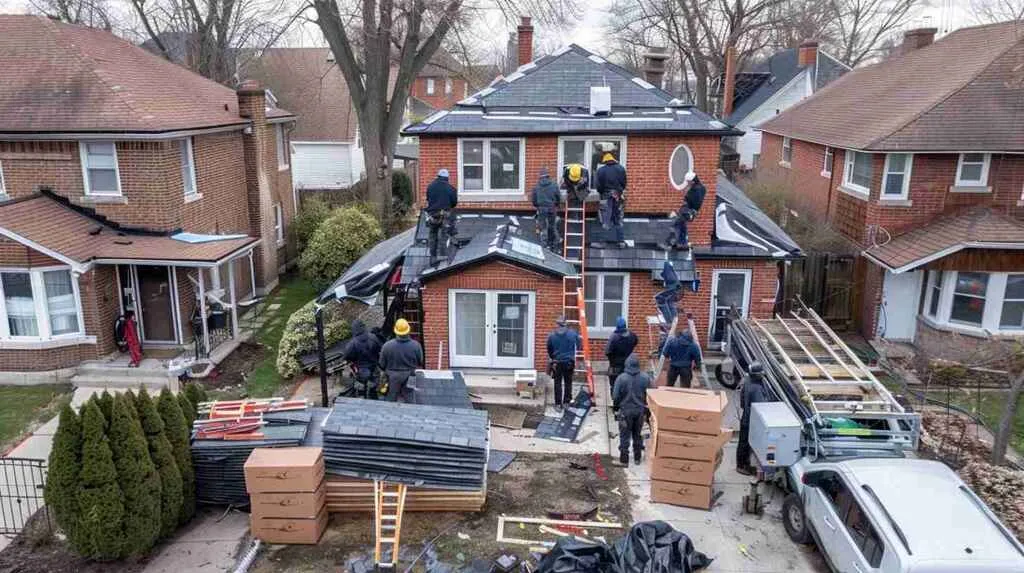
When to Repair Roof Shingles Queens NY – Timing That Matters | Free Quotes
Clockwork – that’s how it goes in Queens: homeowners wait “one more season” on visible shingle damage, and by the time they call, that $450 repair has ballooned into $2,000-$4,000 because water’s been sneaking into the deck and walls. I’m Rafael Dominguez, I’ve spent 19 years on Queens shingle roofs, and I’m going to walk you through exactly which visible signs and weather patterns mean “repair now” versus “you can safely schedule this in a couple months,” using the same straight talk I’d give my own cousins.
Here’s My Blunt Rule About When to Repair Roof Shingles in Queens
On 37th Avenue last fall, I met a homeowner who’d noticed a small wet spot on her bedroom ceiling the previous spring – but only when it rained hard and sideways. She figured she’d wait until she saved up for a full roof replacement, maybe next year. By the time I climbed up in October, three shingles near her wall intersection had curled and cracked open, and the plywood underneath was so soft my boot nearly punched through. What started as a “barely noticeable hiss” – think of a sound system with a tiny bit of distortion you can live with – had turned into blown speakers: rotten decking, soaked insulation, and a repair bill that jumped from around $450 to well over $3,000. That’s the pattern I see every single season in Queens, and it’s why I’m obsessive about timing.
Here’s my blunt rule: if you see missing shingles, curling or cracked edges, or any active leak during normal rain (especially wind-driven rain), you schedule a repair now – this week, not next month. Minor cosmetic wear like slight color fading with zero leaks can sometimes wait a season, but only after a pro checks that your deck and underlayment are still solid. Queens weather is unforgiving: nor’easters hit us sideways, freeze-thaw cycles crack compromised shingles wider, and summer heat cooks south-facing slopes until they blister. Wait too long, and you’re not just fixing shingles anymore – you’re paying for structural repairs, mold remediation, and interior damage that could’ve been avoided with a couple hundred bucks’ worth of attention at the right moment.
🔍 Urgent vs Can-Wait: Queens Shingle Repair Timing
🚨 Fix This Week (Urgent)
- You see shingles on the ground after a Queens windstorm
- Any leak, even “small drips”, during normal or wind-driven rain
- Bare black mat or plywood visible where shingles used to be
- Soft or spongy feeling when you step on the roof (if safely checked)
- Missing or cracked shingles around chimneys, skylights, or walls
⏳ Can Plan Within a Few Months
- Light granule loss but shingles still lying flat and sealed
- Faint discoloration with no active leaks and solid decking
- Older shingles with slight fading but no cracks or curls
- Minor nail pops that haven’t opened visible gaps yet
- A past leak already properly patched and staying dry in storms
What “It Only Leaks When…” Really Means for Your Shingles
When I hear a customer say, “It only leaks when…” my brain immediately goes to the lady I met in Jackson Heights one August afternoon around 3 p.m., sun bouncing off every car hood. She told me, “It only leaks when it rains sideways,” and figured it wasn’t urgent because most storms didn’t hit her house. I climbed up and found three curled, cracked shingles right where her roof met a wall – classic wind-driven rain issue. She’d waited almost a year because “it only happened in storms,” and by the time I got there, the plywood underneath was soft enough that my boot almost went through. That job taught me that phrases like “only when it rains hard” or “only in nor’easters” aren’t signs you can wait – they’re red flags that water is already sneaking under compromised shingles and into your deck. What could’ve been a $450 shingle repair turned into a multi-thousand-dollar deck replacement, plus interior ceiling repairs and paint.
Here’s the thing: one cold February night, about 10:30 p.m., a landlord in Flushing begged me to come out because water was dripping on his tenant’s baby’s crib. I showed up with a headlamp, snow flurries blowing sideways, and found that a few shingles had blown off weeks earlier during a windstorm – he’d seen them in the yard and never called anyone. The missing shingles exposed the felt, the felt tore in the freeze-thaw cycles, and water followed a plumbing vent straight into the nursery. That emergency call convinced me to always tell people: if you see shingles on the ground in Queens, you’re on a clock, not a maybe. Queens windstorms love to rip shingles off around vent pipes, parapet transitions, and anywhere your roof changes direction or meets a wall. Our building styles – lots of flat-ish transitions, older homes with multiple roof planes – create natural weak spots, and when shingles lift or crack at those points, wind-driven rain finds its way in fast.
Why “Occasional Leaks” Are a Big Red Flag in Queens
Leaks that only appear in sideways rain, heavy nor’easters, or snow-plus-wind usually mean water is already sneaking under lifted or cracked shingles and into the roof deck and walls. The “occasional” part doesn’t mean it’s minor – it means the damage is already happening, just not visible yet from inside. Waiting on these situations routinely converts $400-700 shingle repairs into $2,000-5,000 structural and interior repairs, because every storm cycle pushes more water deeper into your roof assembly.
🔀 Do You Need a Shingle Repair Right Now?
Q: Do you see water inside during any rain? → Yes → Call for repair this week.
If No → Q: Do you see shingles on the ground or obviously missing? → Yes → Schedule inspection and repair within days.
If No → Q: Does it leak only in heavy sideways rain or snow + wind? → Yes → High risk for hidden damage; get inspection within a week.
If No → Q: Are shingles flat with only mild color fading? → Yes → Likely can wait, but book routine inspection within 3-6 months.
Any “I’m not sure” answer → Get a pro on the roof before next storm cycle.
If We Were in Your Driveway: What I’d Point Out on Your Shingles
If we were standing in your driveway right now, I’d point your eyes to a few specific things you can see from the ground or a safe ladder: missing shingles (obvious gaps or bare black felt showing), curling edges (shingles that look like they’re peeling up at the corners or sides), color changes or shiny bald spots (that’s granule loss, and it means the asphalt’s getting cooked by UV), and any sagging or wavy sections (that’s your deck starting to fail underneath). One Sunday morning in late May, I was supposed to be at a family barbecue when a long-time customer in Bayside texted me photos of some “weird bumps” on his south-facing slope. It was bright and dry, and he felt silly bothering me because “it’s not leaking.” I went over anyway, climbed up, and found that the shingles were blistering and losing granules fast – his attic fan had failed, and the heat was cooking the asphalt from underneath. We patched a few spots and scheduled a timely repair instead of waiting for a full tear-off, and that situation is why I now tell people: the best time to repair roof shingles is when things just start looking off, not when your bucket collection comes out.
Think about your roof like a speaker cabinet: the underlayment is your bass, the shingles are your treble, and the flashing and seals are like the crossover that keeps everything balanced. When you get blistering or granule loss, it’s like hearing hiss in your tweeters – tolerable at first, but if you don’t correct it, that hiss becomes distortion, then crackle, then blown speakers (which in roof terms means leaks, rot, and interior damage). In Queens, I always tell customers to scan south- and west-facing slopes first, because sun and summer heat cook those shingles faster than north or east. And here’s an insider tip: check around attic fans and ridge vents, because when ventilation fails, you’re baking your shingles from underneath, and that’s what causes the premature curling and blistering that turns a 25-year shingle into a 12-year shingle.
✅ Visual Signs Your Queens Shingles Need Attention
-
✅
Shingles on the ground after wind or storms – this means you’re already losing protection and water is finding paths in -
✅
Curling or cupping edges – shingles that look like they’re peeling up or folding inward, especially on south and west slopes -
✅
Bald, shiny spots or granule piles in gutters – that’s the protective coating washing away, leaving bare asphalt exposed -
✅
Cracked or split shingles – visible lines or breaks running through the shingle surface, often near nails or seams -
✅
Blistering or bubbling texture – weird bumps that look like air pockets under the shingle surface -
✅
Dark streaks or stains on ceilings inside, or water marks on attic rafters – leak evidence you can’t ignore -
✅
Sagging or wavy roof lines when you look up from the street – that’s deck failure starting, and it’s urgent
Think About Your Roof Like a Sound System: How Delay Distorts Everything
Think about your roof like a speaker cabinet: your underlayment is the bass foundation, your shingles are the treble protection on top, and the flashing and seals are the crossover that keeps everything balanced and working together. A small timing issue – say, one lifted shingle or a tiny crack – is like a barely noticeable hiss coming through your tweeters. You can live with it for a bit, but if you don’t correct it early, that hiss becomes distortion, then crackle, then blown speakers, and in roof terms that means major leaks, rotten decking, interior stains, and mold. Here’s the signal chain of damage I see all over Queens: shingle gets nicked, cracked, or lifted in a windstorm → next wind-driven rain pushes water under that shingle and onto the underlayment → underlayment tears or degrades from repeated exposure → water soaks into the plywood deck → deck softens and starts to sag → water finally shows up as a stain on your ceiling or running down your wall, and by that point you’re not fixing shingles anymore, you’re replacing structure. My personal opinion? Fixing the hiss early – that small shingle repair – is always cheaper and cleaner than waiting until you need to replace the speakers, because once your roof deck is compromised, you’re looking at a job that’s 5-10 times the cost of the original repair.
Before You Call Shingle Masters: Quick Self-Check and Answers
$400 today or $4,000 next year – that’s the kind of timing gap I see all over Queens when homeowners delay obvious shingle issues. Have you already seen shingles on the ground, noticed water inside, or spotted curling edges when you look up at your roof?
📋 2-Minute Shingle Timing Checklist (Before You Call)
Walk through this quick list so when you call Shingle Masters, Rafael can give you a sharper recommendation right over the phone:
❓ Timing & Repair Questions About Shingle Roofs in Queens, NY
Can I wait a season if I only see minor shingle damage?
It depends on what “minor” really means. If you have slight color fading but shingles are flat, sealed, and you have no leaks, you can often wait a few months – but you should get a pro inspection to confirm your deck and underlayment are solid. If “minor” means a couple curled edges or small cracks, don’t wait a season – those turn into major issues fast in Queens weather, especially through freeze-thaw cycles and summer heat. I’ve seen too many $400 repairs become $3,000 jobs because someone waited “just one more winter.”
Is winter okay for shingle repairs in Queens, NY?
Yes, many shingle repairs can be done safely in cold weather as long as it’s dry and temperatures are above freezing during application. The adhesive strips on shingles seal better in warmer weather, so we sometimes use hand-sealing or roofing cement for winter repairs to make sure everything bonds properly. The bigger risk isn’t the repair itself – it’s waiting through an entire winter and letting water damage compound with every storm. If you have active leaks or missing shingles, getting them fixed in December is way smarter than waiting until April.
How fast can you come out for an active leak?
For active leaks in Queens, we prioritize same-day or next-day response whenever possible, depending on weather and our schedule. I keep emergency slots open because I’ve been on the receiving end of those late-night calls where water’s dripping on a kid’s bed or ruining someone’s ceiling. When you call, tell us it’s an active leak and describe what you’re seeing – that helps me triage and get someone to you fast. Even if we can’t do the full repair immediately, we’ll get a tarp or temporary patch in place to stop the bleeding while we schedule the proper fix.
Will a repair match my old shingles?
We do our best to match color and style, but honestly, if your roof is more than 5-10 years old, new shingles will look a bit brighter because your existing ones have weathered and lost some granules. On most Queens homes, once the new shingles weather for a season or two, the difference fades and blends in pretty well. If you’re really concerned about appearance and the repair is on a highly visible slope, we can sometimes blend by mixing in a few of your original shingles (if we have extras) or choosing a close color match that weathers similarly. Function always comes first, but we care about how your roof looks too.
How do I know if I need a full replacement instead of just repairs?
If your shingles are nearing the end of their rated life (usually 20-30 years depending on the product), showing widespread curling or granule loss across multiple slopes, or if the deck underneath is compromised in several areas, a full replacement often makes more financial sense than patching. I’ll tell you straight up during the inspection: if repairs will only buy you a year or two before you need a new roof anyway, it’s better to plan for replacement. But if damage is localized – say, one slope or a section around a chimney – and the rest of your roof is solid, targeted repairs are absolutely the right call and can add years to your roof’s life.
🏆 Why Queens Homeowners Call Shingle Masters for Timing-Sensitive Repairs
Here’s the bottom line: catching shingle issues at the “hiss” stage – when you first see granule loss, a curled edge, or a shingle on the ground – is what keeps Queens roofs affordable and functional for the long haul. Wait until you’re hearing blown speakers (major leaks, rotten decking, interior stains), and you’re looking at repair bills that are 5 to 10 times higher. Shingle Masters offers free, local on-site quotes all over Queens, NY, and we prioritize timing-sensitive repairs because I’ve seen too many good roofs destroyed by “I’ll get to it next season.” If you’ve noticed any of the urgent signs we covered – missing shingles, active leaks, curling edges, or anything that leaks “only when it rains sideways” – call or message us now and let’s get eyes on your roof before the next storm makes the decision for you.