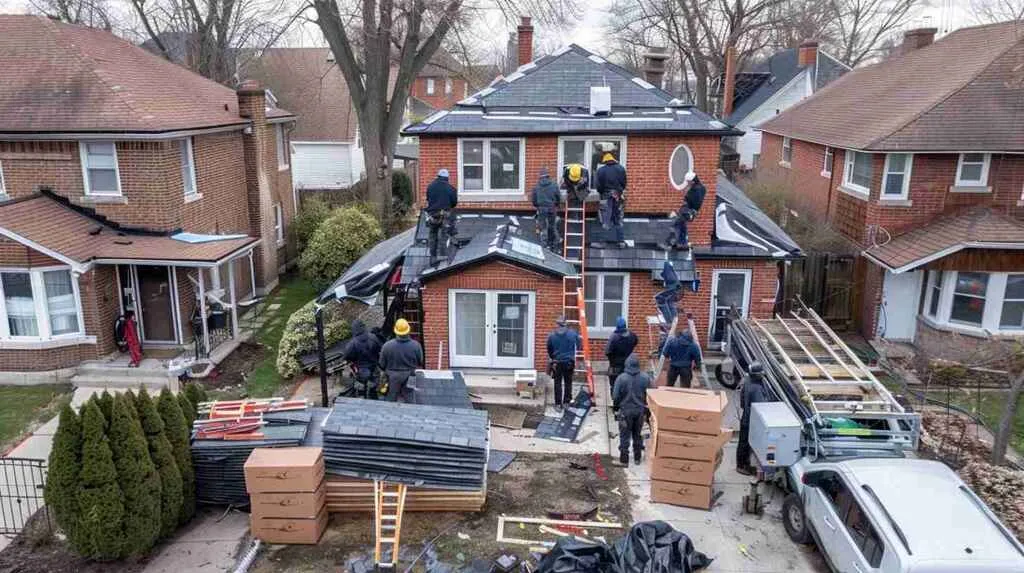
Repair a Section of Roof Shingles Queens NY – The Right Method | Call Today
Blueprint first: the biggest mistake people make when they’re trying to figure out how to repair a section of roof shingles is cutting into the visible damage before checking what’s underneath. In Queens, NY, you always start by exposing and inspecting the underlayment and nail pattern-kind of like checking the backing track before you remix a song.
Start With What’s Under the Shingles, Not What You See on Top
Let me be blunt: if you’re trying to repair a section of roof shingles without seeing the underlayment, you’re not fixing a leak, you’re decorating it. The underlayment is like the backing track to your roof-the shingles are just the melody on top. If the backing track is torn, wrinkled, or soaked through, slapping a fresh shingle over it won’t keep water out after the next storm. I’ve seen too many Queens homeowners lift off a cracked shingle and find nothing but a mess of old felt and exposed nail holes underneath, wondering why their “fix” leaked again two weeks later.
One August evening around 7:30 PM, right after a thunderstorm, I got a call from a music teacher in Forest Hills who tried to replace “just a few shingles” on her colonial by watching a 5‑minute video. She overlapped them backwards so the wind could peel them like Post‑it notes; when I got there, you could literally see daylight at the roof edge. That’s what happens when you don’t understand the rhythm of how shingles layer-each course locks the one below it, and if you stack them out of order, the whole system falls apart. In Queens, where we get wind straight off the East River and those summer storms that dump three inches in an hour, backwards or loose shingles turn into blown-off shingles fast. The lesson: before you touch a shingle, you need to know what’s holding it and what it’s protecting.
Can you safely repair this section of roof shingles yourself?
Start: Is the damaged area smaller than about 6 shingles in a row?
- Yes → Is the roof pitch low enough that you can stand safely with a harness (no steeper than a typical Queens row house, about 4/12 to 6/12)?
- Yes → Can you see intact, flat underlayment with no soft spots when you gently press the area from the attic or ceiling below?
- • Yes → DIY sectional shingle repair might be reasonable if you follow each step exactly.
- • No → Call a Queens roofing pro like Shingle Masters for inspection before touching the shingles.
- No → The damage is more like a re-shingle of a larger field. Stop and call a pro; this is now beyond a simple section repair.
Final note: If you see daylight, multiple cracked shingles around the area, or sagging wood, skip DIY and schedule a repair.
⚠️ Why surface-only shingle swaps fail in Queens weather
- Cutting out a shingle without checking the underlayment lets hidden nail holes and wrinkles turn into leaks after the next storm.
- Queens wind can blow straight in off the water; if your replacement shingle isn’t nailed and sealed in the same pattern as the original, the whole repaired section can lift.
- Ripping shingles without lifting the tabs correctly can tear the self-seal strips on the surrounding shingles, creating a bigger repair area than you started with.
Step-by-Step: How to Repair a Small Section of Roof Shingles the Right Way
Here’s the thing about shingle repairs in Queens-your roof is like a layered remix, and every layer has to be on beat or the whole track sounds wrong. When we’re repairing one section, we’re not just swapping out damaged pieces; we’re making sure the new shingles tie into the existing underlayment, nail pattern, and seal strips so everything moves together when the wind hits. An insider tip: only tackle this work when shingles are warm enough to flex a bit-early afternoon on a mild day is ideal. If it’s too hot, the seal strips can tear when you lift tabs; if it’s too cold, shingles snap like crackers. Check the forecast and aim for temperatures between about 50°F and 80°F if you’re doing this yourself.
One cold January morning, about 9 AM, I was up in Astoria on a three‑family house where a handyman had “repaired” a blown-off section by nailing new shingles straight through ice. After the first thaw, water tracked along those nail holes and soaked the third‑floor bedroom ceiling. I remember my fingers going numb as I warmed the shingles with a heat gun so they’d seal properly, thinking how many people think winter patch jobs are quick fixes when they’re actually some of the most delicate repairs we do. In Queens, where we get freeze-thaw cycles that can crack everything from sidewalks to seal strips, temperature and proper sealing matter. You’re not just nailing down a piece of asphalt-you’re making sure that piece bonds and sheds water the same way the rest of the roof does.
When I’m up on a typical Queens row house roof, I isolate the damaged area first, then gently reveal the nails holding both the damaged shingle and the courses around it. I protect the surrounding shingles by lifting tabs slowly-no yanking-and once I’ve got the old piece out, I check the underlayment and deck before the new shingle even comes out of the bundle. At roof edges and where sections meet valleys or walls, this gets more delicate because you’re working with step flashing and starter strips. That’s why a lot of sectional repairs that look simple from the street turn into precision work once you’re actually up there with a flat bar in your hand.
Correct sequence to repair a small shingle section
- Confirm it’s truly a small section – From the ground, then up close (if safe), map the damaged zone: usually 3-6 shingles wide and not near a major transition like a chimney or valley.
- Expose the nail pattern – Gently lift the tabs of the shingle row above with a flat bar, feeling for the nails that hold both the damaged shingle and the one below. Do not yank; break the seal strip slowly.
- Remove nails in rhythm – Starting from one side, slide the bar under the nail heads and pop them in order so you’re not twisting the shingle like a warped record. Remove all nails holding the damaged piece before trying to slide it out.
- Inspect the underlayment backing track – With the shingle out, check the felt or synthetic underlayment for tears, wrinkles, or nail holes where water could travel. If it’s cut or bunched up, patch with compatible underlayment before proceeding.
- Check the deck for soft spots – Press on the exposed wood; if it flexes or crumbles, the deck section needs to be cut out and replaced by a pro, not just covered with a new shingle.
- Slide in the replacement shingle – Match the size, exposure line, and brand style as closely as possible. Align the new shingle so the butt line sits perfectly in line with the existing course.
- Re-nail and re-seal on beat – Nail in the manufacturer’s zone, following the same horizontal line as the existing shingles. Add a small dab (not a smear) of roofing cement under lifted tabs if temperatures are low so the strip can re-bond.
| Tool / Material | Why It Matters | Queens-Specific Note |
|---|---|---|
| Roofing flat bar | Slides under shingle tabs to lift seals and pop nails without tearing surrounding shingles. | Narrow bars work better on tight row house roofs with limited workspace. |
| Roofing nails (galvanized) | Prevents rust and pull-through, keeps the repaired section anchored in high winds. | Sea air and winter salt spray near Queens Blvd and the bridges demand galvanized or better. |
| Matching asphalt shingles | Ensures correct exposure and seal-strip alignment so water sheds properly. | Common in Queens: architectural shingles in grays and browns; bring a sample to the supplier. |
| Roofing cement (small can) | Helps re-bond tabs disturbed during repair in cooler temps or on older roofs. | Use sparingly; too much turns into a dirt magnet in Queens soot and pollution. |
| Fall protection (harness/rope) | Prevents serious injury on sloped roofs. | Mandatory on taller multi-family buildings common in Astoria, Jackson Heights, and Corona. |
When a “Cheap Patch” Becomes an Expensive Queens Roof Problem
$1,200 later, that “cheap” tar smear on a Jackson Heights roof turned into a full section rebuild. In late May, during the first heat wave of the year, I was working on a brick row house where a landlord wanted “the cheapest way” to fix a missing shingle section over a tenant’s kitchen. Another roofer had just smeared black mastic over the gap and called it a day. At 2 PM, in direct sun, that tar was literally bubbling like pizza cheese, and water had already crept underneath and rotted the decking-I had to cut out and replace the damaged wood, re‑shingle the section properly, and I told the landlord, “You paid once for a band‑aid and now you’re paying twice for surgery.” Trying to repair a roof shingle section with mastic-only or sloppy patching is like dropping a noisy sample into a clean track-everything around it eventually goes off. And in dense Queens housing, leaks often show up in tenants’ kitchens and bedrooms, so bad patches cost you twice: once for the repair, and again for the interior damage and unhappy tenant calls.
| Approach | Pros | Cons |
|---|---|---|
| DIY smear of roof cement over cracked shingles | Fast, cheap in the moment, no special tools. | Cracks again in Queens heat and freeze-thaw; traps water; hides deck damage; usually voids shingle warranty. |
| DIY careful sectional shingle replacement | Can work for very small, simple areas if done correctly; saves some labor cost. | Risk of tearing surrounding tabs, misnailing, and missing underlayment damage; no labor warranty. |
| Pro sectional repair (Shingle Masters) | Underlayment and deck inspected; shingles tied into existing pattern; work guaranteed; looks seamless from the street. | Higher upfront cost; requires scheduling and roof access. |
Typical Queens sectional shingle repair scenarios and cost ranges
| Scenario | Description | Estimated Range* |
|---|---|---|
| Small patch (3-5 shingles) | Easy access, no deck damage, single-story portion of a row house. | $350-$600 |
| Medium section (up to 1 bundle) | Damaged area around 10-20 shingles, minor underlayment repair. | $650-$1,100 |
| Section with deck repair | Rotten plywood under a failed patch that needs cut-out and replacement. | $1,000-$1,800 |
| Multi-family access or steep pitch | Three-family or steeper roof needing extra safety setup and labor. | $1,200-$2,500 |
*These are typical Queens, NY ranges, not formal quotes. Final price depends on access, height, material match, and hidden damage.
Before You Call a Queens Roofer About Your Shingle Section
When I walk a customer through a repair, I always ask them one question first: are you trying to buy time, or are you trying to solve the problem? In Queens, most of the housing stock is row houses in Jackson Heights, colonials in Forest Hills, and three-families in Ridgewood-buildings that are often 60 to 100 years old with multiple roof layers, tight access between properties, and sometimes questionable past repair work. That’s why when you call a roofer about a sectional shingle repair, we’ll ask about the building type, the height, and whether you’ve had previous patches in the same spot. It’s not curiosity-it’s because a repair that would take two hours on a single-story ranch can turn into a four-hour job on a steep three-family with no backyard access and three layers of old shingles underneath.
Worth noting before you dial: if your leak shows up only after heavy wind-driven rain or after a freeze-thaw cycle, tell us that right away. That pattern tells us where water is traveling under the shingles and helps us narrow down whether the damage is really just where you see it or if it’s tracking from somewhere higher up the roof. Think of it like describing when a song skips-if it skips on the same beat every time, we know exactly which track is damaged; if it skips randomly, the problem’s probably deeper in the system. Get the roof and the story of the leak in rhythm before you call, and the whole repair goes smoother.
What to note before calling Shingle Masters for a sectional shingle repair
- ✅ How many shingles look visibly damaged, curled, or missing in the section.
- ✅ Whether the leak shows up after hard rain, wind-driven rain, or freeze-thaw cycles.
- ✅ The age of your roof (or best guess) and if you know of any previous patches in that area.
- ✅ Photos from the ground and, if safe, from a window looking toward the damaged section.
- ✅ Any interior damage locations (ceiling stains, bubbling paint, plaster cracks) and which room they’re in.
- ✅ Building type and height (row house, detached, multi-family; number of stories).
- ✅ Best ladder access point (backyard, alley, front) so we can plan the safest setup.
Urgent – Call Shingle Masters ASAP
- Active dripping or ceiling sagging under the damaged shingle section.
- Multiple shingles missing in a cluster, especially near a ridge, vent, or chimney.
- You see daylight from the attic or top floor near the leak.
- Previous tar patch or mastic is cracked, bubbling, or peeling.
Can Wait a Short Time (Schedule Soon)
- One or two cracked or curled shingles with no interior leak yet.
- Small stain that hasn’t grown after the last few storms.
- Granule loss and light wear in a section you want inspected before it turns into a leak.
Why Queens homeowners call Shingle Masters for sectional shingle repairs
- Licensed and insured in New York City for residential and multi-family roofing.
- 19+ years repairing and blending shingle sections on Queens row houses, colonials, and three-families.
- Typical response time: same day for active leaks, 24-48 hours for non-emergency inspections.
- Workmanship warranty on sectional repairs, with photos of the process available on request.
Straight Answers About Shingle Section Repairs in Queens
A sectional repair has to blend into the whole roof like adding a new track to a playlist, not a jarring skip. On a typical Queens row house roof, nailing and sealing in rhythm with the existing pattern is what prevents callbacks-you want the repair to disappear into the original work so perfectly that even from the street, nobody can tell where the damage was. Below are the questions I get asked most often, answered straight.
Can I just replace the visibly damaged shingles and ignore the rest?
No. You need to verify the underlayment and deck beneath the damaged section are sound first. If the backing track (underlayment) is torn or the wood is soft, a simple shingle swap won’t stop leaks for long.
How do I match new shingles to my older Queens roof?
Bring a loose shingle or a clear photo to a supplier so they can match the style, color, and exposure. A good match keeps the repair from looking like a bad remix and helps the seal strips line up properly.
Is it okay to do a sectional repair in winter?
Yes, but it’s tricky. Shingles are stiff in the cold and seal strips may not bond without help. Pros in Queens often warm tabs and use a bit of roofing cement so the section doesn’t lift after the first thaw.
How long should a proper sectional shingle repair last?
If the roof is otherwise in good shape and the repair follows the nail pattern and underlayment correctly, that section should last close to the remaining life of the roof.
Will a sectional repair be obvious from the street?
Done right, it should blend in so most people don’t notice it. On many Queens row houses I work on, the goal is to make the new section disappear into the existing pattern like a clean edit in a song.
| Myth | Fact |
|---|---|
| “If I can’t see daylight, the section isn’t really leaking.” | Water can travel along underlayment and nail lines for several feet before showing up inside, especially on low-slope Queens roofs. |
| “More roof cement means a better fix.” | Excess cement cracks, traps water, and makes future repairs harder. A proper shingle replacement uses minimal cement and correct nailing. |
| “All shingle repairs are basically the same.” | Repairs near eaves, ridges, vents, or walls in Queens require different detailing and often step flashing work, not just shingle swaps. |
| “Any handyman can handle a small shingle section.” | Incorrect nail placement, skipped underlayment repairs, or working over ice can cause more damage than the original problem. |
A shingle section repair has to stay in rhythm with the rest of the roof or the next Queens storm will expose every shortcut. Call Shingle Masters to have Los inspect, tune, and repair that section properly so it looks and performs like it was always part of the original roof.