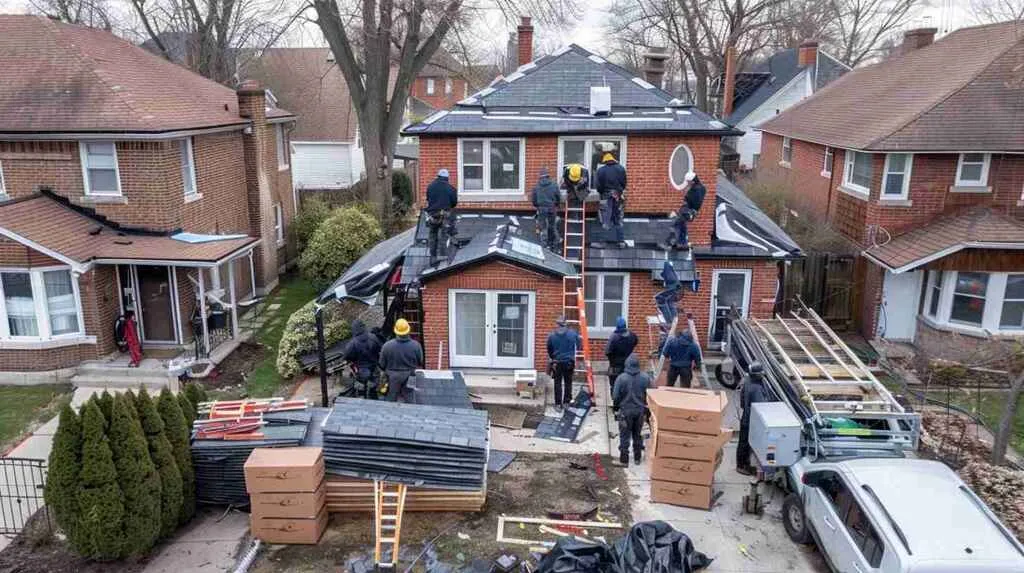
Repair a Leaking Asphalt Roof Queens NY – The Real Solution | Free Quotes
Traffic on your roof doesn’t follow the rules you’d expect. The wet spot on your ceiling? Almost never directly under the leak-water takes detours, sneaks upslope, and drips wherever gravity finally pulls it through. The first real step in repairing a leaking asphalt roof in Queens is to find where water *enters*, not where it shows up inside, and that means looking upslope at intersections like chimneys, vents, and valleys where your roof’s traffic problem actually starts.
Traffic on Your Roof: Why the Wet Spot Isn’t Where the Leak Starts
On a typical Queens two‑family with an asphalt shingle roof, the first place I look for a leak isn’t where you’d expect at all-it’s upslope from the stain, around the intersections where one surface meets another. Chimneys, vent pipes, dormers, and valleys are the “off-ramps” where water changes direction, and that’s almost always where the real leak begins. The stain you’re staring at is just the end of the line, the final drip after water’s traveled a few feet horizontally under shingles, over underlayment, and along rafters.
One January morning around 6:30 a.m., I got called to a semi‑attached in Jackson Heights where water was dripping right onto a family’s baby crib. It hadn’t even started raining hard yet, just that icy drizzle we get before a storm, but the ceiling was already stained. Three different handymen had smeared roof cement around the chimney over the past two years; when I opened things up, the real culprit was a cracked shingle course and a misaligned flashing joint two feet *up-slope* from the chimney. The leak was a traffic problem-water took an off-ramp at that flashing, traveled under the shingles like a side street, and popped out exactly where the family saw it. My honest take: guessing based on stains alone wastes time and money, and tracing the water’s actual path upslope is the only thing that stops the drip for good.
Is Your Asphalt Roof Leak Just a Stain or an Active Water Entry Problem?
Start: Do you only see an old, dry-looking stain on the ceiling?
If YES: → Check the attic or top floor after the next steady rain.
• If insulation is dry and there’s no musty smell → Likely an old leak; schedule a non-urgent inspection.
• If insulation feels damp or you see darkened wood → Active leak; treat as urgent.
If NO (you see fresh dripping, bubbling paint, or spreading stain): → Active leak right now.
• Put a bucket/towel under the drip.
• Turn off power to any nearby light fixtures.
• Call a Queens asphalt roofing pro for same- or next-day visit.
Bonus Check: If the leak only shows during wind-driven rain from one direction, the entry point is usually on that windward side, often around flashing or a roof-wall intersection.
⚠️ Warning: Chasing the stain instead of the water path is the #1 reason Queens asphalt roofs keep leaking after a “repair.” Water often enters 2-10 feet upslope from where you see it inside, especially around chimneys, dormers, and valleys. Patching the wrong spot with roof cement can trap water, rot the decking, and void manufacturer warranties.
How I Actually Diagnose a Leaking Asphalt Roof in Queens
When I first walk into a house, the question I ask is, “Where did you *first* see the stain, and what was the weather doing that day?” That tells me if we’re dealing with a straight-down rain issue, wind-driven water, ice dam backup, or a long-term seep that only shows up during heavy downpours. Queens homes-especially two-families and side-by-side semis-have these flat-to-slope transitions, patched dormers, and rear extensions where water gets confused and backs up. Knowing the weather pattern helps me narrow down which “intersection” on your roof is causing the traffic jam.
Now, follow the water with me. I start at the ridge and work downslope, checking shingles for cracks, curls, and missing tabs, then zeroing in on every penetration-vents, pipes, skylights-and how the flashing sits against them. Valleys get special attention because that’s where two slopes dump water into one channel, and if the metal’s rusted or the shingles are improperly woven, you’ve got a highway pileup. I’m looking for the building-code stuff without getting preachy: proper overlaps, ice-and-water shield in the right spots, nails driven flush but not overdriven. One July afternoon in Richmond Hill, it was 95°F with that frying‑pan humidity, and I was on a two‑family asphalt roof that had been “repaired” by someone who clearly watched one YouTube video at 1.5x speed. They’d layered shingles over rotten sheathing and used clear silicone caulk on an active leak around a bathroom vent. When the homeowner’s cousin suggested we “just add more caulk,” I peeled back one shingle and a stream of hot water literally poured out like a faucet from the soaked decking. Covering a leak is not repairing it-you have to open the system, replace what’s damaged, and route the water correctly.
Here’s an insider tip I use all the time: if the leak source isn’t obvious from visual inspection, I bring a garden hose and work in controlled sections, starting low on the roof and moving upslope until the drip reproduces inside. While I’m up there, I sketch a quick “roof map” on a piece of cardboard or an old pizza box, drawing where water enters, where it travels under the shingles, and where it finally exits into your house. That cardboard diagram shows you exactly what I’m opening up and why, and it makes the whole repair make sense instead of just trusting me to “fix it.” Queens-specific quirks pop up constantly-older homes with three layers of asphalt, patched dormers that were never flashed right, and pre-war buildings where water reappears in weird spots because the framing was done before modern codes. The traffic metaphor holds: water will always find the easiest detour, and my job is to close that detour and give it a proper exit off your roof.
Ray’s Step-by-Step Asphalt Leak Diagnosis on a Typical Queens Roof
- Inside check: Note stain location, size, and direction it’s spreading; ask when it first appeared and what the weather was like.
- Attic/top-floor check: Look for wet decking, mold, compressed or stained insulation, and rusty nails (nail pops).
- Exterior scan: From the street and then from the ladder, spot missing, curled, or cracked shingles, especially upslope from the stain.
- Flashing focus: Inspect around chimneys, vent pipes, skylights, roof-to-wall edges, and sidewall step flashing for gaps, rust, or bad sealant.
- Valleys and transitions: Check where two roofs meet, or where a sloped shingle roof dies into a wall or flat roof-common leak “intersections” in Queens.
- Targeted water test (if needed): Use a hose in short, controlled sections, starting low and moving upslope until the leak reproduces inside.
- “Roof map” explanation: Sketch the water path and recommended repair on cardboard so you can see exactly what’s getting opened and replaced.
| Where You See the Problem | Typical Real Leak Source on an Asphalt Roof |
|---|---|
| Stain near a bedroom ceiling light | Nail pops or cracked shingles upslope, or a failed boot around a vent pipe |
| Water over the kitchen cabinets on an outside wall | Missing or improperly installed step flashing where roof meets siding or brick |
| Drip in the middle of the living room during wind-driven rain | Lifted shingles along windward eave or ridge, or loose ridge cap shingles |
| Peeling paint around a bathroom exhaust fan | Improperly sealed vent flashing or missing storm collar on the exhaust pipe |
| Water line along a ceiling crack near a shared party wall | Old failed flashing or counterflashing at the parapet/party wall intersection |
Real Repairs: Fixing the Asphalt Roof, Not Just Hiding the Leak
Here’s my honest take: if your “repair” plan starts with a tube of roof cement, you’re already going down the wrong road. The blunt truth is, most leaking asphalt roofs in Queens don’t fail because they’re old-they fail because somebody rushed or skipped a step years ago. Maybe the flashing was never installed correctly, or the underlayment stopped six inches short of where it should’ve gone, or shingles got nailed through the tabs instead of the nail line. A real repair means opening up the system: lifting shingles around the problem area, pulling out any rotten plywood or boards, correcting or replacing the flashing with proper materials, and putting down new underlayment or ice-and-water shield where the code actually requires it. Then you re-shingle and seal it right. Anything less is just hiding the leak for a few months.
One windy, cold night in November, close to midnight, I did an emergency tarp job for an older couple in Bayside who had water coming in over their stove. The husband kept pointing at the skylight, swearing it was “junk,” but once I got up there with a headlamp, the skylight was perfectly fine-the real problem was a tiny valley where two asphalt roof sections met above it, with a shoddy patch made of aluminum coil and duct tape. I had to explain, in their kitchen with wet footprints on the floor, that the leak was a “traffic problem,” not a “window problem”-the water was just choosing the easiest path. Think of your roof like Queens Boulevard at rush hour: water, like traffic, will always find the quickest way around an obstacle, and patching the obvious spot won’t stop the flow if the real bottleneck is somewhere else. My job is to re-route that traffic with correct detailing-proper valley metal, overlapped shingles, and flashing that actually directs water *off* the roof instead of under it.
What a Proper Asphalt Roof Leak Repair in Queens Should Include
✅ Removal of damaged or lifted shingles around the leak area
✅ Replacement of any rotten or water-damaged decking/sheathing
✅ Installation or correction of step, counter, or base flashing per current code
✅ New underlayment or ice-and-water shield in vulnerable areas
❌ Surface sealant or roof cement as the only “fix”
❌ Patching over wet or moldy decking without drying/replacing it
❌ Reusing rusted or bent flashing just to save a few dollars
❌ Nailing shingles in the wrong zone or overdriving fasteners
| Temporary Patch (short-term) | Full Repair (long-term) |
|---|---|
| Lower upfront cost, usually same-day | Higher upfront cost but protects structure |
| May slow or stop water briefly | Removes damaged shingles, underlayment, and rotten wood |
| Useful in emergency storms or at night | Resets or replaces flashing to current standards |
| Often uses surface sealants that break down in sun/ice | Preserves or restores warranty potential where possible |
| Does not address rotten decking or hidden damage | Reduces risk of mold and repeated interior damage |
| Can give false sense of security and delay real repair | Usually comes with a written workmanship guarantee |
What It Might Cost to Repair Your Leaking Asphalt Roof in Queens
$450 might cover a small shingle-and-flashing repair around one vent; $2,500+ is where we’re talking about major leak zones or partial re-decks where the water’s been running for months and rotted through the wood. Cost depends on access-getting materials up to a three-story walk-up in Flushing is different than a one-family ranch in Bayside-and on how long the leak has been active, because long-term leaks mean more damaged decking and insulation. If your roof still has two or three layers of old shingles, code usually requires we strip down to the deck before any real repair, and that adds labor and disposal fees. Emergency calls during storms or late at night can carry a premium, but stopping active water before it wrecks ceilings and walls is almost always cheaper than fixing both the roof *and* the interior damage later. These are typical Queens ballpark figures for asphalt leak repairs; your exact price depends on what I find when I open things up.
Typical Queens Asphalt Leak Repair Scenarios and Price Ranges
| Scenario | Typical Work Involved | Approx. Price Range (Queens, NY) |
|---|---|---|
| Small shingle patch around one vent or pipe | Replace 4-12 shingles, reset/replace vent flashing, seal and nail to code | $350-$650 |
| Chimney flashing leak on a two-family | Remove siding or counterflashing as needed, install new step & counterflashing, replace surrounding shingles | $750-$1,500 |
| Valley leak with rotten decking | Open valley, replace rotten plywood, install new underlayment/ice shield, new metal valley and shingles | $1,200-$2,400 |
| Wall-to-roof transition leak on semi-attached | Strip small section, replace step flashing, repair any damaged sheathing, integrate with siding or brick | $900-$1,900 |
| Multiple active leak points on an aging asphalt roof | Several localized tear-offs, wood repairs, flashing upgrades; evaluate need for near-future replacement | $1,800-$3,500+ |
When Your Leaking Asphalt Roof in Queens Needs an Emergency Visit vs a Scheduled Repair
| Urgent – Call Now | Can Usually Wait a Few Days |
|---|---|
| Active dripping during a storm over electrical fixtures or the breaker panel | Old, dry stains that haven’t grown in the last few rains |
| Water coming in over a crib, bed, or main cooking area | Minor staining near an outside wall with no visible dripping |
| Ceiling sagging, bubbling, or feeling soft to the touch | Occasional drip only in extreme, sideways wind-driven rain |
| Multiple rooms showing new wet spots at the same time | Small nail pops in the attic with no visible rot |
Before You Call a Queens Roofer: Quick Checks and Common Questions
I still remember a Saturday in Corona where a homeowner swore the leak was from “cheap shingles” when the real villain was a missing kick-out flashing-a tiny piece of metal that costs maybe eight dollars but would’ve kept 200 gallons of water from running down inside his wall every time it rained. Product is rarely the villain; installation details and skipped parts are. I’m not there to scare you into a new roof when your asphalt shingles still have years left-I’m there to stop the traffic problem and protect your home. My style is calm, kitchen-table explanations, and a little prep before you call speeds everything up: knowing when the leak started, what the weather was doing, and having a few photos ready means I can often give you a ballpark diagnosis over the phone and schedule the right kind of visit.
What to Note Before Calling Shingle Masters About Your Leaking Asphalt Roof
- ✅ Write down when you first noticed the stain or drip and what the weather was doing (steady rain, heavy wind, melting snow).
- ✅ Take 2-3 clear photos of the stain indoors and, if safe, 2-3 photos of the roof area outside.
- ✅ Check if the leak lines up with a bathroom, kitchen, or chimney below the roof.
- ✅ Note if your home is semi-attached, attached rowhouse, or fully detached (helps anticipate wall and flashing details).
- ✅ If you can access the attic safely, quickly look for darkened wood, wet insulation, or visible daylight.
- ✅ Turn off power to any light fixture that’s directly leaking until a pro checks it.
- ✅ Make a list of any past “repairs”-who did them, what they did (tar, caulk, new shingles), and roughly when.
Common Questions About Repairing Leaking Asphalt Roofs in Queens, NY
Can you really just repair my asphalt roof, or will you push a full replacement?
Most of the time, I can isolate and repair a specific leak area without replacing the whole roof, especially if the shingles still have life left. I’ll show you photos and explain honestly if a localized fix is smart or if the roof has earned a bigger conversation.
How fast can you get to my place in Queens for an active leak?
For active leaks with dripping or ceiling damage, I aim for same-day or next-day service within Queens, weather and safety permitting. In heavy citywide storms, I can often at least get an emergency tarp or temporary control in place until we do the full repair.
Will a small leak repair match my existing asphalt shingles?
I carry several common shingle colors and brands used around Queens and can usually get a close match, but older roofs may not be perfect. My priority is stopping the water and integrating new shingles correctly under the existing ones.
What if you open the roof and find rotten wood underneath?
That’s actually pretty common with long-term leaks. I’ll show you photos, replace the damaged plywood or boards, and adjust the price if the repair needs to expand-but only after we talk it through so there are no surprises.
Do you handle both sloped asphalt and those small flat sections near the back?
Yes. A lot of Queens homes mix sloped asphalt with small flat sections by the rear extension. I repair the asphalt portion and coordinate how it ties into the flat roof so one doesn’t dump water onto the other.
Why Queens Homeowners Call Shingle Masters for Asphalt Leak Repairs
- Licensed & Insured for residential roofing work in NYC
- 19+ Years specializing in asphalt shingle roofs across Queens neighborhoods
- Leak Detection Focus – known locally for finding tricky leak sources others miss
- Emergency Response available for active leaks and storm damage
- Photo & “Roof Map” Explanations so you see exactly what’s being repaired
Ray and Shingle Masters can trace and fix the real water path on your asphalt roof anywhere in Queens, from Astoria to Bayside, Jackson Heights to Richmond Hill. Call us for a clear diagnosis, photos of what’s actually happening up there, and a straightforward repair plan tailored to your specific leak-not a guess based on where the stain showed up inside.