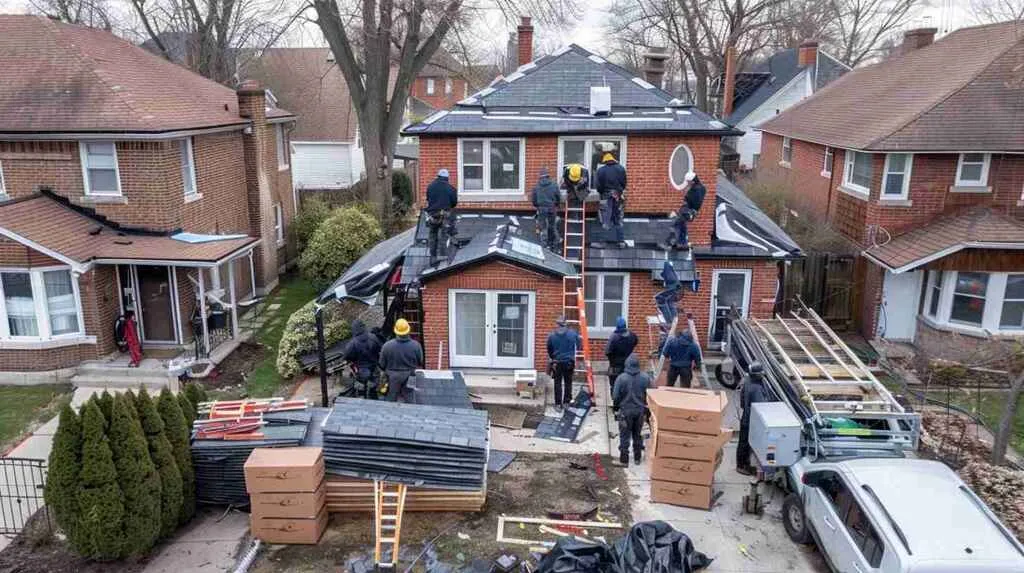
Repair a Leak on a Shingle Roof Queens NY – Permanent Fix | Free Estimates
Blueprint first: the brown stain on your ceiling is almost never directly under the leak, and if you’re serious about fixing shingles, you have to work uphill on the roof slope to find where the water is really getting in. I’m Rafael Ortiz, and for 19 years I’ve tracked down “mystery leaks” across Queens homes from Jackson Heights to Forest Hills, explaining roofs in plain English and showing people exactly what’s happening with photos and quick diagrams on whatever’s lying around.
Start Where the Water Really Enters, Not Where the Stain Shows
On a pitched shingle roof, water is running like it’s watching the clock: it follows the path of least resistance, moving downhill along shingle seams, around nails, and across underlayment until it finds a crack in the decking and drops through. My watchmaker uncle taught me that one tiny leak can ruin the whole machine, and that’s exactly how I think about roofs – the ceiling stain in your living room is just the last step in a long water journey that started several feet uphill on the shingles. Most people look directly above the spot, find nothing, and get confused; the real leak entry point is hidden somewhere higher on the slope, laughing at you.
One February morning around 6:30 a.m., I got an emergency call from a homeowner in Astoria who woke up to water dripping out of the smoke detector in the hallway. The roof “looked fine” from the ground, but when I got up there in the freezing wind, I found a tiny nail pop and a shingle slightly lifted next to a bathroom vent – snow had melted, run sideways under the lifted shingle, and traveled 10 feet before it showed up at the smoke detector. That job taught me never to trust where the leak shows up inside; the real entry point on a shingle roof can be way uphill from the stain, and you always start your detective work by moving in the opposite direction of water flow.
Finding the Real Leak Area on a Shingle Roof in Queens
Start: Do you see a brown stain or active drip inside?
Q1: Is the stain directly under a roof penetration (chimney, vent, skylight)?
• Yes → Go to Q2.
• No → Go to Q3.
Q2: Go outside: is there a vent, chimney, or pipe boot roughly above that area on the roof?
• Yes → Your likely leak zone starts 3-6 feet uphill from that penetration; inspect shingles and flashing there first.
• No → Treat it like a slope leak; go to Q3.
Q3: Is the stain near an exterior wall or where a lower roof hits an upper wall?
• Yes → Suspect step flashing or roof-to-wall joint; start inspection at that junction and move 4-8 feet uphill.
• No → Likely a field shingle issue (nail pops, cracked shingles); start 4-10 feet uphill from the interior stain along the water path.
Next Step: Once you’ve marked a likely zone outside, do not open the ceiling first-start by checking shingles and flashing in that uphill zone.
Is This Shingle Leak an Emergency Tonight?
| Urgent: Call for emergency roof service now | Can likely wait for a scheduled visit |
|---|---|
| Water dripping near electrical (smoke detectors, light fixtures, panel) | Small, slow drip caught in a bucket away from outlets and fixtures |
| Ceiling sagging, bubbling, or soft to the touch | Faint ceiling stain that only darkens slightly in heavy rain |
| Multiple drips in different rooms starting at once | Known nail-pop spot that only leaks in wind-driven rain |
| Active leak above kids’ bedrooms or critical areas that can’t be moved | Attic dampness with no active dripping inside living spaces |
On a Typical Queens Roof, These Are the First Leak Hotspots I Check
On a typical Queens cape or colonial, the first place I look is around roof vents and pipe boots, because the rubber or lead collars crack from sun and freeze cycles, and water loves any gap between metal and shingles. Second hotspot: chimneys, especially old brick ones without proper counter-flashing or where someone piled roof cement to “seal” the joint instead of installing real step flashing. Third hotspot is where a roof meets a vertical wall – attached homes in Jackson Heights, Corona, and Ridgewood have tons of roof-to-wall transitions, and if the step flashing wasn’t lapped correctly behind the siding, rain just runs right down the wall and under the shingles. Queens has a lot of capes and colonials with dormers and complex roof lines, so these joints multiply, and that’s where water-behavior thinking really pays off.
One summer afternoon in Corona, I was fixing what the owner called “a small leak over the TV room” that had supposedly been repaired twice already. Previous contractors had just smeared black roof cement over the shingles in a big ugly blob. When I opened it up, I discovered the real problem was an incorrectly lapped step flashing at the side wall; water was running behind the siding, then sneaking under the shingles. It took me three extra hours in 90-degree heat, but redoing that whole flashing run made the leak disappear permanently – and the owner finally stopped putting buckets on top of his entertainment center every time it rained. That job hammered home for me that leaks around walls need more than surface patching; you have to rebuild how the flashing hands water off to the next layer down.
✅ Primary Shingle Leak Hotspots Rafael Checks First
- ✅ Plumbing vent boots – cracked rubber or lead collars that let water slip around the pipe on Queens roofs with 20+ year old original boots
- ✅ Chimney step flashing and counter-flashing – especially on brick chimneys where mortar has eroded or flashing was never properly embedded
- ✅ Roof-to-wall step flashing on attached homes – common in Queens row houses and semi-detached capes where siding and shingles meet at party walls
- ✅ Nail pops in field shingles – especially on south-facing slopes that get heavy sun expansion and contraction, causing nails to back out over time
- ✅ Valley flashings – on colonial-style homes with dormers or L-shaped additions where two roof slopes meet and water concentrates
Common Queens Homeowner Beliefs About Shingle Leaks
| Myth | Fact |
|---|---|
| “The stain on my ceiling is right under the leak.” | On pitched shingle roofs, water usually travels several feet downhill before it shows inside, especially with insulation and framing in the way. |
| “If I don’t see missing shingles from the street, the roof isn’t leaking.” | Many leaks come from tiny nail pops, cracked flashings, or bad overlaps you can’t see from the sidewalk on Queens streets. |
| “A thick layer of black roof cement means it’s waterproof.” | Excess cement often cracks, traps water, and hides the real failure point instead of rebuilding the water path correctly. |
| “It only leaks in heavy storms, so it’s not serious.” | Storm-only leaks usually mean stressed flashings or lifted shingles that will worsen; by the time it leaks in light rain, damage is already advanced. |
| “I can just fix that one shingle and be done.” | Single shingles rarely fail alone; the underlayment, nails, and flashing around them usually need attention for a permanent fix. |
How to Safely Track a Shingle Leak and Try a Short-Term Repair
Here’s my rule: if your “repair” involves just smearing black goop, you’re not fixing anything.
Step-by-step: follow the water path uphill
The goal is to control how water moves on the shingles, not just cover up the symptom you can see from inside. Water is more patient than you are, and it will find every shortcut you leave it. When I’m up on a roof with a putty knife, I gently lift shingle tabs instead of bending them – especially in cold weather when they can crack – and if I need to add sealant, I use a pea-sized amount of proper roofing sealant under the tab and press it flat, not a big blob on top. That way the shingle stays flexible and the repair doesn’t draw attention to itself or trap water underneath.
Start your inspection at the gutter line below the suspected area and move uphill along the roof slope. You’re looking for nail pops (shiny nail heads sticking up or rusty ones that backed out), lifted shingle tabs that aren’t sealed down, cracked or curled shingles, and damaged pipe boots where the rubber collar has split. The whole time, think in terms of where water wants to flow – if you spot a gap or crack, imagine heavy rain hitting it and trace mentally where that water would travel downhill under the shingles; that mental path will lead you closer to the true entry point than just staring at the obvious spot.
When a pro repair beats DIY every time
One job in Forest Hills Gardens went sideways on me years ago when I trusted the homeowner’s “exact leak location” and only opened the area above her bedroom window. It was a cloudy autumn day, and after my first repair, a light rain came and the leak kept going, just a little slower. I stayed there until dark, moved higher up the roof, and eventually discovered a hairline crack in an old lead chimney flashing joint that only let water in during gentle, wind-driven rains from a certain direction. I ended up coming back the next day to rebuild the counter-flashing properly, and that’s when I promised myself: with shingle leaks, I always check the whole water path, not just the obvious spot. Anything near chimneys, skylights, or complex roof-to-wall joints should be handled by someone who’s seen how water can hide in those transitions – not because you’re not capable, but because the cost of guessing wrong and creating bigger damage is just too high.
DIY Short-Term Shingle Leak Control (for Accessible, Low-Slope Areas Only)
- Stabilize inside first. Move furniture and electronics, put a bucket under active drips, and carefully poke a small hole in a sagging bulge to relieve trapped water into the bucket.
- Locate the likely roof zone outside. Use the decision tree: go 4-10 feet uphill from the interior stain along the roof slope, especially toward any vent, pipe, or wall.
- Visually inspect from a ladder if it’s safe. From the ladder at the eave, look for lifted shingle tabs, cracked shingles, shiny nail heads, rusted flashing, or deteriorated pipe boots. Do not walk steep or wet roofs.
- Address obvious nail pops or small gaps. For a single nail pop on an accessible shingle, gently lift the tab, remove or renail, and apply a small dab of roofing sealant over the nail and under the tab before pressing it flat.
- Never smear cement over flashing joints. If the issue is around a chimney, sidewall, or heavy cement blob, stop and call a roofer-these need proper step or counter-flashing, not more goop.
- Monitor the next rain. After any temporary repair, watch that area during the next storm; if the stain grows or new drips appear, plan a permanent repair with a pro.
DIY Temporary Shingle Leak Fix vs. Hiring a Queens Roofing Pro
| DIY Temporary Fix | Hiring a Local Pro (like Shingle Masters) |
|---|---|
|
Pros: • Costs only materials and your time • Can slow damage before a storm passes • Good for obvious nail pops on low, walkable roofs |
Pros: • Proper diagnosis of hidden water paths • Permanent flashing and shingle repairs • Safer access to steep or high roofs • Warranty on work and materials |
|
Cons: • Easy to mis-read where water enters • Wrong sealant or excess cement can trap water • Safety risk on wet, steep, or icy roofs • No guarantee the leak is actually solved |
Cons: • Higher upfront cost than DIY • Need to schedule a visit (except emergencies) • You have to choose a contractor you trust |
What a Permanent Shingle Leak Repair Looks Like in Queens
Imagine your roof as a series of tiny overlapping umbrellas – each shingle handing rainwater to the next one down, and every nail, flashing, and seam designed to keep water riding on top rather than sneaking underneath. A proper repair rebuilds that umbrella overlap by replacing damaged shingles, fixing the underlayment beneath them, and re-stepping flashing so water is handed off cleanly downhill from course to course. When I climb down and show people my photos, I usually start with this question: Do you see anything wrong here? And then I point out how water wants to flow backward under a mis-lapped shingle or sideways along a rusted flashing seam, and how the fix isn’t just covering that spot but rearranging the pieces so water has no choice except to stay on the surface and run to the gutter.
On a typical permanent repair for a Queens homeowner, I inspect the full water path from the leak symptom back uphill to the true entry point, remove more shingles than the bare minimum so I can see what’s happening with the underlayment and decking, replace any rotten or soft decking boards, install new flashing with proper overlap and embedment in masonry if it’s a chimney, and then reinstall shingles in the correct stagger and nail pattern. After everything’s buttoned up, I walk the homeowner through photos of what I found, what I replaced, and how water will now behave in that area – and I clean up every nail and scrap so their yard looks like I was never there except for the leak being gone.
Typical Permanent Shingle Leak Repairs Rafael Performs in Queens
| Leak Type | Typical Permanent Fix | What Homeowners Often Try First |
|---|---|---|
| Nail pops in field shingles | Lift affected course, remove or reset nails, replace cracked shingles, apply proper sealant, ensure correct shingle overlap. | Dabbing roof cement over exposed nail heads without lifting shingles. |
| Vent or pipe boot leaks | Remove shingles around vent, replace damaged boot or vent, install new underlayment and properly lapped shingles, seal nail heads. | Smearing cement around vent base while leaving cracked boot in place. |
| Chimney leaks | Open shingles around chimney, replace step flashing and counter-flashing as needed, re-shingle and seal transitions, sometimes rebuild mortar joints. | Piling cement where chimney meets shingles and hoping it holds. |
| Roof-to-wall step flashing leaks | Carefully remove siding as needed, replace incorrectly lapped or corroded step flashing, integrate new underlayment, reinstall siding and shingles. | Caulking or painting over siding/roof joint without touching flashing. |
Why Queens Homeowners Call Rafael at Shingle Masters
- Licensed & insured in New York City for residential shingle roofing.
- 19+ years tracking down shingle leaks from Jackson Heights to Forest Hills.
- Fast response in Queens for active leaks and storm damage.
- Photo and sketch explanations so you see exactly how water was getting in.
Quick Answers About Shingle Leak Repairs in Queens, NY
These are the questions Queens homeowners ask me on ladders all the time – the real stuff people want to know about shingle leaks and permanent fixes before they spend a dime.
Can I just replace the one shingle that looks bad?
I still remember a Saturday in Woodhaven when a homeowner asked me this exact question, pointing to a single curled shingle. When I opened the area, three surrounding shingles and the underlayment were waterlogged, and a few nails had already rusted. On shingle roofs, damaged pieces are usually part of a bigger weak spot, so I replace a small section-shingles, nails, and underlayment-so the whole area sheds water properly.
How much does a typical shingle leak repair cost in Queens?
For a small, straightforward leak around a nail pop or vent on a low roof, you might be in the low hundreds; more complex chimney or roof-to-wall flashing rebuilds can run higher because they’re labor-heavy. I always inspect the full water path first, then show photos and give a written estimate before touching anything.
Will roof cement alone ever be a permanent fix?
Used sparingly in the right place, cement or sealant can help, but by itself it’s not a permanent solution. A real fix means arranging shingles, underlayment, and flashing so water wants to stay on top of the roof, not trusting a bead of goop to hold back every storm.
Do you work on attached homes and row houses in Queens?
Yes-attached homes in places like Jackson Heights, Corona, and Ridgewood are where water-path detective work really matters, because shared walls and party walls can hide how leaks travel. I take extra photos and sometimes sketch how water is moving between structures so everyone understands what’s really going on.
How fast can you get here if it’s actively leaking?
For active drips, I prioritize same-day or next-day tarping and temporary control in Queens whenever possible, then schedule the permanent shingle repair as soon as weather and materials allow. You’ll get clear communication on timing so you know what’s happening between the first visit and the final fix.
Things to Note Before Calling Shingle Masters About Your Shingle Leak
- ✅ Where exactly you see the stain or drip inside (room, ceiling vs. wall, distance from exterior wall).
- ✅ Rough idea of your roof style (cape, colonial, row house, flat-to-pitch combo) and shingle age if you know it.
- ✅ Whether the leak happens in every rain, only heavy storms, or only wind from a certain direction.
- ✅ Any past repairs in that area (cement blobs, replaced vents, patched chimneys).
- ✅ Photos from the ground of the roof area, plus interior photos of stains or damage.
The blunt truth is that water is more patient than you are, and it will find every shortcut you leave it. Call Shingle Masters for a free estimate, and I’ll walk you through photos of the full water path on your Queens shingle roof so you know exactly what needs to happen for a permanent fix – not another temporary patch that fails in six months.