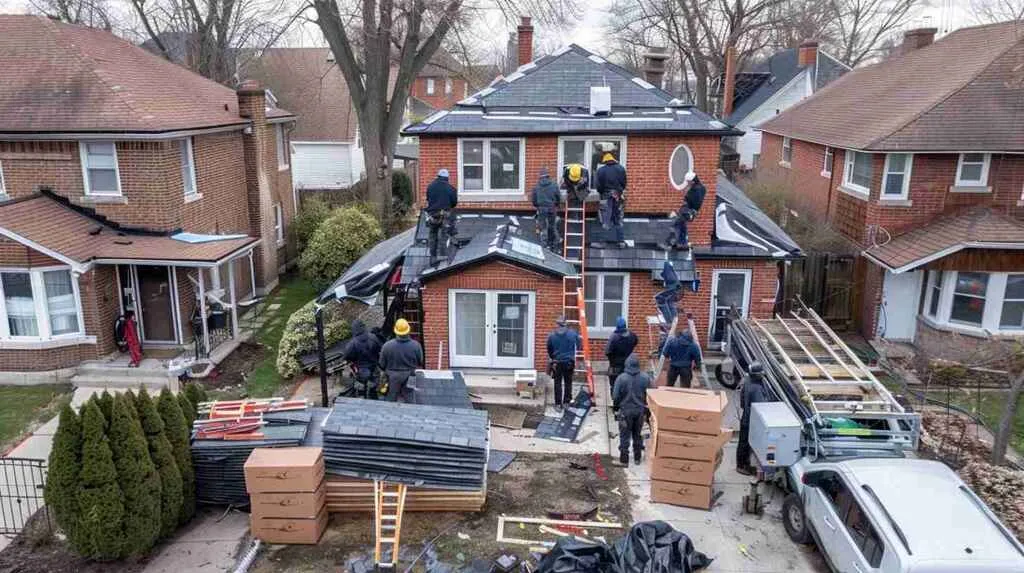
How to Patch a Shingle Roof Queens NY – Repairs That Actually Hold
Wired up wrong, your roof patch won’t last through one Queens winter – because here’s what nobody tells you: you never just patch the visible damaged shingle. You trace how water is traveling under and around it first, like finding the short-circuit before you replace the breaker. Most DIY patches fail because folks just smear tar on the torn spot they can see, ignoring the fact that water already jumped tracks three rows up and ran sideways under the whole section. Think of your roof like a big, sloped circuit board – every shingle overlaps like a connection, and your job with a patch is to keep the “current” (water) on the right path, not just cover the burnt spot.
Diagnose the Leak Path Before You Touch a Shingle
On a typical Queens roof in January, the first thing I look for isn’t the missing shingle – it’s where the water would logically want to run if everything went wrong. Water doesn’t drop straight down through a roof; it travels along the path of least resistance, sneaking sideways under multiple courses, following nail lines, dripping onto underlayment, and pooling wherever it finds a low spot or gap. If you just slap a new shingle over the obvious hole without tracing that whole leak path, you’re guessing – and I’ve seen those guesses turn into $3,000 plywood replacements because the real damage was invisible for months.
One February morning around 6:30 a.m., I was on a two-story in Middle Village with freezing drizzle hitting my face sideways. The homeowner had tried to patch one missing shingle with duct tape and a garbage bag, and water was dripping straight into his recessed light fixture. I still remember shutting off that circuit in the panel and telling him, “Your roof is short-circuiting, and that tape is just a burnt fuse.” I had to peel back four rows of shingles and reflash a vent because the “patch” had forced water sideways under the whole section. That’s what happens in Queens winters – water doesn’t politely wait for summer repairs, it finds every weak link, freezes, thaws, and tunnels its way to your ceiling.
Here’s my honest take: if you don’t spend the first 10 to 15 minutes mapping the leak path before you touch a tool, you’re not fixing the roof – you’re just moving the problem. I sketch it out like a circuit diagram sometimes, right on a scrap of cardboard: shingle overlap here, water jumped tracks there, pooled at this seam, dripped through that nail hole. Any roofer who doesn’t start with leak path mapping is guessing, and guesses cost you money. On a Queens roof, where you’ve got wind driving rain at every angle and freeze-thaw cycles that crack even fresh sealant, understanding where water wants to run is the only way your patch will hold longer than a season.
Should you even try to DIY patch your shingle roof in Queens, NY?
Start: Do you see active dripping or a ceiling bulge right now?
If YES → Is the leak near a light fixture or electrical outlet?
- YES → Stop. Shut off that circuit at the panel and call a roofer/electrician. Do not DIY.
- NO → Can you safely access the roof with a sturdy ladder and a spotter?
- YES → Are 3 rows or less of shingles visibly affected (cracked, missing, curled)?
- YES → You can attempt a careful DIY patch following the steps below.
- NO → You likely have a field or underlayment issue. Call a pro.
- NO → Stay off the roof. Call a pro.
- YES → Are 3 rows or less of shingles visibly affected (cracked, missing, curled)?
If NO (just a stain): Mark the stain, monitor in the next rain, then inspect from the attic or top floor first before climbing on the roof.
If anything about getting on that roof feels sketchy, you’re done – call someone who does this every day.
Tools, Materials, and Queens-Specific Safety Checks
Before you climb, you need to understand the Queens housing stock and weather patterns you’re dealing with. Semi-attached homes in Jackson Heights and Elmhurst share party walls and weird wind channels that make shingles lift faster on one side; older two-story colonials in Middle Village and Forest Hills tend to have steeper pitches and zero walkable ridge space; and anything near the bay or waterfront in Astoria gets hammered by crosswinds that’ll knock you off balance if you’re not braced. Check the forecast for a solid dry window – not just “no rain,” but no snow, no ice, and no high winds. Most Queens roofs sit at a 4:12 to 6:12 pitch, which sounds gentle until you’re 20 feet up and the shingles are slick from morning dew. Walk the perimeter from the ground first, eyeballing the whole slope like you’re checking every connection in a circuit panel before you touch a wire, looking for soft spots, sags, or sections that look darker (water-saturated wood underneath).
✅ Essential DIY patch tools and materials for a small shingle repair that actually lasts
- Flat pry bar – not a crowbar, but a roofing-specific flat bar to gently lift shingles without tearing tabs
- Roofing hammer – the hatchet style with a squared head for setting nails flush and a blade for trimming
- Galvanized roofing nails – 1¼” for standard shingles; don’t use smooth shank or you’ll have pop-ups in six months
- Replacement shingles – matched to your existing (bring a broken tab to the supply house in Maspeth or Ridgewood)
- Utility knife with hook blades – fresh blades so you get clean cuts through the asphalt backing
- Roofing sealant – not generic black tar, but actual roof cement or shingle adhesive rated for freeze-thaw
- Caulk gun – for controlled sealant application under lifted tabs
- Chalk or pencil – for marking the leak path on shingles as you diagnose
- Work gloves – roofing edges are sharp, especially older brittle shingles
- Non-slip shoes and safety glasses – you’re walking on grit-covered slopes with nails popping up everywhere
⚠️ Queens roof safety and weather timing
Do NOT climb your roof if:
- There’s snow, ice, or visible frost on the shingles (common in Bayside and Flushing mornings).
- Wind gusts are over 20-25 mph – open areas like near Astoria Park get nasty crosswinds.
- Your ladder can’t extend at least 3 feet past the gutter line on your Queens two-story.
- You’ve had rain in the last few hours and the shingles still feel slick to the touch.
- You’re not comfortable on a 4:12 to 6:12 pitch – most Queens colonials and capes sit here.
If any of these are true, treat the situation like a live electrical panel you’re not trained on: back away and call a licensed roofer.
| Existing Roof Type | What You Likely Have in Queens | Best Match for Patch | Notes |
|---|---|---|---|
| 3-Tab Asphalt | Pre-2000s homes in Middle Village, Glendale, older sections of Astoria | Standard 3-tab, same color family (GAF or Owens Corning stocked locally) | Match thickness and granule color or the patch will stand out like a bad wire splice |
| Architectural (Dimensional) | Most post-2005 re-roofs in Jackson Heights, Forest Hills, Bayside | Same brand/line if possible (bring a sample); architectural shingles vary in thickness | Thicker than 3-tab, so nailing depth and overlap are critical for a flush repair |
| Older Wood or Slate | Rare historic homes in Ridgewood, Forest Hills Gardens | Stop – don’t DIY this | These roofs need specialty materials and techniques; call a restoration roofer |
Step-by-Step: How to Patch a Shingle Roof So the Repair Holds
I still remember a Saturday in Corona when a guy proudly showed me his YouTube-inspired repair, and all I saw was a perfect little water highway under three rows of shingles. He’d troweled roofing cement over a crack like he was icing a cake, and every rainstorm just pushed water under the blob and down the slope, soaking the underlayment and plywood for months before the ceiling stain even appeared. The problem wasn’t his effort – it was that he treated one damaged shingle like an isolated problem instead of understanding that shingles work as a system, each course lapping over the one below to create a continuous water-shedding circuit. When you skip a step or patch sloppy, you’re basically creating a dead short that sends water wherever it wants to go.
Now that you see how that one shingle works, let’s zoom out to the whole slope. A proper patch isn’t about covering damage – it’s about restoring the intended water flow path, row by row, like re-terminating a series of bad connections in a junction box. You’re going to lift shingles above the damaged area, trace how the nails and overlaps were originally set, remove the failed section without tearing anything else, check the underlayment and deck, install the new shingle exactly where the old one sat, then reseal and re-nail the courses above so water follows the designed path again. Miss one step and you’ve just changed where the leak shows up next time.
Precise patch sequence for 1-3 damaged shingles
- Trace the leak inside first. Note ceiling stains, then measure from outside walls so you know roughly where on the roof that section sits.
- Inspect the shingle field. From the ladder, look 3-4 rows above and to each side of the obvious damage, searching for cracked, lifted, or mis-nailed shingles.
- Gently lift the shingle above. Use the flat pry bar to break the factory seal on the shingle directly above the damaged one, then expose the nails holding the bad shingle.
- Remove nails without tearing. Slide the bar under each nail head, tap lightly until the nail backs out. Think of it like freeing a wire from a terminal without ripping the insulation.
- Slide out the damaged shingle. Pull it straight down; if it snags, double-check for a missed nail so you don’t tear the felt or underlayment.
- Check underlayment and deck. If the felt is torn or the plywood is soft/black, the problem is bigger than a surface patch – stop and call a pro.
- Install the new shingle. Slide it into place, align the exposure with the existing course, and nail in the manufacturer’s nailing strip (usually 4 nails), staying above the cutouts for 3-tab.
- Re-nail and reseal the course above. Replace any nails you pulled from the course above, then apply small dabs of roofing sealant under the lifted tabs and press down.
- Water-test if safe. Once sealant has skinned over, use a gentle hose stream, starting low and moving up, while someone inside watches for drips – just like testing a repaired electrical run under load.
When a Simple Patch Isn’t Enough (And Why Tar Makes It Worse in Queens Heat)
Here’s my honest take: if your “patch” involves tar spread like peanut butter on toast, it’s going to fail faster than you think. One August afternoon, brutal heat, I got called to a semi-attached in Jackson Heights where some handyman had smeared roofing cement over a shingle crack like frosting. The sun baked that blob so hard it cracked, and every thunderstorm sent water under the mess. I showed the owner with a hose test how the water followed the tiniest gap, like current finding the easiest path, and we ended up replacing a whole 5×7 area. The worst part? The ceiling stain didn’t show up for months, so by the time they noticed, the plywood was black. That’s what tar does in Queens summers – it gets soft, slumps, cracks open in the next cold snap, and turns one fixable shingle into a full decking replacement.
Blunt truth: on a shingle roof, the nail holes you don’t see matter more than the torn shingle you do see. If you’ve got multiple soft spots when you walk the roof, widespread granule loss across a whole section, damage around valleys or chimneys, or you’re staring at someone else’s old tar patches that are already cracking, you’re past the DIY stage. In Queens climate, with freeze-thaw cycles from November through March and brutal August heat that bakes roofs to 160°F, tar-only fixes crack and open new leak circuits every single season. Here’s my insider tip: before you even climb the ladder, lightly run your fingers across the shingles near the damage to feel for subtle dips and soft spots that reveal rotten decking before you ever see a stain inside. On hot Queens days, I avoid overusing cement because it will slump and crack – instead, I rely on proper shingle overlap and strategic sealant dabs at the tab edges, rebuilding the system the way it was meant to work.
| Method | Pros | Cons |
|---|---|---|
| Smearing roofing cement over damage | Fast (15 minutes), cheap upfront, no lifting shingles, no special tools | Cracks in freeze-thaw, slumps in heat, forces water sideways under intact shingles, hides real damage to deck, fails within 1-2 seasons, voids most warranties, looks terrible |
| Proper shingle replacement | Restores original water path, lets you inspect underlayment and deck, lasts as long as surrounding roof, maintains warranty, blends in correctly | Takes 60-90 minutes if done right, requires specific tools and matched shingles, steeper learning curve, not safe for everyone |
Deciding when to call a Queens roofer like Shingle Masters instead of DIY
| Urgent – Call Right Now | Can Wait 24-48 Hours |
|---|---|
|
|
Queens-Specific Leak Patterns, Real Fixes, and What Shingle Masters Actually Does On Site
Late one windy November night, a landlord in Ridgewood begged me to come out because a tenant’s kid had stuck their head through a sagging, wet bedroom ceiling. Turned out someone had “patched” a lifted shingle with three drywall screws and no sealant – I could still see the screw box on the roof. Rain tracked along the screw threads like wire and dripped for weeks. I had to tarp the slope in the dark, then come back the next day to do a proper repair – pulling those screws, stitching the shingle field correctly, and checking the underlayment like tracing a bad wire in an old junction box. That’s the thing about Queens weather and the housing stock here: windy November storms hit those Ridgewood colonials and semi-attached homes from angles that turn lifted shingles into water scoops, and if you don’t understand how the wind and pitch combine, your patch just becomes another weak link in the circuit.
When I walk a customer through this, I start with one question: if it rained sideways for an hour, where would you expect that water to sneak in? Common Queens leak zones include the shared walls on semi-attached homes in Jackson Heights and Elmhurst (because the flashing gets neglected), around chimneys in older Ridgewood and Glendale houses (mortar cracks, flashing pulls away), and vent stacks in Middle Village where the rubber boot dried out years ago but nobody noticed until water dripped into the bathroom. When Shingle Masters comes out on a service call, we trace the whole “circuit” – checking nail patterns, underlayment laps, nearby penetrations, even how the gutters are channeling overflow back onto the roof edge. We don’t just swap one shingle and leave. We lift surrounding courses, inspect the deck with a flashlight for soft spots or water stains, verify that the felt isn’t torn, check that nails aren’t backing out in a pattern (which means deck movement), and then either do a focused patch or recommend a larger repair with honest reasons why. Think of your roof as a big sloped circuit board where every overlap, nail, and seal point has to work together – if three connections are burned out, replacing one and hoping for the best is how you end up with water in your walls.
Shingle Masters service snapshot for Queens, NY
- Years on Queens roofs: 19+ years of local shingle and flat work.
- Typical response time: Same-day for active leaks, 24-48 hours for non-emergencies.
- Service area: Astoria, Jackson Heights, Ridgewood, Middle Village, Forest Hills, Flushing, and nearby neighborhoods.
- Typical small patch visit: 60-120 minutes on site, including diagnosis and hose test when possible.
Common questions about shingle roof patches in Queens, NY
Can a small shingle patch really last more than a couple of years?
Yes, if the leak path is diagnosed correctly and the patch rebuilds the shingle layers and nail pattern, a small repair can last as long as the surrounding roof section. The quick-smear tar patches fail fast in Queens heat and freeze-thaw cycles.
How much does a professional shingle patch usually cost in Queens?
For a straightforward 1-3 shingle repair with easy access, expect a few hundred dollars, not thousands. Costs go up when plywood is rotten, access is difficult, or the damaged area covers multiple rows or penetrations.
Will a patch void my shingle warranty?
Improper patches, over-nailing, or using the wrong sealant can cause warranty issues. A properly installed repair that follows manufacturer guidelines generally won’t, which is why many homeowners prefer a licensed roofer.
What if my roof is older than 20 years?
At that age, shingles get brittle and every pry bar move risks cracking surrounding tabs. A patch may still be possible, but often you’re chasing multiple weak links in the circuit, and planning for replacement is smarter.
If your Queens roof leak feels more like a whole bad circuit than a single loose connection – water showing up in multiple rooms, stains spreading, or you just can’t pin down where it’s actually coming from – don’t keep guessing with tar and hoping for the best. Shingle Masters can come out, trace the leak path properly using the same diagnostic approach I’ve walked you through here, and rebuild the shingle system so the repair actually holds through the next winter and the next August heatwave. Call us for a focused diagnostic visit rather than another guesswork patch, and we’ll show you exactly what’s failing and what it takes to restore that water circuit the right way.