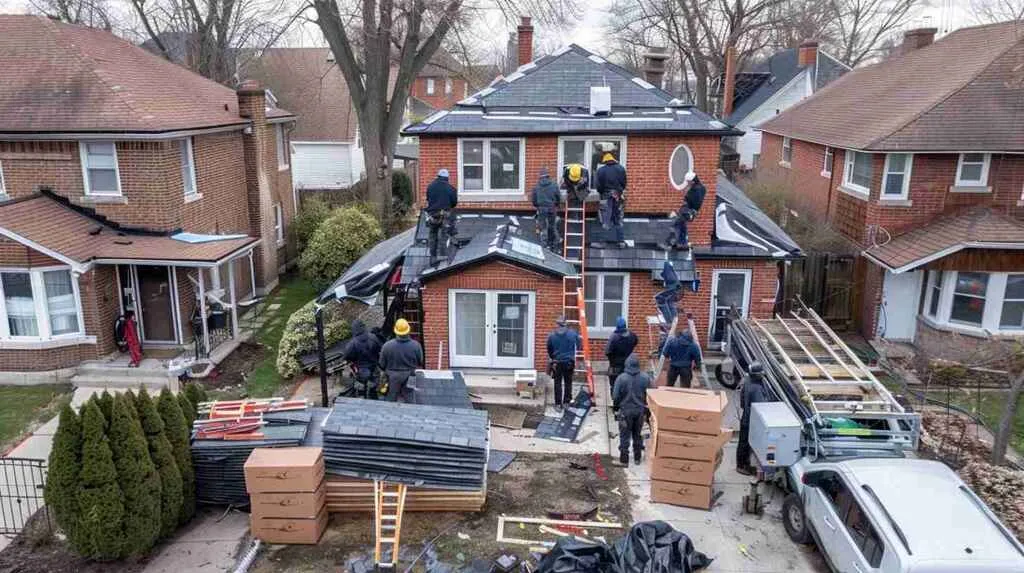
Fix Leaking Roof Shingles Queens NY – Stop Damage Before It Spreads
Underflow is what I call it when water sneaks in one spot on your roof and travels six feet sideways under perfectly good shingles before dripping onto your ceiling – which is exactly why that wet spot above your couch is lying to you about where the real problem is. I’m Irene Kowalski, and after nineteen years on Queens roofs and a previous career teaching high school physics in Elmhurst, I treat every shingle leak like a lab experiment: follow the water path, not the stain, and assume the shingles are guilty somewhere else.
Track the Leak Like a Physics Experiment, Not a Guessing Game
In my grade book, the first mistake most people make with a leaking shingle roof is looking straight up from the wet spot and slapping caulk on whatever seems suspicious. Water doesn’t fall straight down through your roof – it lands on a shingle, hits a gap, and follows gravity along the underlayment or deck until it finds a crack in the ceiling, sometimes ten feet away from the actual entry point. I still hear my old physics students in my head when I ask this: where do you think the water really came from? It’s not magic. It’s slope, capillary action, and the fact that a single lifted shingle tab can funnel a gallon of rain sideways before it drips on your light fixture. And honestly, guessing with a tube of caulk is going to cost you more in repeated “fixes” and hidden rot than one accurate leak-trace visit from someone who knows how Queens roofs actually behave.
One February evening, right after dismissal time at my old school, I got a frantic call from a former student whose mom’s house in Maspeth had water dripping from a light fixture. It hadn’t rained that day, but there’d been a quick freeze-thaw cycle. When I got there, it was 7 PM, 28 degrees, and the leak only showed up when the attic warmed up a bit. I traced it to a single cracked shingle uphill from a vent that was funneling meltwater sideways under the roof. Three other people had missed it because they kept looking right above the fixture instead of following the water path. That’s the reality for most Queens homeowners: the ceiling stain is the symptom, and the real shingle problem is hiding somewhere uphill, waiting to get worse every time it rains.
So what this means for your roof is simple: before you climb up with a caulk gun or call someone who charges you for patching the wrong spot twice, you need to understand that leak-tracing is detective work, not guesswork. Next, we’ll quickly decide whether you’re in “call right now” territory or “schedule this week” territory, because not every drip is an equal emergency.
Do you have a shingle emergency or a same-week repair?
Start: Is water actively dripping right now inside your home in Queens?
-
Yes → Is the drip near electrical (lights, outlets, breaker panel)?
- Yes → Call Shingle Masters for emergency service tonight. Shut off power to that circuit if safe.
- No → Place a bucket/towel, photograph the damage, then call Shingle Masters within the next 2 hours.
-
No → Do you see ceiling bubbles, sagging drywall, or a spreading stain larger than a dinner plate?
- Yes → Schedule an inspection within 24 hours. Avoid poking or cutting the bubble yourself.
-
No → Is your roof older than 15 years or have you done DIY patches around vents/chimneys?
- Yes → Book a same-week leak-trace visit. Hidden shingle issues are likely.
- No → Monitor the area during the next rain and plan a professional check within the week.
Find the Real Entry Point Above That Ceiling Stain
On a typical Queens two-family with asphalt shingles, the water almost always starts its mischief somewhere uphill and to the side – not directly over your head where the drywall is turning brown. One hot July afternoon in Jamaica, I was finishing a shingle repair when a sudden storm blew in off the bay, the kind that goes from sunny to sideways rain in five minutes. The customer, an older gentleman, insisted we’d fixed the wrong spot because the ceiling stain was ten feet away. I had him come up halfway on the ladder so he could see how the valley was channeling water under a lifted shingle, then across the underlayment. When the rain hit, he literally watched the water disappear under one shingle and reappear at the exact point I’d circled in his attic fifteen minutes earlier. Valleys, lifted tabs around vents, and transitions where a dormer meets the main roof are classic culprits in Queens, especially on the two-family and row-house roofs we see all over Maspeth, Astoria, and Jamaica. Water can change direction at a valley seam, sneak under flashing along a chimney, or ride a rafter sideways for six feet before dripping through.
So what this means for your roof is you can’t just stare at the wet spot and guess. Here’s the insider tip I give to every careful homeowner: use binoculars or a short step ladder to scan the shingles uphill from the general area of the leak, and look for small details like lifted tabs, exposed nail heads, or cracks in the sealant line where shingles overlap. Don’t walk a steep or wet roof yourself – that’s how people get hurt. But from the ground or a safe low vantage point, you can often spot the real problem without ever touching a shingle, and that information makes the pro visit faster and cheaper because we’re not hunting blind.
Why you shouldn’t open the ceiling first
Cutting open a wet ceiling before you understand the leak path can:
- Release a sudden gush of trapped water onto floors and electrical.
- Spread insulation and debris through your room.
- Give you a false sense of “fixing” something when the roof is still leaking.
- Increase repair costs when the real problem is a small shingle or flashing defect uphill on the roof.
DIY Shingle Leak Checks You Can Do Safely Before You Call
Picture a raindrop rolling down your roof the way a marble rolls down a tilted lab table – it’s going to follow the fastest path downhill, unless you give it a sneaky side route like a gap under a shingle or a valley seam. That’s the physics of every leak: water obeys slope and capillary action, not your hopes that the caulk you smeared on three months ago is still holding. From the ground or a sturdy step ladder (never a steep pitch in wet conditions), you can check a few things safely: are any shingles visibly curled, cracked, or missing? Do the edges of the shingles around vents or chimneys look lifted or separated? Is there moss or algae trapping moisture and lifting tabs? You’re not diagnosing the exact problem – you’re gathering clues so the pro knows where to start, which saves you time and money on the visit.
I still remember a Saturday morning in October in Astoria, when a DIY shingle “patch” job had gone really wrong. A young couple had used roofing cement like cake frosting, smearing it all over cracked shingles around a bathroom vent. It looked sealed, but the first nor’easter turned that area into a shallow pond. When I peeled it back, water had been slowly migrating under four rows of shingles, rotting the plywood. I ended up showing them, with a marker and a piece of cardboard, how water never listens to wishful thinking – it listens to slope, gaps, and capillary action. So what this means for your roof is there’s a clear line where DIY observation stops and professional repair starts: you can look and document safely, but the moment you start sealing, patching, or removing shingles without understanding the full water path, you risk turning a $400 repair into a $3,000 structural mess.
Quick DIY observations from the ground or low ladder only
Look for missing or broken shingles from the ground using binoculars.
Check for curled or lifted edges around vents, chimneys, and valleys.
Note any moss or algae buildup that might be lifting shingle tabs.
Take photos of the suspect area and the interior stain for reference.
Don’t walk on steep or wet roofs – that’s how falls happen.
Don’t pull up shingles to “peek” without knowing what you’re looking at.
Avoid caulking or cementing random spots you think are the problem.
Don’t open the ceiling until you’ve traced the water path on the roof.
Information to gather before calling Shingle Masters about leaking shingles
- ✅ Take clear photos of the ceiling stain or drip, including a wider shot that shows nearby walls or fixtures.
- ✅ Note when the leak shows up: only during heavy rain, only with wind from one direction, or after snow/ice melt.
- ✅ Check your records for roof age, last replacement date, or any previous patch jobs.
- ✅ From the ground, look for missing, curled, or obviously broken shingles in the area above the leak.
- ✅ Notice whether the leak is near a bathroom, kitchen, or chimney, which often points to vents or flashing issues.
- ✅ Write down your address, building type (one-family, two-family, row house, etc.), and any prior leak history to tell the tech.
$8,000 is about what one of my Astoria couples paid to replace rotten plywood and damaged interior finishes that started with what looked like one harmless shingle crack.
What Shingle Leak Repair Really Costs in Queens, NY
Prices depend on access, roof height, how far the water has spread under the deck, and whether you need flashing work or just shingle replacement, but here’s the straight truth: a focused shingle leak repair in Queens runs anywhere from a few hundred dollars for a simple vent-area fix to a couple thousand if multiple zones are compromised or you’ve got hidden rot. The real lesson from my physics teaching days applies here: a small entry point can cause a large hidden area of saturation, and that’s why the cheapest option isn’t always guessing with caulk – it’s fixing it right the first time before you’re also paying a contractor to rebuild plywood and ceiling drywall.
Why Queens homeowners call Shingle Masters for leak tracing
-
✓
Licensed & Insured in NYC – We work on Queens roofs every week. -
✓
19+ Years on Local Roofs – From Astoria to Jamaica, Maspeth to Laurelton. -
✓
Fast Response – Same-day for active leaks when schedule allows. -
✓
Shingle-Specific Expertise – We specialize in asphalt shingle leak diagnostics, not just generic patch jobs.
When to Stop Experimenting and Call a Pro
Here’s the blunt version, because that’s how I taught lab safety too: if you only fix the spot that’s wet, you’re fixing the symptom, not the problem. Once you see spreading stains, recurring drips after your last “patch,” or water showing up in a new spot every few months, continuing to experiment with caulk and tar is like rerunning a failed physics experiment without changing any variables – you’re guaranteed the same result, which in this case is more rot, more mold, and a bigger invoice when you finally call someone who traces leaks for a living. If you’re in Astoria, Jamaica, Maspeth, Forest Hills, or anywhere else in Queens and that ceiling stain is getting darker or that drip is getting faster, it’s time to stop guessing and call Shingle Masters for a focused leak-tracing inspection before the next storm turns your $600 repair into a $5,000 reconstruction.
Common questions Queens homeowners ask about leaking roof shingles
Can I just caulk over the crack I see in one shingle?
You can, but you probably should not. Caulk rarely bonds well long-term on weathered shingles, and it usually masks the symptom while water is actually entering at a seam, valley, or flashing detail you have not found yet. A proper repair removes the damaged shingles, checks the underlayment, and replaces materials so water flows over, not under, the roof system.
What if my leak only shows up during wind-driven rain?
That is classic for Queens storms. Wind can push water sideways under lifted shingle edges, along siding transitions, and into any tiny gap in flashing. We use that pattern-“only in sideways rain”-as a clue to check specific points like ridge caps, valleys, and wall intersections, not just directly above the stain.
Can you repair just a section, or do I need a whole new roof?
Many shingle leaks in Queens can be solved with a focused repair, especially if the roof is under about 18-20 years old and the damage is localized. During an inspection we will tell you honestly if a spot repair makes sense or if repeated leaks mean your money is better spent on planning a replacement.
How fast can you get to my home in Queens?
For active leaks and storm damage, we aim for same-day or next-day stabilization whenever our schedule and weather allow. For non-emergency shingle leak concerns, we typically book inspections within a few business days.
The fastest, cheapest way to stop shingle leaks is to trace the water correctly the first time – not to guess three times with caulk, then call a pro to undo the mess. If you’re dealing with a drip, a stain that won’t go away, or shingles that look sketchy from the street in Queens, call Shingle Masters for a focused leak-tracing inspection or emergency stabilization before the next storm turns that small entry point into a large, expensive problem.