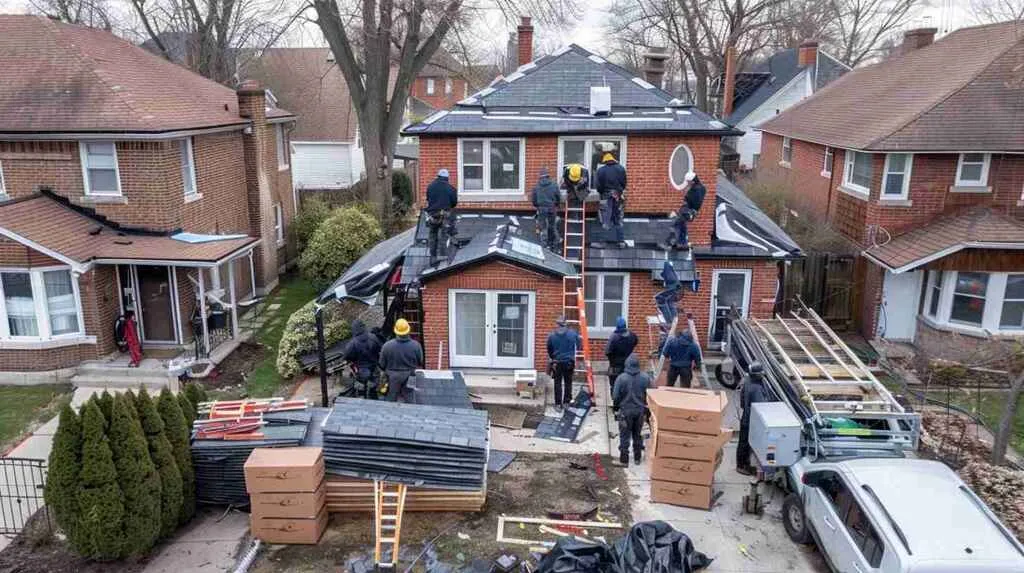
Expert Shingle Roof Install and Repair Queens NY – What to Expect
Blueprint for a solid shingle roof in Queens? 20 to 25 years without headaches-if, and only if, the invisible stuff gets done right. Here’s the catch: two shortcuts kill that lifespan faster than anything else. First, backward underlayment laps where each row overlaps uphill instead of down, turning your water barrier into a funnel. Second, skipped or skimpy flashing at valleys and where the roof meets walls, leaving those high-stress seams wide open to wind-driven rain. I’m Vik Lam, and I’ve been tracking down exactly these failures across Queens for 11 years with Shingle Masters. Most “brand-new” roofs that leak within three years? They’re not bad shingles-they’re bad details under the shingles.
How Long a Shingle Roof Really Lasts in Queens-and What Cuts That Life in Half
On a typical two-family in Queens with a simple gable roof, the difference between a 10-year roof and a 25-year roof usually comes down to three things you’ll never see from the sidewalk. One February morning around 6:30, I was up on a two-family in Ozone Park where the owner swore his “brand-new” roof was junk-only three years old, but every nor’easter soaked his upstairs tenant’s bedroom. I pulled back shingles along the valley and found the underlayment overlapped backwards, like trying to shed water uphill. Sun was barely up, my hands were numb, and I stood there explaining over the steam of his coffee how water follows gravity and capillary action, not wishful thinking. That roof’s “melody”-the shingle color, the warranty brochure-was fine. But the rhythm section underneath? Completely off beat. If a roofer talks to you about shingle colors and warranties before they explain underlayment laps and flashing details, they’re focused on the wrong part of your roof-that’s not an opinion, that’s physics.
Queens weather doesn’t forgive sloppy work. Nor’easters hammer us with horizontal rain and 50-mph gusts that find every gap in your valleys and sidewalls. Summer heat bakes tar paper and makes poorly fastened shingles curl. You get salt air off the water in neighborhoods near the bay, wind funneling between tight rooflines in Jackson Heights and Astoria, and ice dams on low-slope rear additions in Flushing. A bad install might look fine from the curb for two or three years, but the first big storm exposes it. Backward underlayment lets water creep upslope under the shingles. Missing step flashing where the roof meets a brick wall turns that joint into a gutter feeding straight into your ceiling. The cause is invisible; the effect is brown rings on your bedroom walls and a call to three different roofers who all want to sell you a full replacement.
Think of your roof like a layered track on a music mixer-if the rhythm section (your underlayment and fastening) is off, no amount of pretty shingles on top will fix the sound. Three critical “tracks” have to stay on beat. First, underlayment: each row laps downslope, minimum four inches, with ice and water shield at eaves and valleys-not just felt paper slapped down randomly. Second, flashing: step flashing at every sidewall and chimney joint, counterflashing properly embedded in masonry, drip edge at every eave and rake. On that Ozone Park job, I found zero step flashing where the roof met the dormers-just a bead of caulk that had cracked open. Third, nailing patterns: six nails per shingle in the right zone, not overdriven so they tear the mat, not underdriven so they back out in the wind. Miss any one of those, and your 25-year roof becomes a 10-year roof with constant patches.
| Installation Quality | Expected Lifespan in Queens | Typical Early Failure Signs | Most Likely Shortcuts Used |
|---|---|---|---|
| Poor / Handyman Install | 5-10 years, often with repeated leaks starting year 2-3 | Leaks at valleys, dormers, and chimneys after first hard rain; wind-blown shingles; curling edges; visible nail pops | Backward or missing underlayment laps; no step flashing; random nailing; shingles over two or more old layers; no drip edge |
| Average / Mid-Tier Contractor | 15-18 years with occasional minor repairs needed | Occasional leaks at penetrations (vents, pipes); shingles may lift in high wind; granule loss in valleys; some curling after year 12 | Inconsistent underlayment overlap; flashing present but not always counterflashed properly; rushed nailing on windy days; minimal ventilation upgrades |
| Expert / Shingle Masters Install | 20-25+ years with minimal maintenance, no leaks if inspected every 3-5 years | Very rare failures; typically age-related granule loss after year 18-20; no premature leaks if attic ventilation maintained | Full tear-off to deck; proper underlayment laps and ice/water shield; complete step and counterflashing; layout snapped and checked; correct nailing depth and pattern; ridge and soffit ventilation balanced |
Myth vs. Fact: Queens Shingle Roof Lifespan
| Myth | Fact |
|---|---|
| “A 30-year shingle warranty means my roof will last 30 years in Queens.” | Warranties cover manufacturing defects-not installation errors, wind damage, or normal weathering. In Queens, actual lifespan is 20-25 years max with perfect installation and maintenance. |
| “You can just add another layer of shingles to save money.” | NYC code allows up to two layers, but every extra layer traps heat, hides deck rot, and makes the next tear-off more expensive. Most pros recommend full tear-off for a clean start. |
| “Dark shingles make your roof fail faster because they absorb more heat.” | Color affects attic temperature slightly, but proper ventilation and underlayment quality matter 10x more. A dark roof with good airflow outlasts a light roof with poor flashing every time. |
| “If the roof looks fine from the street, it’s probably fine.” | The worst problems-backward underlayment, missing step flashing, improper nailing-are invisible from the ground. By the time you see curling or missing shingles, the damage has been happening for years. |
Where Queens Roofs Actually Leak-and How an Expert Tracks the Water Path
Here’s my honest take: if your roofer can’t explain where your house is most likely to leak, they’re not the one you want touching your shingles. A July heatwave in Jackson Heights, 96 degrees, asphalt shimmering, and I’m on a low-slope roof for an older couple who’d been patched and “tarred” to death by handymen. Every time it rained hard, water dripped right above their fridge. They were convinced they needed a whole new roof. I showed them, piece by piece, how one poorly installed vent boot and a missing shingle course on the upslope side were funneling water straight into their kitchen wall. Your roof doesn’t hate you; it’s just following the path you gave the water. In Queens, the hot spots are always the same: vent boots on pre-war Astoria houses that crack after 15 years, sidewall flashing against vinyl siding in Flushing where the builder stapled instead of counterflashed, low-slope rear additions in Jackson Heights that collect snow and wind-driven rain, and chimneys where the cricket (that little peak behind the stack) was never built in the first place. Leaks almost never start in the middle of an open shingle field-they start at penetrations, valleys, and transitions.
My diagnostic approach is pure “leak detective” mode. When I first step into someone’s house for an estimate, the first question I ask is, “Where do you hear it or see it when it rains hard?” That tells me the endpoint. Then I go into the attic if I can, looking for the water stain or wet insulation, and trace the path upslope-water runs down, so the entry point is always higher than the drip. On that Jackson Heights job, I followed the drip above the fridge back to a vent boot with a torn rubber gasket and then upslope another four feet to where two shingle courses had lifted in the wind, breaking the seal. Fixed the boot, re-laid those courses with proper sealant, added a strip of ice and water shield-total cost maybe $600. They’d been quoted $18,000 for a full replacement. Proper targeted repairs beat endless tar patches because they address the actual cause, not just the symptom you can see from inside.
Do You Need Repair or Full Replacement?
Start here ↓
→ YES: Go to next question
→ NO: Skip to “How old is your roof?”
→ YES: Go to next question
→ NO: Likely candidate for targeted repair – continue to “How many problem areas?”
→ One or two spots (one valley, one chimney, one vent): Targeted Repair ($400-$1,800)
→ Three to five spots across different slopes: Major Repair or Partial Replacement ($2,500-$6,000)
→ Leaks everywhere, multiple slopes, widespread curling: Full Replacement ($8,000-$18,000+ for typical Queens two-family)
→ Flat, intact, no visible curling or bald spots: Probably a flashing or penetration issue – Repair
→ Some curling, granule loss in valleys, a few wind-blown tabs: Roof is aging but repairable in targeted zones – Major Repair
→ Widespread curling, cracked tabs, bald spots across most of the roof: End of life – Full Replacement
Still not sure? Call for a free roof inspection – an honest roofer will tell you if a $600 repair can buy you five more years or if you’re just delaying the inevitable.
⚠️ Call Right Now
(Same-Day or Next-Day)
- ✓ Water dripping near electrical panels, outlets, or light fixtures
- ✓ Large brown ceiling stain that appeared during or right after a nor’easter
- ✓ Visible daylight through the roof deck from your attic
- ✓ Active water running down an interior wall during rain
- ✓ Shingles or flashing visibly torn off and hanging after high wind
- ✓ Smell of mold or wet insulation in the attic space
📅 Can Usually Wait a Few Days
- ✓ One or two missing shingles you spotted from the sidewalk (no active leak)
- ✓ Old water stain on the ceiling that hasn’t grown in months
- ✓ Curling shingles or granule loss you noticed during a routine check
- ✓ Gutter pulling away from fascia but no water entering the house
- ✓ Routine maintenance or inspection before selling your house
- ✓ You want a second opinion on a quote from another contractor
What to Expect From an Expert Shingle Roof Install or Repair Visit
When I first step into someone’s house for an estimate, the first question I ask is, “Where do you hear it or see it when it rains hard?” I listen first-sometimes for ten minutes-because homeowners know their house better than I ever will from one visit. Then I look at the problem areas inside, take a few photos of stains or damage, and head up to the roof with my focus on layout, starter course, and the joints where trouble hides: chimneys, valleys, dormers, and sidewalls. The job that keeps me honest was a windy-day install in Bayside about nine years ago. We were rushing to beat the rain, and I let a junior guy set the starter course on one side while I handled some tricky chimney flashing. He lined it up by eye instead of snapping a chalk line, so by the time we were three rows up, the shingle courses were drifting off-square. I caught it, but we had to strip half that slope and redo it as the first drops started hitting. The homeowner never saw the mess, but I’ll never forget standing on that roof in my soaked harness thinking, “This is why straight lines and patience matter more than speed.” That day is why, when I talk about expert shingle roof installation and repair, I get a little intense about layout and prep. On installation day, ask to see the snapped chalk lines and the starter course before the crew gets too far-that’s when layout issues are easiest to fix.
Think of your roof like a layered track on a music mixer. Before any work starts, I walk homeowners through every “track”-the deck (structural base), underlayment (water barrier), flashings (transitions and penetrations), shingles (weather surface), and ventilation (airflow to keep it all dry)-so they know exactly which parts are getting repaired or replaced and why. On a repair, I show them the failed component, explain how water got past it, and what we’re doing differently so it doesn’t happen again. On a full install, I take progress photos at each stage: stripped deck, new underlayment and ice shield in place, flashing installed, shingles going on, final ridge cap and cleanup. At the end, we do a walkthrough with those photos so you can see the invisible work that makes or breaks the next 20 years. Clear communication isn’t a nice-to-have-it’s how you know you hired someone who cares about the rhythm section, not just the shiny top coat.
Step-by-Step: Queens Shingle Roof Install/Repair Process with Shingle Masters
You call, text, or fill out the contact form. We ask basic questions-where you see the problem, how old the roof is, whether it’s an emergency. Most non-emergency estimates scheduled within 2-3 days; same-day or next-day for active leaks.
Vik arrives, listens to your story, checks interior damage or stains, then goes up on the roof with a ladder and harness. He examines layout, flashing, penetrations, shingle condition, and attic ventilation if accessible. Takes photos of problem areas and explains findings in plain English before leaving.
You get a detailed written estimate within 24-48 hours, breaking down labor, materials, disposal, and permits if needed. We explain your options-repair vs. replacement, shingle brands, underlayment upgrades, ventilation improvements-and give honest recommendations based on your roof’s age and condition.
Once you approve, we pull permits if required, order materials, and schedule the crew. For two-family or multi-tenant buildings, we coordinate access and notify tenants. We confirm a start date and weather window-usually 2-5 days out for repairs, 1-2 weeks for full installs depending on season.
Crew arrives early (usually 7:30-8 a.m.), sets up tarps and safety gear, and starts work. For full installs: tear-off, deck inspection and repairs, underlayment and ice shield, flashing, shingles, ridge cap, ventilation. For repairs: targeted removal, flashing replacement or addition, new shingles, sealant. Vik checks critical stages (starter course, flashing) in person. Noise and some vibration are normal; we protect landscaping and clean up daily.
Crew does a magnetic sweep for nails, hauls away debris, and completes a final inspection. Vik walks you through progress photos showing underlayment, flashing, and finished shingles, explains warranty coverage (materials and workmanship), and answers any questions. You get copies of all photos, permit sign-offs, and material warranties for your records.
Why Queens Homeowners Trust Shingle Masters
| NYC Licensed & Insured | Home Improvement Contractor license #12345-H29 (verify at nyc.gov); $2M general liability and workers’ comp coverage on file |
| Years in Queens | 11 years serving Jackson Heights, Astoria, Flushing, Bayside, Ozone Park, and surrounding neighborhoods-hundreds of installs and repairs completed |
| Leak Emergency Response | Same-day or next-day inspection for active leaks; temporary tarping available while scheduling full repair |
| Workmanship Warranty | 5-year labor warranty on all full installations; 2-year warranty on major repairs; manufacturer warranties on shingles (20-50 years depending on product) |
| Photo Documentation | Progress photos at every stage (stripped deck, underlayment, flashing, finished shingles) provided digitally after every job-proof of proper installation you can show insurance or future buyers |
Costs and Options for Shingle Roof Work in Queens, NY
$350 might get you a small targeted repair-one vent boot replacement or a dozen shingles re-laid after wind damage-but prices in Queens swing wildly based on access (is your house sandwiched between two others with no driveway?), how many old layers we’re tearing off, and the scope of hidden problems we find when we open up a valley or chimney. Brutal truth: most “emergency repairs” I get called for are actually old mistakes that finally ran out of luck. An honest roofer will tell you when a $1,200 targeted repair buys you five more solid years and when you’re just throwing money at a roof that’s ready to quit. Color and brand matter less than installation quality-I’ve seen $80-per-square “premium” shingles fail in eight years because the flashing was garbage, and I’ve seen basic three-tab roofs hit 22 years because every detail was done right.
| Scenario | Typical Scope | Approx. Price Range (Queens, NY) | What Affects the Price Most |
|---|---|---|---|
| Small Targeted Repair | Replace 1-2 vent boots, re-lay 10-20 shingles, patch one small valley section, minor flashing work | $350-$900 | Roof access difficulty, number of trips up the ladder, material matching for older shingles |
| Medium Repair | Full valley rebuild with ice & water shield, chimney counterflashing replacement, 30-50 shingles, one slope section re-laid | $1,200-$3,500 | Amount of flashing work, whether deck boards need replacing, scaffolding or staging requirements |
| Large Repair / Partial Reroof | Tear off and replace one full slope (front, back, or side), new underlayment and flashing on that section, tie into existing roof | $3,800-$7,500 | Slope size (square footage), pitch/steepness, number of penetrations, hidden rot discovered during tear-off |
| Full Tear-Off & Replacement (Typical Queens Single-Family) | Complete tear-off to deck, full underlayment, ice & water shield, all new flashing, architectural shingles, ridge cap, ventilation upgrades, disposal, permits | $8,000-$14,000 | Total square footage, roof complexity (dormers, valleys, multiple chimneys), number of old layers being removed, shingle grade chosen |
| Full Replacement (Queens Two-Family or Larger Home) | Same scope as above but larger footprint, often multiple slopes, more flashing and penetration work, coordination with tenants | $12,000-$22,000+ | Square footage (1,800-3,000+ sq ft is common for Queens two-families), access constraints, deck repairs, premium materials, permit/inspection fees |
Simple Checks and Questions Before You Call a Roofer
Think of your roof like a layered track on a music mixer-if the rhythm section (your underlayment and fastening) is off, no amount of pretty shingles on top will fix the sound. Before you pick up the phone, do a quick at-home pre-check: note exactly where you see stains or hear drips (bedroom corner? above the kitchen? near a vent stack?), figure out roughly how old your roof is (check closing paperwork or ask a neighbor who was here when it was done), and write down any recent big storms or wind events. That info helps any honest contractor give you a realistic estimate and separate the real problems from the “nice-to-haves.” Use the checklist and FAQs below as your prep tools, so when you’re talking to a roofer you can ask the right questions and spot the ones who are more interested in selling you than solving your problem.
✅ Before You Call: Homeowner Prep Checklist
- Note leak locations precisely: Which room, which wall or ceiling area, and does it happen during every rain or only heavy wind-driven storms?
- Find your last roof install or repair date: Check old invoices, home inspection reports, or ask the previous owner; if you can’t find it, estimate based on shingle appearance and neighbor timelines.
- Take photos from the ground: Snap pictures of any visible damage-curling shingles, missing tabs, stains on siding near the roofline-so you can show the contractor and compare quotes.
- Check your attic if accessible: Look for wet insulation, water stains on rafters, or daylight visible through the deck; take a photo of anything suspicious.
- List any past repairs or patches: If you’ve had vent boots replaced, valleys patched, or anything else done in the last 5-10 years, mention it-it helps track recurring problem zones.
- Gather homeowners insurance info (if relevant): If this is storm damage, have your policy number and agent contact ready; some roofers work directly with adjusters.
- Write down your questions about materials and warranties: Don’t wait until the estimate arrives-ask upfront about shingle brands, underlayment types, workmanship warranty length, and what’s covered.
Frequently Asked Questions: Queens Shingle Roofs
How often should I inspect my shingle roof in Queens?
Every 3-5 years if your roof is under 15 years old and showing no problems; annually if it’s over 15 years or you’ve had past leaks. Also inspect after any major storm (nor’easter, hurricane remnants, high wind event). From the ground, look for missing or curling shingles, granule buildup in gutters, and stains on siding near the roofline. If you see anything, call a roofer-don’t wait for an interior leak.
Is it okay to put a second layer of shingles over my old roof in Queens?
NYC building code allows up to two layers, but most pros-myself included-recommend full tear-off for a few reasons. A second layer traps heat and moisture, hides deck rot you can’t see or fix, makes the roof heavier (a problem on older framing), and guarantees the next tear-off will cost more because you’re hauling double the shingles to the dump. The only time it makes sense is if your first layer is in near-perfect shape, the deck is solid, and you’re trying to squeeze a few more years out of a roof on a tight budget. Even then, it’s a short-term fix, not a 20-year solution.
How quickly do I need to address a roof leak in Queens?
If you see active water dripping, staining near electrical, or wet insulation, call the same day or next day. Even a “small” leak can soak ceiling joists, grow mold in wall cavities, and short out wiring. If it’s an old stain that hasn’t grown in months and no rain is forecast this week, you can wait a few days to line up estimates, but don’t let it slide for weeks-small leaks don’t fix themselves, they just get expensive. For wind-blown shingles with no interior leak yet, you’ve got a bit more time, but get it on the schedule before the next storm.
How do you work around tenants in a Queens two-family or multi-unit building?
We coordinate with you to notify tenants at least 3-5 days ahead, explaining the work schedule, expected noise (it’s loud-nail guns and tear-off), and any temporary restrictions (like not parking directly under the work zone). Most full installs on a two-family take 2-4 days depending on complexity. We start early (7:30-8 a.m.) to minimize evening disruption, tarp and protect entry areas, and do a daily cleanup so tenants can move around safely. If there’s an occupied top-floor unit, we let them know when we’ll be directly overhead and offer to cover any valuables or move furniture away from exterior walls to avoid vibration damage.
What about noise, dust, and debris during a shingle roof install?
Not gonna lie: tear-off is loud and messy. You’ll hear pry bars, shovels scraping the deck, nail guns firing constantly during the shingle install, and the rumble of debris sliding into the dumpster. Dust stays mostly outside, but fine particles can sneak into attics if yours isn’t well-sealed-we recommend covering stored items up there. We lay tarps along the house perimeter to catch nails and granules, do a magnetic sweep every evening, and haul away all debris at the end of the job. For whole-house installs, expect vibration throughout the house (especially top floors), so move hanging pictures or fragile items temporarily. It’s disruptive for 2-4 days, but then it’s done for the next 20+ years.
In Queens, the difference between constant leak headaches and a quiet 20-25-year roof comes down to the invisible details-underlayment laps, flashing counterflashed into masonry, nailing depth and pattern-and the roofer’s willingness to explain exactly where your house is most likely to leak and how they plan to prevent it. Call Shingle Masters and have Vik walk your roof like a careful mix engineer, checking every layer and transition before recommending an installation or repair that’s built to last through every nor’easter, heatwave, and ice storm Queens can throw at it.