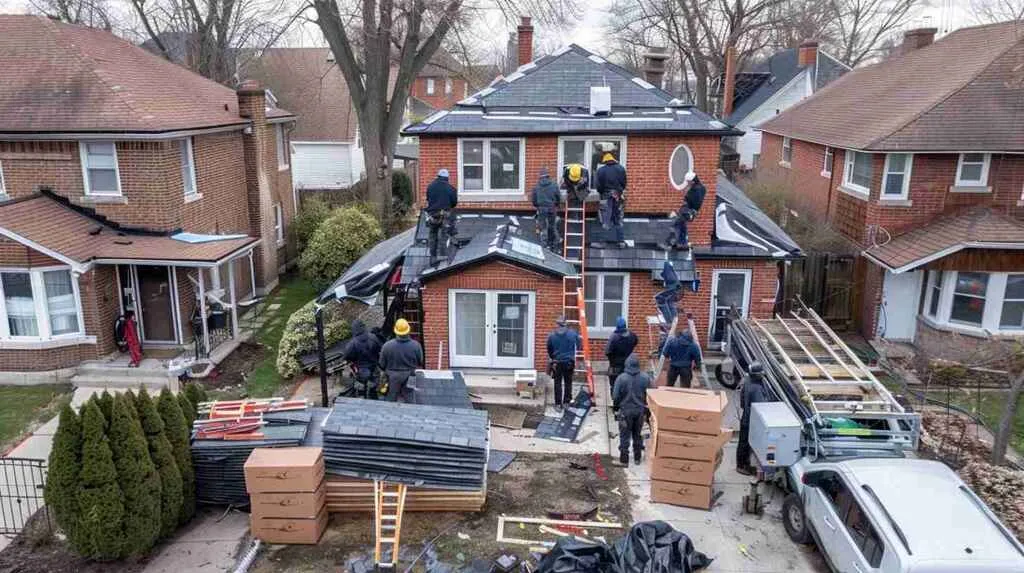
Can a Shingle Roof Be Repaired Queens NY – Repair vs Replace | Free Quotes
Counterintuitive as it sounds, a good chunk of those $12,000+ “full roof replacement” quotes you’re getting in Queens could actually be smart $800-$2,500 repairs if someone took the time to diagnose the problem instead of quoting by habit. I’m Carlos Vega, I’ve been on Queens roofs for 19 years, and I approach every leak like I used to troubleshoot computer networks back in my IT days – isolate the problem device, trace the bad connection, fix what’s actually broken instead of replacing the whole system.
Can a Shingle Roof Be Repaired in Queens, NY or Is Replacement Smarter?
Here’s my honest rule of thumb when someone asks, “Can a shingle roof be repaired?” – if the damage is localized and the surrounding shingles are still doing their job, you’re probably looking at a repair. Think of your roof like a computer network: you’ve got individual devices (shingles) and critical connections (valleys, flashing, vents). When one device fails or one connection goes bad, you don’t throw out the whole server rack; you swap the bad component. Same logic applies to roofs. Most Queens homeowners who call me in a panic after seeing a ceiling stain are picturing a $15,000 nightmare, but in my experience, about six out of ten turn out to be targeted repairs that cost a few hundred to a couple thousand dollars and buy another 5-10 good years.
Most shingle roofs in Queens don’t fail all at once – they age in sections based on sun exposure, wind patterns, and how well certain slopes shed water. A south-facing slope might still have years left while the north side (which stays damp longer) is already soft or curling. The real question isn’t “can a shingle roof be repaired” in some general sense; it’s “should this roof be repaired right now based on its age, the damage pattern I’m seeing, and what makes financial sense for you?” That’s why a proper inspection matters more than any phone estimate or satellite photo guess.
Start: Do you see leaks or stains in 1-2 spots only?
- Yes → Is your roof under 15 years old?
- Yes → Good repair candidate: likely localized shingle/flashings issue. Budget: $800-$2,500.
- No / Not sure → Any missing shingles or soft spots you can feel from the attic?
- No → Inspection needed but usually repairable: targeted shingle + flashing work.
- Yes → Borderline: may need partial replacement on the affected slope.
- No, I see issues in many areas → Do shingles look curled, cracked, or bald across an entire side?
- Yes → Replacement likely: at least one slope is at end of life.
- No → Mixed: could be poor installation or ventilation; inspection will decide between heavy repairs vs. phased replacement.
On a Typical Queens Roof Inspection, Here’s How I Decide Repair vs Replace
On a typical inspection in Queens, I start by asking you to walk me through exactly where you’re seeing water or stains inside – which room, ceiling or wall, near which window or vent. Then I head up to your top floor or attic and look at the underside of the roof deck for dark spots, active drips, and any soft areas around penetrations. This inside-out approach tells me a lot before I even climb a ladder, and it’s especially useful in Queens two-families and attached row houses where the leak path can zigzag along joists before it drips into the living space. One August afternoon in Flushing, I got called to a two-family where the owner was convinced he needed a whole new roof because of a brown stain on his bedroom ceiling. Sun was bouncing off every brick, temperature near 90, and he’d already gotten two quotes over $13,000. Turned out a single lifted shingle and a cracked plumbing vent boot were letting in water during sideways rain – the rest of the shingles were still in their prime, sitting flat and holding granules. I repaired eight shingles, replaced the boot, sealed the flashing, and his “new roof” panic turned into a $650 repair and a promise to stop Googling worst-case scenarios at midnight.
Once we understand what’s happening inside, the next connection is the roof surface itself. I walk every slope, feel for spongy areas with my foot, note any missing or curled shingles, and pay extra attention to north-facing sections that stay damp longer after rain. Then I zero in on the critical connections – valleys where two slopes meet, chimneys, skylights, plumbing vents, and drip edges. These are your network switches, the spots where different materials meet and water has the best chance to sneak through if something’s installed wrong or worn out. Here’s an insider tip I give everyone: if it’s safe, take photos or short videos when the leak is actually happening and note which direction the wind was blowing. That trace-back during the storm is like watching a data packet move through a network – it shows me the exact entry point instead of just the stain downstream.
When I first step into your house, before I even look at the roof, I’m going to ask you when it was last replaced, what work has been done before, and how the leaks behave – every storm, only heavy wind-driven rain, only during snowmelt. That history shapes my diagnosis just as much as what I see on the surface. I map the issues like troubleshooting a network: is this one bad device (a couple of shingles), a bad connection (flashing or valley), or is the whole subnet failing (rotten decking, widespread aging)? That logic is what keeps an $800 repair from ballooning into a $12,000 mistake – or prevents a band-aid patch when you really do need to replace at least one slope. At the end, I lay out a written plan with clear repair and replacement options, costs, pros and cons, and I ask you to repeat the plan back in your own words so I know we’re on the same page before I touch a single shingle.
Step-by-step: How I Diagnose Your Shingle Roof
- Interior check: I look at ceilings and walls under the roof for stains, bubbling paint, and musty smells, especially in top-floor bedrooms and hallways.
- Attic or top-floor access: I check underside of the roof deck for dark spots, active drips, and soft decking near vents and chimneys.
- Roof surface walk: I feel for spongy areas, note missing/curled shingles, and pay extra attention to north-facing slopes that stay damp longer.
- Critical connections: I inspect valleys, chimneys, skylights, and plumbing vents-these are your “network switches” where many leaks start.
- Age & history check: I ask when the roof was last redone, what work has been done before, and how leaks behave during different storms.
- Written plan: I lay out a repair option (if it’s safe and smart) and a replacement option (if needed), with clear pros, cons, and price ranges.
Service Basics for Queens Shingle Roof Inspections
Inspection fee: Often credited toward repair work when you hire us.
Typical inspection time: 45-90 minutes for most Queens one- and two-family homes.
Service area: Jackson Heights, Flushing, Astoria, Corona, Bayside, and surrounding neighborhoods.
Availability: Weekdays plus limited emergency slots after major wind or rain events.
What’s Usually Repairable vs What Demands a New Slope
Blunt fact: shingles don’t fail all at once like a light bulb – they age in zones. A storm might rip off a 3×3 patch on one corner while the rest of the roof sits perfectly flat. Sun-baked south slopes lose granules faster than shaded north slopes. Poorly ventilated sections can cook from below and curl years before the rest. So when I’m up there, I’m separating localized issues (a few missing shingles, a bad vent boot, a small storm patch) from system-level failures (soft decking you can feel underfoot, widespread granule loss, shingles that crack when you step near them). In November a few years back, right after the first cold snap, I was on a roof in Astoria at 7 a.m. with my breath fogging up my glasses. A landlord had paid another crew for a “patch job” that ignored the fact the entire north slope was soft as a sponge from years of trapped moisture – every time I stepped, the decking flexed under my boots like a trampoline. That’s the day I had to tell him: “You didn’t need that last ‘repair’ – you need to replace this whole slope or you’re funding a mold farm in your tenant’s ceiling.” We tore off one side only, rebuilt the deck, and saved him from a full-house replacement for at least another decade. That’s the difference: a repair fixes a local problem; a replacement resets a failing zone.
| When a Repair Makes Sense | When a Replacement Is Smarter |
|---|---|
| Roof is generally under 15-18 years old with most shingles lying flat and intact. | Roof is 18-25+ years old or age is unknown and shingles are curled, cracked, or bald across a full slope. |
| Leak traces back to a small area: a lifted shingle, a bad plumbing vent boot, or a single valley. | Decking feels soft or “spongy” underfoot on more than one area of the same slope. |
| Storm ripped off a section (like a 3×3 patch) but surrounding shingles are still in great shape. | Multiple old patches and mismatched shingles already exist and are failing again. |
| You want to stop an active leak and buy 5-10 more good years from an otherwise solid roof. | You’re planning to own the property long-term and want to reset the clock with a full manufacturer warranty. |
Call ASAP (Same Day or Next Day)
- Water actively dripping or pouring during rain inside your living space.
- Visible section of shingles missing or flapping after a windstorm.
- Ceiling bulging or sagging with trapped water.
- Burning or electrical smell near a water-stained light fixture.
Can Usually Wait a Few Days
- Old, dry stain that hasn’t changed in size for months.
- Small shingle cracks but no leaks inside yet.
- Gutter issues or minor fascia rot without interior damage.
- Planning/second-opinion visit on a replacement quote you already received.
What Roof Repairs in Queens Actually Cost vs Full Replacement
$850 might fix the leak that someone else tried to sell you a $14,000 roof for. Not always – sometimes you really do need that new roof – but more often than most contractors will admit, a targeted repair on the actual problem area gets you back to dry ceilings without emptying your savings. Repair costs in Queens vary based on how much material you need, how steep or high the roof is, whether we have to open up decking, and how accessible the problem spot is (a front gable is easier than a third-floor dormer tucked behind a chimney). Full replacements depend on square footage, how many layers we’re tearing off, whether the decking underneath is rotted, and what shingle grade you pick. Here’s a reality check on typical numbers.
Real Queens Repairs: How We Saved Roofs Without Full Replacement
I still remember one roof in Corona where the homeowner had gotten three quotes, all north of $11,000, and every contractor told him the whole thing had to go. When I got up there on a Saturday morning, coffee still warm in my thermos, I could see why they’d said that – shingles were definitely aging, some curling on the edges, a bit of granule loss. But the leak he was calling about? Traced right back to one lifted valley shingle and a poorly sealed skylight flashing. The rest of the roof had another solid 6-8 years if he kept an eye on it. I replaced the valley section, rebuilt the skylight flashing, and sealed three suspect penetrations for under $1,900. He called me two weeks later after a heavy rain to say his ceiling was bone-dry for the first time in a year. That’s the network-troubleshooting mindset: I found the bad connection (the valley and skylight), fixed those two points, and the whole system started working again. Compare that to the rainy March evening in Bayside – lightning flashing over the Throgs Neck – when a panicked homeowner called because water was “pouring in” over the dining room after a windstorm. When I got up there between showers with a headlamp, I found a 3×3 section of shingles completely ripped off, but the rest of the roof was only six years old and in great shape. We did an emergency tarp that night, documented everything with photos, then came back the next day for a targeted shingle and underlayment repair. His insurance covered it, and he still jokes that I saved his kid’s birthday party from relocating to the garage.
Think of your roof like a network: you’ve got individual devices (shingles) and critical connections (valleys, flashing, vents). Most Queens homes I inspect have issues at those connections – not because every shingle is shot, but because one flashing failed, one valley wasn’t lapped right, one vent boot cracked in the cold. A focused repair at that trouble spot can buy you many good years, especially if the bulk of your shingles are still lying flat and shedding water. I always confirm understanding with the homeowner before starting any work: I’ll lay out the plan, explain why I’m doing X instead of Y, then ask you to repeat it back in your own words. Not to quiz you, but to make sure we’re literally on the same page. If you can explain the logic back to me – “so you’re saying the valley is the problem, not the whole roof, and fixing that plus the two vents should stop the leak for about $1,600” – then I know you trust the plan and I’m not overselling or under-explaining.
Common Questions About Shingle Roof Repairs in Queens
Can a shingle roof be repaired in winter in Queens?
Yes, many repairs can be done in winter as long as temperatures and wind allow shingles and sealants to adhere properly. For deep-freeze days, we may do temporary protections (like tarps or emergency patches) and schedule permanent shingle work for a safer weather window.
Will a shingle repair match the rest of my older roof?
On newer roofs, we can usually get very close matches. On older roofs, there will often be a visible difference because the existing shingles have faded and lost granules; I’ll show you sample pieces on-site so you know exactly what to expect.
Should I call insurance or a roofer first after storm damage?
Call a roofer first if water is coming in; we can stabilize the situation, document damage with photos, and help you present clear information to your insurer. If it’s non-urgent, you can call both and schedule us to be there when the adjuster visits.
How long does a shingle repair usually take?
Most targeted repairs are completed in a single visit lasting 1-3 hours, depending on access and how much decking or flashing needs attention. More complex jobs, like rebuilding a valley or replacing a slope, can take a full day or more.
Can repeated repairs end up costing more than a new roof?
They can, which is why I lay out a side-by-side cost comparison when a roof is near the end of its life. If two or three big repairs would approach the cost of a new slope, I’ll tell you plainly so you can make a long-term decision instead of patching forever.
What to Note Before You Call About a Shingle Roof Leak
- ✅ Where exactly you see water or stains inside (room, ceiling vs wall, near which window or light).
- ✅ When it leaks: only in heavy wind-driven rain, every storm, or just snowmelt.
- ✅ Any recent work on the roof, siding, skylights, or chimneys.
- ✅ Photos or short videos of the leak during a storm, if it’s safe to take them.
- ✅ Any old roofing invoices or notes showing when the roof was last replaced.
The only honest way to know if your shingle roof in Queens can be repaired instead of replaced is a proper inspection – not a satellite guess, not a phone estimate, but someone who’ll walk your roof, check your attic, ask the right questions, and map the problem like a technician instead of a salesperson. Call Shingle Masters for a no-pressure, plain-English diagnosis and a free quote on the right solution for your roof – whether that’s an $800 repair or a phased replacement, you’ll get the truth and the logic behind it.