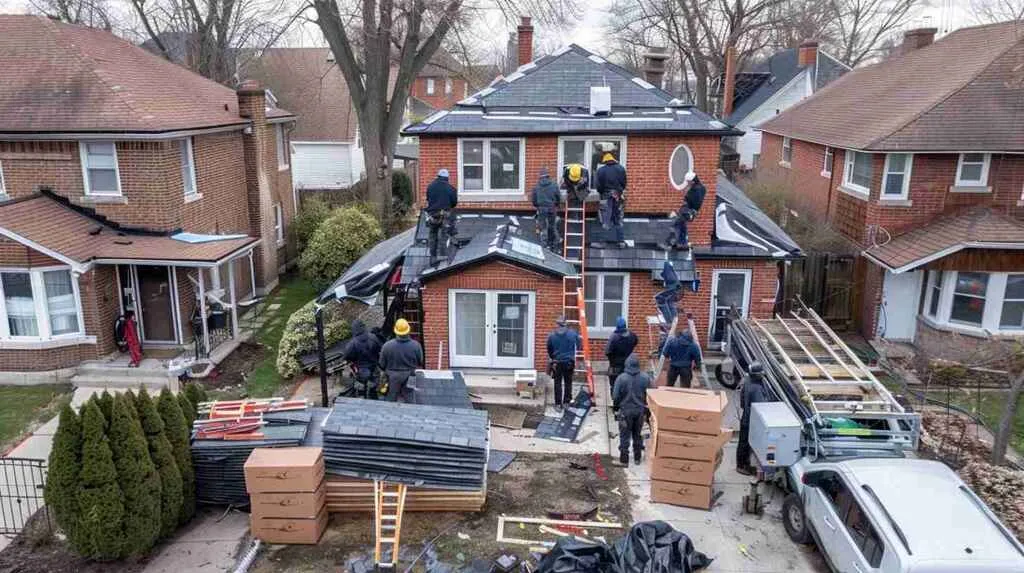
Asphalt Shingle Roof Leak Barrier Queens NY – Ice Shield Guide | Call Today
Parallel to the way a backup shut-off valve behind your wall can save you from flooding your living room, a $300-$600 roll of asphalt shingle roof leak barrier can save you from a $4,000-$9,000 interior repair in Queens. Ice and water shield sits directly on the wood deck under your shingles, bonds tight, and seals around every single nail-so when wind drives rain sideways, or ice backs up from your gutters, water can’t sneak under and run down into your walls the way it would on a bare deck.
How a $300 Leak Barrier Saves a $9,000 Queens Leak Repair
On a narrow block in Woodside, I watched a homeowner hand me a $4,200 estimate from a drywall contractor to fix water damage in two bedrooms and a hallway-all because someone had saved maybe $350 by skipping leak barrier at the eaves during a roof install three winters earlier. That thin, sticky membrane creates a continuous watertight layer under your asphalt shingles that acts like a backup pipe running the whole edge of your roof, catching water that gets past the shingles and directing it down and out instead of into your house.
One February morning in 2018, in Middle Village, I got a call from a retired bus driver around 6:30 a.m.-he had water dripping straight onto his coffee machine. It was 19°F, windy, and he swore his “brand-new” roof was junk. When I got up there, I found a perfectly fine asphalt shingle install with zero leak barrier at the eaves; ice had built up in his gutters, backed under the shingles, and was melting right into his kitchen wall. The gutter ice had created what I call an “accidental backwards pipe”-pointing water into the kitchen instead of out to the street. Here’s my honest take, whether you hire Shingle Masters or not: skipping leak barrier on a Queens roof is like leaving out shut-off valves behind your walls. You might get lucky for a while, but eventually a problem will find you, and when it does, the fix costs ten times what the prevention would have.
| Scenario | Description (Queens Example) | Approx. Cost Range |
|---|---|---|
| Install leak barrier during full reroof | Add ice & water shield at all eaves, valleys, and around two skylights on a typical 1,500 sq ft Astoria cape | $300 – $700 |
| Interior water damage repair (one room) | Ceiling drywall, insulation, and paint after ice dam leak in Middle Village kitchen | $1,800 – $3,500 |
| Multi-room interior damage | Two bedrooms, hallway, and partial attic framing in Jackson Heights two-family after valley leak | $4,200 – $9,000+ |
| Emergency winter repair (active leak) | After-hours call, tarp, temporary patch, then interior cleanup and mold treatment in Forest Hills townhouse | $2,500 – $6,000+ |
✓
Key Ice Shield Facts for Queens Asphalt Shingle Roofs
- Material: Rubberized asphalt membrane that bonds directly to plywood or OSB deck
- Self-sealing: Seals around every nail penetration automatically, creating watertight barrier under shingles
- Coverage: Minimum 2 feet up from eave edge in NYC code; Carlos often runs 4-6 feet on ice-prone Queens roofs
- Lifespan: Rated 20-30 years when properly installed, typically outlasts the shingles above it
Where Your Queens Roof Actually Needs Ice & Water Shield
When I first step onto a Queens roof in winter, the first thing I’m checking is the eaves, valleys, and anywhere shingles meet a vertical wall-because those are the spots where water gets confused about which way to flow and starts looking for shortcuts into your house. In Woodside, Jackson Heights, and Middle Village, I see a lot of older capes and colonials with complex valley systems and short eaves that trap snow and ice. Those roofs need leak barrier in more places than a simple gable, because every valley and every dormer intersection creates what I call a “pressure point” where water piles up and tests the shingles.
One summer evening just after a thunderstorm, I inspected a two-family brick house in Jackson Heights where the owner had tried to “DIY” his own leak barrier. He’d overlapped the ice shield the wrong way on a low-slope section and left bubbles everywhere, so water from the storm had actually funneled under the membrane instead of away from it. At 7:45 p.m., with the sky still flashing in the distance, I peeled it back with my heat gun and showed him how his shortcuts created a hidden swimming pool under the shingles. Here’s how that applies to your roof in Queens: overlap direction and tie-ins to drip edge and underlayment control the water route the same way a plumber decides which way a tee fitting points-get it backwards, and you’re building a funnel that dumps water exactly where you don’t want it.
Critical Locations for Asphalt Shingle Roof Leak Barrier on Queens Homes
Eaves: First 2-6 feet up from edge (depending on ice dam history in your neighborhood)
Valleys: Full length, extending 12-18 inches on both sides of valley centerline
Sidewalls & chimneys: 6 inches up vertical surface and 12+ inches out onto roof deck
Skylights: Perimeter ring at least 12 inches beyond curb in all directions
Roof-to-wall transitions: Dormers, porch tie-ins, and anywhere heated space meets cold eave
Low-slope sections: Any area under 4:12 pitch where water slows down and can back up
If water can see an easier path under your shingles, it will take it-every single time.
Do You Need More Leak Barrier on Your Queens Roof?
• Ice dams or icicles forming along gutters every winter?
YES → You likely need leak barrier at eaves and possibly along warm-wall lines
NO → Continue to next question
• Interior stains on ceiling near exterior walls or below valleys?
YES → Schedule immediate inspection-active leak route already established
NO → Continue to next question
• Roof installed before 2005 or has visible shingle lifting at edges?
YES → Inspection + partial leak barrier upgrade likely smart before next big storm
NO → Your roof may be fine; consider inspection before next full replacement
Not sure? Call Shingle Masters for a 20-minute roof walk-we’ll show you exactly what you’re working with.
How We Install Asphalt Shingle Leak Barriers the Right Way in Queens
Most leaks I fix didn’t start where people think-they started lower, at the edge where a little trickle of melt water found a gap between the drip edge and the shingles and started exploring. Installing leak barrier isn’t just about slapping down sticky rolls; it’s about creating a continuous, self-sealing “channel system” under the shingles, like hidden plumbing under a floor, so any water that gets past your first line of defense has a clear, controlled path back out. On chopped-up Queens roofs with dormers and skylights, I sometimes widen the leak barrier zones beyond the code minimum-running it 4 or 6 feet up the eaves instead of just 2, or extending it an extra foot past a valley edge-to catch those tricky water routes that only show up once every three years when we get a heavy wet snow followed by a quick freeze.
Back in 2011, I did a repair on a late-1800s rowhouse in Ridgewood where the attic had been turned into an Airbnb loft. The guests complained of a “mystery leak” that only showed up during those heavy wet snows we get once every few years in Queens. When I crawled into the eave space with my headlamp, I saw the old boards stained exactly at the transition from heated space to unheated eave, with no leak barrier at the edge-classic ice dam problem. I still remember lying there on my side, shoulder wedged between an antique chimney and a joist, explaining over speakerphone to the owner in Florida why we needed to strip back 6 feet and run a modern ice shield, not just smear on another layer of asphalt cement. It’s the same logic a plumber uses when replacing a short section of bad pipe instead of just wrapping more tape on the outside-you’re not patching the symptom, you’re fixing the water route itself.
Step-by-Step Leak Barrier Installation on an Asphalt Shingle Roof in Queens, NY
Inspect & Prep the Deck
Check plywood or OSB for rot, replace bad sections, sweep clean, ensure surface is dry and above 40°F before rolling out membrane
Install Drip Edge First
Nail metal drip edge along eaves so leak barrier can lap over it, directing water into gutter instead of behind fascia
Roll Out Ice & Water Shield
Start at eave edge, peel backing as you go, roll membrane up slope, press firmly to bond, avoid stretching or leaving bubbles
Overlap Correctly (This Is Critical)
Each upper course laps over the lower by 6 inches minimum, side laps 6 inches, so water always runs onto the next piece, never under it
Treat Valleys & Penetrations
Run separate strips up valleys, wrap around chimneys and skylights, seal all edges with compatible flashing and sealant
Install Shingles Over the Barrier
Nail through membrane into deck; self-sealing properties close around each nail, creating watertight seal under every shingle
DIY Mistakes with Ice & Water Shield on Queens Roofs
I’ve pulled off and redone enough bad leak barrier installs to know the top mistakes that turn a good product into an expensive mess:
- Reverse overlaps: Upper course tucked under lower course creates a funnel pointing water into the house
- Installing over dirty/icy decking: Membrane won’t bond, peels up under shingles, lets water run wild underneath
- Stretching the membrane: Material relaxes later, creates wrinkles and bubbles where water pools
- Leaving bubbles: Air pockets become water pockets; press it flat or start over
- Stopping short of the warm-wall line: Ice dams form right where the barrier ends-extend it past the heated envelope
What You’ll Likely Pay for Leak Barrier Work in Queens, NY
On a narrow block in Woodside, I watched a homeowner choose between adding eave leak barrier during a full reroof (added $420 to the job) versus doing just the one problem valley where she’d had two leaks already (cost $680 as a standalone repair because I had to pull back existing shingles, prep, and re-flash). The lesson: leak barrier is a minor line item when it’s part of a full roof replacement, but it’s still way cheaper than recurring interior repairs-and honestly, a lot cheaper than the anxiety of wondering every time it snows whether this is the storm that finds your weak spot.
Typical Queens Leak Barrier Service Scenarios & Price Ranges
| Situation | Scope of Leak Barrier Work | Typical Price Range (Queens, NY) |
|---|---|---|
| Add to full reroof | Eaves, valleys, skylights on 1,200-1,800 sq ft cape or colonial | $350 – $750 |
| Retrofit one side | Strip shingles, install leak barrier on north-facing eave with history of ice dams | $800 – $1,400 |
| Complex valley repair | Pull shingles from one valley, replace deck if needed, install leak barrier, re-shingle and flash | $650 – $1,100 |
| Around skylight | Remove skylight, treat deck, install perimeter leak barrier, re-flash and reinstall skylight | $700 – $1,300 |
| Full perimeter + valleys | Retrofit on chopped-up roof with dormers, multiple valleys, two chimneys (partial strip required) | $2,200 – $3,800 |
Note: Prices vary by roof access, pitch, existing damage, and whether we’re working around tenant schedules or coordinating with other trades. Call for an exact quote based on your specific Queens roof.
Quick Checks Before You Call a Queens Leak Barrier Pro
If you and I were standing in your driveway right now looking up at your shingles, I’d ask you one question: where did the first stain show up? Because that location tells me exactly where the water found its route-and water always follows a path, just like it does in your house’s plumbing lines. You don’t need to climb onto your roof or rip anything open before calling Shingle Masters, but there are a few simple, safe observations you can make from the ground or your attic that’ll help both of us figure out whether you’re dealing with a leak barrier issue or something else entirely.
✓
What to Check Before Calling About a Suspected Leak Barrier Issue
-
☐
Ice buildup: Do you see ice or icicles forming along your gutters or eaves in winter? -
☐
Interior stain location: Is the water mark on ceiling near an outside wall, below a valley, or under a skylight? -
☐
Attic frost: In winter, check for frost on underside of roof deck near eaves (sign of air leaks + ice dam potential) -
☐
Roof slope: Low-slope areas (under 4:12 pitch) are more vulnerable to water backing up under shingles -
☐
Valleys & skylights: Are there valleys, dormers, or skylights above the area where you see the leak? -
☐
Timing: Does leak appear only during ice/snow or also during heavy wind-driven rain? -
☐
Roof age: Was your asphalt shingle roof installed before ~2005 when leak barrier wasn’t standard practice in Queens?
Common Queens Leak Barrier & Ice Shield Questions
Why Queens Homeowners Call Shingle Masters for Leak Barriers
19 Years on Queens Roofs
Seen every leak pattern from Astoria to Ridgewood
Licensed & Insured
Full liability coverage on every job, every time
Same-Day Response
For active leaks and emergency situations
Complex Roof Specialists
Valleys, dormers, skylights-the tricky stuff
Picture your roof like the veins in your arm for a second-every shingle, every piece of flashing, every strip of leak barrier is part of a system that either moves water safely away or accidentally funnels it into your house. A quick, focused inspection can tell you exactly where you need leak barrier and whether it’s worth doing now or waiting until your next full replacement. Call Shingle Masters in Queens today, and I’ll walk your roof with you, sketch out the water routes in my little graph notebook, and give you a clear plan and price on the spot-no guessing, no upselling, just honest talk about what your roof actually needs.