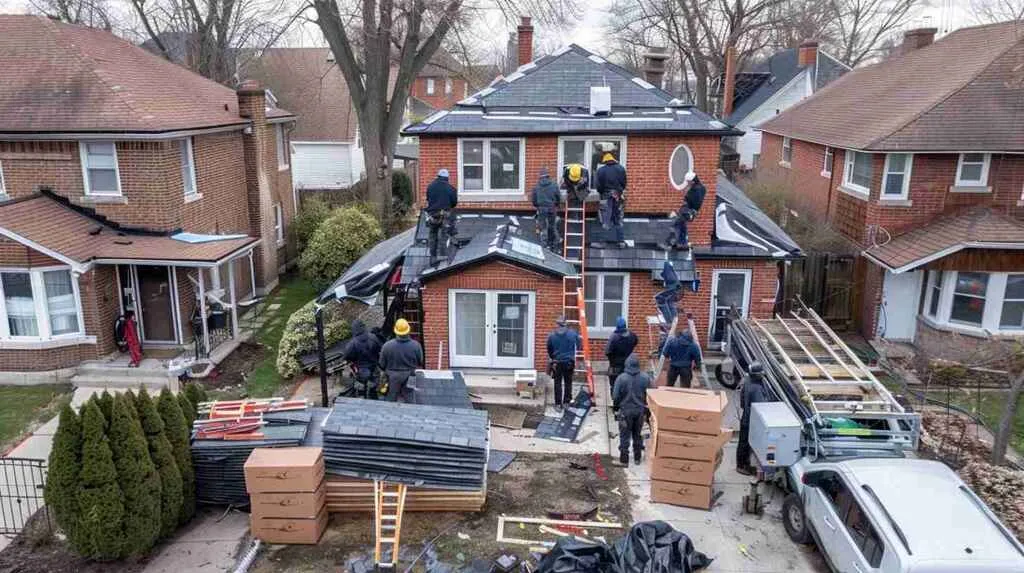
Asphalt Roof Repair Queens NYC – Licensed Roofers, Free Estimates
Underneath most of the brown ceiling stains I see in Queens living rooms is an asphalt shingle roof repair that’ll run you somewhere between $350 and $750 for a small fix, $800 to $1,800 for a medium section rebuild, or north of $2,000 if we’re dealing with multiple leak points or hidden underlayment damage. Two houses on the same block, built the same year, can have wildly different repair costs because one might have three layers of old shingles hiding problems and the other was stripped down clean during the last replacement-and you’d never know it from the sidewalk.
Asphalt Roof Repair Costs in Queens: What You’re Really Paying For
Underneath every repair estimate I write, there’s a story about what’s actually broken up on your roof. A lot of people think replacing a few damaged shingles should cost the same as swapping tiles in a bathroom, but asphalt roofing doesn’t work that way. The number I put on paper depends on your roof’s pitch (how steep it is and how carefully we have to move around), how many old layers are already up there hiding problems, whether your underlayment is shot, and what kind of access we have. On a Queens walk-up with tight lot lines and no alley, we’re sometimes hauling materials up three flights of stairs. And when I find lazy patch jobs from years back-someone who just smeared tar over a vent without fixing the shingle seal-that sloppy work usually adds to the scope because we’re fixing both the old damage and the bad repair.
One July afternoon, right after a brutal heatwave, I got a call from a retired teacher in Forest Hills who swore her roof was “melting.” I climbed up and the shingles were so soft from the heat you could almost leave a fingerprint in them, plus someone years earlier had done a lazy repair around the bathroom vent. I still remember standing there at 3 p.m., sun baking my neck, tracing with my finger how water was running under the lifted shingles and then sideways into her bedroom light fixture. That whole scene reminded me of working a busy shift as a paramedic-you don’t just treat the symptom, the ceiling stain; you find the real patient, which was that half-done vent flashing and three cracked shingles that had been cooking in Queens heat for who knows how long. That job taught me how dangerous half-done asphalt repairs can be when summer temperatures hit the mid-90s and turn your roof deck into a griddle.
The main cost drivers I see over and over in Queens: steep pitch means slower, safer work; multiple shingle layers mean we often have to peel back more than expected to find solid underlayment; deteriorated felt paper under the shingles means a surface patch won’t hold; narrow access between homes or onto a third-floor roof adds labor time; and complexity around chimneys, vent stacks, and old skylights always takes longer than a flat open section. A quick diagnosis from the attic and a chalk line on the roof will tell me whether you’re looking at a $400 shingle swap or a $1,200 section rebuild with new underlayment. Now, here’s what that means for you in real-world Queens scenarios.
Typical Asphalt Shingle Roof Repair Scenarios in Queens, NY
| Situation | Description | Typical Price Range | What I Usually See On Site |
|---|---|---|---|
| Minor storm damage | 3-8 shingles blown off or cracked, underlayment intact, no water entry yet | $350-$550 | Usually after a big windstorm, shingles torn at the edges; easy fix if we catch it before the next rain |
| Vent stack flashing leak | Water around plumbing vent, requires lifting shingles, sealing boot or collar, minor shingle replacement | $450-$750 | Cracked rubber boot or old tar seal that’s pulled away; I’ll replace the boot and re-shingle around it properly |
| Small section rebuild | 4×6 or 6×8 foot area with damaged shingles and underlayment, often near a valley or edge | $800-$1,400 | Multiple leaks traced back to one weak spot; I strip it, replace felt, and re-shingle to match the rest of the roof |
| Chimney flashing failure | Leaking around brick chimney, requires step flashing removal, counter-flashing reset, masonry seal | $1,000-$1,800 | Old flashing rusted or pulled loose from mortar; proper fix means cutting reglets into brick and sealing right, not just tar |
| Multi-layer complexity with hidden damage | Roof has 2-3 old shingle layers, leak source unclear, requires exploratory opening and broader repair | $2,000-$3,500+ | Water traveled sideways under layers; I end up opening a larger area to find rotted decking or soaked underlayment no one knew was there |
All prices assume licensed, insured roofing contractor, not handyman rates. Your exact cost depends on access, materials on hand, and whether you need emergency same-day service.
How I Diagnose Asphalt Roof Leaks in Queens Walk-Ups
On a two-family house in Woodside last fall, I got called for a brown stain spreading across a second-floor bedroom ceiling, right near the closet. The homeowner figured the leak was directly above the stain, but when I climbed into the attic and followed the framing lines with my flashlight, I found the water was actually running down a rafter from a vent stack about eight feet higher up the roof slope. That’s the thing about these Woodside two-families-most of them have asphalt roofs with at least two layers, and water doesn’t drop straight down like rain through air; it travels along nail shanks, across the top of old felt paper, and sometimes sideways for six or eight feet before it finally drips through onto your ceiling. I spend more time in attics tracing water paths than I do actually replacing shingles, and that’s exactly how I used to work emergency calls: find the real problem, not just where the pain shows up.
There was a Saturday in late October, drizzle all day, when a young couple in Astoria called because water was coming in “only when the wind is from the east.” Turned out, an old roofer had layered new asphalt shingles over an existing cracked layer and missed a tiny section by the chimney. I was on the roof in a light rain, marking with chalk every spot the wind-driven water could tuck under the lifted shingle edges, and I remember thinking how much that chalk line looked like the scene diagrams I used to draw on ambulance call reports. We ended up stripping a whole 6×10 section and rebuilding the underlayment, and that’s when I started telling people: if you see someone just smearing black goop around your chimney instead of opening the shingles and checking what’s underneath, send them home. A real fix means lifting the shingles, checking or replacing the step flashing, sealing the counter-flashing into the brick properly, and then re-shingling so it all sheds water the way it’s supposed to. Now, here’s what that means for you when you’re trying to figure out what kind of repair you actually need.
Figure Out What Kind of Asphalt Roof Repair You Probably Need
Ask yourself:
• Is the stain spreading or dripping?
• Can you see the damaged shingles from the street?
• Did this start after a specific storm?
Likely repair: Emergency inspection and immediate shingle/flashing fix or section rebuild. Usually urgent in Queens weather-don’t wait for the next rain.
Ask yourself:
• Is the stain dry and hasn’t changed in months?
• Did you just notice missing shingles from the yard?
• Are you planning to sell or refinance soon?
Likely repair: Full diagnostic inspection to map any hidden damage, then scheduled repair of weak spots, vent seals, or shingle replacement. Can usually wait a few days for the right weather window.
Not sure which path? Call Shingle Masters for a phone walkthrough. I’ll ask you three or four questions about when you see the water and where the stain is, and I can usually tell you over the phone whether you need someone out today or if it’s safe to schedule later in the week.
When a Shingle Patch Isn’t Enough in Queens Weather
Here’s the part most people don’t want to hear about asphalt roof repair: in Queens, you often can’t just replace one cracked shingle and call it done, because the surrounding shingles have been baking in July heat and freezing in February cold right alongside it, and they’re usually brittle or starting to lift at the edges. On top of that, a lot of the houses I work on have multiple shingle layers, so when I pull up one damaged piece I’m also exposing old nail holes in the layer underneath, and those holes become new leak points the minute it rains. Sometimes the only real fix is to open up a four- to six-foot section, check the underlayment for rot or tears, replace what’s bad, and then re-shingle the whole area so it all seals together properly. During a February cold snap at 6:30 in the morning in Richmond Hill, a landlord called panicked because her top-floor tenant had buckets in the living room and ice forming on the inside of the window trim. The shingles themselves looked okay from the street, but once I got up there, I found a patch job from years back where someone had mixed three different shingle brands and nailed through the overlaps. The freeze-thaw had turned those bad nail holes into tiny entry points all along one row, like a row of untreated patients on a triage board, each one bleeding a little bit of water into the attic every time it rained or the ice melted. I was up there with a headlamp in 20-degree weather, popping and replacing shingles one by one, realizing how much damage one sloppy repair line can do over a winter.
A quick surface patch is acceptable when you’ve got isolated storm damage-say, a tree branch cracked two shingles on an otherwise young, single-layer roof with good underlayment-and you catch it right away before water gets under the felt. But if your roof is more than ten years old, if there are already multiple layers, or if the damaged area is near a valley, chimney, or vent where water concentrates, you should insist that the roofer open up the section and check what’s underneath. I’ve seen too many “tar and go” repairs turn into $3,000 problems six months later because the roofer never addressed the real source: a torn piece of underlayment or a line of bad nails that let water run sideways under the shingles. Think of it like stopping the bleeding at the source-you don’t just put a Band-Aid over the wound and hope; you find where the damage actually is, clean it out, and close it up right. Now, here’s what you’re really choosing between when someone offers you a quick fix versus doing it properly.
Quick Asphalt Shingle Patch vs. Proper Section Rebuild
| Approach | Pros | Cons |
|---|---|---|
| Quick Surface Patch (Replace visible damaged shingles, seal with tar or caulk, no underlayment check) |
|
|
| Section Rebuild with Underlayment Repair (Strip 4-8 foot area, inspect/replace felt, re-shingle entire section to match) |
|
|
My take: If your roof is less than five years old and you caught a small storm break right away, a surface patch is fine. For everything else-especially on Queens roofs with multiple layers or if the leak has been going on for more than one storm-do the section rebuild. You’ll spend more today but save yourself from a $3,000 surprise next winter.
Waiting “one more storm” on an asphalt leak in Queens usually turns a $500 repair into a four-figure problem-water doesn’t get better on its own, and every freeze-thaw cycle or July heatwave makes the damage spread a little further across your underlayment and decking.
Queens Asphalt Roof Realities: Heat, Storms, and Old Layers
At 95 degrees on a July afternoon, asphalt shingles in Queens don’t behave the way they did in April. The surface gets so hot you can feel the warmth through your boot sole, and the shingles turn soft and pliable, which means if someone walks around carelessly they can leave scuff marks or even pull granules loose. Then winter comes and those same shingles freeze hard and brittle, and the nails that hold them down start to back out a tiny bit every time the temperature swings from 20 degrees to 45 and back again. That freeze-thaw cycle opens up nail holes, and once a nail hole is loose, water finds it. On top of that, a lot of the homes I work on in Jackson Heights, Astoria, Forest Hills, and Richmond Hill were built in the ’40s, ’50s, or ’60s, and over the decades homeowners or landlords kept layering new asphalt shingles over the old ones instead of stripping down to the deck. So now you’ve got two or three layers hiding problems-rotted felt, cracked old shingles, or even patches of deteriorated wood decking-and none of that shows up until I actually open a section and look.
I think about roofs the way I used to think about emergency scenes: water is the patient trying every possible escape route, and my job is to trace the whole path from where it enters (the cracked shingle or bad flashing) to where it finally causes pain (the ceiling stain or the drip onto your electrical panel). You can’t just treat the symptom and walk away. If I see a brown stain near a bedroom light fixture, I’m not patching the ceiling and calling it done; I’m going up on the roof, into the attic if I can, following the framing and the nail lines and the old felt seams until I find exactly where the water got in and why it traveled that direction. What homeowners should really be worried about isn’t the visible stain-it’s the hidden underlayment damage and the soaked insulation and framing you can’t see yet, because that’s what turns a $600 shingle repair into a $4,000 roof-and-ceiling job if you ignore it long enough.
Key Queens Asphalt Roof Facts Homeowners Should Know
When to Call for Asphalt Roof Repair in Queens
🚨 Call Shingle Masters Now
(same-day or next-morning)
- Active dripping or water pooling inside
- Ceiling stain spreading or paint bubbling
- Leak near electrical fixtures, outlets, or panel
- Large section of shingles blown off after storm
- Water running down interior wall or from light fixture
📅 Can Usually Wait a Few Days
(schedule during next dry window)
- Small, dry, old stain that hasn’t changed in months
- Missing or cracked shingle visible from yard, no leak yet
- Loose shingle flapping in wind but still attached
- Routine inspection before buying/selling home
Not sure? Call anyway. I’d rather spend five minutes on the phone helping you decide if it’s urgent than have you wait and end up with a ceiling full of water.
What to Check Before You Call and How We’ll Handle the Repair
If I’m standing in your living room and I see a brown stain on the ceiling, the first question I’m asking you is, “Does it show up during every rain, or only when the wind is from a certain direction?” The answer tells me whether I’m looking for a simple surface break or a more complex flashing problem where wind-driven rain is getting under shingle edges or around a chimney. I’d rather spend ten minutes on the phone asking you smart questions-when the leak started, what the weather was like, whether you’ve had any roof work done in the past few years-than rush out to your house and waste an hour looking in the wrong place because I didn’t gather the right details first. That’s the paramedic training in me: good triage over the phone saves time and gets to the real problem faster.
✓ Simple Things to Note Before Calling Shingle Masters for Asphalt Roof Repair
- Timing of the leak: Does it happen during every rain, only heavy storms, or when wind comes from a specific direction?
- Size and location of ceiling stains: How big (dinner plate, basketball, bigger?), and which room or rooms?
- Photos: Snap pictures of the ceiling damage and, from the sidewalk, the general roof area above the leak if you can see it safely
- Recent storms: Did this start after a specific windstorm, heavy snow, or heatwave?
- Age of roof: If you know roughly when the roof was last done, or if you’re the second or third owner and have no idea, mention that
- Prior patch spots: Can you see any old tar patches, mismatched shingles, or obvious repair attempts from the street?
- Neighbor roof work: If you’re in a row of attached homes, have the neighbors on either side had roof repairs or replacements recently? (Water sometimes travels between units.)
You don’t need to climb on the roof or go into the attic yourself-just note what you can see safely. I’ll handle the rest when I get there.
Common Queens Asphalt Roof Repair Questions
How fast can Shingle Masters get to my Queens house in an emergency?
For true emergencies-active leak, water dripping inside, or major storm damage-I’m usually on site within 2 to 4 hours during business days, and I’ll return your after-hours call first thing the next morning. If you call me at 7 p.m. with water coming in, I’ll talk you through temporary containment over the phone (buckets, moving furniture, shutting off power to wet fixtures if needed) and be there by 8 or 9 a.m. the next day with a tarp and repair plan.
Do you repair asphalt roofs, or only replace them?
I do both, and honestly I’d rather repair a roof properly than sell you a full replacement you don’t need yet. If your roof is 12 years old and you’ve got a vent leak, I’ll fix the vent and the surrounding section and you’ll get another 5 to 8 years out of the rest of it. But if I get up there and find three layers of shingles, rotted decking in multiple spots, and underlayment that’s completely shot, I’m going to tell you straight: a repair won’t hold, and you should budget for a replacement. I’ll explain exactly what I’m seeing and let you decide.
Can you work on roofs with multiple asphalt layers?
Yes, and I do it all the time in Queens. Most of the older homes I work on have two or three layers. For a repair, I’ll strip back the damaged section through all the layers, check the decking and underlayment, replace what’s bad, and then rebuild the section. If you’re planning a full replacement soon, I can sometimes do a temporary multi-layer patch to get you through one more season, but I’ll be clear about the limitations-it’s a Band-Aid, not a long-term fix.
Will my repair match the existing shingles?
I do my best to match color and style, and I keep a pretty good inventory of common shingle types used in Queens over the past 15 years. If your roof is newer and the shingles are still being made, the match will be nearly invisible. If your roof is older and the shingle line has been discontinued, I’ll bring samples and show you the closest match before I install anything. Asphalt shingles also weather over time, so a brand-new patch on a 10-year-old roof might look a little brighter for the first year, then blend in as it weathers.
Are you licensed and insured in NYC and Queens specifically?
Yes. Shingle Masters carries full NYC Home Improvement Contractor licensing, general liability insurance, and workers’ compensation coverage. I’ll provide copies of all certificates before we start any work, and if your bank or insurance company needs documentation for a claim or a refinance, I’ll send it over the same day you ask. I’ve been doing this in Queens for 19 years, and I make sure every job is by the book.
Why Queens Homeowners Hire Shingle Masters for Asphalt Roof Repair
Most asphalt roof leaks in Queens can be controlled if you catch them early and hire someone who’s willing to trace the problem all the way back to where the water actually got in. If you’ve got a ceiling stain, a drip, or shingles that don’t look right from the street, call Shingle Masters for a licensed on-roof inspection and a written estimate-estimates are free, and I’ll map out exactly what’s wrong, what it’ll take to fix it right, and how much you should budget so there are no surprises.