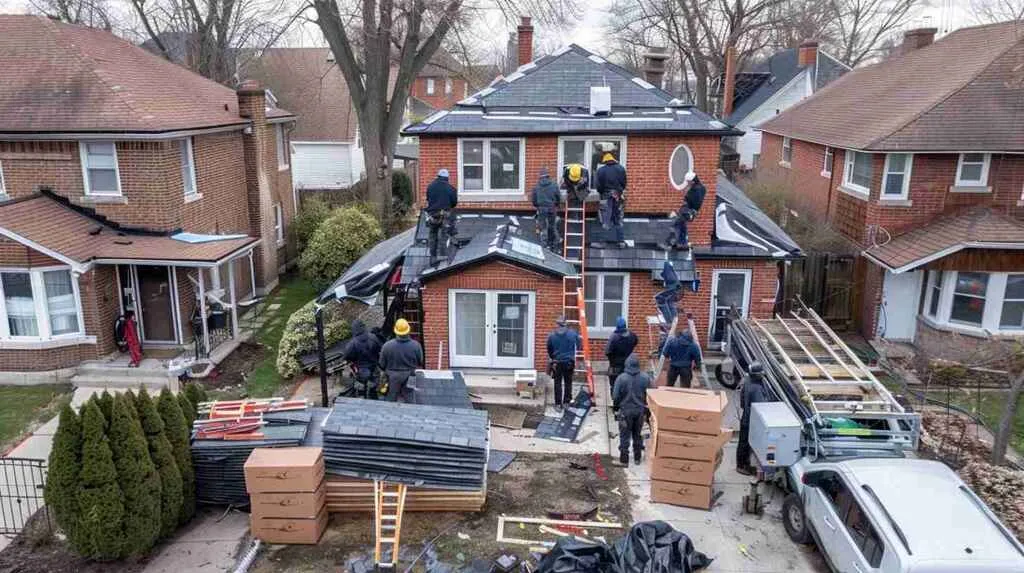
Best Roof Shingles That Look Like Slate Queens NYC – 2026 Options
Blueprint: In Queens in 2026, a roof that convincingly mimics real slate typically runs between $8.50 and $15 per square foot installed, and what separates the low end from the high isn’t marketing flash – it’s impact rating, wind uplift performance, how the color blend holds up under ten years of harsh Queens sun and freeze-thaw cycles, and whether it actually reads as slate from the sidewalk instead of looking like flat charcoal up close. The difference between a slate-look shingle that still impresses your neighbors in 2036 and one that curls, streaks, or blows off in five years comes down to choosing products the way I used to pick set materials for a long Broadway run: not just what looks good on day one, but what survives season after season under real conditions.
What “Slate Look” Really Costs in Queens in 2026
When someone tells me they want their Elmhurst rowhouse or Forest Hills detached home to have that classic slate look without the weight and cost of real stone, the first thing I do is walk them through what the $8.50-$15 installed range actually buys. At the lower end – around $8.50 to $10 per square foot – you’re looking at architectural asphalt shingles with a slate-style profile and a decent color blend, usually from a recognizable brand, installed with proper underlayment and ice-and-water shield on a straightforward roof with no crazy hips or valleys. These work beautifully on attached homes in Jackson Heights or Woodside where the roof isn’t the main character from the street but still needs to look sharp and handle our wind and ice. At the mid-high range – $10.50 to $12.50 – you’re stepping into Class 3 or Class 4 impact-rated slate-look asphalt with richer multi-tone granules, stronger wind ratings (often 130 mph or better), and algae resistance baked in, which matters a lot on north-facing slopes in neighborhoods like Rego Park or Kew Gardens where shade and moisture love to throw a party. And at the top – $12.50 to $15 – you’re into premium synthetic slate panel systems or the absolute highest-end asphalt lines that use sculpted tabs, deep shadow lines, and color blends so convincing that from the sidewalk, your roof reads like it came off a Park Slope brownstone. One August afternoon, about 3:30 p.m., I was on a Sunnyside two-family, the shingles hot enough to bubble a cheap soda, trying to convince the owner not to insist on real slate. She pulled out an old black-and-white photo of her grandparents’ house in Spain and pointed to the roof. I ended up matching that look with a high-end slate-look asphalt shingle and a darker drip edge, then we stood across the street in the heat shimmer and compared the photo to the real thing. That’s when I realized most people don’t want “slate” – they want the memory, and we can fake that very, very well in Queens without doubling the structural load.
On a typical block in Woodside, you’ll see exactly what I’m talking about if you look up for 30 seconds.
You’ll spot a mix: some roofs with cheap three-tab shingles that look flat and dull even on a sunny day, a couple with mid-grade architectural shingles in bland gray, and maybe one or two with a slate-look product that actually has dimension – the kind of roof where the tabs cast little shadows and the color shifts from charcoal to blue-gray to almost purple depending on the light. In harsh afternoon sun, a budget slate-look product often washes out and looks plasticky, almost chalky, while a premium one still holds its depth and texture. In gray winter light or during a rainstorm, those differences get even more obvious: the cheap stuff looks like a costume that got soaked and wilted, but the good stuff still “performs” like the set piece it’s supposed to be. I always tell homeowners to imagine their roof in every lighting condition – bright summer matinee, moody autumn twilight, and that nasty February sleet – because that’s the real test of whether you paid for a convincing slate dupe or just a flat imitation.
Here’s my honest take after nearly two decades of doing this in Queens: if you’re going to commit to a slate-look roof, paying toward the middle or higher end of that $8.50-$15 range is almost always worth it. The extra two or three dollars per square foot buys you impact resistance that matters when hail or ice chunks come flying off your neighbor’s gutter, wind ratings that keep your shingles on during those Broadway-style windstorms we get off the East River, and a warranty that actually holds up when installed by a certified local crew. Plus – and this is the part a lot of budget-focused folks miss – the total installed cost isn’t just about the shingle. It’s the system: the synthetic underlayment that won’t rot if a leak sneaks in, the ice-and-water shield along the eaves and valleys, the proper ventilation that keeps your attic from turning into a sauna and cooking your shingles from below, and the flashing details that stop water from sneaking in around chimneys and pipes. A $10 slate-look shingle installed on a cheap felt underlayment with sloppy flashing is going to fail faster than an $8.50 shingle installed to full manufacturer spec with good backstage work. That’s why I often steer homeowners toward the $10.50-$12.50 sweet spot: it’s the zone where you get a proven product line, solid ratings, and enough budget left over to do the underlayment and details right.
Installed 2026 Slate-Look Roof Costs in Queens by Scenario
| Queens Roof Scenario | Slate-Look Material Type | Estimated Installed Cost per sq ft | Typical Total Roof Cost (1,200-1,600 sq ft) | Notes for Queens Homes |
|---|---|---|---|---|
| Small attached rowhouse in Jackson Heights | Architectural asphalt, slate-look line | $8.50-$10.00 | $10,200-$16,000 | Best budget dupe; lighter weight, good for older framing. |
| Two-family in Woodside with moderate roof complexity | Premium Class 4 impact-rated slate-look asphalt | $10.50-$12.50 | $12,600-$20,000 | Sweet spot for storm resistance and curb appeal. |
| Detached single-family in Forest Hills Gardens | High-end synthetic slate panel system | $12.50-$15.00 | $15,000-$24,000 | Best visual match to slate; requires precise install and good framing. |
| Larger corner lot in Astoria with complex rooflines | Mixed: slate-look asphalt on main roof, metal accents | $11.00-$14.00 | $18,000-$28,000 | Used when owner wants a “custom set” look with accent pieces. |
Fast Queens 2026 Slate-Look Roof Facts
- Typical installed range in Queens: $8.50-$15.00 per sq ft.
- Most popular choice: Class 3-4 slate-look asphalt on attached homes.
- Common roof size quoted: 1,200-1,600 sq ft for rowhouses and small detached homes.
- Real slate in Queens: Often $18+ per sq ft installed plus possible structural upgrades.
How to Judge Slate-Look Shingles That Actually Last in Queens
Let me be blunt: if a “slate-look” shingle curls in ten years, I don’t care how pretty it was on day one – it failed. When I’m sorting through slate-look options for a Queens home, I’m judging them the same way I used to evaluate set pieces for a long-running Broadway show: does this thing have the bones to survive season after season under real conditions, or is it going to look great opening night and then fall apart by week twelve? The criteria that matter aren’t subjective – they’re measurable. I want to see a Class 3 or Class 4 impact rating so the shingle can handle hail and those nasty ice chunks that slide off gutters during freeze-thaw cycles. I want a wind uplift rating of at least 130 mph, because we get those sudden gusts off the East River that peel shingles right off exposed blocks in Astoria and Long Island City. I want algae-resistant granules baked into the product, not just sprayed on as an afterthought, because north-facing slopes in shady neighborhoods like Kew Gardens and Rego Park will start streaking black within a few years if you skip that feature. And I want a rich, multi-tone color blend – not a flat single color – so the roof still reads as “slate” from the sidewalk in bright summer sun, gray winter overcast, and rainy twilight. One November morning, just after a freezing rain, I got a call from a client in Forest Hills Gardens whose “slate-look” plastic tiles – installed by a bargain contractor – were literally snapping in half and sliding into her copper gutters. I remember my hands going numb as I picked up pieces and could see how brittle they’d gone after only eight winters. We stripped it all, beefed up the underlayment, and replaced it with a Class 4 impact-rated slate-style asphalt shingle; two winters later, after a nasty ice storm, she texted me a photo of her roof like it was a Christmas card. That job taught me that material choice in Queens is about performance under stress, not catalog glamour shots.
What separates the winners from the wannabes
The products that actually earn the “best roof shingles that look like slate” title in Queens share a few non-negotiables. First, they’ve been third-party tested for impact and wind – not just the manufacturer saying “yeah, it’s tough,” but actual UL or FM ratings you can look up. Second, they use a fiberglass mat base that stays stable through decades of temperature swings instead of organic felt that can rot or warp. Third, the granule adhesion is strong enough that you’re not going to see bald spots after five years of Queens weather beating on it. And fourth – this one’s subtler but just as important – the shingle profile has enough depth and shadow that it doesn’t look like a flat applique when you’re standing across the street. Some of the best slate-look asphalt lines use a multi-layered laminate construction where the tabs are literally built up in sections, so you get real dimensional shadow lines like individual slate pieces overlapping. The cheaper knock-offs just print a slate pattern onto a flat shingle and call it good, and trust me, your neighbors will be able to tell the difference from a block away.
Queens-specific performance checkpoints
In Queens, your slate-look roof has to survive a few specific challenges that don’t show up in every climate. We get freeze-thaw cycles that can crack brittle materials, intense summer heat that cooks poorly ventilated attics and curls shingles from below, wind exposure on corner lots and elevated blocks that tests every nail and sealant strip, and tree cover in neighborhoods like Kew Gardens and Forest Hills that keeps roofs damp and invites algae and moss. So when I’m vetting a product, I make sure it’s rated for at least 130 mph wind uplift – which covers most of Queens even in a serious storm – and I prefer Class 3 or 4 impact ratings so falling branches, hail, and ice don’t punch through. Algae resistance matters more than most people think; without it, you’ll have black streaks running down your north-facing slopes within five to seven years, and suddenly your beautiful slate-look roof looks like it’s rotting. And the warranty has to be transferable and actually enforceable, which usually means the product was installed by a manufacturer-certified local contractor who followed the exact nail placement, underlayment spec, and starter course requirements in the manual. Skip any of that backstage work, and your warranty is just a piece of paper with nice fonts.
Non-Negotiable Features for a Slate-Look Shingle in Queens
- ✅ Class 3 or 4 impact rating to handle hail and ice chunks from freeze-thaw.
- ✅ 130 mph wind rating or better for those Broadway-style windstorms off the East River.
- ✅ Algae-resistant granules to keep dark streaks off north-facing slopes in Rego Park and Elmhurst.
- ✅ Multi-tone color blend so the roof still “reads” as slate from the sidewalk, not flat charcoal.
- ✅ Manufacturer-certified installation so the warranty actually means something.
⚠️ Warning: Avoid ultra-lightweight plastic slate-look tiles that don’t list a Class 3 or 4 impact rating and only show “limited residential warranty” in fine print. In Queens, these can go from flexible to brittle in under a decade, especially on north-facing slopes that stay icy, leading to cracks, sliding pieces, and torn-up gutters like the Forest Hills Gardens failure I had to rebuild.
High-End Slate-Look Asphalt vs Budget Plastic Slate-Look Tiles
| High-End Slate-Look Asphalt | Budget Plastic Slate-Look Tiles |
|---|---|
| Pros: Class 3-4 impact options, strong wind ratings, predictable aging, easier repairs, good warranties with certified installers. | Pros: Light weight, sometimes slightly cheaper on day one, can look sharp in catalog photos. |
| Cons: Heavier than basic shingles, needs proper ventilation and underlayment to hit lifespan claims. | Cons: Can get brittle in Queens winters, higher risk of cracking and blow-offs, many fade to a chalky, plastic look. |
| Best Use: Attached and detached homes across Queens where owners want 20-30 years of service and solid curb appeal. | Best Use: Rarely ideal in Queens; only consider for very low-slope accent areas after a structural and warranty review. |
Real Slate vs the Best Slate Dupes for Queens Homes
I still remember standing on a Maspeth garage roof at sunset, holding two sample boards side by side while the owner squinted and said, “They look the same to me.” One was a premium slate-look asphalt shingle with sculpted edges and a charcoal-to-blue-gray blend; the other was a piece of actual Vermont slate. From six feet away, yeah, they looked nearly identical. But when you moved in close, the real slate had that irregular edge cut and depth of color that comes from being an actual piece of stone that formed over millions of years, while the asphalt version had a manufactured precision to it – perfect shadows, consistent thickness, and a pattern that repeated every so often. Here’s the thing: from the sidewalk, from across the street, even from your neighbor’s porch, the high-end asphalt “costume” reads as slate. It plays the part beautifully. The subtle differences only show up when someone climbs a ladder and inspects your roof with a magnifying glass, which basically never happens. One job that still makes me laugh was a midnight emergency in Astoria during a windstorm, sirens all over, pizza boxes flying down Broadway, and a film crew next door shooting some fake snow scene. A synthetic slate panel had peeled off a roof that wasn’t fastened to manufacturer spec – the nails were too high, and they’d skipped starter course on the eaves. Under a flapping blue tarp and red set lights, I walked the owner through why his “upgrade” had failed and literally sketched the correct nailing pattern on the back of a takeout menu. We later redid the whole roof with a different slate-look system rated for higher wind uplift, and he kept that greasy drawing taped to his boiler for years. That taught me that installation matters just as much as material choice – even the best slate dupe will fail if the backstage rigging is sloppy.
What you gain and lose when you skip real stone
Real slate is heavy, gorgeous, and can last a century if installed correctly. But in Queens, where a lot of our housing stock is older attached rowhouses and wood-frame detached homes, real slate often means a structural review, possible framing upgrades, and a price tag that lands north of $18 per square foot installed – sometimes pushing toward $25 or $30 if you’re dealing with complex roof lines or historical district requirements. You also need a crew that actually knows how to work with stone slate, which is a specialized skill; a regular roofing contractor who’s great with asphalt can mess up a slate job in ways that won’t show until the first big storm. On the flip side, premium slate-look asphalt weighs about the same as other architectural shingles, installs on standard Queens framing without upgrades, and costs $10.50 to $12.50 per square foot installed for a Class 4 product with strong ratings. Repairs are straightforward – any decent local crew can patch a blown shingle – and the warranties are solid if you use a certified installer. Synthetic slate panel systems split the difference: they’re lighter than stone but heavier than asphalt, they look incredibly convincing up close, and they cost $12.50 to $15 per square foot installed. But they require precise installation – exact nail placement, correct overlap, proper starter and ridge details – and if your installer treats them like regular shingles, you’ll end up with failures like that Astoria windstorm mess.
Picking the right “costume” for your roof
When I’m helping a Queens homeowner choose between real slate, synthetic slate, and slate-look asphalt, I always ask them to think about their roof like a costume for a long-running show: What’s the audience view from the street? How visible is your roof from neighboring properties and passing traffic? What’s your budget for opening night and ongoing maintenance? And how much structural “rigging” can your house handle? For most attached homes in Jackson Heights, Woodside, or Elmhurst, a premium slate-look asphalt shingle is the smart choice: it reads as slate from the sidewalk, it’s light enough for typical framing, and it costs less up front and over time. For detached single-family homes in Forest Hills or Bayside where the roof is a major visual feature and the owner wants that extra level of authenticity, a high-end synthetic slate system makes sense – as long as we’re clear on the installation requirements and the installer actually follows the manual. And for landmark homes or very specific historical contexts where real stone is non-negotiable, we budget for real slate and bring in the right crew and engineer. The key is matching the “costume” to the actual demands of the performance: how the roof looks from the viewing angle that matters, how it holds up under Queens weather for 20 to 30 years, and whether the structure can carry the weight without sagging or cracking.
Real Slate
- Weight: Very heavy; often requires structural review and framing upgrades on older Queens houses.
- Look: Authentic stone texture and random variation up close.
- Maintenance: Individual slate replacement can be fussy; needs slate-experienced crews.
- Cost: Often $18-$30+ per sq ft installed in 2026 in Queens.
- Best For: Landmark-level homes where budget and structure aren’t constraints.
Premium Slate-Look Asphalt
- Weight: Similar to other architectural shingles; usually fine on existing framing.
- Look: Convincing slate “read” from the sidewalk with sculpted tabs and rich color blends.
- Maintenance: Familiar to most Queens roofing crews; easy repair and patching.
- Cost: Typically $10.50-$12.50 per sq ft installed in Queens in 2026.
- Best For: Rowhouses and small detached homes wanting slate look without major structural work.
Common Myths Queens Homeowners Believe About Slate-Look Roofs
| Myth | Fact |
|---|---|
| “All slate-look shingles are basically the same; it’s just color.” | Impact rating, wind rating, base mat quality, and installation method create huge differences in lifespan and performance. |
| “If it looks good in the sample, it’ll look good on my roof.” | Some products wash out in bright sun or streak badly in a few years; you have to think about how it reads from the sidewalk after ten seasons. |
| “Real slate always lasts longer than any imitation.” | On underbuilt Queens framing with poor details, real slate can fail early; a properly installed premium asphalt dupe can outlast a bad slate job. |
| “Lighter synthetic tiles are always safer for old houses.” | Tiny, ultra-light plastic tiles can be more vulnerable to cracking and blow-offs in Queens storms. |
| “Wind damage is just bad luck.” | Correct nail placement, starter course, and matching the product to local wind exposure are the backstage rigging that keep your roof on during a storm. |
Queens-Specific Choices: Block, Budget, and “Audience View”
When I walk into a house and the owner says, “I want slate,” my next question is always, “What scares you most: cost, weight, or maintenance?” That tells me immediately whether we’re talking real stone, premium synthetic, or slate-look asphalt. Then I zoom out and think about the block: Is this a narrow attached street in Jackson Heights where the roof is barely visible, or a wide corner lot in Forest Hills Gardens where your roof is the main character in the streetscape? Is your house surrounded by basic three-tab shingles, or are you next to beautifully detailed Tudors and colonials with high-end roofs? Because the “audience view” from the sidewalk and across the street matters more than most people realize. I had a client on a tight block in Woodside whose roof you could only see if you stood directly in front of her house and craned your neck; we went with a solid mid-range slate-look asphalt that looked great but didn’t need to be the fanciest option on the market. Compare that to a detached home on a wide street in Forest Hills where the roof was visible from half a block in every direction – there, we chose a premium multi-tone slate-look product with deep shadows and a color blend that shifted from charcoal to slate-blue depending on the light, and the homeowner still gets compliments years later. Your roof is a costume playing to a specific audience at a specific viewing distance, and you want to design it accordingly.
Here’s the uncomfortable truth a lot of sales reps skip: some of the fanciest-looking slate imposters age in ugly ways in our Queens climate. I’ve seen slate-look shingles that looked stunning in the showroom sample board but turned chalky and washed-out after five years of harsh Queens sun. I’ve seen products that photographed beautifully but developed algae streaks on north-facing slopes because the manufacturer skipped proper algae-resistant granules. And I’ve seen roofs that looked perfect on install day but started showing curling and cracking after a few freeze-thaw cycles because the base mat wasn’t robust enough for our temperature swings. That’s why I always evaluate sample boards in different light – bright afternoon sun, overcast gray sky, and if possible, twilight – and I show homeowners nearby roofs that are eight to twelve years old so they can see what their shingle choice will actually look like after a decade of real use. On one walk-through in Woodside, I pointed out three different slate-look roofs on the same block: one still looked sharp and dimensional after ten years, one had gone flat and dull, and one was streaking badly. All three had cost roughly the same on install day, but the homeowners had chosen different product lines. Guess which one was still getting compliments?
Decision Guide: Picking Your Best Slate-Look Option
Start: Do you need the roof to look historically exact up close?
If YES: Is your framing strong enough and are you okay with a higher budget?
- ✓ YES → Consider real slate or top-tier synthetic slate with engineer sign-off.
- ✓ NO → Consider premium slate-look asphalt with rich multi-tone colors.
If NO: Is your biggest concern budget or long-term durability?
- ✓ Budget → Choose a mid-range slate-look asphalt on the lower end of $8.50-$10 per sq ft.
- ✓ Durability → Choose a Class 4 slate-look asphalt or robust synthetic rated for high wind uplift.
Final check: Is your house on a wide street or corner lot where the roof is very visible?
- ✓ YES → Prioritize strong color blends and profile depth so the roof “reads” as slate from a distance.
- ✓ NO → You can lean slightly more budget-conscious and focus on performance ratings.
Before You Call Shingle Masters: What to Know About Your Queens Roof
- ✅ Measure or estimate your roof size (or at least number of stories and footprint) so quotes land in the right ballpark.
- ✅ Note your house type: attached, semi-attached, or fully detached.
- ✅ Look around your block and snap 2-3 photos of roofs you like and don’t like.
- ✅ Check if you have any active leaks or stained ceilings – mention where they show up.
- ✅ Gather any past roof paperwork: age of current roof, brand, and any warranty info.
Installation, Maintenance, and What to Expect with Shingle Masters
Think of your roof like a long-running Broadway show: the audience sees the costume, but the rigging and backstage work decide whether it closes in a month or lasts twenty years. When we install a slate-look roof in Queens, the shingles themselves are just the visible final layer – the stuff nobody sees, like the synthetic underlayment, the ice-and-water shield along the eaves and valleys, the proper ventilation baffles, and the exact nail placement specified by the manufacturer, is what actually determines whether your roof survives decades of Queens freeze-thaw, wind, and summer heat. At Shingle Masters, we start every slate-look job with an on-site inspection of your existing roof and framing to confirm the deck is solid, identify any rotten wood that needs replacing, and make sure your house can carry the weight of the product you’ve chosen. Then we do a full tear-off so we can see exactly what we’re working with – no guessing, no shortcuts. The underlayment goes down to spec, the flashing details around chimneys, vents, and skylights get done right, and every shingle is nailed to the manufacturer’s exact pattern so your warranty holds. We finish with a walk-through from the sidewalk so you can see how your new roof reads from the audience view, and we leave you with photos of the underlayment and critical details so you know the backstage work was done properly. With the right product and installation, your slate-look roof will still play beautifully twenty years from now, looking sharp in bright sun and holding strong through every Queens storm.
How a Slate-Look Roof Install Works in Queens with Shingle Masters
-
1
On-site roof and framing check: We inspect decking, existing layers, and structure to confirm what your house can safely carry. -
2
Product selection “casting” session: We match slate-look options to your block, budget, and how visible the roof is from the street. -
3
Full tear-off and deck prep: Old roofing comes off, we re-nail the deck, and replace any rotten wood. -
4
Underlayment and flashing “backstage” work: Ice & water shield, synthetic underlayment, and metal details go in to Queens-specific specs. -
5
Shingle install to manufacturer spec: Correct nail placement, starter courses, and ventilation so your warranty holds. -
6
Final walk-through from the sidewalk: We review the roof with you from the street so you see how the new “costume” reads.
Long-Term Care for a Slate-Look Roof in Queens
| Time After Install | Maintenance Task |
|---|---|
| Year 1 | Visual check from the sidewalk and backyard after major storms; confirm no missing or lifted shingles. |
| Every 2-3 years | Professional roof inspection and gutter cleaning, especially under tree cover in neighborhoods like Kew Gardens. |
| Year 10-12 | Targeted sealant refresh at flashings and penetrations if needed; verify ventilation is still clear. |
| Year 18-25 | Begin planning for replacement depending on product line, exposure, and storm history. |
Common Queens Questions About Slate-Look Roofs
Will a slate-look asphalt roof really fool people from the street?
On most Queens blocks, yes. With the right profile and color blend, your roof will read as slate from typical sidewalk viewing distance – most neighbors will just think you upgraded, not that it’s asphalt.
Can my older rowhouse handle real slate?
Sometimes, but not always. We need to inspect your framing and, if necessary, bring in an engineer; many older attached homes are better served by slate-look products that keep weight down.
How long will a good slate-look roof last in Queens?
Installed correctly with quality materials, you should expect 20-30 years from premium slate-look asphalt here, depending on exposure, ventilation, and storm history.
Do I need permits to change from asphalt to a slate-look system?
In most standard re-roofs where you’re not changing structure, it’s straightforward, but historic districts and major structural changes can trigger extra reviews. We handle that homework for you.
Is winter a bad time to replace my roof in Queens?
We avoid installs in extreme cold snaps, but many winter days are workable; the key is using the right underlayment and techniques for cold-weather installation.
Why Queens Homeowners Choose Shingle Masters for Slate-Look Roofs
- Licensed & insured in NYC for roofing work on attached and detached homes.
- 19+ years of local roofing experience with a focus on slate-look systems in Queens.
- Manufacturer-certified for major premium slate-look asphalt lines.
- Queens-focused: Deep experience with Woodside, Jackson Heights, Astoria, Forest Hills, and surrounding neighborhoods.
The best roof shingles that look like slate for a Queens home in 2026 come down to matching the right product – whether that’s a $10.50 Class 4 impact-rated asphalt shingle, a $13 synthetic slate system, or even real stone if your framing and budget allow – to your block, your budget, your house structure, and how your roof plays from the sidewalk over twenty or thirty years. If you’re ready to stop scrolling through catalog photos and start looking at real roofs in your neighborhood, call Shingle Masters and let’s walk your block together, talk about what you actually need, and get you a precise 2026 quote for a slate-look roof that’ll still look sharp and hold strong decades from now.