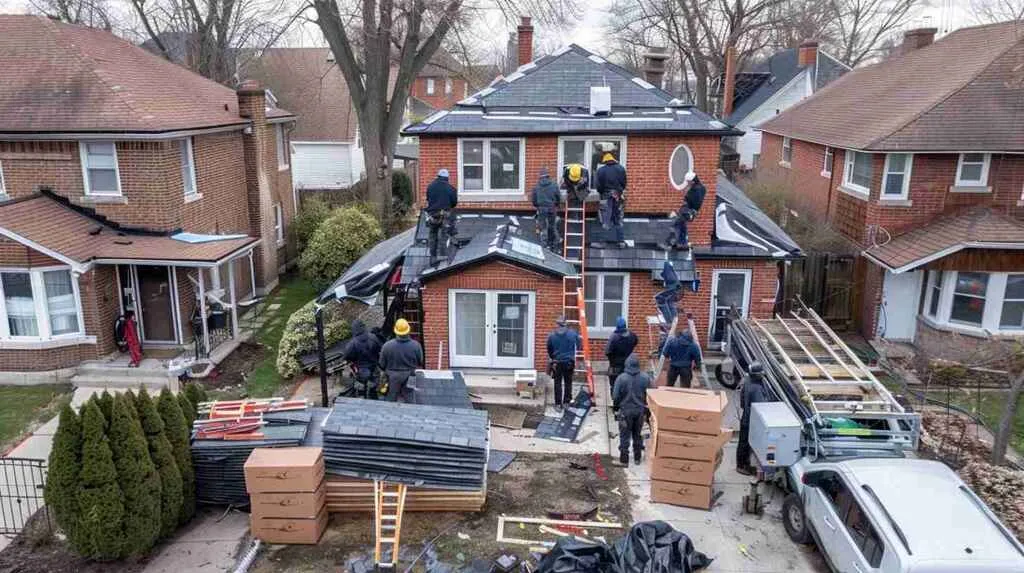
Roof Shingle Cleaner Queens NY – What Works, What Damages | Free Estimates
Chemistry doesn’t lie, and neither do shingles that crumble under your fingers. The fastest, cheapest “solution” most people grab-a jug of straight bleach from the dollar store or a borrowed pressure washer cranked to max PSI-usually causes hundreds or even thousands of dollars in damage, stripping away years of roof life in minutes. I’m going to walk you through exactly why that happens from both a chemistry and roofing standpoint, using real Queens roofs I’ve seen, real cleaners people tried, and what actually protects your shingles instead of wrecking them.
What Really Happens When You Bleach or Pressure-Wash Shingles in Queens
One July afternoon in Woodhaven, it was about 92 degrees and the homeowner’s cousin had already “pre-treated” the roof with straight bleach from a dollar store jug. I climbed up, and the shingles were literally crumbling under my fingers like stale cookies-granules sliding off in sheets. The poor guy thought he was saving money on a roof shingle cleaner; instead he shaved a good 8-10 years off that roof’s life. I ended up cutting out a section, bringing it down, and showing them under a magnifying loupe how the asphalt binder looked dried and cracked from the chlorine. As someone who used to mix industrial cleaners for a living at a cosmetics factory in Long Island City, I can tell you: straight bleach on shingles is like using drain cleaner as shampoo-yeah, it’ll strip everything off, but you’re destroying what you’re trying to protect. The shingle’s job is to shed water and block UV rays; that sandy texture you feel when you run your hand across a good roof is thousands of ceramic granules embedded in asphalt binder. Full-strength chlorine oxidizes and dries out that binder, especially on a hot roof under Queens summer sun, turning it brittle and letting granules just slide away.
Here’s my blunt answer as someone who used to mix industrial cleaners for a living: chlorine bleach at high concentrations breaks down asphalt the same way it breaks down organic stains-by aggressive oxidation. On your roof, that means the flexible petroleum-based binder holding granules on starts to harden, crack, and lose adhesion. Add Queens heat, freeze-thaw cycles from coastal storms, and the humidity that makes algae grow in the first place, and you’ve got a recipe for premature failure. When granules wash away, the fiberglass mat underneath gets exposed to direct sunlight and rain, which is when leaks and curling start showing up. That couple in Woodhaven ended up needing targeted repairs on sections where the bleach had been poured heaviest-not just a cleaning, but actual shingle replacement, all because someone thought “bleach kills everything, so it’ll clean everything.”
⚠️ Major Roof Killers in Queens
- Straight household bleach poured or sprayed at full strength on shingles
- Any pressure washer over 100 PSI pointed directly at the roof
- Generic “mildew remover” with sodium hypochlorite but no surfactants or buffering agents
- Walking all over a hot roof to scrub stains with stiff brushes
Each of these strips protective granules, dries out the asphalt binder, and can void manufacturer warranties.
Bleach, Pressure, and Your Shingles: A Quick Chemistry Lesson from a Queens Roofer
There was a Saturday morning in Howard Beach after one of those sticky August thunderstorms when I got called by an older couple who thought they had a “mold infestation” on their shingles. Turned out their grandson had pressure-washed the roof with a borrowed 3,000 PSI machine, and the black they were seeing was actually exposed shingle mat where the granules had been blasted off. I walked them through the difference between algae staining and mechanical damage, even sprayed a safe cleaner on one test patch so they could see how it should look when it’s done right. The algae-which is just a dark-colored organism called Gloeocapsa magma that loves humid Queens air, especially near the coast in Rockaway or Howard Beach-sits on the surface and doesn’t damage the shingle itself. But when you hit it with high pressure, you’re not removing the algae gently; you’re ripping off the protective granule layer that took millions of dollars of R&D to engineer. That’s mechanical damage, and once the mat is exposed, there’s no fixing it short of replacing those shingles.
Here’s the breakdown in plain chemistry: sodium hypochlorite is the active ingredient in bleach and many roof cleaners, and at the right dilution with surfactants (basically, soaps that help it stick and spread) and pH buffering agents, it can kill algae without destroying asphalt. But at full strength, especially when the roof surface is 140-150° in July sun, it accelerates oxidation of the asphalt binder, making it brittle. Pressure adds a second layer of damage-sheer force. A 2,500 PSI stream doesn’t care if it’s hitting algae or granules; it blasts everything away. And here’s the part that connects to your wallet: a roof that should last 25-30 years in Queens might fail in 15-18 because the protective layer is gone, UV is hitting the mat, and water starts sneaking under edges. You’re looking at a $12,000-$18,000 replacement bill years earlier than necessary, all because someone thought “stronger is better.”
Safe Roof Shingle Cleaner Options vs. What to Avoid
On a windy October evening in Bayside, I was halfway through a gentle soft-wash on a north-facing slope when a neighbor leaned out his window and yelled, “Why don’t you just power wash it like my guy did?” I invited him over, pulled two sample shingles from my truck, and we did a “Rosa experiment”-one got soft-washed, one got hit with a tiny nozzle from my low-pressure pump. After it dried, you could see the difference with the naked eye: one still had its sandy texture; the other was smooth and shiny because the granules were gone. He booked me the next week to fix what the last guy did. If you run your hand across a good shingle and it feels like fine sandpaper, that texture is your roof’s armor-and the wrong cleaner strips that armor off like those harsh exfoliating scrubs that leave your face red and raw. Think of your shingles like skin after a bad sunburn: one harsh scrub and everything fragile underneath shows-roofs react the same way to the wrong “cleaning.”
When a homeowner in Astoria asks me, “Can I just spray this stuff from Home Depot up there?” I always ask them right back: “Did you read the ingredient list, or just the front label that says ‘cleans roofs’?” Here’s my insider tip from years mixing industrial cleaners: test the product on a scrap shingle or an extra tab first. Spray it, let it sit in the sun for 10-15 minutes like it would on your actual roof, then rinse and feel the texture. If the shingle feels smoother or develops a chalky residue, that cleaner is too harsh. You want something that lists sodium hypochlorite at a low percentage (usually 1-3% in the final mix), includes surfactants or “biodegradable detergents,” and mentions pH balancing or buffering. Warning words to avoid: “industrial strength,” “professional grade concentrate” without dilution instructions, “fast-acting in minutes,” or anything that says to rinse immediately because it’s too strong to leave on. And honestly, the application method matters as much as the cleaner itself-low-pressure is the only way. Garden sprayer pressure, not pressure-washer pressure.
✅ Use pH-balanced shingle-safe cleaners with surfactants
Look for sodium hypochlorite at 1-3% in the final mix, biodegradable detergents, and buffering agents on the label.
❌ Avoid straight bleach or “industrial strength” concentrates
Full-strength chlorine and products labeled “fast-acting” or “professional grade” without dilution specs will damage asphalt.
✅ Apply with low-pressure equipment (garden sprayer or soft-wash rig)
Under 100 PSI keeps granules intact while the chemistry does the work on algae and organic stains.
❌ Never use a pressure washer above 100 PSI on shingles
High-pressure tips and settings above 100 PSI blast granules off, exposing the mat and shortening roof life by years.
✅ Test on a scrap shingle in full sun before applying to the whole roof
Let it sit, rinse, and feel the texture-should still be sandy, not smooth or chalky.
❌ Don’t scrub with stiff brushes or walk all over a hot roof
Mechanical scrubbing and foot traffic on hot shingles physically damage granules and can crack brittle tabs.
✅ Protect plants, gutters, and siding with water or tarps before cleaning
Even gentle cleaners can harm landscaping if runoff isn’t managed-pre-wet and rinse thoroughly.
❌ Skip cleaners with mystery “proprietary blends” and no ingredient disclosure
If the label won’t tell you what’s in it or how to dilute it, you can’t know if it’s safe for asphalt shingles.
How We Soft-Wash Shingle Roofs in Queens, Step by Step
Here’s exactly what happens when Shingle Masters shows up for a soft-wash cleaning in Queens, broken down like a lab protocol so you know what to expect. First, we do a full roof inspection from the ground and up close, checking for loose shingles, missing granules, flashing issues, and any areas where a cleaning might expose an underlying problem-because the last thing you want is to clean a roof that’s already compromised and make it worse. Second, we protect everything below: pre-wet landscaping, cover plants with tarps if needed, and set up gutter guards so runoff goes where it’s supposed to. Third, we mix the cleaner fresh on-site to the right dilution for your specific shingle type and the level of algae growth we’re seeing-this isn’t a one-size-fits-all spray. Fourth, we apply the solution with a low-pressure soft-wash rig (under 100 PSI) starting from the bottom and working up in controlled sections, letting the chemistry break down the algae without any scrubbing or high-pressure blasting. Fifth, we give it a dwell time-usually 10-20 minutes depending on temperature and shade-so the cleaner can do its job, then rinse thoroughly with low-pressure water from top to bottom. Sixth, we do a final walkthrough, check gutters and downspouts for any debris that washed down, and make sure the shingles still have that sandy texture and even color. Now, if that’s true, here’s what it means for you: when the process is done right, your roof looks clean without losing years of life, and if I were doing my own roof in Queens, this is exactly the protocol I’d follow-no shortcuts, no harsh chemicals, no pressure washing.
Costs, Red Flags, and When to Call a Roof Shingle Pro in Queens
The first thing I tell anyone calling Shingle Masters about roof shingle cleaner in Queens is not about what to use, but what absolutely never to put on your roof: straight bleach, pressure washers set above 100 PSI, and anyone who shows up with a hot-water rig promising “instant results” for half the normal price. A proper soft-wash cleaning on a typical Queens home runs anywhere from $350 to $1,200 depending on roof size, pitch, accessibility, and how much algae or moss has built up-but compare that to the $1,500-$3,500 you’ll spend on targeted repairs if granules get blasted off, or the $9,000-$18,000+ for a full premature replacement triggered by repeated harsh cleanings. Calling early, when it’s just staining and not yet structural damage, is always cheaper than waiting until the shingles are smooth and brittle.
A $25 jug of harsh cleaner or a “cheap” pressure wash can trigger a $12,000 roof replacement 10 years early. That’s not saving money-that’s paying for the same roof twice.
⚠️ Call Shingle Masters Soon (Next Few Days)
- You see black streaks or green patches spreading across large roof areas.
- There’s a strong bleach or chemical smell from a recent DIY cleaning.
- Granules are showing up in gutters after someone pressure-washed the roof.
- You notice smooth, shiny patches where shingles used to feel sandy.
- Neighbors had roof leaks after the last big storm and your roof is the same age.
✓ Can Likely Wait a Bit (But Schedule an Estimate)
- Light discoloration only on a small, shaded area of the roof.
- Roof looks fine from the street, but you haven’t had an inspection in 2-3 years.
- You’re planning to sell within the year and want clean photos and longer life.
- Only gutters are overflowing, and the shingles above look intact.
- You had professional soft-wash cleaning in the last 2-3 years with no new streaks.
Here’s what I’d do if this were my own roof in Queens: I’d skip the straight bleach, avoid the pressure washer entirely, and either use a properly diluted, shingle-safe cleaner applied with a garden sprayer-after testing it on a scrap shingle first-or I’d call a pro who follows the same soft-wash protocol I just walked you through. Chemistry and low pressure protect your investment; harsh cleaners and high pressure destroy it. If you’re ready to get your Queens roof cleaned the right way, or if you’re worried about damage from a past DIY attempt, call Shingle Masters for a free, no-pressure estimate-we’ll inspect your shingles, explain exactly what’s happening up there, and give you honest options before a small staining issue turns into an expensive repair.