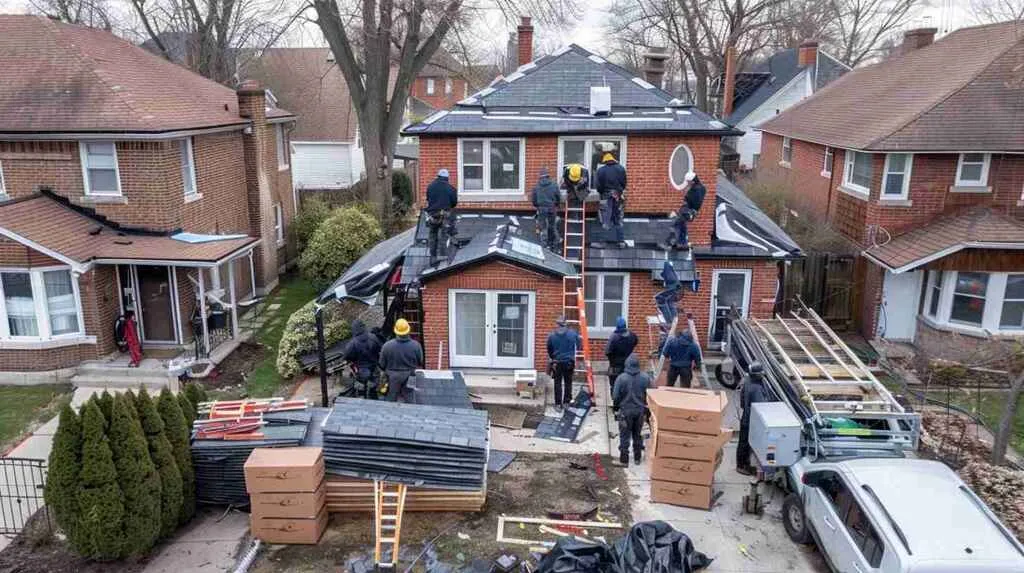
Step-by-Step Shingling a Roof Queens NY – Full Instructions | Free Quotes
Blueprint first. On a typical two-story Queens colonial, the first thing I do-before I touch a shingle-is check the edges and gutters, then snap chalk lines where my starter strip and first three full courses will land. Here’s my honest opinion: if you won’t spend 20 minutes snapping clean chalk lines, you shouldn’t be on a roof trying to shingle it-because every shingle course after that starter has to lock into the same rhythm, and one off-beat nail pattern turns into a leak over your bed six months later.
Lock In the Edges and Rhythm Before a Single Shingle Goes Down
On a typical two-story Queens colonial, the first thing I do-before I touch a shingle-is check the edges and gutters. Setting drip edge, starter course, and chalk lines isn’t optional prep work-it’s locking in the kick and snare before anyone starts soloing. If your drip edge sits crooked or your starter strip runs upside-down, every shingle you nail after that will be fighting gravity and wind, and you’ll see sliding tabs, lifted corners, and water creeping into your attic within the first nor’easter. Most Queens roofs I work on-colonials in Woodhaven, Cape Cods in Glendale, multi-pitch jobs in Forest Hills-have existing gutters, old flashing, and decades of patched-over mistakes, so getting the edge setup right means stripping back to clean wood and metal before you even think about opening a bundle.
One August afternoon in Woodhaven, it was 94 degrees and the shingles were basically soft as brownies. A DIYer called me because his “brand-new” shingle roof started sliding after the first heavy rain. I got up there and saw he’d nailed too high and skipped the starter strip entirely, so water was just marching right under the first course. I had to carefully strip the bottom four rows, reline the drip edge, and rebuild his starter properly-he watched from the ladder while I explained that roofing isn’t about “eyeballing it”; it’s about hitting the manufacturer’s nail line like hitting the snare on 2 and 4. Shingling is rhythm work: if your starter overhangs the drip edge by three-quarters of an inch and your nails land one inch above the shingle cutouts on every course, water sheds down and off. Miss that nail line by half an inch, and tabs lift, seal strips don’t bond, and you’re back up there with a caulk gun pretending it’s a permanent fix.
A correct edge setup on a typical Queens two-story colonial looks like this: aluminum drip edge fastened every eight inches along the eaves and rakes, overlapping at corners with the eave piece under the underlayment and the rake piece over it. Your starter strip-either a full-width shingle flipped upside-down or a dedicated starter roll-runs along the eave with about a half-inch overhang past the drip edge, nailed just above the adhesive strip so the first full course locks down tight. Then you snap horizontal chalk lines every five inches (or whatever your shingle exposure is) from eave to ridge, and vertical lines every three feet to keep your stagger pattern honest. That setup controls the whole layout rhythm: every shingle lands on a line, every joint staggers six inches from the joint below, and water never gets a chance to work its way up or sideways.
Pre-Shingle Edge Setup: Exact Order for Queens Two-Story Colonials
- Install drip edge along eaves: Fasten aluminum drip edge every 8 inches, overlapping joints by 2 inches; edge sits over fascia and under underlayment at eaves.
- Lay underlayment over deck: Roll synthetic or felt underlayment from eave to ridge, overlapping each row 6 inches and lapping over eave drip edge; staple or nail every 12-18 inches.
- Install drip edge along rakes: Rake drip edge goes over underlayment and down gable ends, fastened every 8 inches; overlaps corner with eave piece.
- Run starter strip along eave: Flip full-width shingles upside-down or use starter roll; overhang drip edge by ½ inch; nail 1 inch above adhesive strip, one nail every 10-12 inches.
- Snap horizontal chalk lines: Mark shingle exposure (typically 5-5⅝ inches) from eave to ridge every course; use two people and snap tight, clean lines.
- Snap vertical stagger guides: Every 3 feet horizontally, snap a vertical line from eave to ridge to keep your 6-inch joint offset honest across the entire roof plane.
Common Starter-Course & Drip-Edge Mistakes That Cause Sliding Shingles in Queens
- No starter strip at all: Water runs straight under the first course, lifts tabs, and soaks into the deck within one season.
- Reversed starter orientation: Adhesive strip ends up on top instead of bottom, so the first full course never seals down and flaps in wind.
- Nails placed too high: Nailing above the seal strip leaves the bottom half of shingles floating, and wind gets underneath like a sail.
- No overhang past gutters: Water runs back under the drip edge and rots the fascia board, especially on older Queens colonials with wood trim.
- Eyeballing instead of chalk lines: Courses drift up or down, joints line up vertically, and the whole roof looks like a funhouse mirror from the street.
Underlayment, Decking, and Queens Weather: Build the Waterproof Backbeat
I still remember the first time I saw someone try to nail shingles into bare plank decking in Richmond Hill like it was 1953. The wood was spaced, splitting, and bone-dry, and every nail either missed the plank or punched straight through into the attic. Proper decking checks and underlayment installation are the backbeat under your shingles-the part that actually keeps water out when wind drives rain sideways off the East River or a nor’easter dumps three inches in four hours. Queens housing stock is old: colonials from the ’40s and ’50s with board sheathing, Cape Cods with skip sheathing under old slate, and newer builds with OSB that’s been sitting through humidity swings for decades. Before any underlayment goes down, you walk the deck and check for soft spots, gaps wider than a quarter-inch, and nails that pop up; then you sister in plywood patches, renail loose boards, and replace any section that feels spongy or smells like old water.
At 6:30 in the morning in Astoria, middle of a light drizzle, I got called to a job where another contractor had bailed mid-project. The plywood was down, half the underlayment up, and the homeowner had buckets all over the attic. I walked the roof, showed him where they’d overlapped the underlayment wrong so water was running under seams instead of over, and then, step by step, I had him hold the chalk line while I snapped every course layout. By the time the sun came out, he knew exactly why lining up and staggering shingles is like building a drum fill-you mess up the order, the whole pattern falls apart. Underlayment laps have to shed water like shingle courses: each row overlaps the one below by six inches, and vertical seams get overlapped by twelve inches, always moving water down-slope. If you lap them backwards or leave gaps, wind-driven rain will wick horizontally under the felt, soak the deck, and drip into your bedroom ceiling during the next thunderstorm, no matter how perfect your shingles look from the curb.
Myth vs. Fact: Underlayment and Decking in Queens
| Myth | Fact |
|---|---|
| “Shingles are waterproof, so underlayment is optional.” | Shingles shed water; underlayment is the waterproof layer. Wind-driven rain and ice dams push water up under shingles, and without underlayment you’re soaking the deck. |
| “Old board decking is fine as long as it’s not rotted.” | Gaps between boards let underlayment sag and puncture. Code requires solid sheathing or you patch in plywood strips between planks so felt/synthetic lays flat. |
| “You can skip ice & water shield if you’re careful with valleys.” | NYC code mandates ice & water on eaves and valleys. Insurance and permits both check for it, and it’s the only thing stopping ice-dam leaks in Queens winters. |
| “Underlayment direction doesn’t matter; just cover the roof.” | Overlap direction is everything. Each row overlaps the one below by 6 inches so water runs over seams, not under. Backwards laps = attic buckets. |
| “If the deck looks good from below, it’s solid.” | Soft spots and delam show from the top, not the attic. Walk the deck before underlayment; if it feels spongy or nails pull out easy, that section gets replaced or sistered. |
Lay Out and Nail Shingles to Pattern, Not to Guesswork
Here’s my honest opinion: if you won’t spend 20 minutes snapping clean chalk lines, you shouldn’t be on a roof trying to shingle it. Shingle layout is about locking into a stagger pattern and keeping courses straight-each shingle tab is six inches, so you offset joints by six inches (or sometimes four, depending on manufacturer) every course, and you follow your horizontal chalk lines so courses don’t drift uphill or sag toward the eaves. Think of it like a drum pattern that has to repeat perfectly for a few hundred shingles in a row: if your kick hits on 1 and 3, your snare on 2 and 4, and you never rush or drag the tempo, the whole song locks together. Shingles work the same way-stagger joints so no two line up vertically within three courses, nail each shingle in the same five spots (one inch above each cutout and one at each end), and keep your exposure dead-consistent from eave to ridge.
One windy November morning in Bayside, I was doing a small repair for an older woman who kept every receipt from the 1970s. Her husband had shingled the roof himself back in the day, and you could tell-no underlayment, crooked courses, but it somehow survived 40 years. While I was redoing a section around her chimney, a gust ripped a half-open bundle of shingles off the ridge, and that’s when I started telling customers: never open more bundles than you can use in the next 20 minutes, especially on a Queens hilltop. That day turned into an on-the-spot lesson for her grandson in how to stagger shingle joints properly-I had him hold the chalk line, then showed him how cutting six inches off the first shingle in each course kept the pattern offset and locked the whole roof together like a brick wall. On windy Queens roofs, you work in small, controlled sections: lay three or four courses at a time, nail them all down before the wind gets under a tab, then move laterally across the roof plane instead of racing vertically to the ridge.
Can you keep this pattern perfectly for a few hundred shingles in a row without letting a single joint line up or a single course drift off your chalk line?
Step-by-Step: How to Shingle a Roof Field in Queens, NY
✅ Correct Nailing and Layout Rhythm Checklist
- ✓Nails one inch above cutouts: Hitting the manufacturer’s nail line keeps tabs sealed and prevents wind lift.
- ✓Six-inch joint offset every course: Staggering prevents water from tracking straight down through aligned seams.
- ✓Chalk lines every course: Courses that drift create visible waves and let water pool instead of run off.
- ✓Five nails minimum per shingle: Four along the nail line plus one at each end keeps corners from peeling in Queens wind.
- ✓Work in small lateral sections: Prevents wind from ripping up loose tabs before you nail the next course.
- ✓Seal cut edges at rakes and hips: Dab of roofing cement on trimmed edges stops moisture from wicking into shingle core.
Queens Trouble Spots: Valleys, Vents, and Chimneys That Leak Off-Beat
Blunt truth: most leaks I fix in Queens aren’t from “bad shingles”-they’re from bad details around vents, chimneys, and valleys. These are the tricky fills in your roofing song, the spots where you slow down, measure twice, and think through every layer of flashing and underlayment before you nail a single shingle. A valley is where two roof planes meet and dump all their water into one concentrated channel-if you cut your shingles crooked, overlap them wrong, or skip the ice & water shield, that valley will leak within six months. A vent pipe needs a rubber boot collar that fits snug, step-flashing that tucks under the shingle above and over the shingle below, and roofing cement only where the manufacturer says to use it (not smeared everywhere like frosting). A chimney needs counter-flashing embedded in mortar joints, step-flashing woven into shingle courses, and a cricket or saddle on the uphill side if the chimney’s wider than 30 inches-because water hitting the back of a chimney will pool, freeze, and force its way under shingles every winter.
Complex Queens roofs-think Forest Hills Tudors with sidewall dormers, Maspeth Cape Cods with skylights punched through at odd angles, and old Glendale colonials with brick chimneys that were added in the ’60s-need methodical step-flashing and precise shingle weaving or closed-cut valley patterns, not shortcuts with extra caulk and crossed fingers. Step-flashing a sidewall means bending individual L-shaped pieces of aluminum so one leg tucks under the siding and one leg lays flat on the roof deck, then weaving a shingle over each piece as you work up the slope. Closed-cut valleys mean you run shingles from one plane all the way across the valley, then cut shingles from the intersecting plane to match the valley centerline and overlap by a few inches-sealed with a strip of ice & water underneath and roofing cement where the cut edge meets the valley shingles. These details take three times as long as open field work, and if you rush them or skip a flashing layer, you’ll have an active leak the next time it rains hard.
🚨 Call a Queens Pro Immediately If:
- Active interior leak at valley or chimney during rain
- Soft or rotted decking feels spongy when you walk on it
- Visible flashing gaps or missing counter-flashing at chimney
- Ice-dam damage with water stains on ceilings and walls after snow
📅 Can Wait for Scheduled Service:
- Cosmetic shingle damage (granule loss, fading, minor curling)
- Small lifted shingle tabs that can be re-sealed with cement
- Minor caulk cracks around flashing that aren’t actively leaking
- Missing ridge cap shingles on a dry day with no rain forecast
DIY vs Hiring Shingle Masters in Queens: What Makes Sense for Your Roof
Small, simple shingle repairs-like replacing a few torn tabs on a single-story garage or resealing a lifted corner-are totally within reach for a careful DIYer with a ladder, a few bundles of matching shingles, and a Saturday afternoon. Full roof replacements, multi-story colonial re-roofs, or anything involving valleys, chimneys, and complex flashing are a different rhythm entirely: you’re talking about permitting, multiple days of tear-off and installation, coordinating material delivery, managing waste, staying on beat with weather windows, and making sure every detail meets NYC building code so your insurance and future buyers don’t balk. Knowing your limits and staying on beat with your budget and safety is the difference between saving a few hundred bucks and spending thousands fixing mistakes-or worse, ending up in an ER after a fall.
DIY Shingling
- Tools needed: Roofing nailer or hammer, knife, chalk line, ladder, safety harness-$400-$800 to buy or rent
- Time required: 3-5 days for a typical 1,500 sq ft roof if you work weekends and weather cooperates
- Risk factors: Fall risk, code violations, voided shingle warranty if not installed to spec, no recourse if it leaks
- Quality control: Depends entirely on your patience, measuring accuracy, and ability to spot mistakes before they become leaks
- Warranty: Manufacturer’s material warranty only-no labor warranty, no guarantee against installation errors
Shingle Masters Pro Install
- Tools provided: Full roofing crew with commercial-grade nailers, compressors, safety equipment-no out-of-pocket for you
- Time required: 1-2 days for most Queens residential roofs, start to finish, with tear-off and cleanup included
- Risk factors: Licensed and insured crew, workers’ comp coverage, fall protection systems-zero liability on your end
- Quality control: 17+ years of Queens roofing experience, code-compliant installation, inspection-ready work with photos at every stage
- Warranty: Manufacturer’s material warranty plus multi-year labor warranty covering leaks, blow-offs, and installation defects
Typical Queens Shingle Roofing Scenarios & Price Ranges
| Scenario | Roof Description | Approx. Price Range | What’s Included |
|---|---|---|---|
| Small Porch Repair | Single-slope porch or shed roof, Woodhaven/Glendale, 200-400 sq ft | $800-$1,800 | Tear-off old shingles, inspect/patch deck, new underlayment, architectural shingles, drip edge, cleanup |
| Partial Slope Redo | One slope on Cape Cod in Astoria/Bayside, 600-900 sq ft, one valley | $2,500-$4,200 | Tear-off, deck inspection/repair, synthetic underlayment, ice & water in valley, architectural shingles, ridge caps, haul-away |
| Full 2-Story Colonial | Standard colonial in Bayside/Whitestone, 1,500-2,000 sq ft, 2-3 valleys, chimney | $7,500-$12,000 | Full tear-off, deck repairs, synthetic underlayment, ice & water at eaves/valleys, architectural shingles, new drip edge, chimney flashing, ridge vents, permits, dumpster, cleanup |
| Complex Cut-Up Roof | Tudor or multi-dormer home in Forest Hills, 2,200+ sq ft, multiple valleys, skylights, sidewalls | $12,000-$18,000+ | Full tear-off, extensive deck repairs, premium synthetic underlayment, ice & water all valleys/eaves, step-flashing all sidewalls, skylight re-flashing, architectural or designer shingles, copper or aluminum trim, ridge vents, permits, engineering if required, haul-away |
| Emergency Storm Patch | Urgent repair after wind/tree damage in Jackson Heights/Elmhurst, temporary tarp + permanent fix | $600-$2,500 | Emergency tarp, same-day or next-day response, deck inspection, shingle replacement in damaged area, matching existing shingles if available, temporary waterproofing until full repair |
Prices vary based on shingle grade, deck condition, accessibility, and current material costs. Call Shingle Masters for a free on-site estimate tailored to your Queens roof.
Why Queens Homeowners Call Shingle Masters for Shingle Roofing
- ✓Licensed & insured in NYC: Full liability and workers’ comp coverage, permits pulled and inspections passed on every job.
- ✓17+ years shingling Queens roofs: We know the building stock, the weather patterns, and the details that make or break a roof in this borough.
- ✓Typical response time 24-48 hours: Free estimate scheduled within two days, emergency tarps same-day for active leaks.
- ✓Multi-year labor warranty: We back our installation with a written warranty covering leaks and wind damage-not just the shingles, but the work itself.
- ✓Neighborhoods served: Astoria, Bayside, Woodhaven, Forest Hills, Glendale, Jackson Heights, Elmhurst, Maspeth, Richmond Hill, Whitestone, and all of Queens.
Common Questions from Queens Homeowners About Shingling a Roof
How long does a typical Queens roof re-shingle take?
Most residential re-roofs in Queens-colonials, Cape Cods, ranches-take 1-2 full days with a crew of 3-4. Day one is tear-off, deck inspection/repair, and underlayment; day two is shingling, flashing details, ridge caps, and cleanup. Complex roofs with multiple valleys, dormers, or chimneys can stretch to 3 days. Weather delays (rain, high wind) can push the timeline, so we always tarp the roof at the end of each day if we’re not finishing that day.
Will the noise and mess disrupt my household?
Not gonna lie-roof tear-off is loud. Expect noise similar to heavy construction from about 8 a.m. to 5 p.m., especially during the first day when we’re ripping off old shingles and hammering/nailing new ones. We use tarps and plywood to protect landscaping, gutters, and siding, and we run a magnet sweep across your yard and driveway at the end of each day to pick up nails. Most homeowners stay home and go about their day; if you’re noise-sensitive or work from home, plan to be out during tear-off day, then you’ll barely notice the shingling work on day two.
Do I need a permit to re-shingle my Queens home?
Yes, if you’re doing a full tear-off and re-roof in NYC (including Queens), you need a building permit from the Department of Buildings. The permit ensures the work meets code for wind resistance, fire rating, and structural load. Shingle Masters handles all permit applications and scheduling inspections as part of our service-you don’t need to visit DOB or deal with paperwork. If you’re just patching a few shingles (under 25% of the roof area), a permit usually isn’t required, but it’s worth checking with your contractor or calling 311 to confirm based on your specific situation.
Can you just shingle over my old roof instead of tearing it off?
Technically, NYC code allows up to two layers of asphalt shingles, so if you only have one layer now, an overlay is legal. But here’s my honest take: overlays hide deck problems (soft spots, rot, bad nailing), add weight to your roof structure, void most manufacturer warranties, and make the next re-roof more expensive because we’ll have to tear off two layers instead of one. I only recommend overlays in very specific situations-like a garage or shed roof where budget is extremely tight and the existing deck is known to be solid. For your house, tear-off and start fresh; you’ll get a longer-lasting roof, a transferable warranty, and peace of mind that the deck underneath is sound.
How long will my new shingle roof last in the Queens climate?
Standard architectural shingles (the most common type) are rated for 25-30 years, but real-world lifespan in Queens depends on installation quality, attic ventilation, and maintenance. Expect 20-25 years if the roof is properly installed with good underlayment, ridge vents, and correct nailing. Designer or premium shingles (often called “lifetime” or 50-year shingles) can last 30-40 years, but they cost more up front and still need the same careful installation. Our Queens climate-hot summers, freeze/thaw cycles in winter, occasional nor’easters-is actually pretty friendly to asphalt shingles compared to places with constant hail or extreme heat, so if you keep your gutters clean and fix small issues promptly, you’ll get the full rated lifespan or close to it.
One missed beat in your shingle pattern-one starter strip nailed too high, one valley cut crooked, one course that drifts off your chalk line-can turn into a leak over your bed, a soaked attic, and a few thousand dollars in ceiling repairs before you even realize the roof is the problem. If you want the whole roof done on time, on pattern, and up to code the first time, call Shingle Masters at (347) 801-0230 or fill out our contact form for a free Queens roof inspection and quote. We’ll walk your roof, show you what needs fixing, and give you a written estimate with no pressure and no surprises-because a roof done right locks in that rhythm from the first nail to the last ridge cap, and everything in between sheds water exactly the way it’s supposed to.