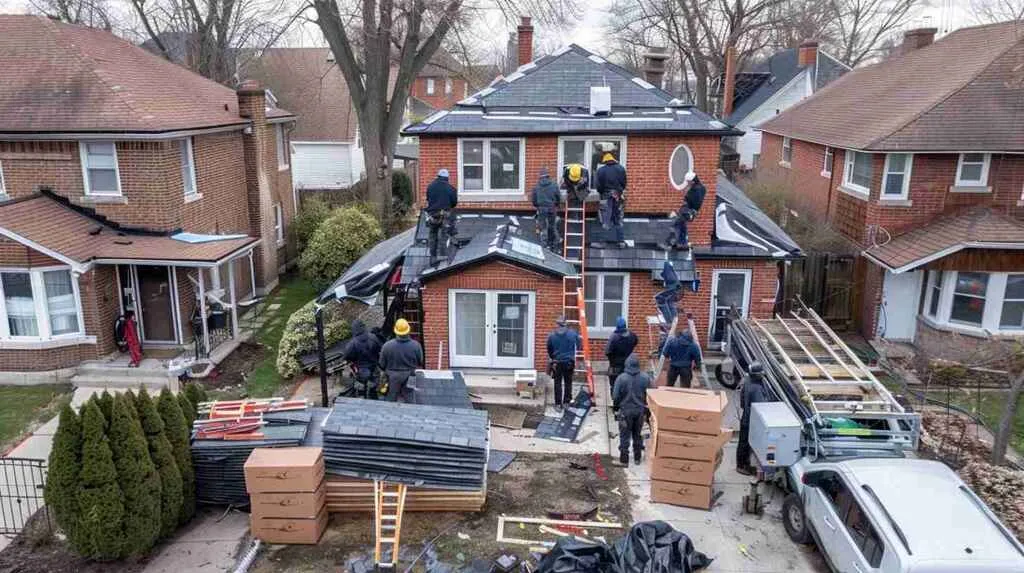
Shingle Installation Queens NY – What a Proper Job Looks Like | Free Quotes
Blueprint: A properly installed shingle roof in Queens should last 20-30 years-and you can usually tell from the sidewalk, in under 30 seconds, whether it’s going to make it or fail early. My name’s Vic Donnelly, I’ve been on Queens roofs for 31 years, and this article walks you through what a solid shingle installation actually looks like when you treat the roof like a well-arranged song, not just a pile of material stapled up fast.
What a 20-30 Year Shingle Roof Looks Like from the Sidewalk in Queens
On 43rd Avenue last fall, I stood across the street from a “brand-new” roof and spotted three problems before I even crossed the curb. The shingle lines weren’t running parallel-they wandered up and down like someone was eyeballing it instead of snapping chalk. The reveals (the exposed part of each shingle) were uneven, some courses showing four inches, some showing six, like a drummer who can’t hold a steady beat. And the edges at the rakes looked ragged, with tabs hanging over at different lengths. If you can see those rhythm problems from the sidewalk, you’re looking at a roof that’s going to start losing shingles and letting water in before it hits year ten.
Here’s my absolute, no-negotiation opinion: if you can’t see straight lines and consistent shingle reveals from the ground, the installer rushed the job. A clean shingle install has a tempo to it-every course parallel, every reveal the same height, every edge trimmed to a consistent overhang. Think of it like sheet music: if the notes are evenly spaced, the song plays right. When I see mismatched reveals or wavy coursing in Flushing or Astoria, I know the crew either didn’t snap control lines or didn’t care when they drifted off them. Worse, I’ve inspected roofs that looked okay from the street but leaked within a year because the fundamentals underneath-the underlayment, the nail depth, the valley prep-were completely ignored. Pretty shingles over rotten prep is like a great vocal over the wrong chords. Sounds fine until you really listen.
✅ Sidewalk Checks You Can Do in 30 Seconds in Queens, NY
- ✅ Shingle coursing: Stand back and look across the roof horizontally-every line should run parallel to the ridge and eaves with no dips, waves, or wandering
- ✅ Reveal spacing: Pick any vertical column of shingles and check that the exposed portion is the same height on every course; uneven reveals mean sloppy layout
- ✅ Rake and eave edges: Look at the roof perimeter where shingles meet the edge-they should overhang evenly (about ½ to ¾ inch) with no wild tabs sticking out or gaps
- ✅ Valley lines: If you can see a valley from the street, the center cut should be crisp and straight, not jagged or meandering like someone freehanded it with dull shears
- ✅ Chimney and skylight perimeter: Shingles around penetrations should lie flat and uniform, not puckered, lifted, or smeared with excess tar as a “fix”
Shingle Installation Basics for Queens, NY Homes
20-30 years with proper underlayment, nailing, and ventilation; cheap installs often fail under 12 years due to wind, ice dams, and summer heat expansion
Most architectural shingles carry 25-50 year warranties on material defects only; installation defects (wrong nails, bad flashing) void the warranty and are the real failure point
4:12 to 8:12 in most neighborhoods; older row houses in Jackson Heights and Elmhurst often have lower slopes (3:12 or less) demanding extra ice & water protection
Ask for shingles rated to 110-130 mph wind if you’re in Bayside, College Point, Rockaway, or within a mile of the East River-standard 60 mph shingles peel in nor’easters
The Hidden Layers: Underlayment, Nail Pattern, and Why Leaks Start Early
Let me ask you the same thing I ask every homeowner: when’s the last time someone actually showed you what’s under your shingles, not just the color chart? The underlayment, the ice & water barrier in the valleys, and the nail depth and angle are the rhythm section of your roof-if they’re off, the whole performance collapses. One August afternoon in Jackson Heights, it was 96 degrees and the shingles were so hot they felt like soft vinyl under my boots. A homeowner called me furious because another contractor had “just installed a brand-new roof” three months earlier and it was already leaking over the kitchen. I pulled up a shingle and found nails half-driven, some at an angle, and no ice & water shield in the valleys-looked like someone tried to play a solo who never learned basic chords. I ended up stripping everything back to the deck and rebuilding it properly, and that’s the job that made me start telling customers, “If I can’t show you the underlayment and nail pattern, don’t pay me.”
Here’s what you need to know about specific Queens neighborhoods: Jackson Heights, Corona, and Elmhurst have a lot of older housing stock with low-slope transitions, flat deck sections, and complex valley tie-ins that demand careful underlayment work and extra ice & water coverage. If your roofer isn’t accounting for those quirks-if they’re slapping down 15-pound felt and calling it a day-you’re going to get leaks the first winter when ice dams form or wind-driven rain works its way sideways. My absolute rule, and I’ve held it for three decades: if the roofer won’t show you the underlayment and nail pattern before you hand over final payment, don’t pay them. A proper install means synthetic underlayment lapped correctly, ice & water shield running at least three feet up from every eave and covering every valley and penetration, and four nails per shingle driven flush (not overdriven, not at an angle). Anything less is cutting the tempo and hoping you don’t notice until the song’s already over.
| Roof Element | Proper Install (Vic’s Standard) | Shortcut That Fails Early |
|---|---|---|
| Underlayment Coverage | Synthetic felt over entire deck, lapped 6″ horizontal, 4″ at hips/ridges, taped or nailed every 12″ | Cheap 15-lb felt with gaps, minimal overlap, left loose and flapping until shingles go on |
| Ice & Water in Valleys | 36″ wide ice & water shield running full length of every valley, plus 3 feet up from eaves on all edges | No ice & water at all, or narrow 18″ strip that doesn’t cover valley sides where water pressure is highest |
| Nail Placement & Count | Four nails per shingle placed in the nail line (just above slots), no nails in exposed area or seal strip | Three nails (or fewer) placed randomly, sometimes nailing through the visible part where they’ll rust and leak |
| Nail Depth & Angle | Nails driven flush-head just touching shingle surface, driven straight in at 90 degrees | Overdriven (punching through shingle) or underdriven (sticking up to catch wind), or angled sideways tearing the mat |
| Decking Repairs & Flat Spots | All soft, rotten, or sagging deck boards replaced with matched plywood; flat areas built up to proper slope | Shingles laid over spongy or wavy decking “because it’s still holding nails”; ponds form, shingles sag and fail |
| Flashing Integration | Step flashing at walls, counter-flashing at chimneys, kick-out diverters at valley/wall junctions, all woven into shingle courses | Continuous “L” flashing slapped against wall and caulked; no counter-flashing; relying on tar instead of mechanical integration |
⚠
Common Queens Roofing Shortcuts You Won’t See Until the First Nor’easter
- Skipping ice & water in valleys: You won’t know until spring melt or a heavy rain sends water sideways under the shingles and into your ceiling-by then, the crew is long gone and unreachable
- Nailing too high on the shingle: The nail misses the underlying course, so wind gets under the tab and peels it like a sticker; looks fine until 40 mph gusts arrive
- Reusing rotten or soft decking: Saves the installer 45 minutes and a couple hundred bucks in plywood, costs you a sagging roof and another tear-off in five years when the deck finally gives out
- Relying on caulk instead of proper flashing: Caulk dries, cracks, and peels in Queens weather (freeze-thaw, UV, summer heat); real step flashing and counter-flashing last decades with zero maintenance
Edges, Starter Strips, and Wind: Where Storms Peel Bad Roofs First
How Bayside Winds Expose Sloppy Starter-Strip Work
The funny thing about bad shingle installation is it usually looks “fine” for the first year-kind of like a band that sounds okay until the drummer loses the tempo. One November morning in Bayside, wind coming off the water hard enough to flap my shirt like a sail, I inspected a roof another company had “storm-proofed” after a nor’easter. The shingles were a high-end brand, but they’d skipped starter strips on the eaves and rakes, so the wind caught the first course and peeled it like a bad sticker. I remember standing up there with the homeowner’s 10-year-old son, showing him how the first shingle row should lock in, and watching him nod like he just discovered a magic trick. That day I realized most “bad roofs” aren’t bad materials-they’re bad fundamentals. A starter strip is a simple thing-either a manufactured strip or a standard shingle installed upside-down and backwards-but it does one critical job: it seals the bottom edge and gives the first course something to grab onto. Without it, you’ve got exposed slots and nail heads right at the eave and rake where wind pressure is highest, and the first good storm plays your roof like a badly tuned drum, lifting tabs and tearing them clean off.
Here’s one strong insider tip: tell Queens homeowners to stand at the rake edge and look for first-course shingles either hanging with no visible starter or misaligned so you can see gaps between the tabs and the edge. In neighborhoods like Bayside, College Point, and Rockaway where wind is harsher-especially near the water-a missing or poorly installed starter strip is the number-one reason roofs lose shingles in the first five years. Edges are like the first bar of a song-if that’s off, everything after drifts. A locked-in edge has a manufactured starter strip running the full eave and rake, the first course of shingles overhanging about ½ to ¾ inch (not two inches, not flush), and everything sealed down with the adhesive strip on the starter bonding to the back of the first shingle. When I see ragged edges, inconsistent overhang, or shingles that flap in a light breeze, I know someone skipped the starter and hoped nobody would notice until warranty time ran out.
Locked-In Edge (Done Right)
- Manufactured starter strip or cut shingles installed along entire eave and rake before first course goes down
- First-course shingles overhang edge by ½ to ¾ inch-consistent across the whole perimeter, measured not guessed
- Adhesive strip on starter bonds to back of first shingle; tabs lie flat with no lifting even in 30+ mph wind
- Nails placed in the nail line, driven flush, with no exposed fasteners visible from the ground or gutter
Peel-Prone Edge (Done Wrong)
- No starter strip at all, or narrow hand-cut strips that don’t cover the slots and nail line of the first course
- First-course overhang varies wildly-some tabs stick out two inches, others are flush or short, creating uneven drip edge
- Tabs lift in light wind because there’s no adhesive bond underneath; you can see daylight or felt paper peeking through gaps
- Exposed nail heads visible along the edge where installer face-nailed through the shingle tabs to “hold them down”
Wind Damage on Shingle Edges in Queens: Urgent vs Can-Wait Situations
🚨 Call Shingle Masters Now
- Missing first course or multiple tabs torn off along eaves or rakes after wind event
- Lifted shingles actively flapping in breeze, exposing underlayment or creating water entry points
- Exposed nails, torn felt, or visible deck along the perimeter where edge shingles pulled free
- Water stains appearing on soffits or interior ceilings near roof edges after recent storm
📋 Schedule an Inspection Soon
- Slightly wavy shingle lines at rake or eave-cosmetic so far, but a sign of poor initial install
- Minor granule loss along edges where tabs rub in wind; shingles still sealed and not lifting
- A couple of tabs slightly raised at corners but not torn or missing; wind testing the bond
- Overhang that looks uneven from the ground but no active leaks or visible damage yet
Valleys, Flashings, and Cut Lines: Where Queens Roofs Usually Leak First
Anytime I see wavy shingle lines in Maspeth or Ridgewood, I know the installer treated the roof deck like a suggestion, not a foundation. Deck prep, straight control lines, and a firm, flat substrate matter most in valleys and at any transition between roof planes. If the deck is wavy, soft, or improperly sloped, the shingles will follow that contour, and water will find every low spot and every misaligned cut. Late one rainy night in Forest Hills, I got an emergency call from an older couple who’d just had a roof installed in the summer and now had buckets catching water in their dining room. I went up in a drizzle with a headlamp and found the dead giveaway: mismatched shingle reveal spacing across the valley and a lazy cut right where two planes met-pretty, but wrong. Water was sneaking sideways under that valley because the installer had cared more about the look than the function. It’s like a beautiful guitar solo played over the wrong chord progression-sounds okay to someone who doesn’t know music, but the structure underneath is broken. I temporarily patched it with ice & water shield and tarps, then came back two days later, under clear skies, to rebuild the whole valley system; they still send me a Christmas card every year with a joke about “no more indoor rain.”
Flashings-around chimneys, skylights, and sidewalls-and valley layouts are the bridge and chorus of the roof song. If they’re cut or stepped wrong, leaks follow no matter how expensive the shingles. Step flashing should weave into each shingle course at a wall, with counter-flashing covering the top edge and tucked into the masonry or siding. Chimneys need a full surround: base flashing, step flashing up the sides, and a cricket (saddle) on the high side if the chimney is wider than 30 inches. Valleys can be open-cut with metal or closed-cut (woven or California-cut) with shingles, but either way, the centerline must be straight, the ice & water shield must run the full length, and the cuts must not expose nail heads or create spots where water can eddy and work its way under. If you see tar smeared around a chimney or skylight, that’s a roofer who skipped proper flashing and is hoping caulk will last longer than their truck payment.
How do I know if my roof valley was cut correctly?
Stand back and look at the valley centerline-it should run perfectly straight from ridge to eave with no kinks, jogs, or wandering. The shingles on each side should be cut parallel to that centerline, with a consistent gap (usually 3-4 inches if it’s an open-cut metal valley). If you see jagged cuts, uneven spacing, or shingles that look like they were trimmed with a dull knife while someone was in a hurry, water’s going to find a way under those edges. Also check that the valley runs downhill with no flat spots or reverse slopes where debris and water can pond.
What should proper chimney flashing look like from the ground?
You should see metal step flashing running up each side of the chimney, with each piece woven into a shingle course so it’s not just one continuous strip. At the top (high side), look for counter-flashing that’s embedded into the chimney mortar joints and covers the top edge of the step flashing-it should be a separate piece, not the same metal bent over. If the chimney is wide, you should see a raised saddle or cricket on the high side to divert water around it. Red flags: continuous “L” flashing just laid against the brick and caulked, or thick beads of tar smeared everywhere to “seal” gaps.
Is metal valley flashing always required on Queens homes?
Not always-you can do a closed-cut valley (woven or California-cut) where shingles from both planes interlock or one plane cuts over the other, but it requires perfect technique, ice & water shield underneath, and a roof pitch steep enough to shed water fast. In Queens, where we get heavy rain, ice, and a lot of older roofs with lower slopes, I almost always recommend open-cut metal valleys with 24-gauge painted or coated steel. Metal is more forgiving, sheds debris better, and lasts longer than relying on shingle-to-shingle integrity in a high-flow area.
Why do I see tar smeared around my skylight-should I be worried?
Yes, you should be worried. Tar (roof cement, mastic, caulk) is a temporary emergency patch, not a permanent flashing solution. A properly flashed skylight has a metal pan integrated with step flashing on the sides and head flashing at the top, all woven into the shingle courses. If someone just smeared tar around the edges, it means they either skipped the real flashing or they’re covering up a leak caused by missing or improper flashing. Tar dries out, cracks, and peels in a year or two, especially in Queens freeze-thaw cycles, and then you’re back to square one with water coming in.
Can I just patch a leaking valley instead of rebuilding it?
Sometimes, but not often. If the valley leak is caused by a single torn shingle or a small puncture in the metal and everything else-ice & water shield, flashing, deck-is solid, then yeah, a targeted patch can buy you time. But if the valley was cut wrong, built without underlayment, or the metal is rusted through in multiple spots, patching is like putting a band-aid on a broken bone. You’ll spend money now and again in six months when the next storm finds a different weak spot two feet away. I’ve seen homeowners spend $800 in patches over two years when a proper valley rebuild would’ve cost $1,200 once and been done for 20 years.
Deciding If You Need a New Install or Just a Fix in Queens
$800 spent on patches in two years usually means you should’ve done the full install once and been done with it. If your roof’s tempo is constantly off-different leaks every season, shingles lifting in every windstorm, granules washing down the downspouts like sand-it’s time to stop swapping out the drummer and replace the whole band.
Do You Need a Full Shingle Installation or Just Targeted Repairs in Queens?
-
Is your roof over 15 years old?
- → Yes:
- Multiple leaks or widespread shingle curling/granule loss?
- ✓ Likely ready for full shingle installation – age plus multiple failure points means the whole system is near end-of-life
- 0-1 leaks, shingles mostly intact?
- ✓ Targeted professional repair may be enough-get an inspection – isolated issues on an older roof can often be fixed if the deck and underlayment are still solid
- Multiple leaks or widespread shingle curling/granule loss?
- → No (roof is under 15 years):
- Evidence of bad install: crooked lines, missing starters, recurring leak in same spot?
- ✓ Likely ready for full shingle installation – a young roof failing repeatedly means it was never done right; fix it now before more damage occurs
- Isolated damage from storm or falling branch, otherwise looks good?
- ✓ Targeted professional repair may be enough-get an inspection – newer roofs with isolated damage usually just need the affected section rebuilt
- Evidence of bad install: crooked lines, missing starters, recurring leak in same spot?
- → Yes:
✅ What to Check Before You Call Shingle Masters for Shingle Installation in Queens
- ✅ Note your roof’s age – check your records or ask the previous owner; if you don’t know, estimate based on shingle condition and neighborhood construction dates
- ✅ Take sidewalk photos of lines and edges – snap pictures showing the overall roof profile, rake edges, and any visible valleys or chimneys so you can reference them during the estimate
- ✅ Check your attic for stains or daylight – go up on a sunny day and look for water marks on rafters, wet insulation, or pinholes of light coming through the deck
- ✅ List past repair costs over the last 2-3 years – if you’ve spent $500+ repeatedly patching the same issues, a full install often pays for itself in peace of mind
- ✅ Note wind exposure – if you’re on a corner lot, end unit, or within a mile of the East River or Jamaica Bay, mention it; wind load affects shingle choice and fastening
- ✅ Write down any past ice dam or valley issues – recurring problems in the same spot tell me exactly where the install was done wrong and what needs to be rebuilt
Why Queens Homeowners Hire Shingle Masters for Shingle Installation
Vic’s been on Queens roofs since 1993-he knows the neighborhoods, the housing stock, and exactly how wind, ice, and summer heat affect different roof types
All required NYC permits pulled, full liability and workers’ comp coverage, and every install meets or exceeds local building code
You’ll see photos of your underlayment, ice & water shield, nail pattern, and flashing integration-Vic’s absolute rule is you don’t pay final until you’ve seen the work that matters
Fast, no-pressure inspections that tell you exactly what’s wrong, whether you need a full install or just targeted repairs, and what it’ll cost-no bait-and-switch, no hidden fees
Picture your roof like a piece of sheet music: if the notes-your shingles, nails, and flashings-aren’t spaced right, the whole song falls apart when the first storm hits. If your roof doesn’t look and “sound” right from the sidewalk-straight lines, clean edges, tight valleys-it’s not going to make its full 20-30 year run in Queens weather, and you’ll be calling someone back every year to patch the same problems. Call Shingle Masters today for a free shingle installation quote and a full walk-through of your roof’s “sheet music”-underlayment, nail pattern, flashing details, and all-before you spend a dollar.