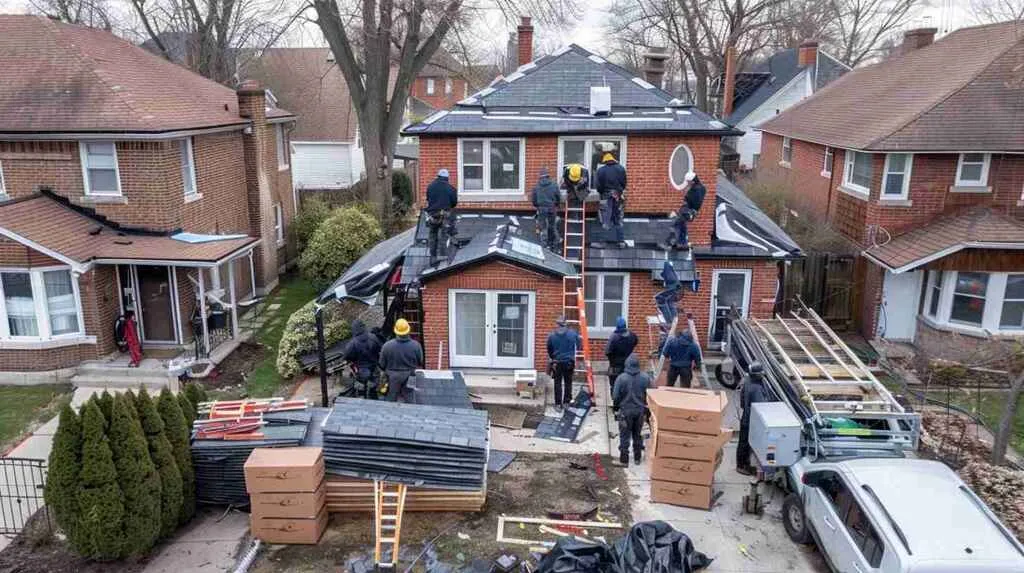
Roof Shingle Installation Instructions Queens NY – Step by Step
Blueprint your underlayment run and starter course correctly on a Queens roof, or no other instruction you follow will stop the leaks. In 17 years of shingling across Astoria, Jamaica, and Forest Hills, I’ve seen more roofs fail from the first hour of work than the last – and it always comes down to how you set up that very first layer and how you start the first course at the eave.
Laying Underlayment and Starter Course the Queens Way
On a typical two-story in Queens with a 5/12 pitch, the very first thing I do is install drip edge along the eave, then roll out the underlayment horizontally from the bottom up – never vertically – lapping it over the drip edge by at least 3 inches and fastening every 12 inches with cap nails or staples that sit flush, not driven through. If you were a drop of water, where would you go? You’d run down the slope and hit that underlayment seam; if it’s pointing the wrong direction or wrinkled like gift wrap, you’ll find a path straight to the plywood. One January morning at 6:45 in Astoria, I stood on a frosted-over roof staring at a crooked starter course a handyman had installed the night before – shingles lifting at the eave because he’d skipped the drip edge and nailed too high. That sunrise over the RFK Bridge turned into an impromptu sidewalk roofing class while I tore off that first row and walked the homeowner through why you can’t afford to rush this step. In Queens, where wind blows off the water and freeze-thaw cycles hit every winter, a sloppy underlayment or missing drip edge will show up as a ceiling stain by spring.
Let me be blunt: if your underlayment looks like wrinkled gift wrap, you’ve already set yourself up for problems. Your horizontal underlayment rows must overlap the one below by at least 6 inches (I usually go 8), and the top layer always laps over the bottom so water sheds down and off – never up and under. At the rakes, underlayment goes under the rake drip edge; at the eaves, it goes over the drip edge you installed first. Fasten with cap nails or staples every 12 inches along the top edge and every 12 to 18 inches through the field, keeping the felt or synthetic smooth and tight; any buckle or bubble is a water trap waiting to happen. And when you place your starter course – which is either a full shingle flipped upside-down or a purpose-cut starter strip – you nail it exactly on the chalk line you snapped 1/2 inch up from the drip edge, driving four nails per shingle in the manufacturer’s nailing zone (usually 5 to 6 inches up from the bottom edge and at least 1 inch in from each end).
A perfect starter course matters more than any fancy shingle brand.
- Install drip edge along eaves – nail every 8-10 inches, overlapping end joints by 2 inches.
- Roll underlayment horizontally from eave up – lap over drip edge 3-4 inches, fasten top edge every 12 inches, keep tight and flat.
- Overlap each row by 6-8 inches – top layer over bottom so water can’t run uphill.
- Install rake drip edge over underlayment – at gable ends, underlayment goes under the rake edge.
- Snap chalk line 1/2 inch up from eave – this is your starter-course guide.
- Nail starter shingles or strips on the line – four nails per piece, 5-6 inches up from bottom edge, flush drive, no overdriving.
- Skipping drip edge – water wicks behind fascia and rots the eave.
- Running underlayment vertically – seams channel water straight down to plywood joints.
- Nailing starter shingles too high – leaves gaps at the eave that wind and rain exploit.
- Not sealing over fascia seams – every joint in the drip edge is a potential leak point if left uncaulked.
Snapping Lines and Staggering Shingles So Joints Don’t Leak
I still think about a little brick house off Queens Boulevard where a single missed chalk line cost the owner an entire interior repaint. The roof looked fine from the street, but every shingle course drifted uphill by about 1/4 inch per row, and by the time we hit the ridge, the whole pattern was 3 inches off – enough to leave a visible seam shadow and, worse, to let wind-driven rain track along the misaligned keyways. Roofs in that Queens Boulevard corridor catch wind funneled between buildings, and older brick homes often settle unevenly, creating subtle roof sags that make layout lines even more critical. You can’t eyeball a shingle layout; you have to snap horizontal chalk lines every 10 or 17 inches (depending on your shingle reveal) from eave to ridge, and you check each line with a level or by measuring up from the eave in three spots to make sure your courses stay parallel.
When I walk a homeowner through roof shingle installation instructions, the first question I ask is: “Do you want it to just look good today, or still be dry in ten years?” The answer decides whether you’ll stagger your shingle joints correctly. For standard three-tab shingles, you offset each course by 6 inches so that the vertical keyways (the slots between tabs) never line up in adjacent rows – if they do, water funnels straight down through the joint and eventually under the shingle. Architectural shingles follow the same principle, though the pattern may be random or diagonal; check the manufacturer’s instructions, but the core idea is constant: no two joints should stack vertically within three courses. Snap your layout lines, measure your shingle reveal to the nearest 1/8 inch (5 inches for three-tab, 5 to 7 inches for architectural, depending on the style), and literally visualize a drop of water traveling down the roof – if it can dive into a keyway and then immediately hit another joint below, you’ve set up a leak highway.
| Shingle Type | Typical Reveal (inches) | Recommended Offset Between Joints (inches) | Chalk Line Spacing Up Roof (inches) |
|---|---|---|---|
| 3-Tab Asphalt | 5″ | 6″ (half-tab offset standard) | 10″ (two reveals) |
| Architectural/Dimensional | 5″-7″ | 6″-8″ or random per manufacturer | 10″-14″ (depends on reveal) |
Nail Placement, Valleys, and Penetrations: Where Leaks Really Start
Here’s the quiet truth most people don’t tell you about shingle work in Queens’ wind and salt-laced air from the bay: the details matter more than the brand on the wrapper. You can buy the fanciest architectural shingles with a fifty-year warranty, but if you drive your nails too low (below the nailing zone), too high (above the adhesive strip), or too close to a keyway, those shingles will lift, crack, or channel water straight through – and in Queens, where coastal wind and winter salt accelerate every flaw, you won’t wait fifty years to see the problem. Each shingle needs four to six nails (check your manufacturer; high-wind zones often require six) placed in the nailing strip, which is usually 5 to 6 inches up from the bottom edge and runs the width of the shingle. Drive each nail perpendicular to the roof – not angled – and flush with the surface; overdriving crushes the shingle and creates a dimple that traps water, while underdriving leaves a bump that the next course can’t seal over. One pro tip I picked up after watching too many shingles blow off windward rakes: add one extra nail about 2 inches in from each gable edge on every course, especially if your house faces the water or catches crosswinds off the bay – that single fastener has saved more edge shingles than any fancy sealant.
When you hit valleys and penetrations – pipe boots, roof vents, skylights – treat each one like a lab test where the layering order is everything. For valleys on typical Queens slopes (4/12 to 8/12), a closed-cut valley (where shingles from one plane run through and shingles from the intersecting plane are cut along the valley centerline) works cleanly if you use underlayment or a valley liner first; woven valleys (alternating shingle courses from each plane) can work on lower slopes but require more precision. Either way, the rule is: water flows down and off, so every layer – valley liner, underlayment, shingles – laps over the one below by at least 6 inches. Around a plumbing vent or boot, slide the flange under the shingles above and over the shingles below, seal the top edge with roofing cement, and nail the flange in place before covering it with the next course; for skylights, follow the same over-under principle and use step flashing along the sides, making sure each piece of flashing is individually lapped and nailed high so the next shingle covers the nail.
- Four to six nails per shingle, all in the nailing zone
- Nails driven flush, perpendicular to deck
- Nails at least 1 inch from shingle edges
- Extra nail 2 inches in from each rake on windward sides
- Nails below the nailing strip or too close to keyways
- Overdriven nails that dimple or tear the shingle
- Nails angled instead of straight down
- Skipping nails to save time (“just four will do” when six are called for)
- Active leak around valley or vent during rain
- Rotten or spongy decking around penetration
- Misaligned valley cut that leaves gaps or exposed underlayment
- Cosmetic flashing touch-ups or minor sealant cracks
- Loose boot collar that’s not actively leaking
- Valley that looks uneven but hasn’t shown water damage yet
DIY vs Pro in Queens: When These Instructions Aren’t Enough
Think of your roof like a layered lab sample: if you stack the layers in the wrong order, the whole test – and in this case, your living room ceiling – fails. A simple gable roof with one or two planes and no dormers is manageable for a careful DIYer who’s willing to measure twice, snap straight lines, and follow these instructions like a procedure checklist; you’ll spend more time than a pro, but you can absolutely get it right if you work methodically. But the moment your Queens roof adds multiple dormers, hip valleys, low-slope tie-ins, or older framing that’s settled unevenly, you’re layering complexity on top of complexity – and one missed step in the water-flow sequence can turn into a leak that takes three contractors to diagnose. I’ve seen it: one sticky August afternoon in Jamaica, a DIY couple called me mid-panic because a surprise thunderstorm was rolling in and they were halfway through their back dormer, underlayment laid vertically (wrong direction), shingle joints unstaggered, and rain already dripping into the nursery. We tarped the worst section and I showed them – while we worked in the rain – how to fix the nail placement and layout, but that moment taught them (and reminds me every time I tell the story) that roofing isn’t just about following instructions, it’s about anticipating where every drop of water will go and making sure your layers say “no” at every step.
Late one fall evening in Forest Hills, around 9 p.m., I was on a low-slope roof under a work light hunting for why a brand-new shingle job was leaking over a bay window. The contractor had done everything by eye with no chalk lines, and I noticed the pattern immediately: nails consistently placed too close to the keyways, exactly where water was tracking down and finding a path under the shingle. I pulled three shingles and showed the homeowner the shiny, exposed nail heads like evidence slides in a lab report – it changed how he thought about “following instructions” forever. The lesson: even well-meaning DIY work can go wrong without methodical, step-by-step checks. Before you touch your roof, walk through every instruction like a checklist, ask yourself at each stage where water will flow if this step fails, and be honest about whether you can maintain that level of precision across 1,200 or 1,600 square feet of shingles over two days in Queens weather.
- Roof age – year installed or best guess, helps estimate remaining life
- Number of shingle layers – one, two, or unknown (affects tear-off cost and code compliance)
- Photos of problem areas – missing shingles, stains, lifted edges, visible nails
- Attic leak signs – water stains on rafters, wet insulation, daylight through deck
- Pictures of any DIY attempts – patches, sealant application, temporary tarps
Common Questions About Roof Shingle Installation in Queens, NY
Every answer below comes from real Queens jobs and the same lab-precise mindset I bring to each roof. Weather, building codes, and housing styles in Queens affect shingle installation more than most people realize, so these aren’t generic answers – they’re specific to what works (and what fails) in our neighborhoods.
What’s the ideal season to re-shingle a roof in Queens?
What’s the minimum temperature for installing asphalt shingles?
How many layers of shingles are allowed by NYC code?
How long should a properly installed Queens shingle roof last?
Are partial shingle repairs worth it, or should I just replace the whole roof?
Full liability and workers’ comp coverage on every Queens job
Astoria, Jamaica, Forest Hills, and beyond – we know Queens roofs
Emergency leak calls answered fast, estimates scheduled within 48 hours
From Astoria to Rockaway, we bring the same lab-precise approach everywhere
Precise, step-by-step work – from the first underlayment run to the final ridge cap nail – is what keeps Queens roofs dry through nor’easters, summer storms, and twenty years of freeze-thaw cycles. If you want that same lab-accurate approach applied to your own home, call Shingle Masters and let’s walk your roof together, one measured step at a time.