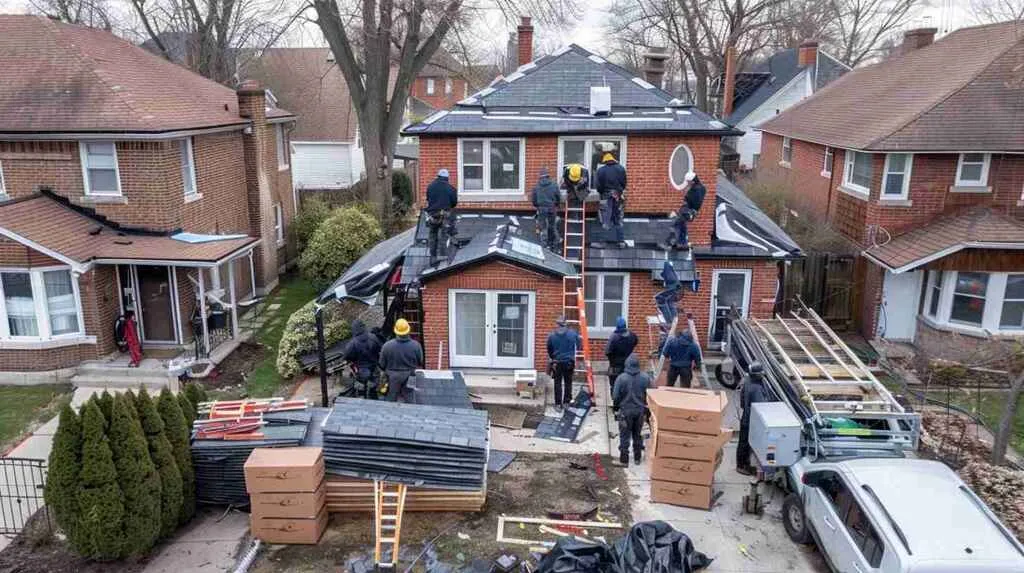
Ridge Cap Shingles Installation Queens NY – Done Weathertight | Free Quotes
Crosswinds off the East River and Jamaica Bay don’t care what you paid for your roof – they hit the ridge line first and hard. A proper ridge cap shingles installation on a typical Queens two-family with about 60-80 feet of ridge usually runs between $1,200 and $2,400, depending on accessibility and whether we’re also installing ridge vent. Repairing a “budget” ridge job that failed after two winters? That same house can easily cost $2,800 to $4,500, because by then we’re tearing off the bad caps, fixing wet deck boards at the peak, replacing soaked underlayment, and re-laying the ridge from scratch while your ceilings have water stains.
On a typical two-family in Queens with about 60-80 feet of ridge…
Let me tell you something I’ve learned after 19 years on Queens roofs: the ridge is like the main express line on the subway – if that track is sloppy, everything backs up. Water sits, wind lifts, and shingles that looked fine from the street start peeling. The homeowner blames “cheap shingles,” but nine times out of ten the problem is at the ridge line where cheap work hides until the first nor’easter. Think of it this way: you can have perfect field shingles running down your roof like smooth local tracks, but if the main line at the peak is cracked or loose, the whole system stalls.
$850. That’s the minimum I’ve ever charged to properly redo a ridge cap line on a small bungalow in Howard Beach with maybe 35 feet of ridge and great ladder access. A proper ridge cap shingles installation includes complete tear-off of the old caps down to bare deck, checking the top course of sheathing for any soft spots or nail pops, inspecting or repairing underlayment right at the fold, then laying actual high-profile ridge cap shingles – not chopped-up 3-tabs some handyman scissored in his truck – with the correct overlap, nail pattern, and wind orientation. You’ll see the pricing breakdown below, and then I’ll walk you along the roof step by step so you know exactly what’s happening up there.
Ridge Cap Shingles Installation & Repair – Queens NY Price Calculator
Prices are estimates for asphalt shingle roofs with standard ladder access. Final quotes depend on pitch, height, and conditions found at inspection.
| Scenario | Home Type / Ridge Length | Scope of Work | Typical Price Range (Queens, NY) |
|---|---|---|---|
| Small bungalow ridge repair | One-story, 30-40 ft ridge | Remove old caps, check deck, install new ridge caps only | $850 – $1,400 |
| Typical two-family ridge install | Two-family, 60-80 ft ridge | Full ridge cap replacement, underlayment spot repair, high-profile caps | $1,200 – $2,400 |
| Ridge vent + cap install | Two-family, 60-80 ft ridge | Cut ridge opening, install ridge vent system, seal with ridge caps | $2,200 – $3,800 |
| Failed budget ridge repair | Two-family, 60-80 ft ridge | Tear off failed caps, replace wet deck boards, new underlayment at peak, proper ridge caps | $2,800 – $4,500 |
| Complex multi-hip ridge | Three-family or row home, 100+ ft total ridge & hips | Full ridge and hip cap system, multiple intersections, vent coordination | $3,500 – $6,200 |
I’ll be blunt: the ridge is where cheap work goes to hide until the first nor’easter.
One August afternoon, about 3:30 p.m. with the sun bouncing off every surface in Corona, I got called to a house where a handyman had “saved money” by cutting 3-tabs into ridge caps. On the first nor’easter that October, the whole peak peeled back like a zipper – I’m talking six or seven full sections of ridge caps flapping in the wind like flags, water pouring into the top-floor bedroom. I still remember standing up there with the homeowner’s teenage son, sweating through my shirt as thunderheads built over LaGuardia, showing him the difference between a real ridge cap shingle and the chopped-up tabs his dad’s buddy had scissored in the driveway. Those cut tabs were maybe half the thickness, had exposed nail heads every eight inches, and curled at the edges because they weren’t designed to bend over the ridge. We re-did that ridge with proper high-profile caps and I made him help carry bundles so he’d never repeat that shortcut. The kicker? The original “budget” job saved them maybe $400. The emergency repair two months later, with deck damage and wet insulation, cost $3,200.
Here’s what most folks don’t realize: real ridge cap shingles are thicker than field shingles, pre-scored to bend cleanly over the peak, and designed with a specific overlap and nail zone that keeps wind from catching an edge. When you chop a 3-tab shingle into three pieces and bend them over the ridge, you’re creating a thin, stiff strip with no wind rating and no layering protection. Around Queens, where crosswinds off the bay or the East River hit row homes and two-families at weird angles, that shortcut fails fast. Water doesn’t just drip – it follows the “track” under those bad caps like a subway line with a broken switch, backing up into the underlayment and eventually soaking the top course of deck boards. By the time you see a stain on the ceiling, the ridge has been leaking for weeks.
✓ Proper Ridge Cap Shingles
- Lifespan: 20-30 years, matching main roof warranty
- Wind resistance: Rated for 110+ mph when installed correctly
- Appearance: Uniform, thick profile visible from the street
- Long-term cost: One install, minimal maintenance for decades
✗ Cut 3-Tab Shingles Used as Ridge Caps
- Lifespan: 3-7 years before curling or tearing begins
- Wind resistance: Minimal; lifts in moderate storms
- Appearance: Thin, uneven, often visible nail heads
- Long-term cost: Repeat repairs every few years, plus leak damage
!
Red Flags: Handymen & Satellite Techs at the Ridge
- Flat 3-tab shingles bent over the ridge – they’ll curl within months and lift in the first windstorm
- Exposed nail heads every few inches – each one is a potential leak point once sealant cracks
- Caulk blobs instead of proper overlap – caulk hardens and splits; overlap sheds water naturally
- Ridge caps not aligned with prevailing wind – they should face away from the strongest wind direction, or they’ll peel like a banana
I still remember a November Saturday in Flushing when I learned what happens if you rush nailing along the peak.
Actually, it wasn’t Flushing – it was a cold, windy January morning in Rockaway, finishing a ridge cap install on a roof that faced the ocean. Wind chill was single digits, and the homeowner, an older retired firefighter, insisted on watching from the backyard with a cup of coffee and a skeptical look. Midway through, a gust ripped one bundle of caps loose before we fastened them; I had to belly-crawl along the ridge, pin them with my body weight, and reset every single piece while my fingers went numb inside the gloves. Afterward, shaking but smiling, I climbed down and showed him how every nail head was buried in the double-thickness fold and why that mattered for salt-laden wind coming off the water. He nodded, refilled my thermos, and said, “Now I know why you charge what you charge.” That job taught me that the ridge isn’t just the highest point on the roof – it’s the most exposed, the most punished, and the one place you absolutely cannot cut corners or rush.
Follow me from the soffit up to the ridge
Here’s how a proper ridge cap install actually happens on a Queens roof. First, I’m checking the sheathing at the very top – not just looking, but pressing with my boot to feel for any soft spots where old leaks soaked the deck. If underlayment is torn or missing at the peak, we’re cutting it back and laying new ice-and-water shield for at least 12 inches on each side of the ridge line. Then, if you’ve got a ridge vent – and a lot of Queens two-families do now for attic airflow – I’m making sure it’s seated flat, not kinked or gapped, because the caps will follow that line. We start laying caps from the downwind side, which in most of Queens means starting at the back of the house and working toward the street, away from the prevailing wind off Jamaica Bay or the East River. Each cap overlaps the one before it by about five inches, and the nails – four per cap, two on each side – go into the double-thickness zone where the next cap will cover them completely. No exposed fasteners, no relying on a dab of roofing cement to hold things down.
Nailing, overlap, and venting at the top
Think of the ridge like the main express line on a subway map. Hot air rises from your house and “boards” at the soffit vents down low, then rides up through the attic and “exits” at the ridge vent at the top. Wind moves along the ridge too, hitting from the side like trains switching tracks. If your ridge caps are nailed wrong – say, too close to the edge or with exposed heads – wind catches that edge like a turnstile gate and lifts it. If the overlap is short or backward, water that hits the ridge during a sideways rainstorm doesn’t shed cleanly; it “backs up” under the cap and soaks the underlayment, just like a stuck train jams the whole line. Around ridge vents, we’re especially careful to seal the cap edges against the vent flanges so air moves through the vent opening, not under the shingles. And here’s an insider tip I don’t see a lot of crews doing: I always make sure the very last cap at the front of the house – the one everyone sees from the street – is facing away from the prevailing wind off the East River or Jamaica Bay, and I bury the nail heads in the double thickness so there’s zero chance of liftoff during a nor’easter. That last cap is like the final turnstile – if it’s loose, everything behind it is at risk.
Our Ridge Cap Shingle Installation Process – Queens Homes
Walk the entire ridge checking for old satellite dish mounts, vent damage, soft deck spots, and underlayment condition before touching a cap.
Remove every old cap, pull embedded nails, sweep the ridge clean so we can see exactly what we’re working with at the peak.
Replace any soft or split sheathing boards, patch or replace underlayment for 12+ inches on each side of the ridge fold, seal around any vent flanges.
Lay factory ridge caps from downwind to upwind, five-inch overlap, four nails per cap buried in the double-thickness zone, no exposed fasteners.
Press each cap to activate sealant strip, verify last cap faces away from prevailing wind, check ridge line from the street for uniform appearance.
Sweep gutters, magnet-sweep ground for nails, then walk you to the curb and point back at the ridge, explaining it like a subway map so you know what we did.
✅ What’s Included in a Proper Ridge Cap Shingles Installation
Complete tear-off of old ridge caps down to bare deck and sheathing inspection
Deck inspection at the ridge line for soft spots, old fastener holes, and prior leak damage
Underlayment repair at the peak if torn, missing, or compromised by old vent or dish mounts
Installation of proper high-profile ridge cap shingles matched to your roof color and warranty
Correct fastening pattern – four nails per cap, buried in double thickness, no exposed heads
Cleanup and curbside explanation – we walk you through what we did, subway-map style, so you understand your ridge
When I first step onto a roof, I always ask the owner one thing: do you know where your house actually sheds wind, not just water?
Most folks point at the gutters and say “down there,” but the real answer is more like a subway route map. Wind and water hit your roof and split into main lines and local tracks – the ridge is the main express line running front to back, the hips and valleys are the local tracks branching off, and the dormers or vent stacks are the switches where “traffic” changes direction. If the main line at the ridge is damaged, crooked, or loose, everything backs up: hot air can’t vent properly, water doesn’t shed cleanly, and you end up with leaks that seem to move around the attic because the moisture is following those jammed tracks. Before I touch a shingle, I’m mapping that route in my head – and usually sketching it on a piece of cardboard or the back of my estimate sheet – so you can see exactly where the problem is and why fixing the ridge solves issues that look like they’re coming from somewhere else entirely.
Common Queens Ridge Cap Questions
How long do properly installed ridge caps last in Queens?
High-profile ridge cap shingles installed correctly – with proper overlap, sealed nail heads, and wind alignment – should last 20 to 30 years in Queens, matching the warranty of your main roof shingles. The salt air near the coast and the freeze-thaw cycles we get don’t affect factory ridge caps much because they’re thicker and designed for exposure. Cut 3-tabs used as caps? You’re lucky to get five years before curling or tearing starts.
How do I know if my ridge caps were installed right?
From the street, you should see a uniform, thick ridge line with no visible nail heads, no caulk blobs, and no gaps or lifted edges. Walk around to the back – the caps should overlap consistently, all facing the same direction. If you see thin, flat shingles bent over the ridge, or if you can spot nails every few inches, that’s cut 3-tabs and they’ll fail. Also check around vents or old satellite dish mounts – proper work means the caps are sealed tight to those penetrations, not just caulked over.
Can I replace just the ridge caps without re-roofing the whole house?
Absolutely, and it’s a common repair on Queens homes where the field shingles still have 10+ years of life but the ridge caps failed early because of wind or poor initial install. We tear off the old caps, inspect and repair the top course of deck and underlayment, then install new ridge caps matched to your existing shingle color. It’s a fraction of the cost of a full roof and buys you another decade or two of weathertight protection at the peak.
How does storm damage show up at the ridge first?
Wind hits the ridge before anything else because it’s the highest, most exposed line on your roof. If caps aren’t sealed properly or are installed backward, a strong gust – especially the crosswinds we get off the bay or river – catches the edge and peels them back. You’ll see lifted or missing caps, sometimes curled edges. After a nor’easter, walk around your house and look up at the ridge from all four sides; if you spot any sections that look uneven or darker (wet underlayment showing), call right away before the next rain.
Are ridge vents always recommended with new ridge caps?
Not always, but often worth it on Queens two-families and row homes because attic ventilation prevents ice dams in winter and lowers cooling costs in summer. If you’ve already got soffit vents or gable vents, adding a ridge vent creates that “express line” for hot air to exit at the top. We can install ridge vent and ridge caps together in one job. If your attic already vents well or if your roof design makes ridge vent tricky (multiple short ridge lines, for example), we’ll tell you honestly whether it’s needed or just upselling.
Here’s the truth nobody tells you – most leaks blamed on ‘old shingles’ start within three feet of the ridge line.
There was a Saturday in late May in Astoria where I got called back on my own job – a ridge vent and cap install from three years earlier. The leak showed up only during sideways rain, staining the top-floor bedroom ceiling near the front window. The homeowner was furious, convinced I’d done a “bad ridge.” I climbed up, found a satellite dish bracket mounted right through the ridge cap line – installer had drilled four lag bolts straight through my work and barely dabbed any sealant around them. The homeowner calmed down fast when I showed him the dish logo and the fresh drill marks. I pulled the dish, rebuilt three feet of ridge deck where the bolts had split the sheathing, re-laid the caps, and left the water bottle I’d used for my leak-trace demo on his windowsill as a reminder: “Anything that touches this line, call me first.” That callback taught me two things: one, always photograph the ridge before you leave a job, and two, most “mystery leaks” aren’t mysteries – they’re just water following the easiest track, and that track almost always starts at the ridge. Now, if you’re seeing ceiling stains near the top of your house, or if you noticed lifted or missing ridge caps after the last storm, call Shingle Masters right away. If it’s just some granule loss or minor curling and there’s no active leak, you can schedule within the month and we’ll plan the repair around good weather.
🚨 Call Shingle Masters Now
- Ceiling stains or drips near top floor, especially after rain
- Visible lifted, curled, or missing ridge caps from the street
- Pieces of ridge shingle in gutters or yard after a storm
- Recent satellite dish, antenna, or roof penetration install at the ridge
- You can see daylight or feel airflow through attic at the ridge peak
📅 Schedule Within the Month
- Granule loss or slight curling at ridge edges, no active leak
- Ridge caps look uneven or thin but are still sealed down
- Planning a roof cleaning or gutter job and want ridge inspection included
- Neighbor just had ridge work done and you want yours checked
- You’re preparing to list your house and want the ridge looking sharp
Why Queens Homeowners Trust Lou & Shingle Masters with the Ridge Line
19+ years on Queens roofs – from Jackson Heights walk-ups to Rockaway beach houses, I know how wind and weather hit every neighborhood differently.
Licensed & insured in NYC – full liability and workers’ comp, so you’re protected if anything goes wrong on the job.
Familiar with Queens multi-family and row home ridges – I understand the tricky intersections, short ridge runs, and vent coordination these homes need.
Fast response after storms – when a nor’easter or summer squall rips your ridge, I’m on-site within 24-48 hours to tarp and assess damage.
Written workmanship warranty on ridge cap installations – if my work fails because of faulty install (not storm damage or dish techs), I come back and fix it at no charge.
Think of your ridge cap like the zipper on a winter coat: the fabric can be thick and fancy, but if the zipper’s crooked or weak, you’re still freezing.
Your main roof shingles might be brand-new architectural-grade with a 30-year warranty, but if the ridge caps are chopped 3-tabs or were nailed wrong, water and wind will get in at the peak and work their way down. I’ve seen it happen dozens of times on Queens homes – beautiful roof from the street, disaster waiting at the ridge. Don’t let a handyman or a satellite tech improvise at the top of your house just to save a few hundred dollars. Call Shingle Masters for a free quote on proper ridge cap shingles installation, or if you’ve got a leak you think might be coming from the ridge, call for a diagnosis. I’ll meet you at the curb, walk you through what’s happening up there like it’s a subway map, and give you a written estimate with no pressure and no surprises. Because after 19 years on roofs, I know one thing for sure: the ridge line is the last place you want to cut corners.