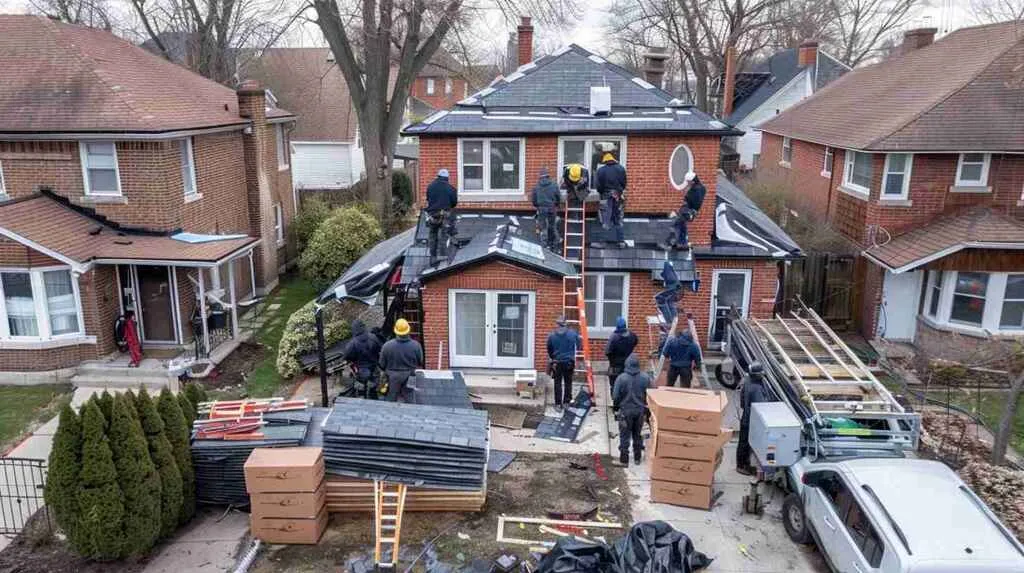
Installing Architectural Shingles Queens NY – Certified Crew | Free Quotes
Rail down the line with me here: a well-installed architectural shingle roof in Queens typically runs between $7.50 and $10.50 per square foot, and that’s not me padding numbers-it’s what honest work costs when you’re tearing off old shingles, fixing decking, and laying down proper underlayment and flashing. The $4.50-per-square-foot quote you got last week? That’s the roof that leaks first, because cheap bids almost always skip the prep work and the valley details that keep water flowing where it should instead of into your attic.
Architectural Shingle Pricing in Queens and Why Cheap Jobs Leak
Rail through the numbers like you’re picking an express versus a local train: the higher price buys you a full tear-off down to the deck, synthetic underlayment instead of felt paper, ice-and-water shield at every eave and valley, and a crew that actually knows how to handle the transfer points-chimneys, skylights, and vents-where most leaks start. In Queens, we’ve got Tudors with steep pitches, two-families with flat spots over porches, and row houses where one bad valley dumps water straight into a shared wall. If your installer is skipping the deck inspection or “saving you money” by layering new architectural shingles over old three-tabs, you’re not on the express line-you’re stuck at a bottleneck that’s going to fail the first time a nor’easter hits.
One February afternoon in Forest Hills, it was 34 degrees and spitting that annoying half-snow, half-rain mess, and I had a homeowner who insisted we could just “layer the new architectural shingles over the old three-tabs to save time.” I walked him up to the attic hatch, showed him the nail pops and the sagging deck, and then laid out exactly how the heavier shingles would telegraph every defect. Two months later his neighbor, who had gone with a cheap overlay from another crew, called me to fix the buckling and wind damage. That day cemented my rule: I don’t install architectural shingles on a bad deck, no matter how cold it is or how much someone wants to rush.
Typical Architectural Shingle Installation Scenarios in Queens, NY
| Scenario | Queens Example | Scope | Cost per Sq Ft | Approx. Total (1,500 sq ft) |
|---|---|---|---|---|
| Basic Replacement | Simple gable roof on Bayside ranch | Full tear-off, architectural shingles, synthetic underlayment, new ridge vent | $7.50-$8.50 | $11,250-$12,750 |
| Multi-Plane Roof | Jackson Heights Tudor with dormers and valleys | Tear-off, deck repairs at valley intersections, ice & water at all valleys, woven or cut valley install | $8.50-$9.75 | $12,750-$14,625 |
| Two-Family or Row House | Astoria walk-up with shared wall and chimney | Tear-off, chimney reflashing, coordinate with neighbors, tight lot protection | $8.75-$9.50 | $13,125-$14,250 |
| Extensive Deck Damage | Older Flushing home with soft spots and rot | Tear-off, replace 30-40% of plywood decking, full ice & water at problem areas, architectural shingles | $9.00-$10.50 | $13,500-$15,750 |
| Premium Install with Upgrades | Forest Hills colonial with high-end architectural shingles and copper flashing | Full tear-off, GAF Timberline HDZ or Owens Corning Duration, custom metal work, extended warranty prep | $9.50-$11.00 | $14,250-$16,500 |
All prices assume architectural shingles, not basic three-tabs. Tear-off is included for full replacements.
⚠️ Red Flags in Queens Roofing Bids That Are Too Cheap
- No tear-off included on an older roof: If the estimate says “overlay” or doesn’t explicitly list tear-off and you’ve got a 15+ year-old roof, you’re looking at a job that will buckle, telegraph every deck defect, and void your shingle warranty. Queens wind will rip those loose in two years.
- Vague language about underlayment and ice & water: When the bid just says “standard materials” without calling out synthetic underlayment and ice-and-water shield at eaves, valleys, and penetrations, that crew is planning to use cheap felt and skip the waterproofing that matters in nor’easters.
- Crew refuses to show proof of license and insurance: If they dodge your request for a copy of their NYS license and current liability certificate, you’re not just risking a bad install-you’re liable if someone falls off your roof or damages a neighbor’s property on a tight Queens lot.
Why Underlayment, Decking, and Valleys Matter More Than the Shingle Brand
On a typical block in Jackson Heights, you’ll see at least three roofs that prove why architectural shingles only work if the underlayment and decking are done right. Those older Tudors, two-families, and row houses were built with decent framing, but 70 or 80 years later the plywood’s got soft spots, the valleys are collecting leaves and ice, and the original tar paper has turned to dust. When you slap premium architectural shingles over that mess, you’re choosing the express train but running it on local-train tracks-every bump, every sag, every bad transfer point is going to show up as a leak or a buckle. Water moves across a roof like passengers through the subway: it flows smoothly along the shingles until it hits a valley, a chimney, or a skylight, and that’s where it needs a clean transfer to the next line. If your valley flashing is improvised or your underlayment stops short, you’ve just created a bottleneck, and the next heavy rain is going to back up straight into your walls.
Around 6:15 in the morning one July, right as the sun was rising over Flushing, we started an architectural re-roof on a two-family with a complicated L-shaped valley. The previous installer had mixed three different shingle brands and “improvised” the valley flashing, so every heavy rain dumped water straight into the wall cavity. I still remember peeling back those shingles and seeing mold tracing the exact path the water had been taking for years. That job taught me to spend an extra 30 minutes explaining valley design to every Queens homeowner with a multi-plane roof-because the nicest shingle in the world won’t save a bad valley.
✅ Hidden Details That Make Architectural Shingles Last in Queens
-
✅
Full deck inspection and replacement of soft spots: Before a single shingle goes down, we check every square foot of plywood from the attic and the surface, mark the spongy areas, and swap out damaged sheets so your new roof has a solid, flat base. -
✅
Proper synthetic underlayment plus ice & water at eaves and valleys: Synthetic underlayment won’t tear or rot like old felt, and a 3-foot run of ice-and-water shield at every eave and valley seals the spots where Queens ice dams and wind-driven rain love to creep under shingles. -
✅
Woven or cut-valley method explained to homeowner: We walk you through whether a woven valley or a cut valley with metal makes sense for your roof’s pitch and water volume, then execute it exactly to manufacturer spec so water flows cleanly and fast. -
✅
Correctly installed starter strips at all edges: Starter strips lock down the first course of shingles and seal the eaves against wind uplift-skip this step and your architectural shingles will flap and tear in the first big Queens windstorm. -
✅
Clean metal flashing transitions at chimneys, skylights, and vents: Every penetration gets step flashing or counter-flashing that overlaps the shingles and directs water down and away-this is the transfer point that separates a 20-year roof from a 5-year leak factory.
Proper Architectural Shingle Valley in Queens
- Flashing type: Pre-formed metal valley liner or high-quality ice-and-water shield extending 18 inches each side of centerline
- Shingle layering: Shingles woven or cut with clean, straight lines; each course overlaps the one below and channels water toward the valley center
- Water path in a nor’easter: Rain flows smoothly down the valley, picking up speed and exiting at the gutter without backing up under shingles
- Expected lifespan before leaks: 20+ years if maintained; matches or exceeds shingle warranty period
Typical Corner-Cut Valley
- Flashing type: No metal or minimal felt paper; shingles “meet” at valley with improvised cuts or no underlayment protection
- Shingle layering: Irregular cuts, gaps, or overlapping shingles that trap debris and create dams; often mixed brands or mismatched colors
- Water path in a nor’easter: Water hits the valley, slows down at rough edges, and backs up under shingles; ice forms and forces water sideways into the deck
- Expected lifespan before leaks: 3-7 years; often fails during the first major ice storm or prolonged rain event
Our Step-by-Step Queens Architectural Shingle Install (No Shortcuts)
I’ll be blunt: if a crew can’t show you how they’re handling valleys and penetrations, they have no business installing architectural shingles on your Queens home. Before you sign any contract, ask the roofer to physically walk your property with you and point out-not just talk about, but actually point at-every chimney, every skylight, every plumbing vent, and every valley where two roof planes meet. Make them explain their flashing plan for each one. If they get vague or annoyed, that’s your sign they’re planning to wing it on install day. Think of those spots like transfer points on the 7 train: if one station is poorly designed or bottlenecked, the whole line backs up and passengers (or in this case, water) start going places they shouldn’t.
One windy October evening in Astoria, we were finishing up an architectural shingle install on a three-story walk-up, and a tenant came home furious because we’d “changed the color” of his building. In reality, what he’d been staring at for a decade was a faded, algae-streaked roof that used to be charcoal, and we’d put on a new architectural shingle in a deep “Weathered Wood” blend. I pulled out an old photo on Google Street View to show him the original tone, then walked him across the street to see how the new shingle profile broke up the boxy lines of the building. By the end, he was asking me for the exact brand and color for his mom’s house in Woodhaven. That job reminded me that a good install doesn’t just stop leaks-it modernizes the whole look of a walk-up, and matching the shingle color to existing brick or stone is part of the process, not an afterthought.
Exact Process Shingle Masters Follows to Install Architectural Shingles in Queens
-
1
On-site inspection and attic check: We measure the roof from the ground and the attic, check ventilation, look for stains or soft deck spots, and photograph any existing problem areas so you see exactly what we’re fixing. -
2
Full tear-off down to decking and deck repairs: Every old shingle, felt, and nail comes off. We replace damaged or spongy plywood, re-nail loose boards, and leave you with a clean, solid platform for the new roof. -
3
Install drip edge, ice & water, and synthetic underlayment: Drip edge goes on first to protect fascia, then ice-and-water shield at all eaves and valleys, topped with synthetic underlayment across the entire deck-this is the real waterproofing layer. -
4
Flashing and valley prep for Queens-style multi-plane roofs: We install step flashing at chimneys and walls, set valley metal or woven valleys to manufacturer spec, and prep every vent and skylight with proper boots and counter-flashing before any shingles go down. -
5
Architectural shingle layout and installation with manufacturer pattern: Starter strips go on first at eaves and rakes, then we snap chalk lines and lay each course following the shingle’s offset pattern so the dimensional tabs line up and the roof looks factory-clean from the street. -
6
Ridge vent and cap shingles installed to handle Queens wind: We cut a continuous ridge vent for proper attic ventilation, then cap it with ridge shingles nailed on both sides so nor’easter winds can’t peel them back. -
7
Final cleanup, magnet sweep, and walkthrough: We haul every scrap of old shingle, run a rolling magnet over your driveway and lawn to catch stray nails, then walk you around from the ground and show you photos of the finished flashing and valleys so you know exactly what you paid for.
Why Queens Homeowners Hire Shingle Masters for Architectural Installs
- NYS licensed and fully insured: We carry current liability and workers’ comp so you’re never on the hook if something goes wrong on a tight Queens lot.
- 19+ years of hands-on roofing experience in Queens: I’ve personally installed architectural shingles on every housing type in this borough-Tudors, colonials, two-families, row houses, and walk-ups-so I know how Queens roofs fail and how to prevent it.
- Factory-certified for leading architectural shingle brands: Certifications from GAF, Owens Corning, and CertainTeed mean we follow exact install protocols and can offer extended manufacturer warranties when it makes sense.
- Written workmanship warranty tailored to Queens weather exposure: You get a clear, written guarantee covering our labor and install quality, because a shingle warranty is worthless if the install is what fails first.
Should You Upgrade to Architectural Shingles on Your Queens Home?
When I sit at your kitchen table and you ask, “Do I really need architectural shingles, or will basic three-tabs do?” I start by asking how long you plan to stay in the house. If you’re selling in two years, a code-compliant three-tab job might be the smart financial move-though I’ll still warn you that cutting corners on tear-off or underlayment to save a few hundred bucks can blow up an inspection and kill your sale. But if you’re staying seven years or more, architectural shingles are the express train: better wind resistance, a cleaner look that lifts curb appeal on Queens’s brick-and-stone homes, and a 30-year warranty instead of a 20-year gamble. Honestly, the decision isn’t just shingle-versus-shingle; it’s whether you’re willing to invest in the prep work-deck repairs, proper underlayment, detailed valley and flashing work-that makes any shingle last. Cheap three-tabs installed right will outlast premium architectural shingles slapped over a bad deck.
Think of your roof like the 7 train during rush hour-if one transfer point is jammed or badly designed, the whole system backs up and fails in the worst possible place. If your roof already has tricky chimneys, skylights, or old framing with multiple valleys, then investing in architectural shingles plus a detailed install is like choosing an express route that avoids constant delays and repairs. You pay more up front, but you’re not calling me back in five years to fix a botched valley or replace wind-damaged shingles. On the other hand, if your roof is a simple gable with no penetrations and you’re on a tight budget, three-tabs installed with the same care-full tear-off, synthetic underlayment, proper flashing-will get you where you need to go. Just don’t let anyone convince you that layering shingles or skipping the ice-and-water shield is an acceptable shortcut, because those are the jobs that turn into emergency leak calls during the next big storm.
| Factor | Architectural Shingles – Pros | Three-Tab Shingles – Cons |
|---|---|---|
| Lifespan | 30-year warranty; heavier construction and better granule adhesion mean they hold up longer in Queens wind and UV exposure | 20-year warranty; thinner profile and lighter weight mean faster granule loss and more frequent wind damage in nor’easters |
| Wind Resistance | Rated for 110-130 mph winds when properly installed; dimensional design and heavier weight resist uplift better | Rated for 60-70 mph; lighter and flatter, so edges can lift and tear in strong Queens windstorms, especially on exposed gables |
| Curb Appeal on Queens Housing Styles | Dimensional profile mimics wood shake or slate; wide color blends complement brick Tudors, colonials, and two-families and add resale value | Flat, single-color appearance looks dated on most Queens homes; doesn’t enhance architectural details and can hurt resale perception |
| Upfront Cost | $7.50-$10.50 per sq ft installed in Queens; higher material and labor cost, but spreads over 30 years of life | $5.00-$7.00 per sq ft installed; cheaper now, but you’ll likely replace sooner and total lifetime cost may be higher |
| Resale Impact | Buyers expect architectural shingles on Queens homes; recent install with transferable warranty is a strong selling point and can justify higher asking price | Buyers may ask for a roof allowance or discount if they see worn three-tabs; limited warranty appeal and perceived as builder-grade or rental-property material |
Do You Really Need Architectural Shingles on Your Queens Roof?
Start here: Plan to keep the home 7+ years?
→ Yes, staying long-term:
Ask yourself: Is the roof complex (valleys, dormers, chimneys)?
Complex roof: Recommend architectural shingles with full tear-off and detailed valley/flashing work. The upfront investment pays off in fewer leaks and longer life.
Simple gable roof: Ask about budget and curb appeal goals. Architectural is still the best long-term value, but properly installed three-tabs are acceptable if budget is very tight-just don’t skip tear-off or underlayment.
→ No, selling within 5 years:
Recommend a code-compliant solution that passes inspection and looks clean from the street. Three-tabs may work if installed correctly, but warn against the cheapest crews that skip tear-off or use substandard materials-a failed inspection or visible defects will kill your sale or force a price reduction.
When was the last time you looked up at your roof after a heavy Queens rain and really checked what it was telling you?
Queens-Specific Questions About Installing Architectural Shingles
Here’s the unglamorous truth: 80% of the performance of your fancy architectural shingles comes from details you’ll never see once the job’s done. The FAQs below tackle the Queens-specific stuff that homeowners actually ask me about-wind ratings for nor’easters, permitting headaches, working on lots where your neighbor’s driveway is four feet from your roofline, and whether you can really skip the tear-off to save money (spoiler: you can’t, not if you want it to last).
▸How does Queens wind and nor’easter weather affect which architectural shingles you recommend?
I look for shingles rated for at least 110-mph winds, because nor’easters can hit Queens with sustained 50-60 mph gusts and higher bursts, and you don’t want edge lift or blow-offs. GAF Timberline HDZ, Owens Corning Duration, and CertainTeed Landmark all meet that standard when installed with proper starter strips and the right nail pattern. But honestly, the shingle brand matters less than the install: if your roofer skips the ice-and-water shield at eaves and valleys or doesn’t seal the first course correctly, even a premium shingle will fail in the first big storm. Queens gets ice dams on north-facing eaves and wind-driven rain that pushes water sideways, so I always spec extra protection at those spots.
▸Can you install architectural shingles over my existing layer?
Short answer: I won’t, and you shouldn’t let anyone else do it either. Longer answer: architectural shingles are heavier than three-tabs-sometimes twice the weight-and layering them over an old roof means you’re adding that load to a deck that might already have soft spots, broken trusses, or nail pops. The new shingles will telegraph every bump and defect underneath, you’ll void the manufacturer warranty, and the first windstorm will expose the loose edges where the old shingles buckled. I’ve seen too many overlay jobs fail within three years, and then the homeowner pays for a full tear-off anyway, plus the cost of fixing water damage that leaked through in the meantime. It’s never worth it.
▸How long does a typical Queens re-roof take on a two-family or row house?
Most residential re-roofs in Queens-1,200 to 1,800 square feet-take 2 to 4 days depending on complexity. Day one is tear-off and deck repairs. Day two we install underlayment, flashing, and start shingles. Day three we finish the field shingles, ridge vent, and caps. Day four is cleanup, final inspection, and magnet sweep. If your roof has multiple valleys, dormers, or a complicated chimney setup, add a day. Weather can stretch things out-we won’t install shingles in rain or when it’s below freezing, because the adhesive won’t seal properly and you’ll end up with wind damage later. Row houses and tight lots take a bit longer because we have to coordinate material staging and protect neighbors’ property, but the actual roofing steps are the same.
▸Do I need permits or approvals in Queens for a shingle roof replacement?
In New York City, a straight shingle-for-shingle replacement (same material type, no structural changes) typically doesn’t require a permit as long as you’re not altering the roof framing or adding new penetrations. But if you’re changing the pitch, adding skylights, or doing significant deck repairs that affect the structure, you’ll need a permit and possibly an architect’s sign-off. I always check with the Department of Buildings for your specific address before we start, because some landmarked districts or co-ops have extra rules. If you’re in a co-op or condo, you’ll also need board approval even if the city doesn’t require a permit-ignore that step and you can face fines or be forced to tear the work out.
▸How do you protect my siding, neighbors’ property, and landscaping on tight Queens lots?
Tight lots are standard in Queens, so we plan for it from day one. We set up tarps and plywood lean-boards against your siding and your neighbor’s fence, position the dumpster or dump trailer as close as possible to minimize carrying debris across landscaping, and use roof brackets and safety harnesses so we’re not leaning ladders on gutters or flower beds. For shared driveways and row houses, we coordinate with neighbors on timing and parking, and we always run a rolling magnet over driveways, walkways, and lawns at the end of each day to catch stray nails. If there’s expensive landscaping or a new patio right under the eaves, we’ll add extra plywood protection and stage materials on the opposite side of the house when possible. It takes an extra hour of setup, but it’s a lot cheaper than replacing a neighbor’s vinyl siding or killing a homeowner’s prize hydrangeas.
✓ Before You Call Shingle Masters for an Architectural Shingle Quote
-
☐
Note any interior stains on ceilings or walls – even small brown spots near chimneys or in corners can tell me where the roof is leaking and help me plan the tear-off. -
☐
Check the age of your current roof if known – if it’s over 15 years old, we’re almost certainly doing a full tear-off, and knowing the install date helps me estimate how much deck damage to expect. -
☐
Take 2-3 photos from the street or yard – pictures of the roof from different angles help me spot problem areas and give you a ballpark quote over the phone before we schedule an on-site visit. -
☐
List any chimneys, skylights, or vents you know about – every penetration adds flashing work and material cost, so the more details you give me up front, the more accurate your estimate will be. -
☐
Think about whether you’re staying long-term or selling within 5 years – your timeline changes whether architectural shingles make financial sense and helps me recommend the right level of investment in prep work and materials.
If you’ve read this far, you’re not looking for the cheapest quote-you’re looking for a Queens roofer who’ll walk you through every valley, every chimney, and every decision like it’s their own house. Schedule a no-pressure on-site visit with Shingle Masters for an architectural shingle assessment, and I’ll show you exactly where your roof should send water and where it’s getting stuck. Call us or request a free quote, and I’ll map out your roof like a subway diagram, pointing out the express routes and the transfer points that need attention so your new shingles last 30 years instead of leaking in five.