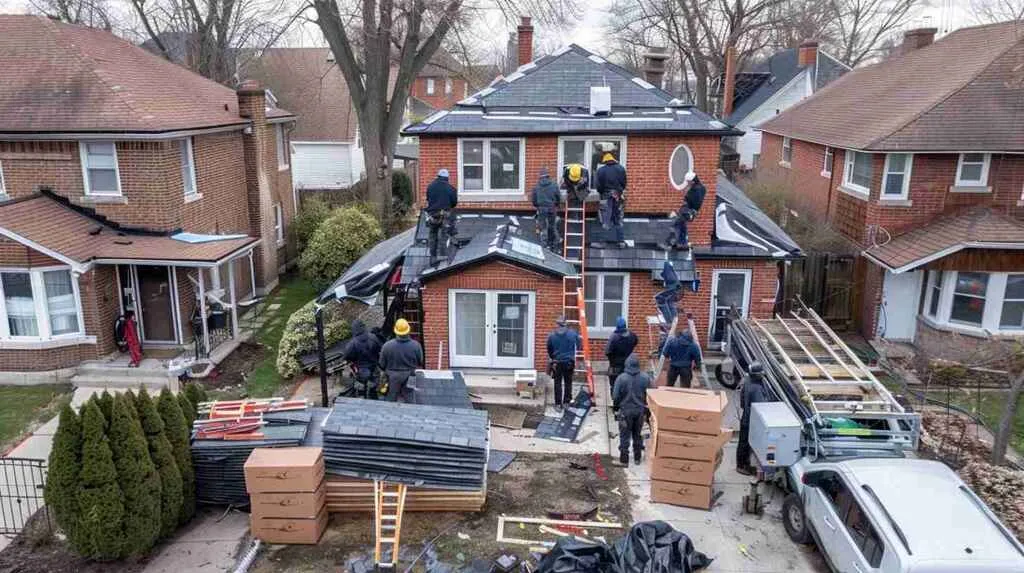
Shingle a Steep Roof Queens NY – Safety and the Right Technique
Gravity doesn’t negotiate. On a steep roof in Queens, your first move isn’t grabbing shingles-it’s installing solid fall protection and a walkable path, because technique only matters if you’re still on the roof. I’m CJ Jimenez, and after 19 years of steep-pitch work from Jackson Heights to Bayside, I’ve learned that every successful steep-roof shingle job is really a chess match against gravity, and your opening moves determine whether you’re still standing three hours later or riding in an ambulance.
Why Steep Roofs in Queens Play by Gravity’s Rules
On a 10/12 roof in Middle Village last fall, I watched a rookie from another crew learn the hard way that your first tool on a steep slope is not a nail gun, it’s a roof jack. He scrambled up with bundles before anyone set protection, hit a patch of morning dew on the north face, and slid six feet before grabbing a valley flashing that bent under his weight. The foreman stopped everything to rig proper jacks and planks-an hour lost, but nobody rode a stretcher. Here’s my blunt opinion about steep roofs: the first thing you install is a system to control gravity’s next move, not your shingle pattern, because gravity is the opponent who never gets tired and always finds your mistakes.
Queens housing stock-those classic Capes in Flushing, Victorians in Bayside, colonials across Astoria-means we see a lot of 10/12 to 12/12 pitches. Add in wind gusts off the East River, winter frost that doesn’t burn off until noon on north faces, and tight lot lines where a bad fall can land you on a neighbor’s car or power lines, and you’ve got conditions that amplify every risk. Every move you make on a steep roof has to anticipate what gravity will do with water, wind, and workers-because on these slopes, shortcuts don’t just fail, they fail fast and publicly.
Steep Roof Reality Check in Queens
- Falls from 10/12 and steeper pitches happen faster than you can grab anything-your body accelerates before your brain registers the slip.
- Frost, pollen, and airborne grit settle on Queens roofs overnight, making early-morning and post-rain starts slippery even when the deck looks dry.
- Tight lot lines mean a bad fall can take you into a neighbor’s yard, car, fence, or power lines-creating liability and injury beyond just hitting the ground.
- One misplaced ladder or loose roof jack can turn your whole setup into a slide, taking tools, shingles, and people with it.
| Myth | Fact |
|---|---|
| If I can walk it, I don’t need a harness. | You need tie-offs even when it feels walkable-your body’s center of gravity shifts with every reach and load, and steep slopes give you zero margin for a stumble or wind gust. |
| Steep roofs shed water better, so the shingle pattern isn’t as critical. | Steep roofs amplify any water entry-gravity accelerates runoff, so a bad overlap or nail placement lets water race down and find every crack in the deck twice as fast. |
| Queens capes are small, so a fall wouldn’t be that bad. | Even a one-story fall onto concrete, pavement, or a narrow side yard can be fatal or permanently disabling-height doesn’t care about your square footage. |
| I can copy what I see other crews doing from the sidewalk. | Good crews hide most safety gear from street view-the harnesses, ridge anchors, and tie-off systems aren’t visible when you’re watching from below, but they’re what keep everyone upright. |
Build Your Defense: Fall Protection and Walkable Paths First
One January morning around 6:30 a.m. in Flushing, I was on a 12/12 pitch with frost still on the shingles because the homeowner insisted we “beat the sun.” I refused to let my guys go up until I could feel the granules under my boot, not ice, and the owner was fuming-until the neighbor two houses down slipped off his own roof trying to chip ice out of his gutter. Watching the ambulance lights bounce off that steep row of Capes was the last time I ever let a client push me to start early on a frozen roof. It’s also when I started carrying a cheap thermometer and moisture meter to show people, “See? The roof is still trying to kill you.” That morning taught me that in Queens winters, your schedule doesn’t dictate start time-surface conditions and gravity do.
Here’s my blunt opinion: if you don’t know how you’re going to stop yourself from sliding, you have no business planning how you’re going to stagger your shingle joints. Safety setup isn’t the thing you do before the “real work”-it’s the real work, and every piece of it is a move in the chess game against gravity. I count my tie-offs out loud on every steep job, announcing each clip-in and anchor check like chess moves, because the moment you stop thinking three steps ahead is when gravity makes its countermove and you’re out of position to block it.
Your essential safety setup on a steep Queens roof starts before you touch a shingle. You inspect the driveway and yard to find solid ladder footing away from power drops and soft soil, then secure that ladder with stabilizers and a tie-off at the eave so it can’t kick out when you’re loading bundles. If your lot line is tight and neighbors walk underneath, you install a temporary guard or catch platform over entrances and walkways. Next come roof jacks and planks, starting at the lowest practical working row and following manufacturer spacing-these aren’t suggestions, they’re the boardwalk that keeps you off the slope. You install at least one ridge anchor and connect your full-body harness with a shock-absorbing lanyard, checking every clip and buckle like you’re gearing up for a climb. And you test-walk the plank and tie-off system with no tools in hand before you carry anything up, because discovering a loose jack while holding a bundle is how people end up in the ER.
Safe Setup Sequence Before Touching a Shingle on a Steep Queens Roof
- Inspect driveway/yard and choose solid ladder footing away from power drops, soft dirt, and buried utility covers-concrete or pavers work best.
- Secure ladder with stabilizers and tie-off at the eave using a rope or strap to a structural anchor point so it can’t slide or kick out when you’re climbing with loads.
- Install temporary guard or catch platform if possible over entrances, walkways, or neighboring property where falling tools or shingles could hit people or cars.
- Set roof jacks and planks starting at the lowest practical working row, spacing jacks per manufacturer specs (usually 4-6 feet apart) and securing them to rafters, not just deck.
- Install at least one ridge anchor and connect full-body harness with shock-absorbing lanyard, making sure all clips are locked and the anchor is rated for fall protection, not just lifting.
- Test-walk the plank and tie-off system before carrying tools or shingles up-bounce on the plank, tug the harness connection, and verify your working radius before adding weight or distractions.
✅ Non-Negotiable Safety Gear for Steep-Roof Shingling in Queens
- ✅ Full-body harness rated for roofing work-not a climbing harness or old lineman’s belt, but ANSI-compliant with D-ring positioned for fall arrest.
- ✅ Ridge anchors compatible with your roof framing-temporary anchors that clamp or screw into ridge board, rated for your weight plus shock load.
- ✅ Roof jacks with 2×10 planks for walkways-metal jacks nailed into rafters (not just sheathing) with solid lumber, not warped or cracked boards.
- ✅ Ladder stabilizer to clear gutters and siding-standoff brackets that distribute load and keep the ladder from crushing gutters or denting vinyl.
- ✅ Non-slip roofing boots with intact tread-rubber-soled work boots designed for steep slopes, not worn-out sneakers or smooth-bottom shoes that slide on granules.
Laying Shingles on a Steep Slope: Moves That Don’t Give Gravity an Opening
About five years ago in Bayside, I took over a “DIY rescue” on a steep colonial after a retired electrician tried to re-shingle his own roof using YouTube videos. He’d stapled underlayment horizontally, stopped it just shy of the rake edge, and nailed architectural shingles like siding-right through the top, no stagger. It rained sideways for two days, and water was running down his bedroom wall in perfect little lines matching his nail pattern. I still remember the sound of rain on that Bayside DIY project-like someone tapping on the ceiling with pencils-because every bad nail was an invitation for water on a steep run. I spent half a day undoing his “system,” and as we worked, I walked him through every single step he’d skipped-especially on the steep slopes where gravity punishes you twice as hard for every shortcut. Think of your steep roof the way I think about a chessboard: every row of underlayment and every course of shingles is a move that sets up what can-or cannot-go wrong three steps later.
On a steep roof, gravity cashes every shortcut you take.
Correct underlayment and starter technique for steep roofs starts with vertical laps running parallel to the eaves with proper headlaps (usually 6 inches minimum, more in high-wind zones), not horizontal runs that channel water sideways into seams. You extend ice and water shield fully to rakes and eaves in vulnerable zones-valleys, penetrations, and the first three feet up from the eave where ice dams form in Queens winters. On steep pitches, you can’t stop underlayment short of the rake or rely on drip edge alone to catch it-wind-driven rain will ride gravity straight under that gap and into your wall cavity. Every edge needs meticulous control because steep roofs accelerate water flow, giving it more force to exploit weak points.
Shingle layout basics specific to steep slopes demand precision in the nail zone-you nail in the manufacturer’s specified line (usually just below the adhesive strip), not randomly high or low, and you add extra nails on end shingles in high-wind Queens conditions (five nails instead of four). Your stagger pattern matters more on steep roofs because water moving fast will find any vertical alignment of seams and pour through. You work off roof jacks from bottom up, moving planks as you go and never standing on loose shingles or assuming friction will hold you. And with every course, you ask the question I ask on every steep job: “If gravity gets a gust of wind and a sheet of rain, where will it try to sneak in?” That question catches more mistakes than any checklist.
| Wrong Move | Right Move on a Steep Roof |
|---|---|
| Horizontal underlayment runs that create water channels | Properly overlapped courses running parallel to eaves with correct headlaps (6″+ minimum), shedding water downslope without sideways flow |
| Stopping underlayment short of rake edge | Wrapping underlayment tight to the rake with metal drip edge installed over it, creating a sealed edge that wind-driven rain can’t penetrate |
| Nailing shingles high, low, or randomly through the face | Nailing in manufacturer’s nail line (just below adhesive strip) with correct count-5 nails on steep/windy roofs, 6 on end shingles-so tabs stay sealed and nails stay hidden |
| Skipping starter strip to save time or money | Installing starter strip with proper adhesive alignment at eaves and rakes to seal the first course and prevent wind from lifting shingles from below |
| Working off loose shingles or “riding the slope” without protection | Working from secured roof jacks and planks, moving them methodically as you progress up the roof and staying tied off at all times |
| Shingle Type | Pros | Cons |
|---|---|---|
| 3-Tab Shingles | Lighter weight makes handling easier on steep ladders; lower cost; simpler to cut and fit around penetrations and valleys | Less wind resistance on exposed steep pitches; less forgiving of nail placement errors; thinner profile shows deck imperfections more |
| Architectural Shingles | Better wind ratings for Queens coastal gusts; thicker laminate hides small deck waves; dimensional look enhances curb appeal on steep visible pitches | Heavier bundles (80+ lbs) on steep ladders and planks; trickier for DIYers to align patterns and maintain reveals without training |
DIY or Call a Pro? Reading Your Position Before You Make a Move
When a homeowner in Queens asks me, “Can I just do this myself?”, my first counter-question is, “Would you feel comfortable standing on a ladder, leaning over, and closing your eyes for ten seconds?” If the honest answer is no, you’re not ready for steep-roof work-and if it’s yes, you still need to assess pitch, height, and your ability to rig real fall protection, not improvise with a rope and a prayer. The truth about steep roofs is they turn small mistakes into fast problems; gravity is like that annoying coworker who magnifies every little error you make. This choice-DIY or pro-is the most important move in your game against gravity, because once you’re on the slope, there’s no pause button and no reset.
Deciding Between DIY and Hiring a Steep-Roof Specialist in Queens
Start: Is your roof steeper than 6/12 pitch?
↳ NO: You may be able to handle minor repairs, but still consider pro help for a full re-shingle-even moderate pitches demand solid technique.
↳ YES: Next question: Do you own and know how to properly use harnesses, ridge anchors, and roof jacks?
↳ NO: Hire a steep-roof specialist-this is not a first-time DIY project, and YouTube can’t teach muscle memory for fall recovery.
↳ YES: Next question: Are you comfortable working 20+ feet up for several hours with no distractions?
↳ NO: Call a pro-fatigue and distraction on steep roofs are how experienced people get hurt.
↳ YES: You might DIY small sections, but have a Queens steep-roof pro inspect and quote before you start so you know what you’re truly facing.
DIY Steep Roof
- Out-of-pocket cost for tools and safety gear (harness, anchors, jacks, boots) can run $400-$800 before you touch a shingle
- Risk of installation errors that only show up in the next Nor’easter when water’s running down your walls
- Higher fall and injury risk-one slip can mean hospital bills, lost work time, and long-term disability
Hire a Steep-Roof Pro
- Team arrives with full safety setup and insurance-if something goes wrong, you’re not liable for their medical bills
- Work done to manufacturer specs for steep pitches, protecting your warranty and ensuring code compliance
- Job completed faster with less disruption to neighbors, fewer DOB complaints, and no learning curve on your nickel
Before You Call Shingle Masters in Queens: Quick Roof Readiness Check
A bit of preparation on your side helps my crew plan the safest, most efficient shingle job from day one. Knowing your roof’s approximate age, any past leak spots, and how tight your lot line and access are lets us plan ladders, planks, and material staging like a chessboard before we arrive-so we’re not improvising safety moves while standing on your eave, and your neighbors aren’t dealing with surprise ladder placements blocking their driveway.
✓ What to Have Ready Before Calling Shingle Masters About a Steep Roof in Queens
- Approximate age of current shingles and any prior layers-knowing if it’s original 1980s 3-tab or a 2010 re-roof helps us estimate tear-off labor and disposal.
- Any known leak areas or ceiling stains-note which rooms and which corners so we can inspect those zones first and plan any deck repairs.
- Photos of the front, back, and any dormers or turrets from the ground-even smartphone shots help us see pitch, complexity, and access before the estimate visit.
- Note how close neighbors’ houses and power lines are to your roof edges-tight lot lines affect ladder placement, material staging, and fall-zone planning.
- Info on existing attic ventilation-soffit vents, ridge vent, gable vents, or none-so we can recommend upgrades that protect your new shingles from heat damage.
- Preferred days/times when driveway or curb space is clear-for ladders, dumpsters, and material deliveries without blocking your car or your neighbor’s routine.
Why Steep-Roof Homeowners in Queens Call CJ and Shingle Masters
Common Steep-Roof Shingle Questions from Queens Homeowners
Can you re-shingle my steep roof in winter in Queens?
Technically yes, but with strict limits. Asphalt shingles need temperatures above 40°F to seal properly, and the adhesive strips won’t activate in the cold. If there’s frost on the deck or the forecast shows overnight lows in the 20s, I won’t start-remember that Flushing morning when I refused to let my crew up until the granules weren’t slick with ice? Winter work is possible on warmer stretches (50s during the day), but I’ll never let a schedule override surface conditions, because frozen roofs don’t just slow you down, they put you in the ambulance.
Do you always use harnesses on steep roofs?
Always. On any pitch steeper than 6/12, full-body harnesses and ridge anchors are non-negotiable-not just for my crew’s safety, but because insurance, OSHA, and DOB all expect it, and I’m not risking someone’s life or my license to save ten minutes. I count tie-offs out loud on steep jobs, treating each clip-in like a chess move, because the moment you skip one connection is when gravity makes its countermove and you’re out of position to block it.
How long does a steep re-shingle usually take on a typical Queens cape?
For a standard 1,200-1,500 sq ft cape with one or two layers to tear off and no major deck repairs, expect 1-3 days depending on weather, crew size, and how many dormers or valleys complicate the layout. Steep roofs take longer than low-slope jobs because safety setup, plank moving, and careful nailing slow the pace-but that’s how we keep everyone upright and the work watertight. If we hit rotten deck or need to coordinate with the power company to move a drop, add another day.
Will you protect my neighbor’s property when working this close together?
Absolutely. On tight Queens lot lines, we use tarps and drop zones to catch nails, shingle scraps, and debris before they land on cars, shrubs, or walkways. We plan ladder and plank placement to avoid your neighbor’s fence, AC units, and power lines, and we communicate with adjacent homeowners before we start so they know when to move vehicles or keep windows closed. Respecting the neighbor isn’t just polite-it’s how we avoid complaints, damage claims, and the kind of drama that gets DOB involved.
Steep roofs in Queens turn small mistakes into fast problems, and if you’re not fully confident in your safety setup, the smartest move you can make is calling a pro who’s already played this chess game a few hundred times. And honestly, that’s where I come in. If you’ve got a steep pitch in Bayside, Middle Village, Astoria, Flushing, or anywhere else in Queens, schedule an on-roof assessment with me and we’ll plan the moves that keep both your shingles and my crew exactly where they belong-secured, sealed, and not riding in an ambulance.