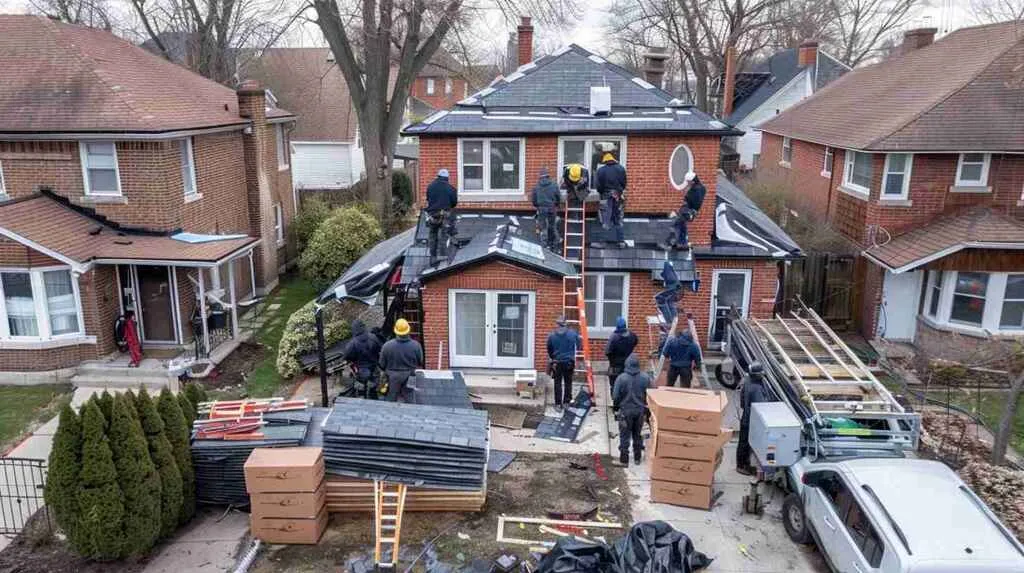
Shingle a Roof Step by Step Queens NY – Full Walkthrough | Free Estimates
Blueprint lines don’t lie. When I snap a blue chalk line exactly 6 inches up from the eave on a Queens roof, I’m deciding whether the entire job reads as professional or amateur from the sidewalk below. That starter line – one clean pop of blue dust – sets the stage for every shingle, every nail, and every layer that follows, and honestly, it’s where most folks lose money they don’t even know they’re throwing away. Every step after that snap is about protecting your home from Queens weather, which collects on leaks like a loan shark with no patience.
Snap Your First Line: Where a Pro-Level Shingle Job Actually Starts
On my tape measure, 6 inches from the eave is where the whole story starts. I hook my tape at the edge, mark three or four spots along the eave with a carpenter’s pencil, then stretch a chalk line from gable to gable across those marks. Before I snap, I measure again at two more points to confirm the line sits perfectly parallel – because a crooked starter line is like losing money every single month. You can lay the best shingles in the world, but if your first row wanders drunk across the eave, the whole roof broadcasts “amateur hour” and water will find those gaps faster than you think. I’d rather walk away from a job than knowingly start with a bad line; that’s not pride, it’s just bad long-term value for the homeowner.
Snapping the Starter Chalk Line – 4 Quick Steps
Measure up from the eave edge at several points (typically 6 inches for a standard starter strip) and mark with a carpenter’s pencil. Check at least four spots across the eave to catch any sag or bow.
Hook your chalk line on one gable-edge mark, then stretch it tight to the opposite gable-edge mark. Keep tension steady so the string doesn’t sag in the middle.
Confirm measurements are equal at three to four points so the line is perfectly parallel to the eave. A wandering line means each course above will compound the error.
Snap the line in one clean pop and double-check visibility before placing starter shingles. If the chalk is faint, re-snap – that blue line is your only guide once you’re moving fast.
One August afternoon in Woodhaven, we started a shingle job at 7:00 a.m. because the forecast said 95 degrees and full sun by noon. By 10:30, the asphalt shingles were soft enough that a guy’s boot almost twisted one out of place, and a homeowner’s cousin on the lawn was yelling that we were “going too slow.” I stopped everyone, pulled the cousin up the ladder, and had him touch the shingle surface – it was practically burning his palm. That job taught me that timing your install and explaining heat-related buckling in plain English upfront saves both your crew and your customer from future callbacks. Rushing in Queens sun is like burning cash, and starting with a perfect line when the shingles are cool is like earning interest – every careful move pays dividends in fewer leaks and longer shingle life. This is exactly how Shingle Masters starts every roof in Queens, NY, and why straight lines and right timing prevent you from taking on “roofing debt” that compounds with every rain.
Layering From Eave Up: Underlayment, Starter, and First Courses
Underlayment: Your Roof’s Insurance Policy
Here’s the uncomfortable truth – water doesn’t care how good your roof looks, only how smartly it’s layered. Underlayment is the backup plan when shingles fail, when wind drives rain sideways, or when ice dams form on Queens eaves in February. You’ve got two main choices: traditional asphalt-saturated felt (15 or 30 lb) or modern synthetic underlayment. Felt is cheap and works fine on simple roofs, but it tears easier and can wrinkle in Queens humidity. Synthetic costs a bit more but grips better, won’t rip when your boot slides, and holds up in our sticky summers. Skipping underlayment to save a few bucks is like taking out high-interest roofing debt – you’ll pay way more later when the first leak shows up. The insider move is to overlap each course of underlayment by at least 2-4 inches, run ice and water shield at the eaves and in valleys, and seal carefully around chimneys and vents. That’s cheap insurance with massive ROI.
One evening in Bayside, starting around 4:00 p.m. in early spring, we were finishing a step-by-step shingle job when a homeowner insisted we skip underlayment on a small rear addition “to save a few bucks.” I sat with him on his back steps, drew a quick sketch of the roof slopes, and showed him how water always finds the cheapest path – right under unprotected shingles. In Bayside, Astoria, and especially the Rockaways, you’re dealing with wind-driven rain off the bay and Nor’easters that hit eaves and side walls like they’re collecting a debt. Queens rooflines catch sideways rain in ways flat states never see. Two months later, after a nasty wind-driven storm, he called me just to say, “I’m glad you out-stubborned me on that felt paper,” because his neighbor’s addition without underlayment was already leaking. In neighborhoods like Ridgewood and Jackson Heights where homes are packed tight and roofs intersect at odd angles, skipping underlayment is like loaning your roof to a storm with no collateral.
Starter Shingles and First Full Course
Let me be blunt: if your shingles aren’t in straight lines, nothing else you did matters. Once your underlayment is down and you’ve snapped that perfect chalk line, you’ll lay your starter strip – either a dedicated starter product or field shingles flipped upside down with the tabs trimmed off. The starter sits right on your snapped line and overhangs the eave edge by about 1/4 to 3/8 inch to direct water into the gutter. Nail it down following the manufacturer’s pattern, usually four to six nails per strip, staying above the adhesive strip so the first full course can bond. Then lay your first full course of shingles directly on top, aligning the bottom edge with the starter and maintaining that same overhang at the eave and down each rake edge. The nails should land just above the cutouts or on the marked nail line, depending on your shingle style. Over-drive those nails and you tear the mat; under-drive them and the shingle flaps in the next windstorm. Now, before we move up the roof, take a step back and sight down that first course – it should look like a ruler edge, not a wave.
Money-Smart vs Money-Dumb Moves: Underlayment & Starter in Queens
✅ Money-Smart Moves
-
✅
Run underlayment horizontally with 2-4 inch overlaps, upper course over lower -
✅
Wrap underlayment over the eave edge before drip edge where manufacturer allows -
✅
Use dedicated starter strip or properly cut and flipped field shingles along the snapped chalk line -
✅
Maintain a consistent 1/4″-3/8″ shingle overhang at the eave and rake edges
❌ Money-Dumb Moves
-
❌
Skipping underlayment to save a few bucks – first leak costs 10× more -
❌
Letting underlayment wrinkle or bridge over dips instead of laying it smooth -
❌
Forgetting ice & water shield at eaves and valleys in Queens freeze-thaw cycles -
❌
Eyeballing the first course instead of following the snapped line to the millimeter
Working Up the Roof: Stagger, Nail, and Protect the Details
Shingle Stagger and Nailing Pattern
When customers in Queens ask me, “Where do I actually put the first nail?”, here’s what I show them. Each shingle manufacturer prints a nail line on the back or recommends a specific height above the cutouts – usually that’s about an inch above the top of the slots on a standard three-tab or in the common-bond area on architectural shingles. You want four to six nails per shingle, depending on wind zone and roof slope, and each nail should penetrate straight down through the shingle and into the deck, not angled. Over-drive a nail and you tear the mat; under-drive it and the shingle flaps loose in the next windstorm. As you move up course by course, stagger each row by about 6 inches (or per the manufacturer’s pattern) so the cutouts or joints don’t line up vertically – that creates a weak channel for water. I’ll never forget a November job in Astoria, right off 30th Avenue, where we were reshingleing a small cape for a retired math teacher. We stripped the first course and found three different shingle brands nested on top of each other, with nails scattered like someone closed their eyes and hoped for best. Midway through, a surprise cold rain started, and I had to make a call: either rush the new shingles or tarp and come back. I chose the tarp, walked the homeowner through how wet decking ruins adhesion, and she later told me she used my explanation as a probability lesson for her grandkids about “acceptable risk on a roof.” Leaving nails out or placing them randomly is like leaving twenties on the sidewalk – the weather’s going to collect every dollar you didn’t secure.
Flashing, Valleys, and Dormers
Think of your roof like a savings plan: each layer is a deposit that protects you from the day it really pours. And nowhere is that truer than around chimneys, skylights, dormers, and valleys. Step flashing is the metal interleave that runs up a wall or chimney, with one piece of L-shaped metal tucked under each course of shingles and lapped over the course below. You never run one continuous strip – that’s a rookie move that channels water straight down to the deck. In valleys, you can use open-metal valley, woven shingles, or closed-cut valley; in Queens, where heavy rain and ice are both real threats, I lean toward open metal valleys with ice and water shield underneath because they shed debris and won’t dam up. Hold that thought and slide it one step higher: dormers are mini-roofs that tie into your main plane, so every intersection needs careful step flashing and counter-flashing. These are high-risk, money-smart spots where DIY often turns expensive fast. If you’re looking at a cut-up roof with multiple valleys, skylights, or party walls, this is exactly where calling Shingle Masters makes financial sense – we do this every day, and one bad flashing detail can cost you thousands in interior damage.
Critical Nailing & Valley Mistakes That Kill Warranties
Never nail too high above the nailing strip – your next course won’t seal properly and wind will get under the shingle tabs.
Never place nails in the exposed part of the shingle where sun and rain hit – that’s a guaranteed leak path and voids most manufacturer warranties.
Never run continuous flashing down a wall instead of proper step flashing – water tracks behind it and rots your sidewall in silence.
Never weave valleys with mismatched shingle brands or drive nails too close to the valley centerline – that’s where Queens runoff concentrates and every fastener is a future leak waiting to happen.
Is Your Queens Roof a DIY Candidate or a Call-a-Pro Situation?
$300 on the wrong nails or a crooked valley can turn into a $3,000 ceiling repair when water finally collects its debt. So here’s the question you need to answer honestly: is your roof a simple, low-slope rectangle or a multi-plane, dormered Queens special with skylights, party walls, and odd angles? Weather is Queens’ most aggressive bill collector, showing up every rainstorm and Nor’easter to test every decision you made on that roof. Knowing when to call Shingle Masters is often the most money-savvy move in the whole process – we’ve fixed enough “I thought I could handle it” jobs to fill a notebook, and every one cost the homeowner more than if they’d just hired a pro from the start.
Should You DIY or Call Shingle Masters? – Quick Decision Tree
START HERE: Is your roof single-story and low-slope (4/12 or less)?
→ YES: Next question – Is the roof a simple rectangle with no valleys, dormers, or skylights?
→ YES: DIY may be reasonable if you follow manufacturer instructions and safety rules to the letter, and you already own proper fall protection.
→ NO: High risk of flashing or valley mistakes – call Shingle Masters.
→ NO (multi-story or steep): Steep or high roof – safety and leak risk too high; call Shingle Masters.
SIDE CHECK: Do you already own proper fall protection harness, roof jacks, and staging planks?
→ NO: Equipment cost alone often wipes out DIY savings – hire a pro.
When to Call Shingle Masters: Urgent vs Can Wait
🚨 Call ASAP (Urgent)
-
•
Active leak during rain or fresh ceiling stains -
•
Shingles missing or flapping along eaves or ridges after a Queens windstorm -
•
Soft or spongy spots when walked, hinting at rotten decking -
•
Water stains inside near chimneys, skylights, or party walls
📋 Can Wait for a Scheduled Visit
-
•
Curled or aging shingles with no current leaks -
•
Minor granule loss visible in gutters -
•
Small, isolated damage on detached garages or sheds -
•
Planning a full reroof within the next 6-12 months and wanting a bid
Queens Roof Maintenance: Protect Your Shingle Investment
I remember a roof in Ridgewood where a homeowner tried to eyeball every course; from the sidewalk, it looked like a drunk snake. That’s what happens when you skip the chalk line and rush the layout – and it’s also what happens when you ignore maintenance after the job’s done. A shingle roof isn’t “set it and forget it”; it’s an investment that needs small, regular deposits to keep compounding value instead of leaking equity. Clean gutters, trim back branches, check for lifted shingles after windstorms – these aren’t chores, they’re the interest payments on the smartest purchase you’ve made for your Queens home.
Small, scheduled checkups are like making regular deposits into a savings account, and ignoring moss, clogged gutters, or lifted shingles is like letting roofing interest charges pile up until the bill comes due in the form of a ceiling stain or rotten decking. In Queens, where we get everything from summer thunderstorms to winter ice, your roof takes a beating year-round. Shingle Masters offers free estimates in Queens and can walk you through a simple maintenance plan in plain English – no jargon, no upselling, just a straight explanation of what’s worth doing now and what can wait. That’s how you turn a good roof into a great one that protects your home for twenty years instead of ten.
Simple Shingle Roof Maintenance Schedule for Queens, NY
Every Spring
Inspect for winter damage, check for lifted shingles, clear branches and debris from the roof surface, and clean out gutters and downspout leaders so spring rains flow freely.
Every Fall
Remove leaves from valleys and gutters before they pack into ice dams, check flashing around chimneys and skylights before heavy rain season, and verify attic ventilation is clear.
After Major Storms
Walk the property (safely from the ground), look for missing or creased shingles, check for granules in downspouts, and scan ceilings inside for any new stains or water marks.
Every 3-5 Years
Have a pro like Shingle Masters perform a full roof inspection, assess granule loss and shingle condition, seal any exposed nail heads, and review remaining roof life so you can budget in advance for a reroof.
Common Questions About Shingling a Roof Step by Step in Queens, NY
Can I shingle over my existing roof in Queens, or do I need a full tear-off?
NYC building code and most Queens jurisdictions allow one layer of shingles over an existing roof under certain conditions, but a full tear-off is almost always the money-smart choice. Tear-off lets you inspect the decking for rot, ensures proper adhesion, and resets your warranty clock. Layering over hides problems and adds weight, which older Queens homes weren’t always designed to carry. If you’re serious about long-term value, strip it down and start fresh.
How long does it take to re-shingle a typical Queens house?
A simple one-family gable home with no valleys or dormers usually takes 1-3 days from tear-off to cleanup, depending on crew size and weather. Multi-family homes, complex rooflines with skylights, or jobs requiring extensive decking repair can stretch to 5-7 days. We give every customer a realistic timeline upfront and text daily updates so you’re never guessing where we are in the process.
What’s the best season to re-shingle in Queens?
Spring (April-May) and fall (September-October) are ideal – mild temps, stable weather, and shingles seal properly without being too hot or too cold. Summer works fine if we start early and avoid the midday heat that softens shingles. Winter jobs are possible but tricky; adhesive strips won’t activate below 40°F, so we use extra hand-sealing and pick the warmest days. If you’re planning ahead, book for spring or fall and you’ll get the smoothest install.
How do I know if my decking is too far gone to just re-shingle?
Soft spots when you walk on the roof, visible sagging between rafters, or dark water stains on the underside of the decking (check from the attic) are all red flags. Once we strip the old shingles, we inspect every sheet of plywood or board decking and point out any rot or delamination. Replacing bad decking adds cost, but nailing new shingles onto spongy wood is like building a house on sand – it’ll fail fast and cost way more to fix later.
Do you offer free estimates and written proposals in Queens, NY?
Yes – Shingle Masters provides free, no-pressure estimates with line-item costs and material options spelled out in plain English. We’ll climb the roof, measure it properly, check the decking from below if possible, and walk you through every number so you understand exactly what you’re paying for. No surprises, no fine print, just honest pricing and a handshake.
A straight, well-layered shingle roof is one of the smartest investments you can make in a Queens home, and trying to “save” money by skipping steps or eyeballing the layout usually costs you more when the first leak shows up or when you have to call someone like me to redo what should’ve been done right the first time. If you’re ready to stop worrying about your roof and start treating it like the long-term savings account it should be, call Shingle Masters for a free, line-by-line estimate on shingling or re-shingling your Queens, NY roof. I’ll walk you through the numbers, the steps, and the honest truth about what your roof needs – no upselling, just the kind of straight talk I’d give my own family in Jackson Heights.